How to Get Rid of Mice: What Works, in What Order
To get rid of mice, set plenty of snap traps against the walls where you find droppings, no more than about 10 feet apart, and at the same time seal every gap of 1/4 inch or more with metal, concrete or hardware cloth. Trapping removes the mice you have; sealing stops the next ones. UC IPM calls exclusion “the most successful and permanent form” of house mouse control. A new infestation usually clears in two to three weeks, and the CDC’s test for success is a full week with no captures and no new signs.
Mice are easier to trap than rats because they are curious rather than wary. The New York State Department of Health notes that mice “are not afraid of new things or bothered by the smell of humans or dead mice on traps,” so there is no need for the days of pre-baiting rats demand. What mice punish is too few traps, traps in the wrong place, and gaps left open.
The order of work, and why it runs this way
- Confirm it is a house mouse. A house mouse is about 5 to 7 inches long including a 3 to 4 inch nearly hairless tail and weighs about half an ounce (UC IPM). A deer mouse has a white belly sharply divided from a darker back and a furred, two-tone tail. That difference changes how you clean up, because deer mice carry hantavirus.
- Map the activity. Droppings, gnaw marks, shredded nest material and a musky smell show where mice live; a light dusting of unscented talc, checked the next day with a flashlight, shows where they run (New York State Department of Health).
- Trap hard, straight away, while the population is small.
- Seal entry points in the same week. Trapping without sealing turns into a subscription.
- Cut food and nesting cover, so traps are the most interesting thing in the room.
- Bait only if trapping stalls, and only in tamper-resistant stations.
- Clean up wet, then confirm with a quiet week.
Trapping comes before sealing here, the reverse of rats, for a mouse-specific reason: house mice seldom travel more than 30 feet from their nest (UC IPM; the University of Nebraska says 50 feet), so most mice inside are living inside. Seal first and you trap them in with you; trap first, then seal behind them. Do the two in the same week, not months apart.
Trapping that actually clears a house
How many traps
More than people expect. The University of Nebraska’s rule of thumb is two dozen properly placed snap traps for a new infestation in a 1,500 square foot building. UC IPM says to “use enough traps to make the trapping period short and decisive.” One or two traps catch a mouse or two and leave the rest to breed: a female can have 5 to 10 litters a year of about 5 or 6 pups, born 18 to 21 days after conception, and the young mature at 5 to 6 weeks (UC IPM). Our page on how fast mice reproduce shows what that looks like in practice.
Where and how to set them
- Spacing. No more than about 10 feet apart where mice are active (UC IPM and Nebraska); the New York State Department of Health says 6 to 10 feet. The University of Georgia warns not to expect a mouse to travel more than 5 or 10 feet to find a trap.
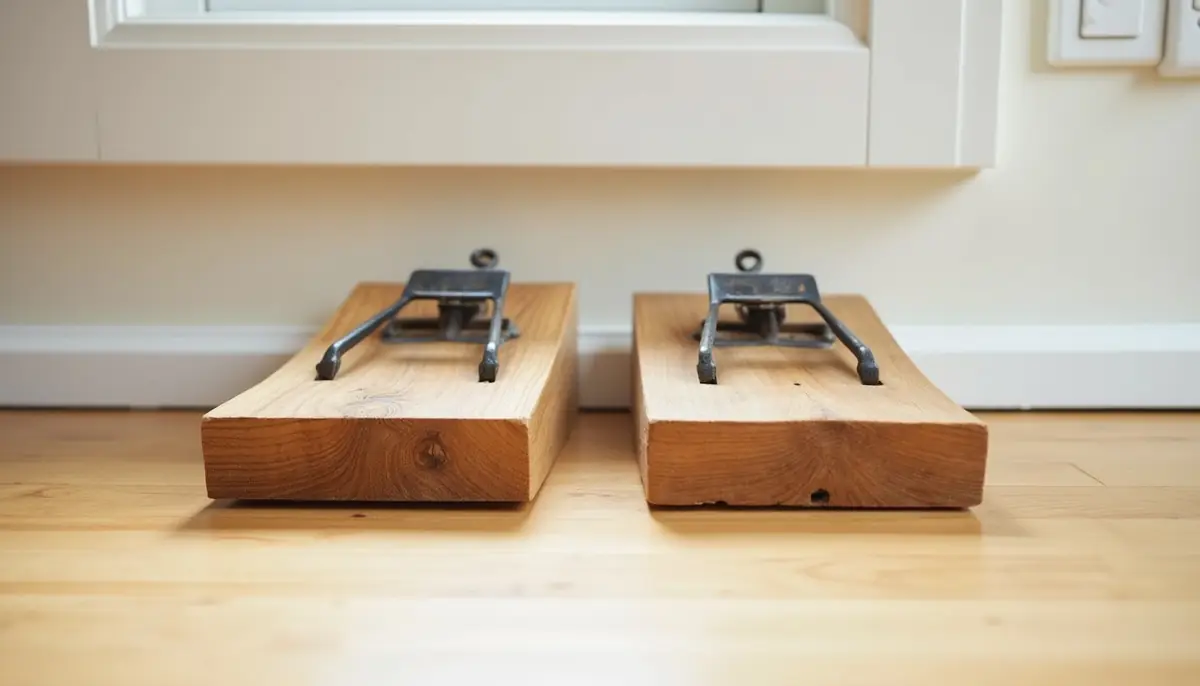
- Angle. At right angles to the wall with the trigger end touching it, so the trap forms a T with the wall (CDC). Traps set in pairs work best (New York State Department of Health); UC IPM says pairs 1 to 2 inches apart catch mice that jump obstacles.
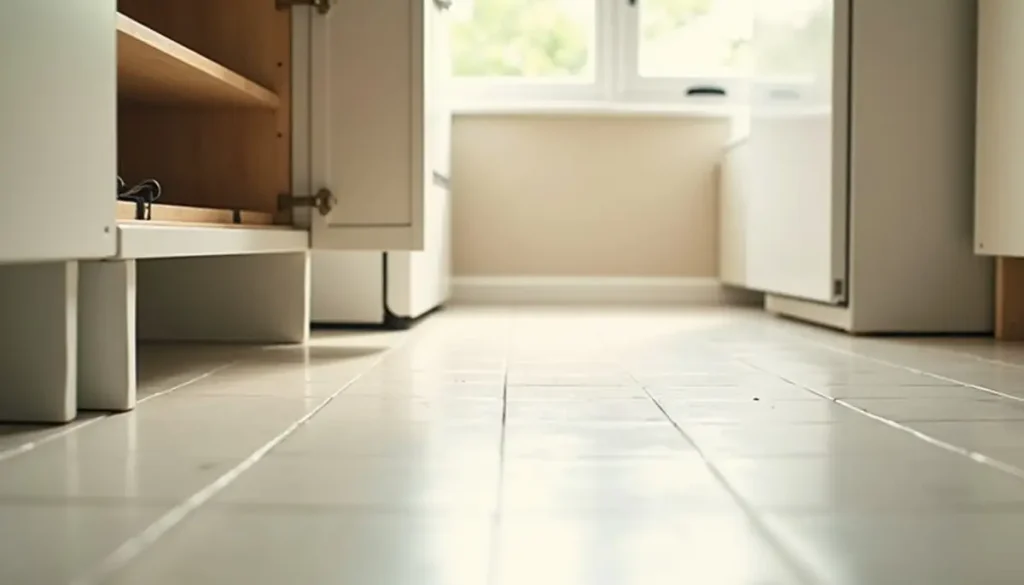
- Locations. Behind appliances, in the backs of cabinets and drawers, in dark corners and wherever droppings are. Refrigerators, water heaters and furnaces are favourite den sites (Nebraska). Mice climb well, so ledges and shelf tops count too; our guide asking whether mice can climb walls lists the surfaces they manage.
- Trigger. Set lightly, and choose wide trigger plates, which UC IPM says have higher catch rates.
- Move them. If nothing happens in a couple of days, move traps to a new spot (New York State Department of Health).
- Refresh. Nebraska notes research showing female house mice avoid traps that have caught dominant males, so add clean or new traps as you go.
Bait
Use a small amount; too much lets a mouse lick it off without firing the trap (UC IPM). Peanut butter is the standard choice for both UC IPM and the CDC, though UC IPM flags allergy risk in some homes. The New York State Department of Health lists bacon, fruit, nuts and gumdrops, fastened with thread. Nesting material works too: UC IPM says a ball of cotton wool or dental floss draws females that are building nests. The best bait is often what the mice are already eating, which our guide to what mice eat and which bait works covers.
Placement in detail, including the T-set and double set, is in our step-by-step guide on how to catch a mouse.
When mice are recorded, and when to check traps
House mice are recorded mostly at night. In our analysis of 3,650 US iNaturalist research-grade house mouse records with a recorded hour, 17.0 per cent were made between 8 PM and 6 AM, against 7.9 per cent of records of all species, almost exactly the rate for Norway and roof rats. Between midnight and 3 AM mice run at 2.35 times their average share of what people record, and between 9 AM and noon at 0.70. Records reflect when people notice and record mice, often dead or trapped, not exactly when mice are active, but they agree with Nebraska’s advice that mice are most active before dawn and after dusk, “so check traps in the morning.” A mouse seen in daylight is discussed on our page asking whether mice are nocturnal, which also shows house mouse records peaking in October.
Sealing: the 1/4 inch standard
UC IPM says house mice “can squeeze under gaps 1/4 inch tall, and through openings 3/8 inch wide,” and tells you to eliminate “all gaps and openings larger than 1/4 inch.” The CDC puts it as a hole the width of a pencil. Mice can also jump 12 inches from the floor onto a flat surface and run along wires and ropes, so gaps above floor level count.
What to use, by source:
- Works: metal, concrete, sheet metal, 1/4 inch wire mesh for vents and fans, knitted copper mesh, tight metal door sweeps (UC IPM; New York State Department of Health). Nebraska adds stainless steel fibre fills, which do not rust.
- Temporary only: steel wool scouring pads, which UC IPM says “make good temporary plugs but may rust over time.”
- Does not work: plastic screening, rubber, vinyl, expanding foam and wood, all of which UC IPM lists as “ineffective for plugging holes used by house mice.” Nebraska adds latex and boards less than 1/2 inch thick.
The common entry points are gaps around pipes, cables, vents and garage door corners, plus door bottoms. Our comparison of steel wool, copper mesh and what actually stops a rodent explains why patches fail at the edges.
Our guide to what attracts mice to a house covers the warmth and smells that draw them to those gaps, especially in autumn, when UC IPM says outdoor mice frequently move in as nights turn cold.
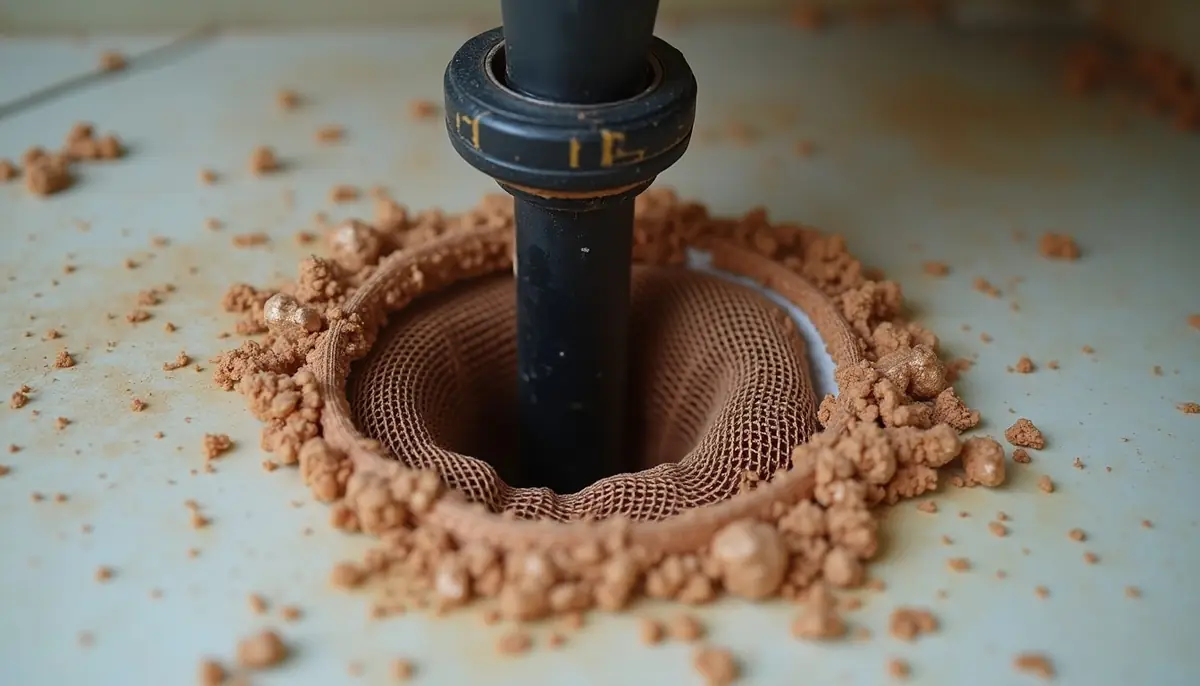
Food, water and nest cover
UC IPM is candid that sanitation “will seldom completely control house mice,” because a house mouse can live in a very small area on very little: it eats about 20 per cent of its body weight a day in around 200 small meals and does not need to drink if its food is moist enough. Poor sanitation still lets more mice thrive. Practical moves: store dry goods and pet food in metal, glass or heavy plastic with tight lids, feed pets only what they eat at one sitting, fix leaks (New York State Department of Health), and clear clutter, cardboard and stored fabric where nests go. Our guide to what a mouse nest looks like shows where to search.
What kills mice: methods compared
Compiled by The Pest Control Brief from UC IPM Pest Notes: House Mouse (7483), the University of Nebraska’s NebGuide G1105, the CDC and the US EPA. Active ingredients only, no brands.
| Method | How fast | Risk to children, pets, wildlife | Legal position for a homeowner | What the sources say |
|---|---|---|---|---|
| Snap traps | Catches from the first nights; results seen each morning | Finger and paw injury; place where children and pets cannot reach | Legal everywhere | “A great first step” (UC IPM); preferred in homes (Nebraska); recommended by CDC |
| Electronic traps | Kills on entry | Low if enclosed | Legal | “Considerably more expensive” but good control reported (UC IPM) |
| Multiple-catch live traps | Catch several mice without resetting | Low | Mice must be removed and euthanised; relocation is illegal in California without a permit (UC IPM) | Released mice home from half a mile (UC IPM); not recommended in Nebraska |
| Glue boards | Hold mice alive; must then be euthanised | Catch pets and wildlife | Sold to consumers | Catch mostly juveniles as adults avoid the glue (UC IPM); CDC says do not use |
| First-generation anticoagulants (diphacinone, chlorophacinone, warfarin) | Several days of feeding; deaths begin at about 5 days (Nebraska) | Antidote: vitamin K1 (Nebraska) | Consumer bait stations only; most uses banned in California | Fresh bait needed for at least two weeks (Nebraska) |
| Second-generation anticoagulants (brodifacoum, bromadiolone, difenacoum, difethialone) | One feeding can be lethal; deaths begin at about 5 days | Greatest secondary poisoning risk (EPA) | Not sold to consumers; professional use only | Persist longer in animal tissue (EPA) |
| Bromethalin | Can kill after a single feeding (UC IPM) | No antidote (Nebraska); can pass to predators (UC IPM) | Consumer bait stations | One of two residential options in California |
| Cholecalciferol | Can kill after a single feeding (UC IPM) | No antidote (Nebraska) | Consumer bait stations | One of two residential options in California |
| Zinc phosphide | Acute | Acute toxicant | Restricted use; licensed applicators (Nebraska, UC IPM) | Not a homeowner tool |
Under the US EPA’s rules, rodenticides sold in consumer stores must be ready-to-use bait stations holding block or paste bait, labelled for indoor use and outdoors within 50 feet of buildings; pellets are no longer allowed in consumer products. Indoors, UC IPM’s advice is to ask first whether dead mice in walls will be a problem, because mice tend to stay within 30 feet of the nest and poisoned ones usually die inside the structure. If you have smelled one, our guide to how long dead mouse smell lasts explains the wait.
Children aged 5 and under were 64 per cent of single-substance rodenticide exposures reported to US poison centres in 2024, according to our analysis of rat poison calls to poison centres, which is a strong reason to keep any bait locked in stations.

What does not work
- Ultrasonic plug-ins. UC IPM says high frequency electronic devices “aren’t effective,” and there is “little evidence that sound, or magnetic or vibrational devices of any kind will drive established house mice or rats from buildings.” Ultrasound is directional, does not go behind objects and fades with distance.
- Peppermint oil. In the controlled mouse study covered in our review of whether peppermint oil repels mice, avoidance had faded within a week.
- Dryer sheets, ammonia, cayenne and other scents. No repellent has kept mice out of a home for long in the published evidence; our scorecard of mouse repellents against the evidence rates each one.
- Mothballs. The National Pesticide Information Center says mothballs “are not wildlife repellents”; they are insecticides for airtight containers.
- Catch and release. UC IPM says house mice released half a mile away can navigate home, and in California relocating them without a permit is illegal.
- The cat. Nebraska says predators “rarely provide effective mouse control,” and UC IPM notes they can make mice more secretive, giving a false impression of success. Our page on what eats mice goes further.
How long it takes to get rid of mice
| Stage | Typical time | Source |
|---|---|---|
| Leave a trap in one spot before moving it | A couple of days | New York State Department of Health |
| Most catches | The first nights, while mice are unsuspicious | New York State Department of Health; UC IPM |
| Bait stations: keep fresh bait available | At least 2 weeks | University of Nebraska |
| Poisoned mice begin dying | About 5 days after a lethal dose | University of Nebraska |
| Declare them gone | A week with no captures and no new signs | CDC |
A small, new infestation in a sealed house typically clears in two to three weeks on that timeline: a week or so of catches, then the quiet week. The University of Georgia advises leaving traps in place for a few weeks, since it is hard to say when you have caught them all. Our guide on how to tell if mice are gone sets out the tracking-patch test.
The deer mouse exception
If the mice are deer mice, or you cannot tell, clean as if hantavirus is present. The CDC’s method: open doors and windows for 30 minutes and leave; wear rubber or plastic gloves; spray droppings, urine and nests with disinfectant or 1.5 cups of bleach per gallon of water; soak 5 minutes; wipe with paper towels and bag it. Never sweep or vacuum droppings. The full protocol is on our page about mouse droppings and hantavirus cleanup. House mice carry their own risks: UC IPM estimates about 5 per cent of US house mice carry lymphocytic choriomeningitis virus, and mouse urine proteins are a major allergen.
Do it yourself or hire a professional?
| Situation | Reasonable choice | Why |
|---|---|---|
| A few mice in a kitchen or garage, gaps you can find | DIY | Snap traps plus metal sealing is the extension method; traps cost a few dollars each |
| Mice in walls, attic or ceiling | DIY trapping, professional sealing if gaps are high or hidden | Mice climb and enter well above ground |
| Catches still coming after three weeks | Professional | An entry point is being missed or the population is large |
| Apartment or attached housing | Landlord or building-wide programme | Mice move between units; your sealing cannot cover shared walls |
| Deer mice, heavy droppings or a cabin closed all winter | Professional cleanup, or CDC method carefully | Hantavirus risk |
Published estimates put a mouse trapping and baiting programme at $150 to $550, after a $75 to $150 inspection usually credited to the job, with whole-house sealing a separate $1,000 to $3,000; snap traps are listed at $3 to $6. These are contractor-reported estimates collected on our page on what pest control for mice costs, not measured prices.
In New York City, housing inspectors issued 27,273 mouse violations in 2025, our analysis of roach and mouse violations in New York apartments found, which is why renters there have a route beyond DIY.
Every mouse guide we publish
Biology and behaviour
- Found baby mice? Their age, what to do, and whether mom returns
- How long do mice live? Wild, indoor and pet mice compared
- How fast do mice reproduce? Litters, timing and real growth
- Do mice hibernate? Why they move indoors in autumn
- Are mice nocturnal? What a mouse seen in daylight means
- Can mice climb walls? What they climb, jump and squeeze through
- What do mice eat? Their real diet, and what bait works
- What eats mice? Predators, and whether they control mice
Signs
- Signs of mice in the house: a room-by-room checklist
- What does a mouse nest look like, and where to find one
- Dead mouse smell: how long it lasts and how to find it
- How to tell if mice are gone, and whether they will come back
Where mice turn up
- Mice in the attic: signs, noises and how to get them out
- Mice in the walls: how to tell, and how to get them out
- Mice in the garage: why they move in and how to keep them out
- Mice in your car: signs, wiring damage and getting them out
- Mice in your stove or oven: signs, smell and safe cleanup
- Mouse in the toilet: how it got there and what to do
Health
- Are mice dangerous? The real health and property risks
- Do mice bite? Mouse bites, rabies risk and what to do
- Mouse droppings and hantavirus: the cleanup CDC requires
Control
- How to catch a mouse: trap placement that actually works
- Steel wool, copper mesh and what actually stops a rodent
- What attracts mice to a house, and what keeps them coming
- Mice keep coming back? Why, and how to stop the cycle
- Do mouse repellents work? Every type against the evidence
- Does peppermint oil repel mice? What the studies found
- How to get rid of rats: a step-by-step plan
Professionals and costs
- Does pest control get rid of mice? What exterminators actually do
- When to call pest control for mice
- How much does pest control cost for mice? Exterminator prices
- Rodent removal cost 2026: trapping vs exclusion
Our data
- Roaches and mice in New York apartments: the violation data
- Rat complaints in New York and Chicago: what 311 shows
- How often a city inspection actually finds rats
- Rat poison calls to poison centers fell 22 percent in a decade
Frequently asked questions
What gets rid of mice fastest?
A large number of snap traps set at once along walls where droppings are. The University of Nebraska suggests about two dozen for a new infestation in a 1,500 square foot building, spaced no more than about 10 feet apart. Mice are not wary of new objects, so most catches come in the first nights. Poison takes about 5 days to start killing.
What keeps mice away permanently?
Sealing every gap of 1/4 inch or more with metal, concrete, hardware cloth or copper mesh, which UC IPM calls the most successful and permanent form of control. Steel wool is only a temporary plug, and foam, rubber, vinyl and wood do not stop mice. Re-check the house each autumn, when outdoor mice move in.
What smells do mice hate?
Mice may avoid strong smells such as peppermint briefly, but no scent has been shown to keep them out of a house. UC IPM says sound and other repelling devices do not drive established mice out, and the one controlled peppermint study found the effect faded within a week. Mothballs are not wildlife repellents, according to the National Pesticide Information Center.
What is the 5 day rule with mice?
An online rule of thumb that five days with no catches means the mice are gone. We could not find it in CDC or extension guidance. The CDC’s standard is a full week with no captures and no new signs, and the University of Nebraska says poisoned mice only begin dying around day five, so five quiet days after baiting proves little.
How long does it take to get rid of mice?
Usually two to three weeks for a new infestation in a house that is being sealed: one to two weeks of trapping, then the CDC’s quiet week. Bait programmes run longer, since Nebraska says fresh bait must stay available for at least two weeks. Mice that keep returning point to an unsealed gap.
Sources
- Quinn N. Pest Notes: House Mouse. UC Statewide IPM Program, UC ANR Publication 7483, 2025.
- Quinn N. Pest Notes: Rats. UC Statewide IPM Program, UC ANR Publication 74106, 2024 (rat gap sizes and vent mesh).
- Vantassel SM, Hygnstrom SE, Ferraro DM. Controlling House Mice, NebGuide G1105. University of Nebraska-Lincoln Extension, revised March 2012.
- New York State Department of Health. Mouse Control, Publication 3206.
- Centers for Disease Control and Prevention. How to Trap Up to Remove Rodents; How to Seal Up to Prevent Rodents; How to Clean Up After Rodents. Healthy Pets, Rodent Control.
- US Environmental Protection Agency. Restrictions on Rodenticide Products.
- Kohl M, Mengak MT. Rats and mice: get them out of your house and yard. University of Georgia Integrated Pest Management, 2025.
- National Pesticide Information Center, Oregon State University. Mothballs.
- The Pest Control Brief analysis of iNaturalist research-grade records, pulled November 2026.
- The Pest Control Brief analyses of New York City housing violation data and US poison center rodenticide exposure data, as published on this site.