Signs of Mice in the House: A Room-by-Room Checklist

The surest signs of mice in a house are small pointed droppings about 1/8 to 1/4 inch long, chewed food packaging, shredded paper or fabric nests, and scratching in walls or ceilings at night. A musky, ammonia-like smell in cupboards, greasy smudges along baseboards and footprints in dust complete the list. Most people find droppings first, usually in kitchen drawers, cabinets and under the sink. Fresh droppings reappearing after you clean are the clearest proof that mice are still active.
Mice are active mostly at night and keep to the edges of rooms, so the evidence, not the animal, is what you look for. This checklist goes room by room, then covers active versus old signs, what the signs say about numbers, and what to do next.
Signs of mice, room by room
| Room | What to look for | Where exactly |
|---|---|---|
| Kitchen | Droppings, chewed packaging, nibbled food | Drawers, back of cabinets, under the sink, behind the stove and refrigerator |
| Pantry and food cupboards | Small holes in boxes and bags, a musky ammonia smell, food stashes | Low shelves, bulk bags, pet food and bird seed |
| Stove and appliances | Missing fabric insulation, nest material, droppings in the drawer | Inside stove insulation, under dishwashers and fridges, near heat sources such as water heaters, ovens and refrigerators |
| Living areas | Scratching or scampering in walls, greasy rub marks | Baseboards, behind sofas, where pipes and cables enter |
| Bedrooms and closets | Chewed cloth or paper, droppings in drawers | Stored clothes, boxes, under beds, the backs of closets |
| Attic | Nests in insulation, droppings, sounds above the ceiling | Along joists, near vents and where the roof meets the walls |
| Basement and utility room | Rub marks on pipes and beams, droppings, nests in stored goods | Pipe runs, around the water heater and furnace, cardboard storage |
| Garage and sheds | Nests, chewed bags of seed or fertiliser, burrows outside | Cluttered shelves, under workbenches, beside the door seal |
The kitchen list comes almost word for word from public health guidance. The CDC tells people to set traps “behind the stove and refrigerator, and in the back of cabinets and drawers,” and the EPA lists droppings “around food packages, in drawers or cupboards, and under the sink” as the first sign of rodents. Arizona extension entomologists add the stove: mice will strip the fabric insulation from modern stoves because it is ideal nesting material.

The checklist: every sign and what it looks like
1. Droppings
House mouse droppings are 1/8 to 1/4 inch long (3 to 6 mm), dark, rod shaped and pointed at one or both ends, about the size of a grain of rice. One mouse leaves a lot of them: the University of Arizona puts it at 50 droppings a day and NC State at 50 to 75. Unlike rat droppings they rarely collect in piles; Nebraska Extension notes they “usually do not collect in piles” but are scattered along routes and where mice feed. For telling mouse droppings from rat or cockroach droppings, see our droppings identification guide, and before you touch any, read how to clean up mouse droppings safely. The CDC’s instruction is plain: “Don’t vacuum or sweep rodent urine, droppings, or nesting materials.”
2. Gnaw marks and chewed packaging
Mice nibble. NC State describes them chewing into packaging and taking “one or several small tastes,” so damage is spread across many items rather than one bag emptied. Nebraska gives the sizes: fresh gnaw marks about 1/32 inch wide and clean-cut holes about 1 1/2 inches across in cardboard. Check baseboard edges and cords too.
3. Nests
Nests are loose balls of shredded paper, fabric, insulation or plant material, 4 to 6 inches across according to Arizona extension, built in undisturbed, enclosed spaces near warmth. They are hard to find even for professionals, so chewed paper or cloth in a drawer or box is often the only nest evidence you will see.
4. Smell
House mice have what Arizona extension calls “a musky ammonia smell,” most noticeable in enclosed spaces such as pantries, cabinets and drawers, and stronger along baseboards where mice leave urine as they travel. The 1994 wildlife damage handbook calls the musky odour “a positive indication” of mice. Nebraska notes it occurs where mice have been present for a long time, so a strong smell usually means an established problem rather than a newcomer.
5. Urine
Mice urinate continuously as they move, in tiny droplets rather than puddles. Arizona extension describes “thousands of microdroplets of urine each day.” Mouse urine fluoresces, so an inexpensive ultraviolet torch in a dark room can show trails along walls and around food. Some other materials fluoresce too, as the wildlife damage handbook points out, so treat a glow as supporting evidence rather than proof.
6. Rub marks
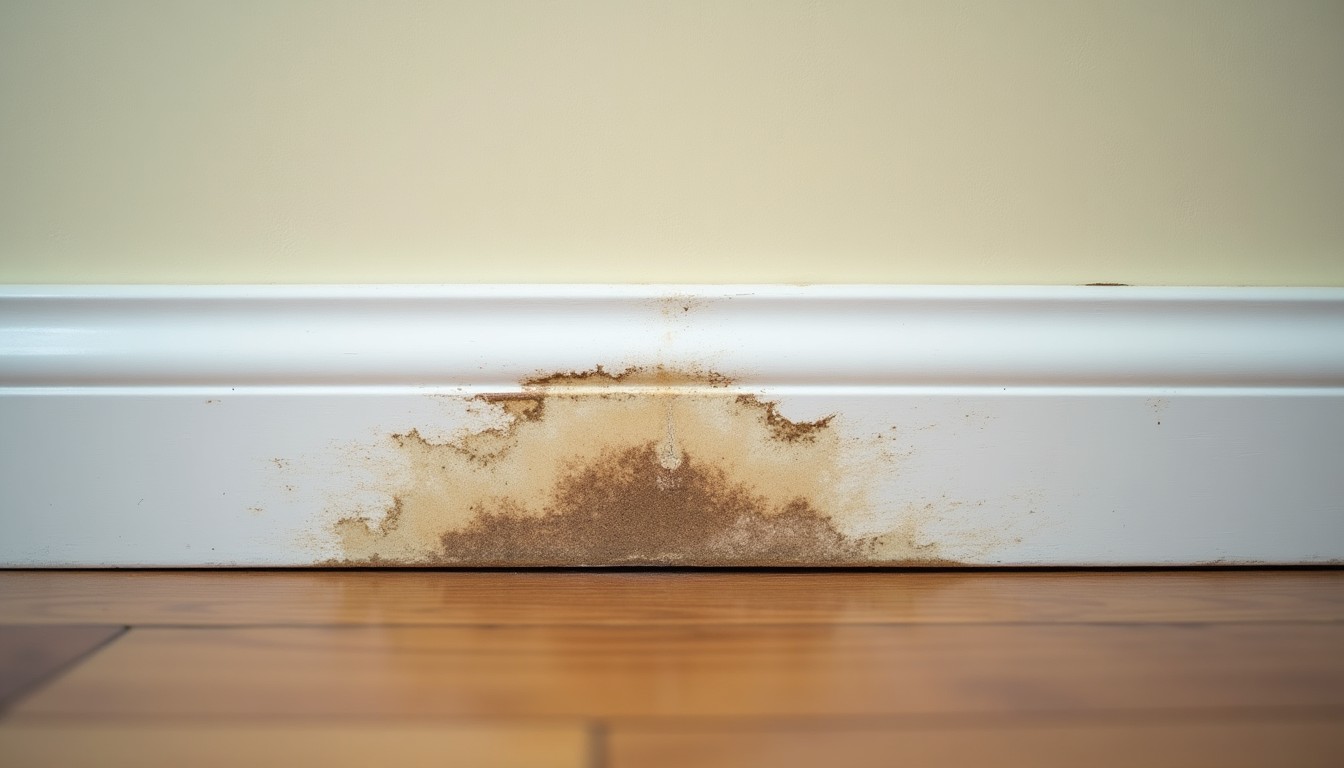
Mice run the same routes repeatedly, and oil and dirt from their fur leave dark smudges on baseboards, pipes, beams and the edges of holes. They are fainter than rat rub marks and darken over time, which makes them a sign of a route used for weeks rather than a single visit.
7. Sounds at night
Listen after dark for quiet scampering, scratching in wall voids, movement above ceilings and occasional squeaks. Arizona extension makes a useful distinction: animal noises are irregular, while sounds that are consistent or predictable usually point to something mechanical or structural. Our article on mice in walls covers telling mice from other animals by sound.
8. Tracks
Footprints and tail marks show up in dust or spilt flour; a tracking patch, covered below, makes your own evidence.
9. Sightings, by day and by night
Mice are mostly nocturnal, with feeding peaks before dawn and after dusk, but UC IPM notes they “can be seen occasionally during daylight hours” when food is available. The wildlife damage handbook makes a point many guides get wrong: seeing a mouse in daylight “does not necessarily mean that a high population is present,” although for rats it usually does.
10. Pets and pet food
Extension guides do not list a pet’s behaviour as a reliable sign, but they do point at pet food. Nebraska observes that mice often live in close association with dogs and cats because the food, water and shelter provided for pets also serve mice, and Arizona extension reports that stashes of cached pet food are commonly found when an infested home is deep cleaned. A pet bowl that empties overnight or kibble turning up in odd places is worth investigating.
Active signs or an old problem?
Many homes carry evidence of mice that left long ago. The test is whether it comes back.
| Sign | Suggests current activity | Suggests an old problem |
|---|---|---|
| Droppings | New droppings on a surface you cleaned | Dry, grey, crumbling droppings that do not reappear |
| Gnawing | Fresh shavings, bright chewed edges | Weathered, darkened edges; the CDC notes gnaw marks alone may only mean rodents were there at some point |
| Rub marks | Smudges that return after cleaning | Old dark staining that stays clean once wiped |
| Smell | Strengthens in closed cupboards | Fades steadily once cleaned and aired |
| Tracks | Footprints in a fresh flour or talc patch overnight | An untouched patch after several nights |
The CDC puts the key rule simply: “If droppings are present after cleaning, this indicates an active rodent presence.” Clean a defined area safely, check it over the following days, and anything new is current. For the full protocol once you have trapped and sealed, see our guide on how to tell if mice are gone.
The flour test, and how many mice the signs suggest
A tracking patch is the simplest diagnostic tool there is. The wildlife damage handbook describes a patch of flour “rolled smooth with a cylindrical object” placed in a pathway overnight. Arizona’s school and home IPM newsletter suggests scattering a small patch of flour or talc along a wall, putting a cracker in the middle and checking the next day.
The same handbook turns this into a population check: place flour or talc patches at 20 to 30 foot intervals through the building, and the percentage that show tracks indicates the relative size and spread of the mouse population. That works because house mice stay close to home. They usually travel an area 10 to 30 feet across, according to the handbook, and Nebraska says they seldom go more than 50 feet from shelter and food.
Counting droppings does not work nearly as well. At 50 to 75 a day per mouse, a single animal can litter a cupboard in a week. Spread is more telling than quantity: droppings in one kitchen drawer suggest a mouse or two near that spot, while droppings in the kitchen, the basement and an upstairs closet suggest several groups. Our guide to when to call pest control for mice sets out the thresholds.
When mice show up, and why it feels sudden
UC IPM says outdoor house mice frequently enter homes in autumn, when nighttime temperatures fall. Our analysis of iNaturalist research-grade records shows the same rhythm in where and when people photograph house mice.
US house mouse records fall to 235 in June and climb to 443 in October, almost double, staying high through November. Norway rat records hold between 691 and 760 a month from July to October and fall away to 444 by December. These are mostly outdoor sightings, not counts of indoor infestations, but the house mouse curve fits the autumn move indoors that extension services describe.
That seasonal shift is the usual answer to “why do I have mice all of a sudden.” A house that had no trouble all summer acquires a gap a quarter of an inch high, an open garage door or a stored bag of bird seed, and the first cold nights bring mice to it. Breeding then does the rest: UC IPM records 5 to 10 litters a year of about 5 or 6 young, with females mature 5 to 6 weeks after birth.

Where mice are most often recorded
House mice live in every state, but they are not equally prominent in what people record. Relative to all research-grade iNaturalist observations, they turn up most often in Oklahoma, Nebraska, Utah and Hawaii.
Florida sits near the bottom, at 0.11 records per 10,000 observations, and Texas at 0.23, so a low rate means fewer photographed house mice, not mouse-free homes. In cities the picture comes from inspections rather than sightings: New York’s housing inspectors issued 27,273 mouse violations in 2025, after a 2024 peak of 32,994, figures we analysed in New York apartment roach and mouse violations.
What to do once you see the signs
- Do not sweep droppings dry. Follow the CDC cleanup steps: ventilate, wear gloves, wet the material with disinfectant and wipe it up.
- Find the way in. Look for gaps of a quarter inch or more around pipes, vents, doors and the foundation. UC IPM calls exclusion “the most successful and permanent form of house mouse control,” and our early signs of infestation guide gives an inspection order for the whole house.
- Trap where the signs are. Snap traps set close to walls, no more than about 10 feet apart, where droppings and rub marks cluster. Our guide on how to catch a mouse covers traps, bait and placement.
- Clean and declutter. Seal up food, pet food and bird seed and clear cardboard clutter so new signs show.
A few mice in one area of a house is a reasonable DIY job. Call a licensed professional if signs keep reappearing despite several weeks of trapping and sealing, if you find evidence on several floors, if droppings are in an attic or crawl space with heavy contamination, or if anyone in the home has asthma triggered by mouse allergen.
How we did this
The Pest Control Brief analysis of iNaturalist research-grade records, pulled October 2026, gives monthly US counts for house mice and Norway rats (all years) and state rates as records per 10,000 iNaturalist observations of anything in that state; we left out states with fewer than 30 house mouse records. These are photographed sightings, mostly outdoors, not infestation rates. New York figures come from our analysis of the city’s housing violation records.
Frequently asked questions
What are the first signs of mice in your house?
Droppings are usually first: small, dark, pointed pellets about 1/8 to 1/4 inch long in kitchen drawers, cabinets, under the sink or behind appliances. Chewed food packaging, shredded paper or fabric, scratching in walls at night and a musky smell in cupboards follow. The EPA lists droppings around food packages, nesting material, chewed packaging, chewed holes and stale smells as the signs to look for.
What is the 5 day mouse rule?
It is an informal rule of thumb shared online: if you go five days without catching a mouse or finding new signs, the mice are gone. We could not trace it to the CDC or any extension service. The CDC’s own threshold is longer: if no rodents are captured for a week and there are no new signs, they are gone. Use the week, and keep checking after that.
Will mice go away if you clean?
Not on their own. UC IPM says good sanitation “will seldom completely control house mice,” though poor sanitation lets them thrive in greater numbers. Mice need very little food and live within a small area, so crumbs and pet food are enough. Cleaning makes traps work better and new signs easier to spot, but mice already inside usually need trapping and their entry gaps sealed.
Is it possible to have mice and not know?
Yes, for a while. Mice are mostly nocturnal, keep to wall edges and hidden spaces, and Arizona extension notes nests can be very difficult to find even for professionals. Droppings collect in the back of cabinets and drawers out of plain sight. Small numbers can go unnoticed for weeks, but because mice breed quickly, droppings, smells or noises usually give them away.
Do you only see mice at night?
Mostly, but not only. House mice are most active before dawn and after dusk, and UC IPM notes they can be seen occasionally in daylight when food is available. Unlike rats, a mouse seen during the day does not necessarily mean a large population, according to the wildlife damage handbook. Night is when you are most likely to hear them in walls and ceilings.
Sources
- US Centers for Disease Control and Prevention, Rodent Control and How to Trap Up to Remove Rodents, healthy pets guidance.
- US Environmental Protection Agency, Identify and Prevent Rodent Infestations.
- University of California Statewide IPM Program, Pest Notes: House Mouse, UC ANR Publication 7483, Quinn and Frye, revised July 2025.
- University of Nebraska Extension, Controlling House Mice, NebGuide G1105, revised March 2012.
- NC State Extension, Surveillance and Management of Common Structure-Invading Mice, Hayes and Alder, 2024.
- University of Arizona, House Mice: Signs of Uninvited Four-Legged Visitors, School and Home IPM Newsletter, Gouge and colleagues, January 2022; and School and Home IPM Newsletter, November 2014.
- University of Arizona Cooperative Extension, The House Mouse, Schalau, Backyard Gardener.
- Timm, R.M., House Mice, in Prevention and Control of Wildlife Damage, University of Nebraska Cooperative Extension and USDA APHIS, 1994.
- The Pest Control Brief analysis of iNaturalist research-grade records, pulled October 2026.
- The Pest Control Brief analysis of New York City housing maintenance code violations, 2019 to 2025.