Are Mice Dangerous? The Real Health and Property Risks

Mice are rarely dangerous in a direct way: they seldom bite, and none of the 840 house mice tested for rabies in the US between 2011 and 2020 was positive, but what they leave behind is a real health risk. House mice contaminate food and carry salmonella, leptospirosis and lymphocytic choriomeningitis virus (LCMV), which CDC warns is serious in pregnancy. Their urine protein is a common household allergen that worsens asthma in allergic people. Deer mice, not house mice, are the main US carrier of hantavirus. Mice also gnaw wiring.
So the honest answer is “yes, but not in the way most people fear.” The mouse itself is timid; the hazards are dust, droppings, urine and chewed cable. Here is each risk, the evidence behind it, and who it matters most for.
Are mice dangerous to humans? The risks, ranked by evidence
| Hazard | Which mouse | How it reaches you | How common | Who is most at risk |
|---|---|---|---|---|
| Allergen (mouse urinary protein) | House mouse | House dust, settled urine | Detectable in 82% of US homes | Allergic people with asthma, children |
| Salmonellosis | House mouse | Food contaminated with droppings | The mouse disease Kentucky extension singles out | Anyone eating contaminated food |
| LCMV | House mouse | Fresh urine, droppings, saliva, nest material | 2 to 5% of urban people have had a past infection | Pregnant women, people with weak immune systems |
| Leptospirosis | Rats and mice | Water or soil with infected urine | Uncommon; rises after flooding | People and dogs exposed to contaminated water |
| Hantavirus | Deer mouse (also white-footed mouse) | Breathing dried droppings and urine | 890 US cases, 1993 to 2023 | People cleaning cabins, sheds, outbuildings |
| Rat-bite fever | Rats and mice | Bites, scratches, contaminated food | Rare in the US | Pet rodent owners, lab and pet store staff |
| Bites | Any mouse | Handling or cornering | Uncommon; no US count exists | People catching mice by hand |
| Rabies | Any mouse | Bite | 0 of 840 house mice tested positive, 2011 to 2020 | Negligible |
| Fire and appliance damage | House mouse | Gnawed wires and gas lines | No reliable national count | Homes with long-term infestations |
Hantavirus is the most lethal item on the list and one of the least likely. Allergen is the least dramatic and the most widespread.
The diseases house mice actually carry
UC IPM names three diseases carried by house mice: leptospirosis, salmonella and lymphocytic choriomeningitis. CDC’s rodent page adds that many of these infections do not make the rodent visibly ill, so a healthy-looking mouse tells you nothing.
Salmonella: the everyday risk
The University of Kentucky’s extension fact sheet calls salmonellosis, bacterial food poisoning, the most notable disease mice transmit, spread when food is contaminated with infected faeces. Nebraska extension says a house mouse deposits roughly 50 to 75 droppings a day as it explores. Droppings are scattered as mice travel, which is why gnawed packets should be thrown out, not trimmed. What mice target in a kitchen is covered in what mice eat.
LCMV: rare, but the one pregnant women should know
CDC describes LCM as a viral disease spread by the common house mouse, caught from fresh urine, droppings, saliva or nesting material. UC IPM says an estimated 5 per cent of US house mice carry the virus. Most infections in adults are mild or pass unnoticed: CDC puts deaths below 1 per cent and notes that studies show 2 to 5 per cent of people in urban areas have had a past infection. A 2021 Philadelphia study published in CDC’s journal found antibodies in 2.7 per cent of 300 randomly selected pregnant women.
The exception is pregnancy. CDC states that LCMV can pass to the fetus, that first-trimester infection may cause miscarriage, and that later infection can cause serious birth defects. If you are pregnant and have mice, let someone else handle the traps and cleanup, and raise it with your doctor. Our guide to pest control during pregnancy covers treatment choices.
Leptospirosis and rat-bite fever
CDC lists rats and mice among the animals that carry the bacteria behind leptospirosis, spread mainly through water or soil containing infected urine, particularly after hurricanes or flooding. Rat-bite fever, despite the name, is also carried by mice, according to CDC, and can spread through scratches or contaminated food as well as bites. Both are uncommon in US homes; anyone who develops a fever after rodent contact should see a doctor and mention it.
Hantavirus is mainly a deer mouse problem
CDC states that the hantavirus responsible for most US cases of hantavirus pulmonary syndrome is spread by the deer mouse. The house mouse is not on CDC’s list of US hantavirus carriers. CDC counted 890 cases from 1993 to the end of 2023, 35 per cent of them fatal, and 94 per cent west of the Mississippi.
That is about 29 cases a year nationally. The risk sits in cabins, sheds and closed-up outbuildings where deer mice nest, not in a city kitchen. Because the danger comes from stirring dry droppings into the air, follow the steps in our mouse dropping cleanup guide rather than sweeping or vacuuming. If you are not sure which mouse you have, droppings identification helps.
Our analysis of iNaturalist research-grade records shows why the two mice belong in different mental boxes. Deer mouse records peak at 1,015 in May, the outdoor breeding season. House mouse records rise from 235 in June to 443 in October, when UC IPM says outdoor house mice move into homes as nights turn cold. These are mostly outdoor sightings, so they show when people meet each mouse, not infestation rates.
The risk most homes actually carry: mouse allergen
The most widespread mouse hazard in America is a protein. The National Survey of Lead and Allergens in Housing, a nationally representative study of 831 homes run by the National Institute of Environmental Health Sciences, found detectable mouse urinary protein in 82 per cent of US homes. In 35 per cent, at least one room exceeded 1.6 micrograms per gram of dust, a level linked to higher sensitisation rates.
The health effect was specific. Among people with allergies, elevated mouse allergen roughly doubled the odds of asthma symptoms in the past year (adjusted odds ratio 1.93). Among people without allergies there was no association. Elevated levels were most common in high-rise apartments, mobile homes, older homes and low-income homes, and kitchens had the highest concentrations.
Two findings from the same survey are directly useful. Homes reporting a rodent problem had 3.38 times the odds of elevated allergen, and homes where floors were mopped rather than vacuumed had 2.17 times the odds. If someone in the house has allergic asthma, reducing mice is a health measure, not just a tidiness one.
Do mice bite?
Rarely, and almost always when handled or cornered. We could find no US study that counts mouse bites; the published bite research is about rats, which we cover in do rats bite. A Baltimore survey of 1,363 people in the late 1980s found residents reported more contact with house mice than rats inside their homes, yet infections with rodent-borne viruses were rare compared with how often people reported contact.
A mouse bite is small but it breaks the skin. Wash it with soap and water and contact a doctor, who can advise on infection and tetanus. Rabies is not the concern: CDC-linked surveillance found no rabid house mice among 840 tested from 2011 to 2020.
Will mice bite humans while sleeping?
There is no evidence that mice seek out sleeping people. Mice forage at night along walls and edges, usually within 10 to 25 feet of the nest, according to Kentucky extension, and they are drawn to food and nest material, not to people.

Is it dangerous to sleep in a house with mice?
For most healthy adults, a night in a house with a few mice is not dangerous in itself. The risk is cumulative: allergen builds up in dust and droppings contaminate food. People with allergic asthma, pregnant women, infants and anyone with a weakened immune system have more reason to act fast.
Will mice crawl on you in your sleep?
It is possible but unusual, and no study we found has measured it. A mouse crossing a bed is usually travelling between a gap and food. Keep food out of bedrooms and trap along that room’s walls.
Are mice dangerous to babies?
The documented risks to babies are indirect. UC IPM says exposure to house mouse urinary proteins has been linked to early onset of asthma in sensitive children. LCMV during pregnancy is the most serious mouse-borne risk to an unborn child. And the poison bought to kill mice is itself a hazard: in our analysis of US poison centre data, children aged 5 and under made up 5,416 of 8,452 single-substance rodenticide exposures in 2024, about 64 per cent.
Exposures among young children have fallen from 8,809 in 2014, after EPA required consumer rodenticides to come in ready-to-use bait stations. The full series is in our rodenticide poisoning statistics. In a home with a crawling baby, snap traps in covered boxes or behind appliances are the lower-risk choice; any bait must be used exactly as the label directs.
Are mice dangerous to dogs and cats?
CDC says dogs and cats can become infected with rat-bite fever bacteria through contact with infected rodents. Dogs can catch leptospirosis from contaminated urine in water or soil, according to CDC. Cats can become infected with Toxoplasma by eating infected rodents, birds or other small animals, CDC states.
The bigger hazard is often the rodenticide, either eaten directly or through a poisoned mouse. UC IPM notes that federal rodenticide rules introduced in 2011 were designed partly to reduce hazards to wildlife and pets. Talk to a vet if a pet eats a mouse or any bait. Pet-aware options are in pet-safe pest control products.
What mice damage: wiring, food and insulation
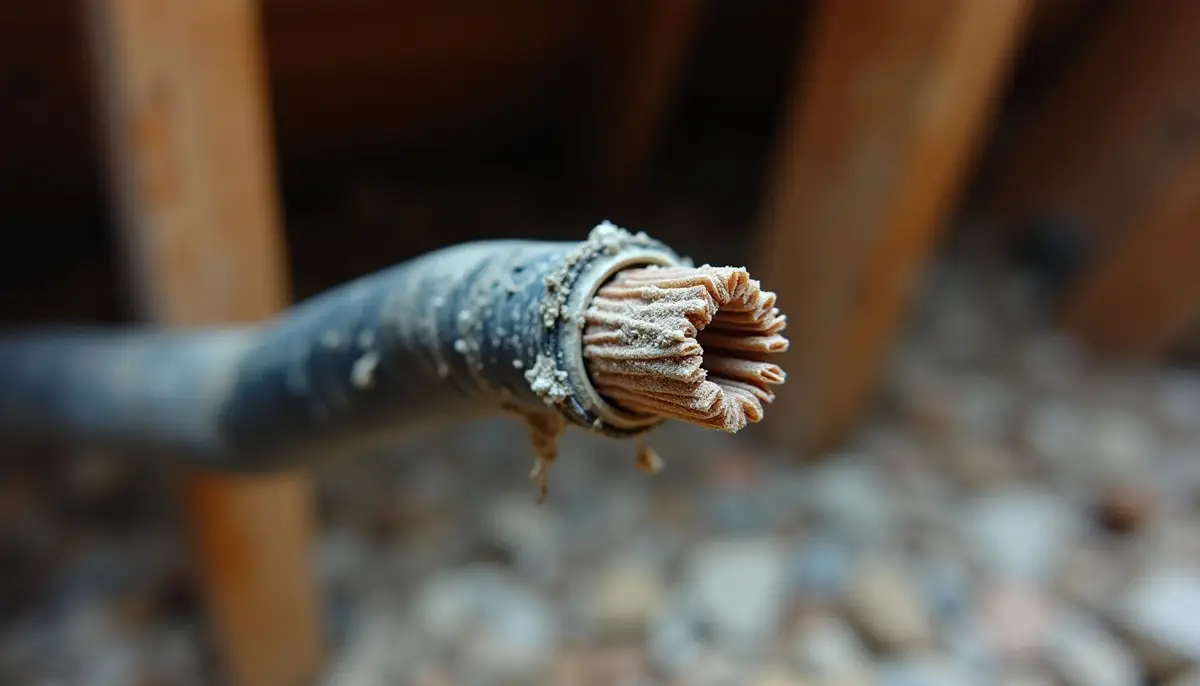
UC IPM says house mice gnaw electrical wires and gas lines in structures and vehicles, and that many fires of unknown origin are believed to be caused by rodents gnawing wires. Kentucky extension says house mice gnaw through electrical wiring, causing fires and failure of freezers, clothes dryers and other appliances. Neither gives a count, and we found no reliable national statistic for rodent-caused fires, so treat percentage figures you see elsewhere with caution.
Kentucky extension notes the greatest loss is not what mice eat but what must be thrown out because of contamination, and Nebraska extension estimates house mice cause about $20 million of damage to stored feed and structures in that state each year.
| Your situation | How urgent | Sensible next step |
|---|---|---|
| One mouse seen, few droppings | Low, act this week | Snap traps along walls, seal gaps a quarter inch or larger |
| Droppings in food cupboards | Moderate | Discard exposed food, clean wet, trap |
| Someone with allergic asthma | Moderate to high | Trap and seal promptly; vacuum rather than mop dust |
| Pregnant household member | High | Someone else handles traps and cleanup; tell the doctor |
| Droppings in a cabin or shed | High for cleanup method | Ventilate and wet-clean per CDC; never sweep dry |
| Gnawed wiring, droppings in several rooms | High | Licensed professional plus an electrician check |
Can mice kill you?
Very rarely, and almost always through hantavirus from deer mice, which killed about a third of the 890 US patients CDC recorded over three decades. CDC puts LCMV deaths under 1 per cent overall, though far higher in people with weakened immune systems. For a house mouse in a kitchen, the realistic outcomes are food poisoning and worse asthma, not death.
Is it okay to live in a house with mice?
Living with a few mice for a short time is common and usually survivable without harm, but leaving them is a poor bet. UC IPM notes that an infestation almost always needs some form of population reduction, and that sanitation alone seldom controls house mice. Allergen accumulates, and a few mice become many: a female can have 5 to 10 litters a year. Start with the signs of mice in the house to judge how established they are.
What gets rid of mice immediately?
Nothing works instantly, and products sold as instant are usually repellents with weak evidence. The fastest reliable method is several snap traps set close to walls where droppings appear, baited with a little peanut butter; mice investigate new objects quickly, so catches often start the first night. Our guide to how to catch a mouse covers placement. If you find droppings in several rooms, gnawed wiring or mice in a multi-unit building, read when to call pest control for mice.
Frequently asked questions
Are mice dangerous to have in your house?
They are a health and property risk rather than a physical danger. House mice contaminate food with droppings and urine, carry salmonella, leptospirosis and LCMV, and leave an allergen that national survey data found in 82 per cent of US homes. They also gnaw wiring. Bites are rare and rabies is not a realistic concern. The risks grow with time, so it is worth trapping and sealing promptly.
Do house mice carry hantavirus?
CDC does not list the house mouse as a US hantavirus carrier. The deer mouse spreads the virus behind most US cases of hantavirus pulmonary syndrome, with the white-footed mouse, cotton rat and rice rat also involved. House mice still carry LCMV, salmonella and leptospirosis, so their droppings should be cleaned wet with disinfectant rather than swept or vacuumed dry.
Can you get sick from breathing mouse droppings?
Yes, though it is uncommon. Hantavirus spreads mainly by breathing particles from dried deer mouse droppings and urine stirred into the air, and CDC advises ventilating, then soaking contamination with disinfectant before wiping it up. House mouse allergen also becomes airborne in dust, and in allergic people elevated levels roughly doubled the odds of asthma symptoms in a national survey.
Do mice carry rabies?
Effectively no. In US surveillance from 2011 to 2020, none of 840 house mice and none of 1,052 rats submitted for testing had rabies, and rodents are not rabies reservoirs in the US. CDC classes small rodents as negligible risk. A mouse bite still deserves washing and a call to a doctor about infection and tetanus.
Sources
- University of California Statewide IPM Program, Pest Notes: House Mouse, UC ANR Publication 7483, N. Quinn, 2025.
- University of California Statewide IPM Program, Pest Notes: Rats, UC ANR Publication 74106, N. Quinn, 2025.
- University of Kentucky Cooperative Extension, ENTFACT-617: Control of Mice, M. Potter.
- University of Nebraska-Lincoln Extension, G1105: Controlling House Mice, Vantassel, Hygnstrom and Ferraro, revised 2012.
- Centers for Disease Control and Prevention, About Lymphocytic Choriomeningitis.
- Emerging Infectious Diseases (CDC), Lymphocytic Choriomeningitis Virus Seroprevalence among Urban Pregnant Women and Newborns, Philadelphia, Pennsylvania, USA, 2021, vol. 32 no. 3, 2026.
- Centers for Disease Control and Prevention, Hantavirus Cases and Data; About Hantavirus.
- Centers for Disease Control and Prevention, Controlling Wild Rodent Infestations; About Rat-Bite Fever; About Leptospirosis; Toxoplasmosis: Causes.
- Centers for Disease Control and Prevention, Rabies post-exposure prophylaxis risk algorithm, 2026.
- Salo P.M. et al., Exposure to Mouse Allergen in U.S. Homes Associated with Asthma Symptoms, Environmental Health Perspectives 117(3), 2009.
- Cohn R.D. et al., National prevalence and exposure risk for mouse allergen in US households, Journal of Allergy and Clinical Immunology 113(6), 2004.
- Childs J.E. et al., Human-rodent contact and infection with lymphocytic choriomeningitis and Seoul viruses in an inner-city population, American Journal of Tropical Medicine and Hygiene 44(2), 1991.
- Hareza D.A. et al., Rabies in rodents and lagomorphs in the USA, 2011 to 20, Journal of Wildlife Diseases 59(4), 2023.
- The Pest Control Brief, Rodenticide Poisoning Statistics, analysis of America’s Poison Centers National Poison Data System annual reports, 2014 to 2024.
- The Pest Control Brief analysis of iNaturalist research-grade records, pulled October 2026.