Dead Mouse Smell: How Long It Lasts and How to Find It
A dead mouse usually starts to smell within two to four days of dying, smells worst for roughly the following week, and fades once the body dries out, in most homes within one to three weeks. The smell is rarely dangerous, though it can cause a temporary headache or nausea. You find the body by following the smell to its strongest point, watching for metallic green or blue flies, and checking traps, voids and stains. If you cannot reach it, airflow and patience work; ozone machines and sprays do not remove it.
“A few days to several weeks” is the usual answer, and it does not help you decide whether to cut into drywall. Forensic studies have timed how rodent carcasses decompose and what they give off, and the wildlife damage literature says when opening a wall is worth it.
What the smell tells you
First check that a dead animal is the likely cause. One look-alike smell is an emergency.
| What you smell | Most likely cause | What to do |
|---|---|---|
| Putrid rot that gets stronger over several days, often in one room | A dead animal in a wall, ceiling or floor | Find the strongest point; look for flies and stains |
| Rotting fish, especially in the second week | Trimethylamine from decomposing tissue | Same; a later stage of decay |
| Garlic, onion or cabbage-like sulphur smell | Dimethyl disulfide from a carcass | Treat as a dead animal, but rule out gas first |
| Rotten eggs, near a gas appliance or meter | Possible natural gas leak (the added odorant, mercaptan, contains sulphur) | Leave the building now and call the gas utility or 911 from outside |
| Faecal or sewage smell that comes and goes | Indole from decay, or a cracked wastewater pipe | If no flies or stains appear within a week, have the drains checked |
| Stale, musky, ammonia-like smell along cupboards and baseboards | Live mice: urine and long-term activity | The mice are still there; see how to tell if mice are gone |
A 2021 Texas A&M study of decomposing rats found indole, dimethyl disulfide and dimethyl trisulfide among the main indicator compounds. PubChem describes dimethyl disulfide as garlic-like with an intense onion odour, and indole as smelling of faeces when concentrated; the National Library of Medicine says trimethylamine smells like rotten fish. So a dead mouse can smell of fish, sulphur or faintly of poop, depending on the day.
If the smell is rotten eggs, think gas first: the Kansas Corporation Commission says to stop what you are doing and leave immediately, without using light switches or phones, and call from a safe place.
How long after a mouse dies will it start to smell?
Usually within two to four days, sooner in a warm room. The clearest timing comes from a 2016 Central South University study of rats at about 78°F (25.7°C) and 73 per cent humidity.
- Bloating began at 12 hours where flies could reach the body and 18 hours where they were kept out.
- Active decay, marked by strong odour and leaking fluid, began on day 2 with flies and day 4 without.
- With flies, odour was absent from day 4 and the body was dry by day 6.
- Without flies, the rats were still in active decay when the 8-day study ended.
That explains many “the smell won’t go away” complaints: a mouse sealed in a wall cavity is often out of reach of flies, and without maggots the smelly stage lasted at least twice as long.
How long does a dead mouse smell bad for?
For a single mouse, usually one to three weeks, peaking in the first 10 days. The Internet Center for Wildlife Damage Management says a dead animal smell starts faint, gets progressively stronger and lingers for days to weeks, and that as soon as the carcass dries out the odour disappears. Nebraska Extension adds that it depends on how many mice died, where, the humidity and airflow, their size and the sensitivity of your nose. The carcass studies give the best markers.
| Study | Conditions | What happened, and when |
|---|---|---|
| Guo and others, Scientific Reports, 2016 | Rats, about 78°F, 73% humidity, flies allowed | Strong odour from day 2; odour absent from day 4; dry by day 6 |
| Guo and others, 2016 | Same, flies kept out | Strong odour from day 4; still in active decay at day 8 |
| Li and others, Legal Medicine, 2018 | Rat tissue held at about 61°F (16°C) | Fish-smelling trimethylamine rose until 192 hours (day 8) and declined only after 384 hours (day 16) |
| Tomberlin and Adler, Journal of Medical Entomology, 1998 | Rat carcasses in a South Carolina field, summer and winter | Summer: final remains stage in 1 to 2 weeks. Winter: carcasses on land reached the dried remains stage, and different blow fly species colonised them |
Compiled by The Pest Control Brief from the named studies. All used rats; a house mouse is far smaller, so read these as upper markers for one mouse.
Why your wall may smell for longer than the studies suggest
- No flies. A closed void keeps maggots off the body.
- Cool rooms. At 61°F trimethylamine was still building in the second week.
- Damp. Humidity slows drying, and drying ends the smell.
- Size. UC IPM gives about half an ounce for a house mouse and 5 to 18 ounces for rats, so a rat carries 10 to 36 times the tissue.
- More than one body. After poisoning, several mice may die in different places, so the smell seems to move.
What to do if you can smell a dead mouse but can’t find it?
- Check the obvious first. The University of Wisconsin Insect Diagnostic Lab notes that in many cases it is just a matter of checking mouse traps and discarding a mouse that recently died. Check every trap, including forgotten ones.
- Map the gradient. Walk the room at nose height along each wall, then low near the floor and high near the ceiling, and mark the strongest point. Precision matters: the wildlife damage centre warns that it is easy to end up one stud away from the source.
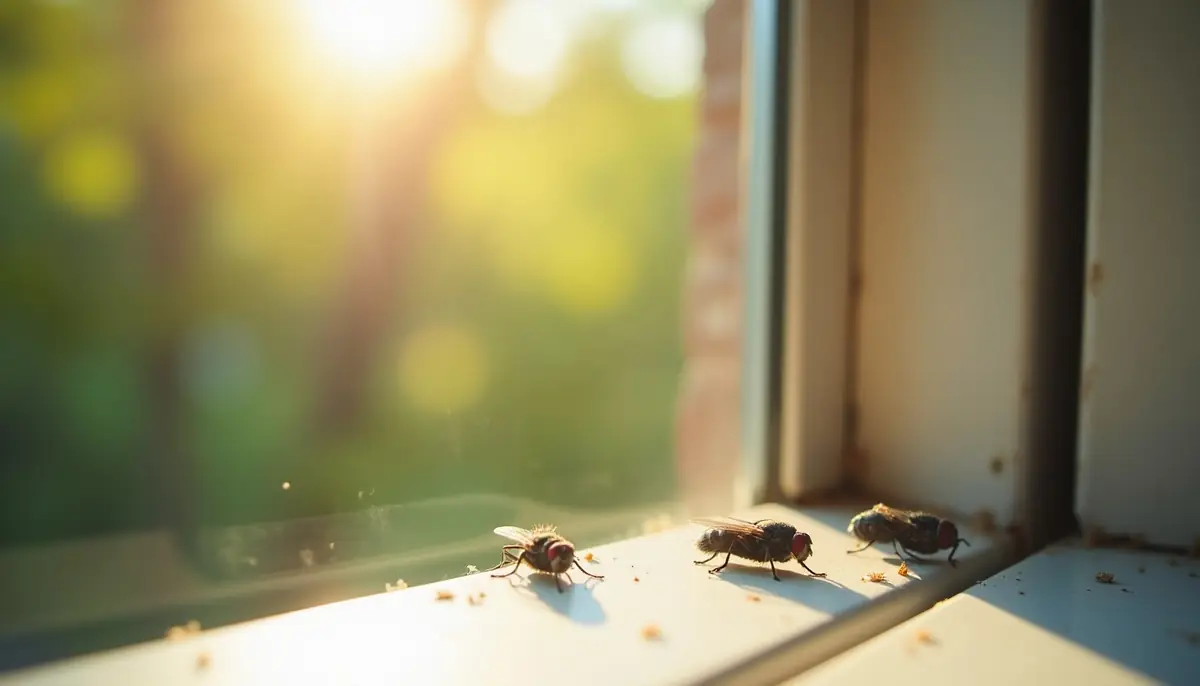
- Watch for flies. Large metallic green or blue flies, about a quarter to three-eighths of an inch long, are the best locator. Wisconsin’s lab says they detect the faint odours of death from long distances and often reach a dead animal within seconds. Flies gathering at one window point you to the right room. Our guide to flies in the house all of a sudden covers the fly wave in detail.
- Look for maggots and pupal cases. Iowa State Extension says the larvae feed on a carcass for 5 to 10 days, then wander off to find a dry place to pupate. Small pale maggots crossing a floor, or brown capsule-shaped puparia along a baseboard, point back towards the source.
- Look for stains. The active decay stage involves fluid leaking from the body, so a damp patch, a yellow-brown stain on a ceiling or drywall, or a darkened area of insulation is a strong sign.
- Check connecting spaces. Iowa State’s advice is to check for dead animals in the walls and attic as well as the room itself.
Our analysis of iNaturalist records shows why the fly clue works best in late summer and autumn and often fails in midwinter. On our seasonality index, where 100 is a taxon’s average share of all records, blow flies sit at 161 in September and 160 in October, then drop to 55 in December and 33 in January. A mouse that dies in a wall in January may smell for weeks with no flies at all.
Should you open the wall?
Usually not, at least not first. The wildlife damage centre does not recommend tearing a hole, because you can end up one stud away and need a second; it suggests a fibre optic scope through a small hole. Opening the wall makes sense with a confirmed location (stain, flies, scope sighting), a smell still strong after three weeks, or an animal larger than a mouse. When the body is behind finished walls, in a ceiling or in a chimney, a wildlife or pest professional is usually the faster route; our guide to wildlife removal costs shows what that typically involves.
Is inhaling dead mouse smell harmful?
For most people, no, though it can make you feel unwell. The Agency for Toxic Substances and Disease Registry says environmental odours are generally not toxic but can cause temporary symptoms such as headache and nausea, depending on concentration and how long you are exposed. It flags young children, pregnant women and people with asthma, COPD or emphysema as more at risk. The smell of one dead mouse will not poison or kill you.
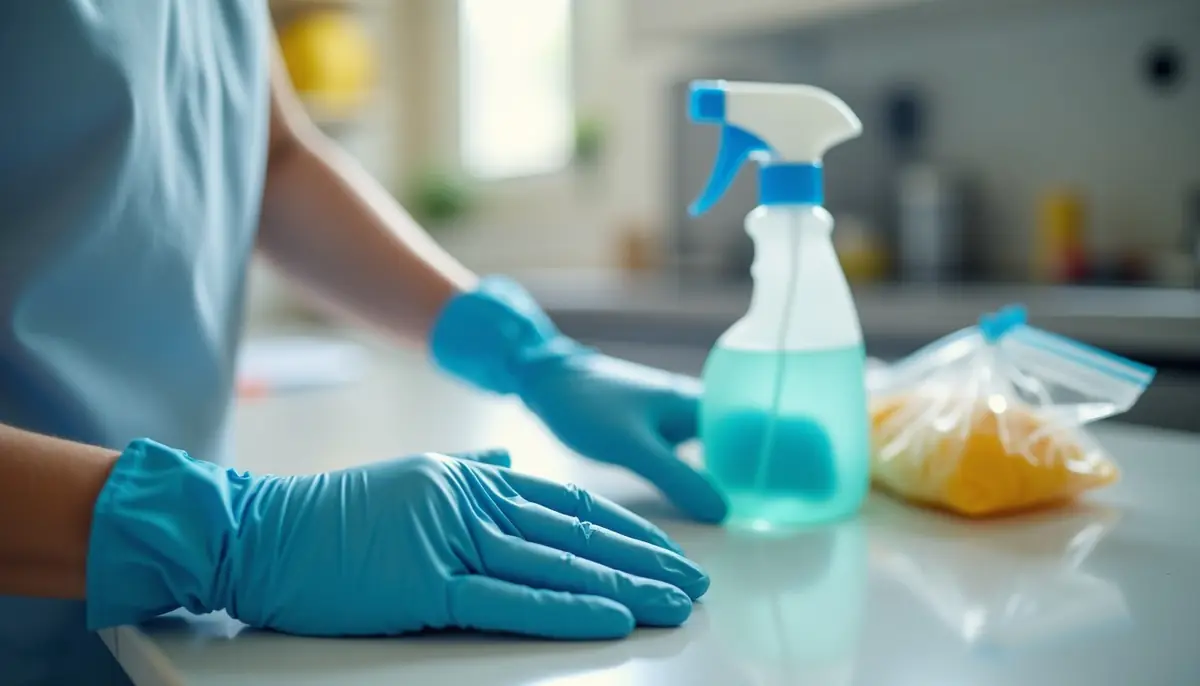
The real health issue is touching the carcass, not smelling it. The CDC says to wear rubber or plastic gloves, spray the rodent and area with disinfectant (or 1 part bleach to 9 parts water), soak for 5 minutes or as the label directs, double bag it with any used traps, put it in a covered bin and wash your hands after removing the gloves. Never sweep or vacuum droppings. The full method, and why deer mice raise the stakes, is in our hantavirus cleanup guide. If you feel unwell after handling a mouse or its droppings, speak to a doctor and say what you were doing.
Getting rid of the smell, with or without the mouse
Removing the body ends the smell fastest. Otherwise, move air and wait for the carcass to dry.
| Method | What the evidence says | Verdict |
|---|---|---|
| Remove the carcass and clean the spot | Wildlife damage centre: removing it makes the odour go away even faster | Best option when reachable |
| Ventilation: open windows, run an extractor or a fan blowing out | Wildlife damage centre: air flow dissipates the smell | Works, and speeds drying |
| Portable air cleaner with an activated carbon filter | EPA: activated carbon can be effective for gases provided there is a large amount of material, and filters need regular replacement | Helps in the affected room |
| Deodorant sprays and masking scents | Wildlife damage centre: any deodorant will do, choose one you like to smell, and take care because some can discolour surfaces | Makes waiting bearable |
| Enzyme or bacterial odour cleaners | Sold for organic stains; we found no extension or peer-reviewed trial of them on carcass odour | Reasonable on a reachable stain, unproven inside a wall |
| Ozone generators | EPA: few scientific studies support odour removal, and relatively low amounts of ozone can cause chest pain, coughing and throat irritation | Avoid |
Clean any reachable stain with disinfectant and let it dry. Nebraska Extension says bagged mice go in an outdoor trash container.
Why poison baits lead to dead mice in walls
Many “dead mouse in the wall” stories start with rodenticide. UC IPM says it will often result in house mice dying inside the structure, and advises deciding beforehand whether dead mice will cause an odour problem. Nebraska Extension calls predictions about where poisoned mice will die impossible, and the idea that they go outside for water “little more than hopeful speculations”. Mice that take a lethal dose begin dying in about five days, so the smell can appear a week or more after bait goes down. The wildlife damage centre advises avoiding poisons for mice for this reason.
Trapping is the fix: Nebraska notes it allows disposal of trapped mice, eliminating odours from carcasses. Our guide to mice in walls sets out the right order: trap first, then seal the gaps, so you do not wall mice in to die. If you already have a smell, it is worth confirming whether the rest of the population has gone too.
House mouse records on iNaturalist peak in October, matching UC IPM’s note that house mice frequently enter homes in autumn when nighttime temperatures become colder. Any baiting in response falls in the same months the fly clue starts to disappear.
Frequently asked questions
Can dead mouse smell make you sick?
It can make you feel ill for a while but is unlikely to harm you. The Agency for Toxic Substances and Disease Registry says environmental odours are generally not toxic but can cause temporary symptoms such as headache and nausea, especially in people with asthma, COPD or emphysema. The disease risk comes from touching the mouse or its droppings, so use gloves and disinfectant, and see a doctor if you feel unwell afterwards.
Does a dead mouse smell like fish?
Sometimes, yes. As rodent tissue decomposes it produces trimethylamine, which the US National Library of Medicine describes as smelling like rotten or decaying fish. In a 2018 study of rat tissue at about 61°F, trimethylamine kept rising until around day 8 and fell only after day 16. A fishy note that appears several days after the first smell of rot is consistent with a dead rodent.
Does dead mouse smell keep mice away?
There is no evidence that it does, and no extension source we read suggests it. The wildlife damage centre notes that chemical repellents of any kind are seldom practical for mice. A dead mouse in the wall tells you only that one mouse died; the rest may still be active. Look for fresh droppings and gnawing, and use the tests in our guide on how to tell if mice are gone.
Does dead mouse smell go away on its own?
Yes. The wildlife damage centre says the odour disappears as soon as the carcass dries out, and that larger carcasses take longer to dry. For one mouse that is usually one to three weeks. Warm, dry rooms with airflow shorten it; a cool, damp, sealed void with no flies can stretch it. Several dead mice after a poison treatment can keep it going longer.
Does a dead mouse smell like pee?
Not usually. A stale, musky, ammonia-like smell is the sign of live mice: UC IPM describes a characteristic musky odour that is common in large or long-term infestations. A dead mouse smells putrid and gets stronger day by day, often with sulphurous, faecal or fishy notes from compounds such as dimethyl disulfide, indole and trimethylamine. If both smells are present, you probably have dead mice and live ones.
Sources
- Guo, J. and others, Potential use of bacterial community succession for estimating post-mortem interval as revealed by high-throughput sequencing, Scientific Reports 6:24197, 2016.
- Li, W. and others, Trimethylamine in postmortem tissues as a predictor of postmortem interval estimation using the GC method, Legal Medicine 35:80 to 85, 2018.
- Tomberlin, J.K. and Adler, P.H., Seasonal colonization and decomposition of rat carrion in water and on land in an open field in South Carolina, Journal of Medical Entomology 35(5), 1998.
- Kotzé, Z. and others, Volatile organic compounds in variably aged carrion impacted by the presence of the primary colonizer, Cochliomyia macellaria, International Journal of Legal Medicine 135, 2021.
- Internet Center for Wildlife Damage Management, Smells: Identifying and Responding to Wildlife Odors; and House Mouse Damage Prevention and Control Methods.
- University of Nebraska Extension, Controlling House Mice, NebGuide G1105, revised 2012.
- University of California Statewide IPM Program, Pest Notes: House Mouse, Publication 7483, Quinn and Frye, updated July 2025; Pest Notes: Rats, Publication 74106.
- University of Wisconsin Insect Diagnostic Lab, Blow flies indoors, November 2022.
- Iowa State University Extension and Outreach, Yard and Garden: Blow and Flesh Flies.
- US Centers for Disease Control and Prevention, How to Clean Up After Rodents.
- Agency for Toxic Substances and Disease Registry, Environmental Odors.
- US Environmental Protection Agency, Guide to Air Cleaners in the Home, 2nd edition; and Ozone Generators that are Sold as Air Cleaners.
- US National Library of Medicine, MedlinePlus Genetics: Trimethylaminuria; and PubChem compound records for dimethyl disulfide and indole.
- Kansas Corporation Commission, Natural Gas Safety.
- The Pest Control Brief analysis of iNaturalist research-grade records, pulled October 2026.