Are Termites Attracted to Light? Swarmers, Porch Lights and Timing
Worker and soldier termites are not attracted to light, but winged swarmers are, and the ones you find around a porch light at night are almost always Formosan, Asian subterranean or dampwood termites. Native subterranean termites and western drywood termites fly in daylight, so they gather at bright windows instead of lamps. Workers are blind and live sealed inside soil, wood and mud tubes. Swarmers at a light mean a colony is nearby; swarmers inside, or piles of wings, point to one in the building.
The answer splits by caste, then by species. The table sorts the termites US homeowners meet by when they fly and whether they reach lights after dark.
Which termites fly to lights, species by species
| Termite | Where in the US | Flight season | Time of day | At porch lights after dark? | Source |
|---|---|---|---|---|---|
| Formosan subterranean (Coptotermes formosanus) | Gulf states and Southeast, Hawaii; rare in California | April to July; peak early to mid May in Louisiana | Dusk to about midnight | Yes, strongly | UGA B1209; LSU AgCenter; MSU P3999 |
| Asian subterranean (Coptotermes gestroi) | South Florida | February to April | Dusk or night | Yes | UF/IFAS EENY128 |
| Eastern subterranean (Reticulitermes flavipes) | Most of the eastern half of the US | February to April (mid February to mid May in Mississippi) | Daytime | No; indoors they go to windows | UGA B1209; MSU Extension |
| Dark and light southeastern subterranean | Southeast | April to June (dark); July to September (light) | Daytime | No | UGA B1209 |
| Western subterranean (Reticulitermes spp.) | California and the West | Spring or fall, after a soaking rain | Afternoon, clear days | No | UC IPM Pest Notes 7415 |
| Desert subterranean (Heterotermes aureus) | Sonoran Desert | Not given | Early evening | Yes | UC IPM Pest Notes 7415 |
| Western drywood (Incisitermes minor) | Southern California and desert areas; indoor flights in Florida | Late September to November in southern California; as early as May in Palm Springs | Daytime, sunny, 80 to 100°F | No, but alates move towards light | UF/IFAS EENY248; UC IPM Pest Notes 7440 |
| West Indian drywood (Cryptotermes brevis) | Florida | April to June, possible all year | Not stated in the UF profile | Not stated | UF/IFAS EENY079 |
| Florida dampwood (Neotermes spp.) | Florida | Several months; N. castaneus peaks late fall to early winter | Dusk or night | Yes | UF/IFAS EENY122 |
Compiled by The Pest Control Brief from University of Georgia Extension Bulletin 1209, LSU AgCenter, Mississippi State University Extension Publication 3999, UF/IFAS Featured Creatures EENY079, EENY122, EENY128 and EENY248, and UC IPM Pest Notes 7415 and 7440.
The rule: workers stay in the dark
The termites that eat wood never come out to a light. University of Georgia Extension Bulletin 1209 says workers are blind and probably only perceive changes in light intensity, and that termites quickly dry out when exposed to wind or dry air. That is why subterranean termites build mud shelter tubes, which UGA says protect them from drying air and from natural enemies such as ants. Soldiers are also wingless and blind.
So “are termites attracted to light or dark” has two answers: the colony lives in darkness, and only the winged alates leave it, for a few hours a year. Never seeing workers is normal; the University of Kentucky notes that damage can go undetected even in exposed wood because the outer surface usually stays intact, which is why the signs that separate an active infestation from old damage matter more than any sighting at a lamp.
The exception that fills porch lights: night fliers
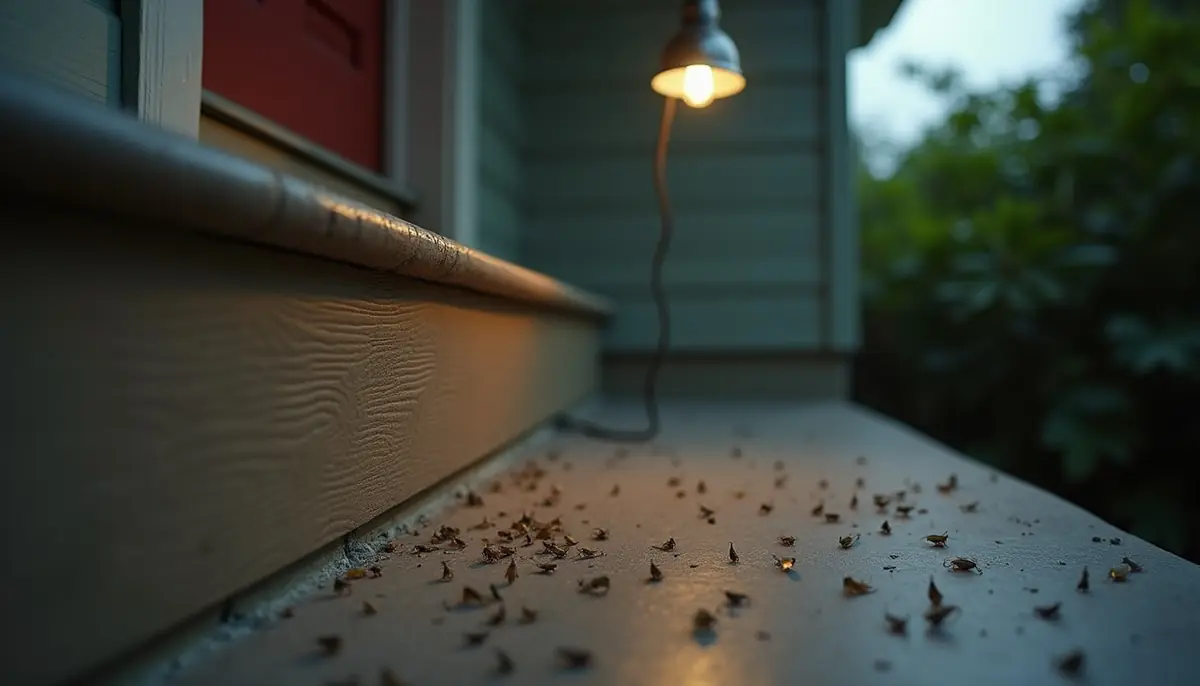
The termites seen in clouds around streetlights in New Orleans, coastal Mississippi and Honolulu in May are Formosan subterranean termites. UGA puts their flight from dusk until about midnight, April through July. LSU AgCenter entomologist Qian Sun writes that they prefer warm, humid, windless evenings and swarm in such numbers that thousands may hover around a single street light. Mississippi State says they emerge for a few hours after sunset, often after a daytime rain, and are highly attracted to light. The University of Hawaii Termite Project gives a shorter figure for each swarm, about half an hour, on warm, humid, nearly windless nights in May and June.
Formosan swarmers are about half an inch long including wings and yellow to golden brown, according to Mississippi State, which separates them from the smaller, dark brown to black native swarmers. Our guide to what workers, soldiers and swarmers look like has the full set of features.
Three less familiar termites behave the same way. UF/IFAS says Asian subterranean termites in South Florida fly at dusk or at night between February and April, and that porch lights, indoor lights and video monitors often attract the alates inside when doors and unscreened windows are open. UF says the same of Florida dampwood termites, which it calls relatively strong fliers. UC IPM adds the desert subterranean termite of southeastern California, which flies in the early evening and comes to lights.
Daytime fliers still head for the brightest window
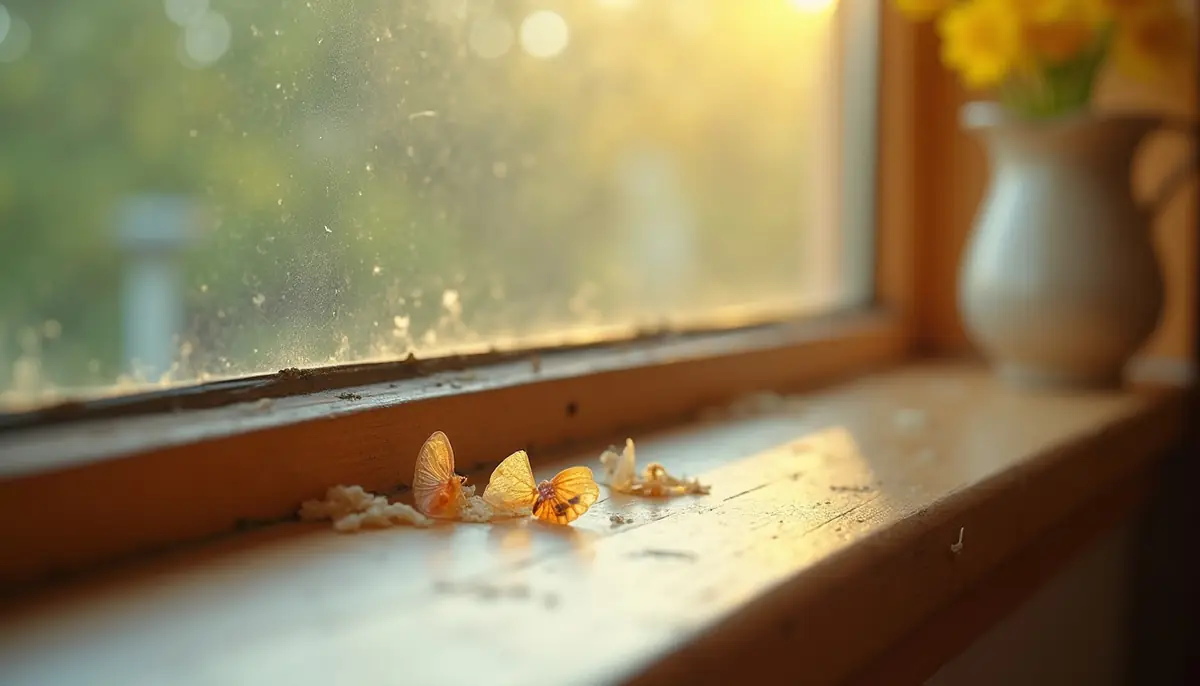
Native subterranean termites swarm in daylight, so they rarely reach a porch lamp, but light still steers them. The University of Kentucky says swarmers emerging inside a home are attracted to light and are often seen around windows and doors. A daytime swarm indoors therefore ends on the sills of the sunniest windows, where the dropped wings collect. Our explainer on why termites lose their wings covers what that wing pile tells you.
Western drywood termites are the clearest case. The UF/IFAS profile by Cabrera and Scheffrahn says the alates fly during the day, usually on bright, sunny days between about 80 and 100°F, emerge from exit holes in the wood and are attracted to light, which entomologists call positive phototaxis. In Florida, all recorded flights of this species were indoors and in daytime, with half of them in September, October or November. UC IPM uses the light response to tell two termites apart: dampwood termites also swarm in summer and fall but are larger and come to lights at dark.
Are termites attracted to light at night? What the records show
Our hour of day analysis of iNaturalist records, published in full in the piece on flying ants at night, gives the same split. Of 699 timed Formosan termite records from April to June, 81 per cent were logged between 7 pm and 6 am. Native subterranean termites from March to May were the reverse, at 5.5 per cent. Drywood termite records from August to October sat in between, mostly afternoon. The chart below shows the evening share for all three.
These are the times people recorded termites, not a count of flights, but they match the extension descriptions. If winged insects are at your light at 9 pm in May anywhere along the Gulf, a Formosan flight is the first thing to rule out. A swarm of dark insects at noon in March is far more likely to be native subterranean termites or ants; the differences in antennae, waist and wings are set out in our guide to telling termites from flying ants.
What swarmers around a light mean for your house
Outdoors, swarmers at a light say a colony is within flying range, not necessarily in your walls. LSU AgCenter says swarming termites are poor fliers that usually travel no more than half a mile, and that a few crawling in a bathroom or kitchen after entering through a vent is common. Termites flying indoors, or a large number of wings inside, mean an active infestation in the house is quite likely. The University of Kentucky says indoor swarmers live for about a day and cannot damage wood.
- A handful at an outdoor light in May, nothing inside: record the date and check for the moisture and wood contact that attract termites around the foundation.
- Several inside one evening, no mud tubes: LSU’s Mark Carriere says there is not much to worry about and they can be vacuumed up; the guide to finding a single termite swarmer indoors explains what to check next.
- Swarmers emerging from a wall, ceiling or floor, or wings in quantity: call a licensed professional, as Mississippi State advises. A termite inspection and WDI report is the usual first step.
- Dead swarmers on sills the next morning: read our notes on what dead termites around the house indicate.
How to keep swarmers away from your lights
Extension advice is consistent and simple. LSU AgCenter recommends turning off outdoor lights at night in May and June during Formosan season, and closing blinds or curtains so indoor light does not draw swarmers to windows. Mississippi State calls keeping outdoor lights off and blinds closed the best way to deter Formosan swarmers. Window screens and shut doors after dusk follow from the UF/IFAS note that alates enter through open doors and unscreened windows.
No US extension source we read tests bulb colours, so claims that yellow or blue light keeps termites away cannot be checked against them; switching lights off is what they recommend.
None of this stops an infestation. LSU’s Qian Sun writes that killing swarmers in or around the house does not provide much protection from further termite activity, because the damage is done by the workers. The month each termite species swarms tells you when to switch the lights off; protection comes from inspection and treatment.
Frequently asked questions
What is a termite’s worst enemy?
Ants. University of Georgia Extension says subterranean termites build mud shelter tubes partly to protect themselves from natural enemies such as ants, and that soldiers use their mandibles mainly against ants. UC IPM adds that most swarmers die during the flight to birds, lizards, ants and other insects. Predators thin the swarm but do not remove a colony from a house.
Which smell do termites hate?
No extension source we read names a smell that keeps termites out of a home. Orange oil, whose active ingredient is d-limonene, is the one most often sold for this, and UC IPM notes that lab and field tests at two universities question its efficacy against drywood termites. Our page on home remedies for termites and what kills them scores the alternatives.
Do termites ever just go away?
Not on their own. Swarmers die within about a day, but the colony stays in the soil or wood. LSU AgCenter says Formosan colonies can survive for decades, and the University of Kentucky says do it yourself products seldom eradicate an existing infestation. A licensed professional treatment is the usual answer once termites are confirmed in a structure.
What kills termites instantly naturally?
Nothing natural kills a colony instantly. Exposed workers dry out quickly, as University of Georgia Extension notes, but that only kills the termites you can see. Heat is the main nonchemical treatment for drywood termites: UC IPM says wood must reach at least 120°F and be held for at least 33 minutes, which is a professional job, not a home method.
Are termites attracted to light in the house?
Swarmers are. The University of Kentucky says swarmers that emerge indoors head for light and gather around windows and doors, and UF/IFAS says indoor lights and video monitors draw night fliers in through open doors. Workers avoid light entirely. Swarmers coming from inside walls or floors are a sign of an infestation in the building.
Sources
- University of Georgia Extension. Biology of Subterranean Termites in the Eastern United States, Bulletin 1209 (Suiter and colleagues), reviewed 2024.
- LSU AgCenter. Preparing for the Termite Swarms, Qian Sun, 2021.
- LSU AgCenter. Termites Begin to Swarm, Mark Carriere, 2023.
- Mississippi State University Extension. Pest Snapshot: Formosan Subterranean Termite, Publication 3999, 2024.
- Mississippi State University Extension. Protect property from heavy termite swarms, May 2026; Formosan termite swarms threaten large part of state, 2024.
- University of Hawaii, CTAHR Termite Project. Alate Project.
- UF/IFAS Featured Creatures. Western Drywood Termite, Incisitermes minor, EENY248 (Cabrera and Scheffrahn).
- UF/IFAS Featured Creatures. Asian Subterranean Termite, Coptotermes gestroi, EENY128 (Scheffrahn and Su).
- UF/IFAS Featured Creatures. Florida Dampwood Termites, Neotermes spp., EENY122 (Scheffrahn).
- UF/IFAS Featured Creatures. West Indian Drywood Termite, Cryptotermes brevis, EENY079 (Gordon, Scheffrahn and Su), 2021.
- University of California IPM. Pest Notes: Termites, Publication 7415.
- University of California IPM. Pest Notes: Drywood Termites, Publication 7440.
- University of Kentucky Entomology. Termite Control, ENTFACT 604.
- The Pest Control Brief analysis of iNaturalist research-grade records, pulled October 2026 (b19 to b30 files) and November 2026 (b35 hour files).