Raccoon in the Garage: How to Get It Out Safely Tonight

To get a raccoon out of your garage, open the main door fully before dusk, keep people and pets away, leave the lights and floor clear, and let it walk out on its own after dark, then close the door. Raccoons are nocturnal and usually leave at nightfall to feed. Sprinkle flour across the threshold, as Paterson, New Jersey’s animal control advises, so you can see the tracks going out before you shut it. If it stays put night after night between March and June, assume a mother with young and do not seal anything yet.
The biggest mistake is chasing or cornering it in daylight. UC IPM warns that raccoons can become vicious when cornered, and an adult weighs 7 to 30 pounds. Your job tonight is to make leaving easy.
What you found, and what to do about it tonight
| What you see | Most likely meaning | What to do |
|---|---|---|
| A raccoon in the garage at night with the door open | Foraging: bins, pet food or birdseed | Back away, leave the door open, let it finish and go; store the food in sealed metal bins tomorrow |
| A raccoon curled up on a shelf or in boxes by day | Resting for the day after a night out | Open the door before dusk, keep pets in, check the flour for tracks after dark |
| Chirring, squealing or chattering from rafters or a storage corner, March to June | Probably a nursing female with kits | Do not block her route; see the litter section below |
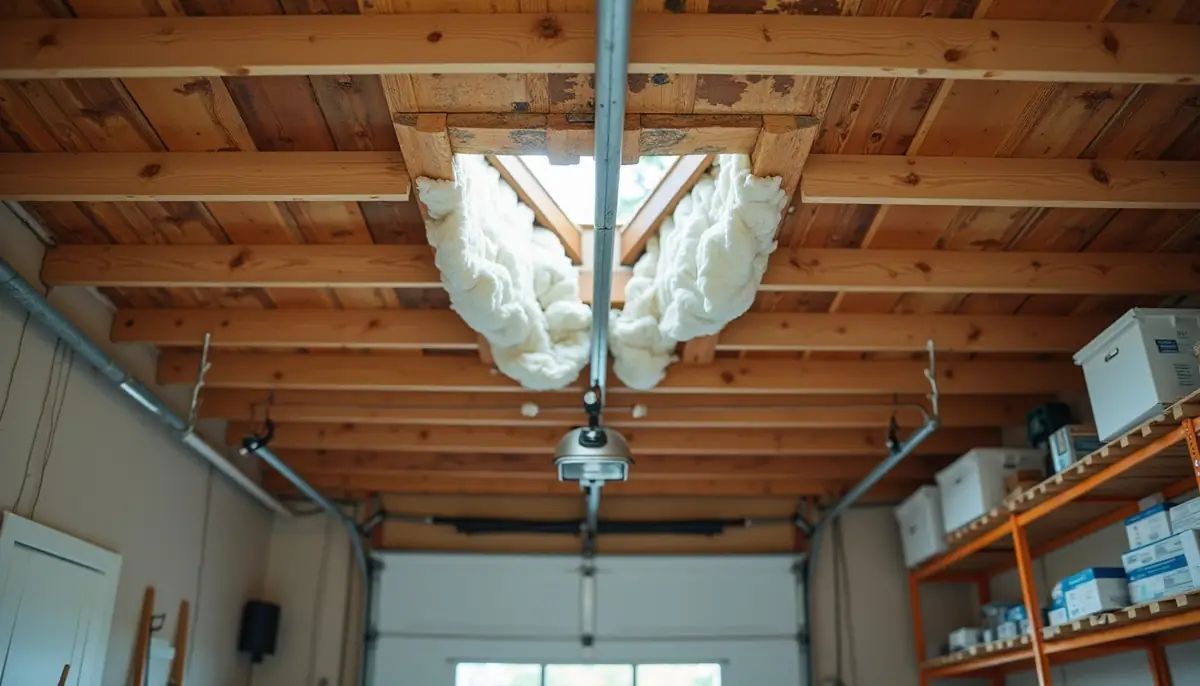
| Noise above a garage ceiling, nothing seen on the floor | Denning in the ceiling void, often reached from the roof | Find the outside entry; a ceiling den is usually a job for a licensed wildlife control operator |
| Droppings piled in one spot | A latrine; raccoons reuse the same place | Do not sweep dry; check it against our droppings identification guide, then follow the CDC steps below |
| Staggering, circling, unusually tame or aggressive | Possibly sick (rabies or distemper look alike) | Keep everyone away and call animal control |
Getting it out: the four-step evening routine
- Clear the path. Bring children and pets indoors and move anything blocking the route to the door.
- Open the main door before dusk and leave it open. Raccoons usually move after dark, so it is the door left open through the evening that matters.
- Dust the threshold with flour. Paterson’s animal control fact sheet gives exactly this method: open the door before dusk, sprinkle flour underneath, watch for footprints leaving, then close the door. A hand-like print pointing outwards is the sign you want.
- Close up the same night and fix the reason it came in. The New York State Department of Environmental Conservation (DEC) puts it simply: keep garage, shed and basement doors closed, because crowded storage areas offer many attractive nooks for a nesting raccoon.
Will raccoons eventually leave on their own? A foraging or resting adult usually will, within a night or two, once the door is open and the food is gone. A mother with kits will not: the DEC warns that once raccoons have young, it is extremely difficult to convince them to vacate.
Baby raccoons in the garage: read the calendar first
Raccoons mainly breed in February or March, gestation lasts about 63 days, and most litters are born in April or May, according to the Internet Center for Wildlife Damage Management (ICWDM). Late litters can arrive in June, July or August. The New York DEC gives the raccoon nesting period as March to June. A garage visitor that keeps coming back in spring is very often a female looking for a den, and the storage loft, a stack of boxes or the void above the ceiling are all candidates.
Sources differ a little on when the young can follow her. The Pennsylvania Game Commission says eyes open after about 19 days and kits start short trips with the mother at about four weeks. Connecticut’s Department of Energy and Environmental Protection (DEEP) says young leave the den at around 8 weeks; NYC Parks and Health say 8 to 12 weeks. So a spring garage den usually clears itself within two to three months, often sooner.
If you cannot wait that long
Connecticut DEEP lists light, a portable radio and vinegar or ammonia odours as ways to encourage eviction, and Paterson notes that mothers typically move their young in response to that kind of harassment. Put the radio near the den, never across the exit, and confirm with the flour check that she has gone. If you then hear crying, open up again or call a licensed operator; UC IPM stresses that young must not be left behind to starve. Our guide to removing raccoons from attics, chimneys and decks once the young are mobile covers one-way doors and timing.
What not to do with a raccoon in the garage
- Do not touch it or try to pick up a kit. CDC names raccoons among the common rabid animals in the US and advises keeping your distance from wildlife and never approaching animals that appear injured, sick or dead.
- Do not judge it by the time of day. A raccoon in the garage at noon is not proof of rabies; the NY DEC notes nocturnal animals do come out by day, often, especially when they have young to feed. Our explainer on what a raccoon out in daylight usually means lists the behaviours that do matter.
- Do not rely on mothballs. UC IPM reports that mothballs and other home remedies have been tried against raccoons to no avail, and using them outside their label directions is illegal; see why mothballs are dangerous off-label.
Can you trap and move it? Four rule sets compared
Compiled by The Pest Control Brief from the named state and city agencies. Rules vary by state and change, so check with your own state wildlife agency before setting a trap.
| Jurisdiction | Relocating a trapped raccoon | What the rule allows instead | Source |
|---|---|---|---|
| New York State | Not allowed: you may not live-trap wildlife, transport it off your property and release it elsewhere | Raccoons may be destroyed on your property if causing damage, a nuisance or a health concern; licensed nuisance wildlife control operators | NYS DEC, Nuisance Wildlife fact sheet |
| New York City | Licensed trappers must humanely euthanize trapped raccoons and may not release them into parks or public property | Homeowners may destroy raccoons that damage property; remove food and shelter first | NYC Parks and Health, WildlifeNYC: Raccoons |
| Connecticut | Not allowed under state law | Release on site after openings are closed, or humane euthanasia; licensed operators | CT DEEP, Raccoon Nuisance Problems |
| California | Prohibited without written permission of the Department of Fish and Wildlife | Hire a professional wildlife control operator | UC IPM Pest Notes: Raccoons, 74116 |
Paterson’s fact sheet adds a practical warning: if you trap a raccoon, animal control can only release it back on your property, and the resident is responsible for the trapped animal.
Cleaning up after it: the garage latrine
CDC lists garages, along with decks, rooftops and attics, among the places raccoon droppings are found. The concern is raccoon roundworm (Baylisascaris procyonis), whose eggs take at least 2 to 4 weeks to become infective, so prompt removal reduces the risk. CDC advises disposable gloves, an N95 respirator in a confined space, lightly dampening the area so dust does not spread, and removing feces to be burned, buried or sent to landfill. Most chemicals do not kill the eggs; heat does, but a propane torch is a poor idea near stored fuel, so use boiling water on concrete. The full method is in our guide to identifying a raccoon latrine and cleaning it safely.
Keeping raccoons out of the garage
Raccoons come in for food and shelter. Removing the food matters more than any deterrent.
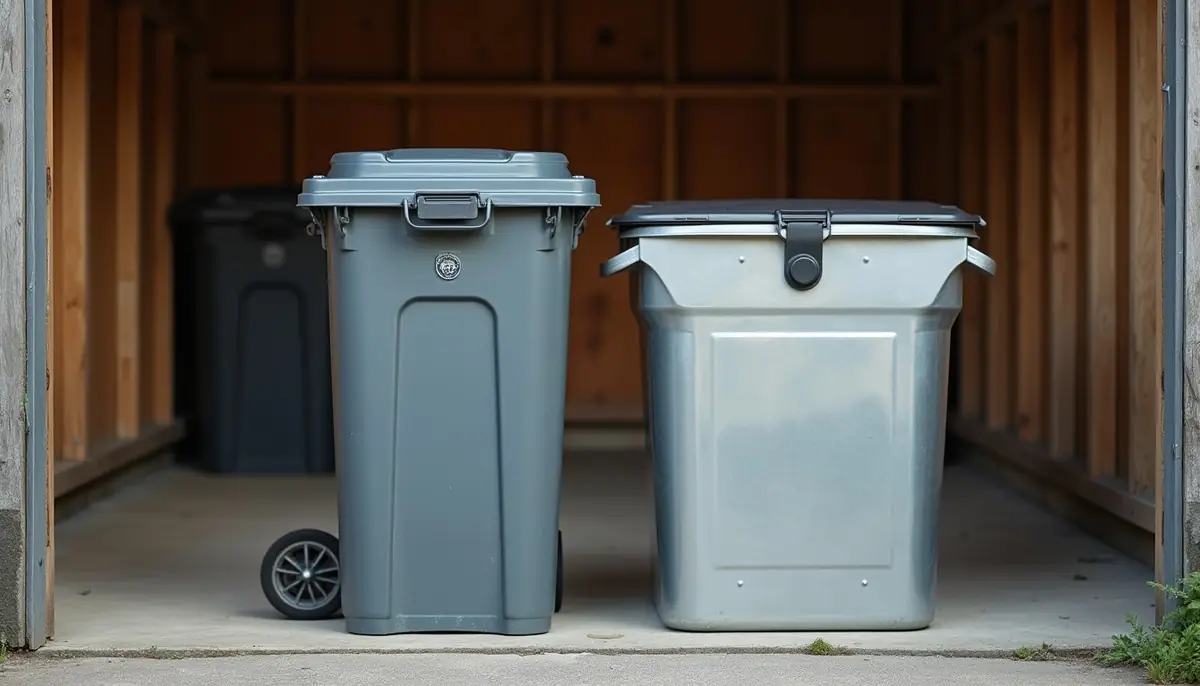
- Bins: metal cans with tight lids, secured with a bungee cord or wire (UC IPM). Connecticut DEEP suggests keeping cans in the garage, which only works if the door stays shut at night.
- Pet food and birdseed: store in sealed metal containers and bring outdoor pet bowls in before nightfall, as UC IPM advises.
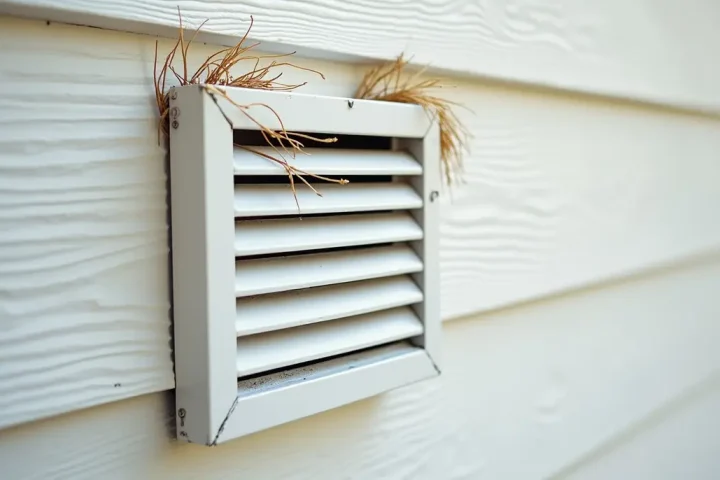
- Gaps: ICWDM says raccoons need only a 4 inch gap. Check the bottom corners of side doors, gaps beside the main door and holes into the ceiling void. For vents and openings, UC IPM specifies 10 gauge galvanised hardware mesh with 1/4 or 1/3 inch openings; our home exclusion guide covers the rest of the house.
- The door itself: the most reliable fix is closing it at dusk. Paterson’s fact sheet notes raccoons wander in, usually in spring or summer, when the door is left open for a long period.
Gadgets do not hold up: UC IPM says frightening devices work for a few days before raccoons learn there is no threat. Small droppings and low gnawing point to rodents instead; compare the signs in our guide to rats in the garage.
When to call a professional, and what it costs
Call a licensed wildlife control operator if the raccoon is in the ceiling void, if young are present and you cannot wait, if there is a large latrine, or if the animal seems sick. Published estimates on our wildlife removal cost guide put raccoon removal at $300 to $450, an inspection at $100 to $300 (usually credited against the job), and each additional exclusion door at $225 to $400. Those are estimates, not measured prices, and a quote for trapping without sealing the gap pays for the problem to come back.
Opossums wander into open garages at night too and leave the same way; our guide to getting opossums out from under decks and sheds covers the differences.
Frequently asked questions
How do I get rid of a raccoon in my garage?
Open the main garage door before dusk, keep pets and people away, and let the raccoon leave on its own after dark. Sprinkle flour at the threshold to confirm outgoing tracks, then close the door and move bins, pet food and birdseed into sealed metal containers. If it stays for several nights between March and June, assume it has young and wait or call a licensed operator.
Will raccoons eventually leave on their own?
A foraging or resting adult usually leaves within a night or two once the door is open and food is gone. A mother with kits stays until the young can travel: Connecticut DEEP puts that at about 8 weeks and New York City at 8 to 12 weeks. Sealing her out before then can trap the young inside.
Should I be worried about a raccoon in my yard?
Usually not. UC IPM says an occasional visit by a raccoon or family may not be cause for major concern, but if visits become commonplace and raccoons are climbing on your roof, some action is probably warranted. Remove outdoor pet food and secure bins, keep pets vaccinated, and call animal control only if one staggers, circles or acts unusually tame or aggressive.
What is a raccoon’s worst enemy?
People and dogs. The Pennsylvania Game Commission names humans and dogs as the main enemies of adult raccoons, while owls, foxes, fishers and bobcats may take young that stray from the mother. That is why decoy owls do little to an adult raccoon, and why a dog left out at night risks being injured by one.
Sources
- University of California Statewide IPM Program, Pest Notes: Raccoons, Publication 74116 (R.A. Baldwin).
- Internet Center for Wildlife Damage Management, Raccoons: Biology, Damage Identification, and Damage Prevention and Control Methods, based on E.K. Boggess, Prevention and Control of Wildlife Damage (1994).
- New York State Department of Environmental Conservation, Bureau of Wildlife, Nuisance Wildlife: problems and strategies (fact sheet, rev. 2013).
- NYC Parks and NYC Health, WildlifeNYC: Raccoons.
- Connecticut Department of Energy and Environmental Protection, Raccoon Nuisance Problems.
- Pennsylvania Game Commission, Wildlife Notes: Raccoon.
- City of Paterson, New Jersey, Animal Control, raccoon self-help fact sheet.
- CDC, Preventing Baylisascaris Infection (raccoon roundworm).
- CDC, Preventing Rabies.