Bee Removal Cost 2026: Relocation vs Extermination
Bee removal averages $180. Relocation runs $100 to $400 and a cutout $400 to $1,500. A beekeeper will often take an accessible swarm for free.
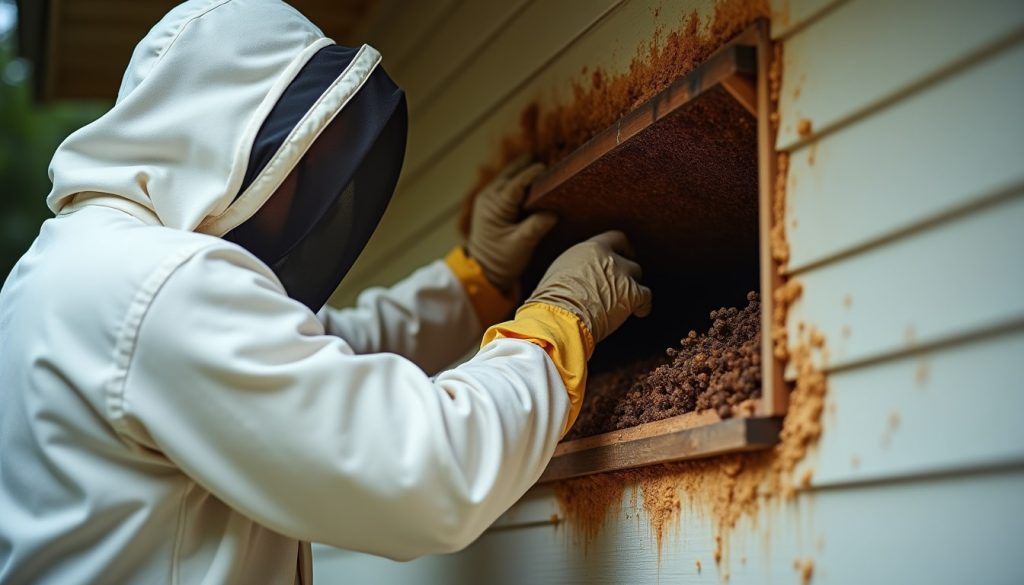
Bee removal costs $180 on average, with most jobs between $150 and $500 and a full reported range of $135 to $1,065. Live relocation typically runs $100 to $400 and extermination $150 to $1,000. A cutout of an established hive inside a structure costs $400 to $1,500. A local beekeeper will often take an accessible swarm for free.
Bees are the one household stinging insect where the cheapest option and the responsible option are usually the same. That is unusual, and it is worth knowing before you call a general pest control company.
What bee removal costs in 2026
| Service | Cost | When it applies |
|---|---|---|
| Swarm collection by a beekeeper | Often free | Accessible swarm, not yet established |
| Live relocation | $100 to $400 | Depends on hive size and location |
| Extermination | $150 to $1,000 | Where relocation is impractical |
| Cutout of established hive | $400 to $1,500 | Hive inside a wall or roof structure |
| Overall average | Around $180 | Most jobs $150 to $500 |
Contractor-reported ranges compiled by home services and beekeeping sources in 2026, not government statistics.
Bees are not wasps, and the price reflects it
General pest control companies frequently decline honey bee work or refer it to a beekeeper. That is not evasion, it is the correct call, and understanding why saves you money.
| Honey bees | Wasps and hornets | |
|---|---|---|
| Default approach | Relocation where practical | Extermination |
| Who handles it | Beekeeper or bee removal specialist | Pest control company |
| Typical cost | Free to $400 for relocation | $300 to $700, up to $1,300 |
| Structure left behind | Comb and honey, must be removed | Paper nest, minor residue |
| Nest reuse | Colony persists year to year | Abandoned after first frost |
If what you have is a paper nest under an eave or a ground nest that turns aggressive when mown near, that is wasp work. Our guide to wasp nest removal costs covers it.
The part people skip: removing the comb
Killing a colony inside a wall without removing the hive creates a second, worse problem. An established colony holds honey. With the bees gone there is nothing maintaining hive temperature or defending the comb, so honey can ferment, seep through plasterboard and stain interior finishes, and the abandoned comb attracts secondary pests.
This is why a cutout costs $400 to $1,500 while a spray costs less. The cutout price includes opening the structure, removing comb and honey, and closing up. It is the actual job.
- Ask whether the quote includes comb removal or is treatment only.
- Ask how the entry will be sealed, since residual hive scent attracts future swarms to the same cavity.
- Ask who repairs the opening made to reach the hive, and whether that is included.
- For a swarm rather than an established hive, call a beekeeper first. A swarm hanging in a tree or on a fence has no comb and is often collected free.
Swarm or established colony
The distinction determines both the price and who you should call. A swarm is a cluster of bees in transit, typically hanging in the open with no comb built, and it may move on within a day or two. An established colony has built comb inside a cavity and will not leave.
Swarms are the free or cheap case. Established colonies inside a structure are the expensive case, and the longer one is left the more comb there is to remove.
Frequently asked questions
How much does bee removal cost?
Bee removal averages around $180, with most jobs between $150 and $500 and a reported range of $135 to $1,065. Live relocation costs $100 to $400 and extermination $150 to $1,000. A cutout of a hive established inside a wall or roof runs $400 to $1,500.
Will a beekeeper remove bees for free?
Often, for an accessible swarm that has not yet built comb, since a beekeeper gains a colony. An established hive inside a structure is different: it requires opening the building and removing comb, which is skilled work and is charged accordingly, typically $400 to $1,500.
Should bees be relocated or exterminated?
Relocation is generally preferred where practical, is often cheaper at $100 to $400 against $150 to $1,000, and preserves pollinators. Where a colony is deep inside an inaccessible structure, relocation may not be feasible. Many general pest control companies refer honey bee work to a beekeeper rather than treating it.
What happens if you kill bees inside a wall?
The comb and honey remain. With no colony maintaining it, honey can ferment and seep through interior finishes, and abandoned comb attracts secondary pests. This is why a cutout, which includes opening the structure and removing comb, costs more than a treatment. Residual hive scent also attracts future swarms unless the cavity is properly sealed.
Sources
- Contractor-reported price ranges compiled by This Old House, Angi, HomeGuide, Lawn Love and beekeeping sources, 2026. Sample sizes and methods are not published by those sources.
- U.S. Bureau of Labor Statistics, Producer Price Index programme. Confirmed no published series for NAICS 561710.