Carpenter Bee vs Bumble Bee: The Shiny Abdomen Test
Look at the top of the abdomen: a carpenter bee’s is bare, shiny and black, while a bumble bee’s is covered in hair, usually with yellow bands. Carpenter bees drill perfectly round half-inch holes in bare wood and live alone; bumble bees live in colonies of 50 to 400, usually in the ground. Male carpenter bees, the ones that hover in your face by the deck, have no stinger at all. Female carpenter bees rarely sting, while bumble bees will sting repeatedly if their nest is disturbed.
The two are the same size, the same colours on the front half and active in the same months, so most people go by gut feeling. Penn State’s extension entomologists put the deciding feature plainly: the top of the carpenter bee’s abdomen is without hairs and shiny black, while the bumble bee’s abdomen is fully clothed with hairs, many of them yellow. Once you look at the back end rather than the front, the confusion usually ends.
Carpenter bee vs bumble bee at a glance
| Eastern carpenter bee | Bumble bee | |
|---|---|---|
| Abdomen (the back half) | Bare, shiny, glossy black | Fuzzy, black with yellow (sometimes orange) hair bands |
| Thorax (the middle) | Yellow hair | Yellow and black hair |
| Head | Broad, shiny; males have a yellow or white face patch, females an all-black face | Narrower than the thorax, hairy face |
| Length | About three quarters of an inch to 1 inch | Up to about 1 inch; workers vary widely within a colony |
| Social life | Solitary, but many females may nest in the same area | Colony of 50 to 400 with a queen |
| Nest | Tunnel in bare or weathered wood: eaves, fascia, decks, fences | Ground cavity: old rodent burrows, compost, grass piles, insulation |
| Typical sign | Round hole about half an inch across, sawdust below | Bees flying in and out of a hole near the ground |
| Males sting? | No stinger | No stinger |
| Females sting? | Rarely, usually only if handled | Yes, repeatedly, when the nest is threatened |
| Damage | Wood, plus woodpecker damage as birds hunt the larvae | None to the house |
| Winter | Adults hibernate in the tunnels | Colony dies; only new queens overwinter |
How can I tell the difference between a carpenter bee and a bumblebee?
Use these checks in order. The first one is usually enough.
- The shine test. Look at the abdomen from above. Mirror-shiny black with almost no hair means carpenter bee. Fuzzy with yellow bands means bumble bee. The University of Georgia describes the carpenter bee as metallic black with a glossy, hairless abdomen.
- The face. Ohio State notes the female carpenter bee has an entirely black head, while the male has yellow or white markings on the face. A bumble bee’s face is hairy, and Ohio State adds that its head is much narrower than the width of its thorax, whereas a carpenter bee’s head looks broad and shiny.
- Where it goes. A bee that disappears into a round hole in a fascia board, deck rail or fence is a carpenter bee. A bee that goes into the lawn, a bank, a compost pile or the base of a shed is far more likely a bumble bee, or one of the ground-nesting bees.
- What it does. Penn State notes that male carpenter bees hover near nests and dart after any other flying insect that enters their territory, sometimes approaching people. A bee hovering on guard by the eaves in spring is usually a male carpenter bee.
Carpenter bee vs bumble bee size
Size does not separate them. Ohio State and Clemson give eastern carpenter bees as about three quarters of an inch to 1 inch long, roughly 19 to 25 mm. Texas A&M gives bumble bees as 15 to 25 mm, and Ohio State’s bee identification guide records bumble bees from 8 to 21 mm, because workers within one colony vary a lot. A large bumble bee queen in spring and a carpenter bee are effectively the same length. Some popular sites give bumble bees as up to an inch and a half; none of the extension guides we read supports that.
Carpenter bee vs bumble bee face
The face is the quickest way to sex a carpenter bee. Cornell describes males as having a yellow patch on the face; Clemson calls it white markings on the head. That pale-faced bee hovering at eye level by your porch is a male, and it cannot sting.
Do carpenter bees sting or bite you?
Males cannot sting. Cornell, Clemson, Penn State and the University of Georgia all state it: the male has no stinger, because a stinger is a modified egg-laying organ, and only females have one. Cornell describes males as hovering near female nest sites, chasing off other males and sometimes mock-attacking people. It is bluster.
Females can sting, but seldom do. Penn State says the female must be extremely provoked, meaning handled, before she will sting. Ohio State describes females as docile, stinging only if handled, and notes they can sting more than once. In practice that means a sting usually comes from grabbing a bee or pressing one against skin.
As for biting, carpenter bees chew wood with their jaws to make their tunnels, but none of the extension sources we read describes them biting people. The hovering male that bumps your head is defending territory, not biting.
Are bumble bees or carpenter bees more aggressive?
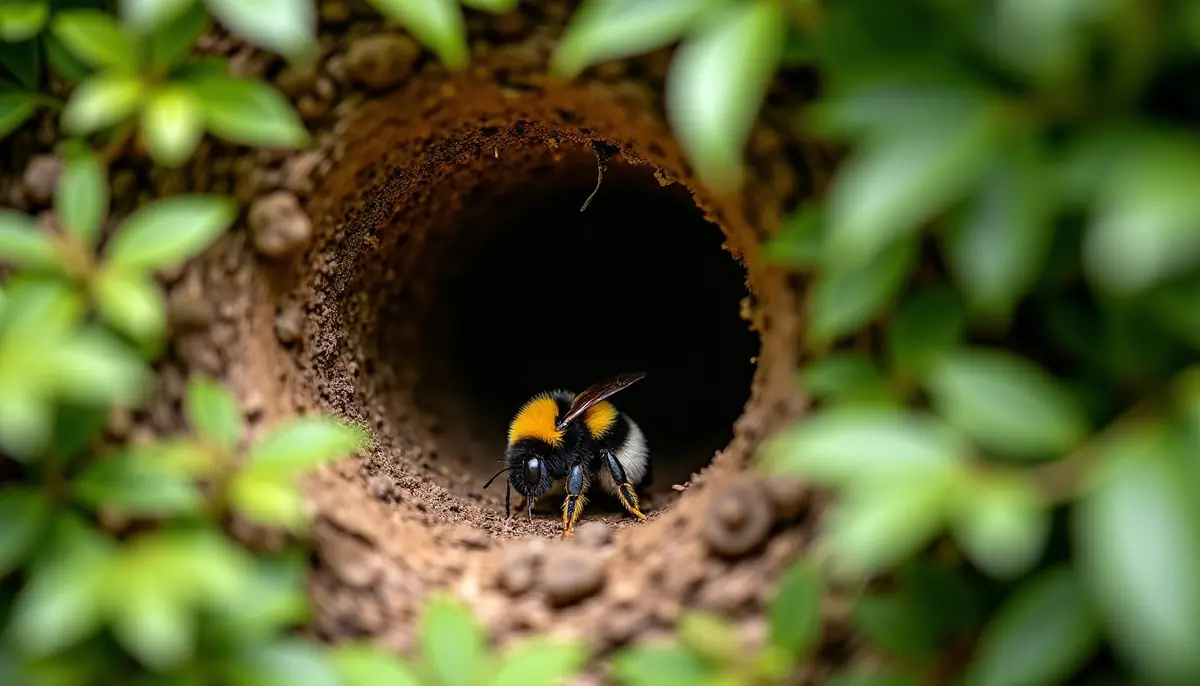
Neither is aggressive away from the nest, but if you are going to be stung, a bumble bee is the more likely culprit. Cornell describes bumble bees as docile when alone and notes they do not sting unless they perceive danger to themselves or the hive. The trouble comes when a colony is disturbed: Cornell says a severe sting event is most likely when a mower or weed trimmer runs over the nest, and that unlike honey bees, bumble bees can sting repeatedly, like wasps. Texas A&M says the same, adding that most stings happen when a nest is disturbed rather than during foraging. Cornell also notes stings happen when a bee is stepped on with bare feet, and advises against walking barefoot on lawns with clover where bees forage.
Carpenter bees look more aggressive, because of the hovering males, but carry far less risk.
| Situation | Carpenter bee risk | Bumble bee risk |
|---|---|---|
| Pale-faced bee hovering at face height by the deck | None: it is a male with no stinger | Not a bumble bee behaviour to worry about |
| Bee on a flower you brush past | Very low | Low |
| Picking a bee up, or one trapped in clothing | A female may sting | May sting, and can sting repeatedly |
| Mowing or trimming over a nest | Not applicable; nests are in wood | Highest risk: several bees may sting repeatedly |
| Barefoot on a clover lawn | Very low | Stings happen when a bee is stepped on |
Anyone with a known allergy to bee venom should treat any sting seriously and have an emergency plan agreed with a doctor.
When each one is about: what iNaturalist records show
We analysed US research-grade iNaturalist records for the eastern carpenter bee, Xylocopa virginica, and bumble bees, genus Bombus. The chart shows each one’s monthly share of all records, scaled so its yearly average is 100, which removes the effect of more people recording in summer.
Carpenter bees jump early: their index is 82 in March and 124 in April, when bumble bees are only at 29 and 49. That matches the extension timetable: Clemson says adult carpenter bees emerge in spring, in April and May, when males start hovering and females start drilling. Carpenter bees then dip to 89 in June, while the next generation develops inside the wood, and surge to 189 in August and 239 in September. Penn State says new adults emerge in August and feed on nectar before returning to the tunnels to overwinter.
Bumble bees build steadily as colonies grow, to 154 in June and a peak of 252 in July, then fade as colonies die off in autumn; by November they are down to 28.
Measured as each bee’s share of its own records, 29.9 per cent of carpenter bee records fall in March to May, against 15.3 per cent for bumble bees. Bumble bees put 39.6 per cent of their records into June and July. So a big bee hovering around the eaves in April is very likely a carpenter bee, and a big fuzzy bee on July flowers very likely a bumble bee. These are records of when people photographed and identified each bee, mostly outdoors, so they show when each is noticed, not how many nest on a given house.

Are carpenter bees bad?
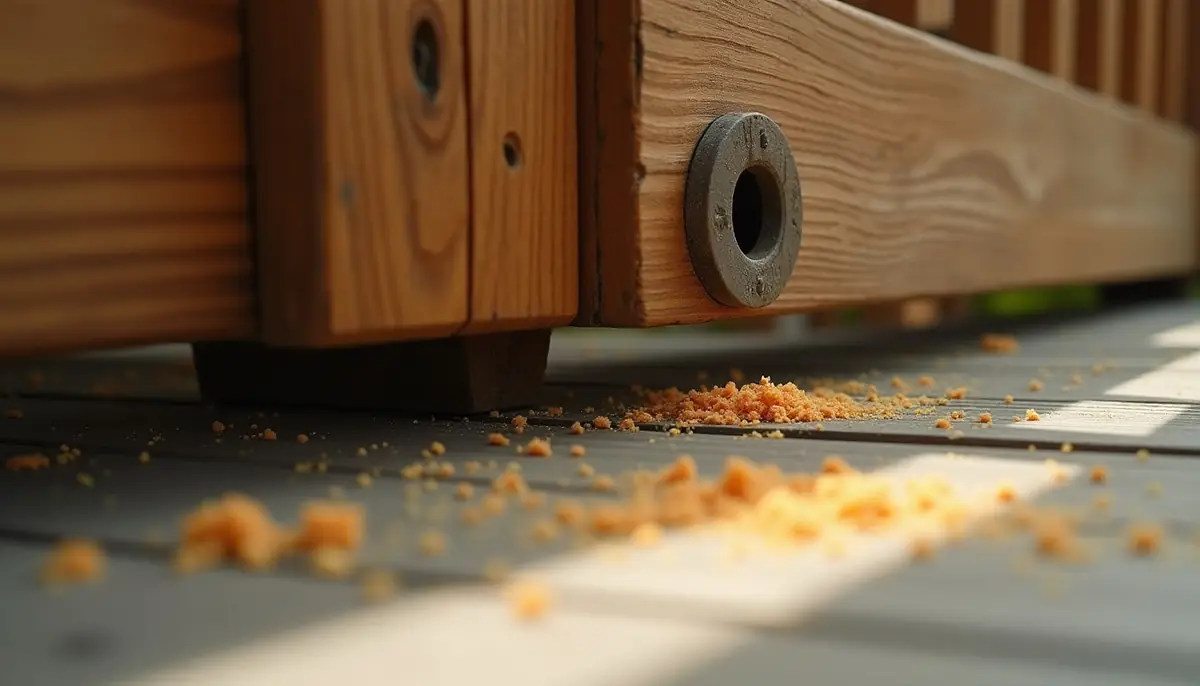
For wood, sometimes; for people, rarely. Carpenter bees do not eat wood; Cornell notes that, like carpenter ants, they use it. The female chews a nearly perfectly round entrance hole, about half an inch across in Penn State’s description and about 1 cm in the University of Georgia’s, then turns at a right angle and tunnels along the grain. Ohio State and Clemson put a single gallery at about 4 to 6 inches long, but galleries reused over the years have measured 10 feet. Clemson adds that repeated colonisation over several years can cause considerable damage, along with yellowish stains from bee waste below the holes.
The bigger damage often comes from birds. Ohio State notes that woodpeckers and flickers can riddle wood with holes while hunting the larvae, and the University of Georgia describes woodpeckers as one of the important predators of carpenter bees. Our guide to woodpecker damage to a house explains how to read those holes.
Carpenter bees prefer bare wood. Cornell says females favour soft wood that lacks paint, and Penn State notes that painted or varnished surfaces discourage them while stained wood usually is not protected.
Should you get rid of carpenter bees?
Usually only where they are drilling into your house, deck or fence. Carpenter bees are spring pollinators, and a few holes in a fence post rarely matter. The case for action is repeated nesting in the same timber year after year, which is what turns small holes into long galleries and woodpecker damage. Our carpenter bee and wood-destroying insect guide covers treatment, why plugging the hole on its own often fails, and what it costs, so we will not repeat it here. Any insecticide must be one labelled for carpenter bees and used exactly as the label directs.
Bumble bees are a different case. Cornell describes them as important pollinators facing an uncertain future as their numbers dwindle, and advises leaving a nest that can be kept away from people and pets: the colony dies out in autumn on its own. If a nest sits where people walk, mow or play, a pest professional or local extension office can advise; our bee removal cost guide explains what removal usually involves.
Bumble bees are in trouble; carpenter bees are not
The conservation story is one-sided. A 2011 national study in the Proceedings of the National Academy of Sciences, which compared more than 73,000 museum records with surveys of more than 16,000 specimens, found that the relative abundance of four US bumble bee species had declined by up to 96 per cent and their surveyed ranges had shrunk by 23 to 87 per cent, some within 20 years. The rusty patched bumble bee was listed as federally endangered in 2017; the US Fish and Wildlife Service cites an introduced pathogen interacting with pesticide exposure, along with habitat loss and climate change. Cornell notes there are about fifty bumble bee species in the US.
That is a practical reason to identify before acting: killing a bumble bee colony by mistake, when the problem is a carpenter bee in the fascia, does nothing for the wood. For pesticide use near flowering plants, see our guide to pollinator protection and pesticide labels.
Carpenter bee vs bumble bee: who would win?
There is no contest. Both feed on nectar and pollen, neither hunts other insects, and they nest in different places, wood versus ground. The only fighting either does is the male carpenter bee chasing rivals from nest sites. For a genuine predator, our guide to wasp vs bee explains why yellowjackets, not bees, are the insects that raid and kill other bees.
Frequently asked questions
Do carpenter bees sting?
Male carpenter bees cannot sting; they have no stinger, even though they hover close and dive at people near nest sites. Females have a stinger but are docile, and Penn State says they must be extremely provoked, meaning handled, before they sting. Ohio State notes a female can sting more than once. In everyday life, carpenter bee stings are uncommon.
How can I tell the difference between a carpenter bee and a bumblebee?
Look at the top of the abdomen. A carpenter bee’s is bare, shiny and black; a bumble bee’s is covered in hair, usually with yellow bands. Then check where it goes: carpenter bees enter round half-inch holes drilled in wood, while bumble bees nest in the ground, in old rodent burrows, compost or grass piles. Male carpenter bees also have a pale face patch.
Are bumble bees or carpenter bees more aggressive?
Bumble bees are the bigger sting risk, though neither is aggressive while foraging. Bumble bees defend their colony and can sting repeatedly, and Cornell says severe sting events usually follow a mower or trimmer disturbing a nest. Carpenter bee males look aggressive because they hover and chase, but they have no stinger, and females sting only when handled.
Should you get rid of carpenter bees?
Only when they are nesting in wood you care about. They are pollinators and a few holes rarely matter, but Cornell notes females tend to return to the same area, and galleries reused over years can reach 10 feet long and attract woodpeckers. Painting or varnishing bare wood discourages them, and an established problem on a house is worth a professional assessment.
Do bumble bees damage wood?
No. Bumble bees do not drill into wood. They nest in existing cavities, such as abandoned rodent burrows, depressions in the ground, compost and grass piles, hollow logs or, occasionally, cavities in buildings close to the ground. If you see round half-inch holes and sawdust in a deck, fascia or fence, the bee responsible is a carpenter bee, not a bumble bee.
Sources
- Penn State Extension, Carpenter Bees (Jacobs), revised 2014.
- The Ohio State University Extension, Carpenter Bees, HYG-2074 (Jones), 2017; and Ohio Bee Identification Guide, ENT-57, 2015.
- Clemson Cooperative Extension, Home and Garden Information Center, Carpenter Bees (Hood and Roach), 2020.
- University of Georgia Cooperative Extension, Carpenter Bees: A Serious Pest of Wooden Structures in the Landscape, C1342 (Joseph), 2025.
- Cornell University, New York State IPM Program, Identifying Bees and Wasps: carpenter bees and bumble bees.
- Texas A&M AgriLife Extension, Bumble Bees, ENT-3005 (Merchant), 2016.
- Cornell Cooperative Extension of Nassau County, Home Grounds Fact Sheet: Stinging Insects, B-2-1.
- Cameron and others, Patterns of widespread decline in North American bumble bees, Proceedings of the National Academy of Sciences 108(2), 2011.
- US Fish and Wildlife Service, Rusty patched bumble bee (Bombus affinis) species profile.
- The Pest Control Brief analysis of iNaturalist research-grade records, pulled October 2026.