Carpenter Bees and Wood-Destroying Insects Beyond Termites
Carpenter bee treatment costs $150 to $500, powderpost beetles $500 to $5,000. None of them are covered by your termite bond.
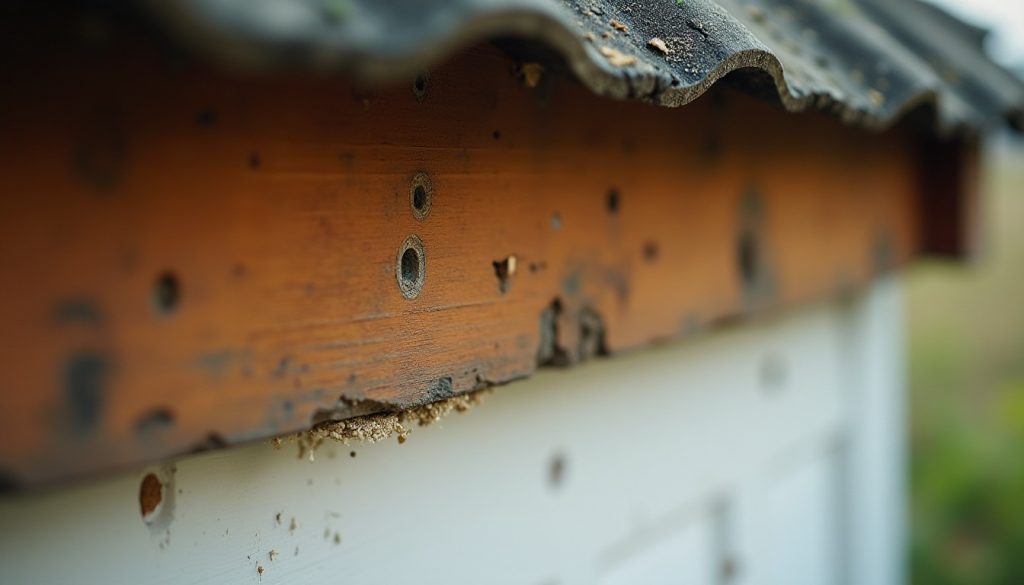
Carpenter bee treatment costs $150 to $500 for most homes, rising to $600 to $1,500 with several active nests and visible damage, and $1,500 to $3,000 or more for widespread colonies needing wood replacement. Powderpost beetles, the second most destructive wood-destroying insect after termites, run $500 to $5,000 depending on whether fumigation is required.
Termites get the attention and the warranties. Three other insects damage structural wood in American homes, they are frequently misdiagnosed as termites, and none of them are covered by a termite bond.
What the non-termite wood destroyers cost
| Insect | Treatment cost | What it does to wood |
|---|---|---|
| Carpenter bees, small | From about $180 | Round entry holes, galleries in soft exposed timber |
| Carpenter bees, typical | $150 to $500 | Several nests across one or two elevations |
| Carpenter bees, medium | $600 to $1,500 | Multiple active nests plus visible damage and some repair |
| Carpenter bees, severe | $1,500 to $3,000+ | Widespread galleries, wood replacement, repeat treatment |
| Powderpost beetles | $500 to $5,000 | Larvae reduce wood interior to fine powder |
| Carpenter ants | $250 to $1,500 | Excavate nesting galleries, do not eat wood |
Contractor-reported ranges compiled in 2026. There is no federal price index for pest control services, a gap covered in our analysis of where pest control money goes.
Telling them apart
| Sign | Points to |
|---|---|
| Perfectly round holes about half an inch across, often on eaves, fascia, decks and railings | Carpenter bees |
| Coarse sawdust below a hole, and a large bee hovering nearby | Carpenter bees |
| Tiny holes under a sixteenth of an inch with fine flour-like powder | Powderpost beetles |
| Coarse sawdust with insect body parts in it, and large black ants | Carpenter ants |
| Mud tubes on foundation walls, no sawdust anywhere | Termites |
The distinguishing question is what appears below the damage. Termites leave mud and no sawdust. Powderpost beetle frass is fine enough to look like flour. Carpenter bee and carpenter ant debris is coarse and visibly wood. Our guide to carpenter ants and how to tell them from termites covers that pairing in detail.
Carpenter bees: why plugging the hole fails
The visible hole is an entrance. Behind it the bee turns and tunnels along the grain, often for several inches, and existing galleries are reused and extended in following years. Sealing the entrance without treating the gallery traps developing bees, which commonly chew a fresh exit nearby.
The sequence that works is treat first, seal after. Treat the gallery, allow time for the treatment to act, then plug the hole and refinish the surface. Order matters more than product here.
- Identify the active holes, which usually have fresh sawdust below them.
- Treat the gallery rather than the surface.
- Wait as the treating company directs before sealing.
- Plug and finish. Bare, unpainted softwood is the preferred target, so a finished surface is genuine prevention.
- Expect the following spring to matter. Untreated galleries are reused, so an untreated elevation compounds year on year.
Structural risk from carpenter bees is usually modest in the first year and accumulates. The secondary problem is woodpeckers, which open galleries to reach larvae and turn a half-inch hole into a much larger repair.
Powderpost beetles and why they surface at sale
Powderpost beetle larvae develop inside the wood for months to years, so the first sign is emergence holes and fine frass appearing well after the wood was infested. Infestation often traces back to lumber that arrived already carrying eggs, particularly unfinished hardwood.
They matter disproportionately in property transactions because they are a named wood-destroying insect on inspection reports. A WDI report covers wood destroying insects generally, not termites alone, so beetle activity in a crawlspace can surface at closing and become a negotiation. Our guide to termite inspection and WDI reports explains what those documents cover.
None of this is covered by your termite bond
This is the point most homeowners get wrong. A termite bond covers termites. Carpenter bees, powderpost beetles and carpenter ants are separate insects and are generally excluded, so discovering carpenter bee damage does not trigger a claim under an agreement you have been renewing for years.
Check the covered organisms in your agreement rather than assuming, and note whether the coverage is retreatment only or includes damage repair, which is the distinction that decides what a bond is worth. Our guide to termite bonds and warranties sets out the six terms to check.
Frequently asked questions
How much does carpenter bee treatment cost?
Most homes cost $150 to $500, with small jobs from about $180. Several active nests with visible wood damage run $600 to $1,500, and widespread colonies requiring wood replacement and repeat treatment reach $1,500 to $3,000 or more. Price is driven by the number of holes, elevations involved and access.
Do carpenter bees cause structural damage?
Individually the damage is modest, but galleries are reused and extended each year, so an untreated elevation compounds. The larger risk is often secondary: woodpeckers open galleries to reach larvae, turning a half-inch hole into a substantially bigger repair. Bare, unfinished softwood is the preferred target.
What are powderpost beetles and how much does treatment cost?
They are the most destructive wood-destroying insect after termites. Larvae tunnel inside wood and reduce its interior to a fine powder called frass. Treatment runs $500 to $5,000 depending on extent and whether fumigation is needed. Infestation often traces to lumber that arrived already carrying eggs.
Does a termite bond cover carpenter bees or beetles?
Generally no. Termite bonds cover termites, and carpenter bees, powderpost beetles and carpenter ants are usually excluded. Check the covered organisms in your specific agreement rather than assuming, since discovering non-termite wood damage will not normally trigger a claim under a bond you have been renewing.
Sources
- Contractor-reported price ranges compiled by home services and pest control cost guides, 2026. Sample sizes and methods are not published by those sources.
- U.S. Bureau of Labor Statistics, Producer Price Index programme. Confirmed no published series for NAICS 561710.