Why Do Termites Lose Their Wings? The Swarm Explained

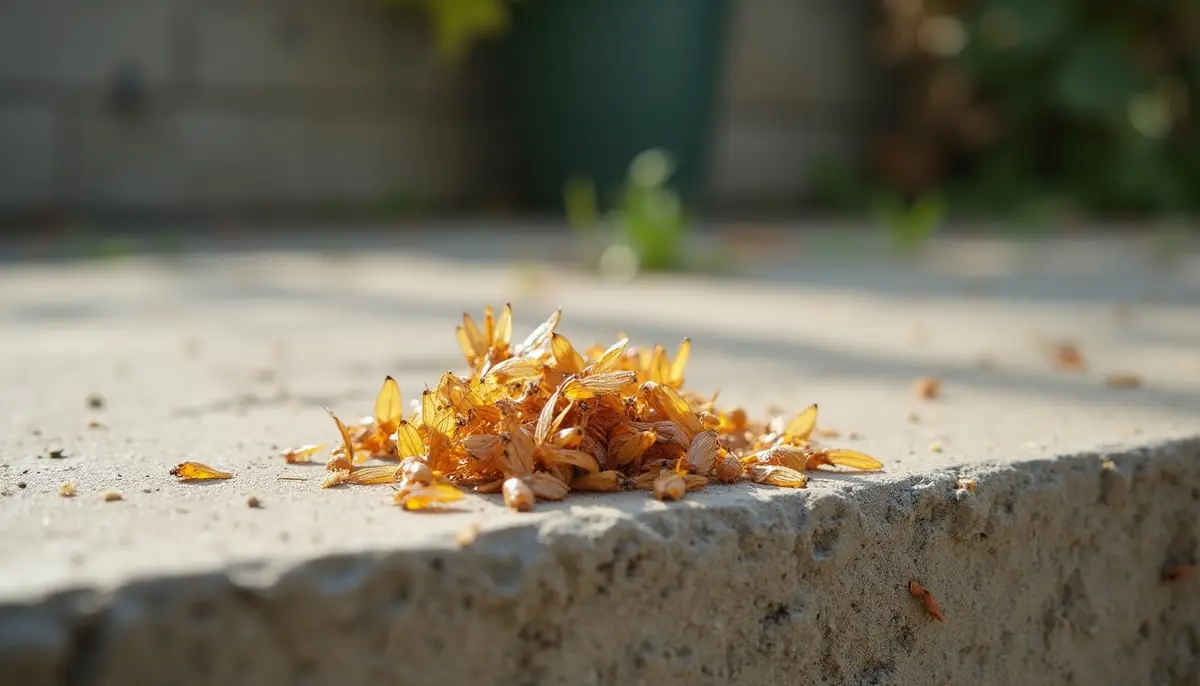
Termites lose their wings because the wings are built for one short mating flight and nothing else: after landing, each swarmer snaps them off along a ready-made fracture line at the wing base, then pairs up to start a colony in soil or wood. Wings would only get in the way underground. Termites are the only insects with that breakaway seam, the humeral suture, which is why their wings come off so easily and pile up on sills. Wings indoors mean a mature colony, usually several years old, produced the swarm nearby.
How termites drop their wings
The mechanism is anatomical. In a 1967 paper in Psyche, the termite taxonomist Alfred Emerson wrote that only termites have a humeral suture at the base of the wing that “enables the wings to be easily shed at the end of the colonizing flight.” Many sources call the same seam the basal suture. Each wing is designed to fail at that line.
The termite does the breaking itself. University of Hawaii entomologists describe Formosan swarmers landing after a short flight and dropping their wings, which “break off close to the termite’s body when it folds them up and forward.” What stays on the body is a short stub: Louisiana State University’s identification sheet lists “stubs left by detached wings” as a termite feature, against “no wing stubs” on a worker ant.
That answers why termites lose their wings so easily. A seam that breaks with one fold, as Hawaii describes it, is the point of the design, and it is also why a light knock or a vacuum nozzle leaves a sill strewn with loose wings.
What happens after the wings come off
Every extension source describes the same sequence, though not always in the same order:
| Step | What the sources say | Source |
|---|---|---|
| Flight | Triggered by warmer temperatures and rainfall; swarmers fly short distances | Kentucky ENTFACT-604; Texas A&M |
| Landing and shedding | Swarmers drop to the ground and shed their wings | Kentucky; University of Hawaii |
| Pairing | Males and females pair off using pheromones; the female leads and the male follows in a fast-running “train” | Texas A&M; NC State |
| Nest site | The pair looks for a moist, sheltered place; Penn State says moist wood in contact with soil | Rutgers FS338; Penn State |
| Survival | Few succeed: most are eaten by birds, toads, insects and other predators, and many die from dehydration or injury | Texas A&M; Penn State |
Compiled by The Pest Control Brief from the named extension documents.
The sources disagree on when mating happens. NC State says pairs mate before they drop to the ground and lose their wings; Kentucky, Penn State and Hawaii describe shedding first, then pairing. None of the sources we read gives a measured survival rate for founding pairs, only “few”, “very few” and “a small percentage”.
The timing of the flight differs by species too. Texas A&M says Formosan swarmers fly at night in late May and early June towards lights, and Hawaii adds that Formosan swarms happen on warm, humid, nearly windless nights and last about half an hour. Native subterranean termites fly by day, often after rain (NC State). Dates by region are on our termite swarm season calendar.
From swarm to first workers: the first year of a colony
The best measured account of what a wingless pair achieves comes from a 2013 study in Sociobiology by Janowiecki, Jones and Bryant, which censused 180 laboratory colonies of the eastern subterranean termite, each started by one king and queen, monthly for a year.
- The largest egg batch came in the first month, a mean of 14.5 eggs.
- Larvae were present at 1 month and the first workers at 2 months.
- A single soldier appeared in some colonies at 6 months.
- One-year-old colonies held 20 to 40 termites, an average of 28.9, weighing 39.8 mg in total.
The founders pay for this with their own bodies. The king and queen lost a great deal of biomass in the first 2 months while they produced eggs, and by 11 months their offspring weighed four times as much as the pair.
From there it is a long wait for wings. Texas A&M says a subterranean colony is mature and produces swarmers after 2 to 4 years; NC State gives 3 to 5 years. By then the queen is laying the eggs described in our guide to what termite eggs look like and where they are.
The founding pair can keep going for years after that; our page on how long termite kings, queens and workers live sets out the published lifespans.
Why do termites lose their wings in my house?
Because they emerged there. Swarmers leave a colony through exit points in soil, wood or mud tubes, and Penn State says the tubes themselves may serve as swarming exits. When the colony is under a slab or in the framing, the exits open indoors. Penn State says winged termites are attracted to light and swarm about doors and windows, then break off their wings and look for a mate.
Indoors they cannot finish the job. Mississippi State says swarmers trapped inside die of desiccation because they need moist soil, and Kentucky gives them about a day. That is why wings and bodies collect on sills. What a drift of bodies means for the house, find by find, is set out in our guide to what dead termites in the house mean.
Bathrooms are a common emergence point on slab homes, because plumbing passes through gaps in the slab; our explainer on why termites show up in bathrooms first covers the route.
What the wing pile tells you
| What you see | What it points to | Source |
|---|---|---|
| Four wings of equal length, much longer than the body | Termite; Penn State says termite wings are nearly twice the body length | Penn State |
| Front wings larger than the hind wings | Ant | NC State; Kentucky |
| Wings with a dense covering of hair, found near lights after dark in May or June | Formosan termite | Texas A&M |
| Dark bodies and wings on a sill between February and June in Pennsylvania | Eastern subterranean termite season there | Penn State |
| Wings beside six-sided pellets under wood | Drywood termites | UC IPM |
| Wings inside a closed room with no open window | Swarmers emerged from the structure | NC State; Kentucky |
Compiled by The Pest Control Brief from Penn State Extension, NC State Extension, University of Kentucky, Texas A&M AgriLife and UC IPM.
Wings matter more than bodies for identification. Texas A&M notes that drywood swarmers quickly lose their wings, but the wings are needed to identify the species, so keep a few on tape. The photo guide to termite swarmers, workers and soldiers shows what to compare them with.
Do flying ants lose their wings too?
Some do, which is where confusion starts. Penn State says carpenter ants mate during a brief flight, after which the male dies and the female removes her wings to search for a nest site. Louisiana State’s sheet says ant wings do not shed. Both can be true for a homeowner: ant wings are not shed in piles the way termite wings are, and a dealate ant queen still has her pinched waist and elbowed antennae. Our guide to telling termites from flying ants walks through the three checks.
Why flying termites suddenly appear, then die
A swarm is a weather event. Kentucky says warmer temperatures and rainfall trigger it, and NC State says flights often follow a rainstorm on warm, gusty days. The swarmers that land on lawns face predators; the ones that emerge indoors die of drying out. Rutgers says mature colonies swarm once or twice a year, while Mississippi State says once, so a second flight from the same house is possible but not the rule.
In our analysis of iNaturalist research-grade records, native subterranean termite sightings peak in April (661 of 2,335 records) and Formosan sightings in May (519 of 760), which matches the extension calendars.
Should I worry about winged termites?
Worry about the colony, not the swarmers. Penn State says no damage is done by the winged forms, and Kentucky says they cannot damage wood. But Kentucky also says winged termites indoors almost always indicate an infestation warranting treatment, and Mississippi State says the building has usually been infested for several years by the time they appear. An inspection is the next step; our termite inspection cost guide puts a formal WDI report at $75 to $150.
Before the inspector arrives, check for the other evidence they will look for, such as mud tubes on foundation walls; our guide to signs of termites ranked by what they prove shows how to test whether each is active.
Frequently asked questions
Do termites lose their wings after they swarm?
Yes. Every extension source we read, from Kentucky to Penn State, says swarmers shed their wings shortly after the flight, before or after pairing, and then look for a nest site. The wings break along a seam at the base that only termites have. Swarmers still found with wings are usually those that died indoors before shedding.
What is a termite’s worst enemy?
Ants, for a swarmer on the ground. Texas A&M says most swarmers fall to birds, toads, insects and other predators, and University of Hawaii names ants alongside geckos, spiders and toads. A 2015 PLoS ONE study in Gabon found termite DNA in 17.2 per cent of 215 soil ants examined.
What smell do termites hate most?
No smell has been shown to keep termites out of a house. UC IPM says orange oil and neem oil have been tried against drywood termites, but tests from two universities question the efficacy of d-limonene. Our review of what home remedies for termites actually do scores each one against the research.
Do dead termites mean infestation?
If they are swarmers that emerged indoors, usually yes: Kentucky says winged termites indoors almost always indicate an infestation. Clemson is more cautious, saying a few termites in a house do not by themselves mean a structural infestation while large numbers or wings indoors often do. An inspector should make the call.
Sources
- Emerson, A. E. (1967). Cretaceous insects from Labrador 3. A new genus and species of termite (Isoptera: Hodotermitidae). Psyche 74: 276 to 289.
- Janowiecki, M., Jones, S. C. and Bryant, J. L. (2013). Population growth characteristics of incipient colonies of the eastern subterranean termite, Reticulitermes flavipes. Sociobiology 60(4): 441 to 445.
- University of Hawaii CTAHR, Crop Knowledge Master, Coptotermes formosanus; and Termite Project, About Termites.
- Louisiana State University AgCenter, Publication 2841, Termite identification sheet.
- University of Kentucky Entomology, ENTFACT-604, Termite Control: Answers for Homeowners.
- NC State Extension, Termite Swarmers: What Do They Mean for You?; Biology and Behavior of Eastern Subterranean Termites; Monitoring and Management of Eastern Subterranean Termites.
- Penn State Extension, Eastern Subterranean Termites; and Carpenter Ants.
- Texas A&M AgriLife Extension, Urban and Structural Entomology Program, Native Subterranean Termites, Formosan Subterranean Termites and Drywood Termites.
- Rutgers NJAES Cooperative Extension, Fact Sheet FS338, Termite Prevention and Control.
- Mississippi State University Extension Service, Bug’s Eye View, Eastern Subterranean Termite Swarmers, Vol. 5 No. 3, 2019.
- Clemson Cooperative Extension, Home and Garden Information Center, Termites.
- University of California Statewide IPM Program, Pest Notes: Drywood Termites, Publication 7440.
- Fayle, T. M. and colleagues (2015). Detection of mitochondrial COII DNA sequences in ant guts as a method for assessing termite predation by ants. PLoS ONE 10(4): e0122533.
- The Pest Control Brief analysis of iNaturalist research-grade records, pulled October 2026.