Voles vs Mice: How to Tell Them Apart and Why It Matters
A vole is a stocky, blunt-nosed rodent with tiny ears and a tail about 1 inch long that lives in lawn runways and eats plants; a house mouse is slimmer, with big ears and a tail as long as its body, and it moves indoors. Voles weigh 1 to 2 ounces against a house mouse’s 0.4 to 0.9. Voles rarely enter homes, so the fix is outdoors: cover removal, trunk guards and traps in runways. Mice need indoor exclusion.
Side by side: the features that settle it
| Feature | Vole (Microtus) | House mouse (Mus musculus) |
|---|---|---|
| Build | Compact, heavy body, short legs, blunt nose | Small and slender, slightly pointed nose |
| Tail | Short and furred, about 1 inch; one quarter to one half of head and body length | Nearly hairless with scale rings; 2 to 4 inches, about as long as the head and body |
| Ears and eyes | Small eyes, ears partly hidden in fur | Large, sparsely haired ears; small black eyes |
| Fur | Long, coarse, blackish brown to grayish brown | Gray-brown with a gray or buff belly |
| Weight | 1 to 2 oz | 0.4 to 0.9 oz |
| Total length | 4 to 8.5 in depending on species | 5 to 7 in including the tail |
| Diet | Mostly plants: grasses, bulbs, tubers, roots, bark | Omnivorous: cereals, seeds, insect larvae, any stored food |
| Droppings | About 3/16 inch (4.5 mm), greenish when fresh, in runways | Average 1/4 inch, dark, along walls and in cupboards |
| Where you find it | Lawns, beds, mulch, orchards; poor climber | Inside buildings, garages, sheds |
| Signature sign | Surface runways and 1.5 to 2 inch burrow holes, girdled bark | Droppings, gnawed packaging, shredded nesting |
| Family | Cricetidae, shared with native deer mice | Muridae, shared with Norway and roof rats |
Compiled by The Pest Control Brief from UC IPM Pest Notes on voles and house mice, UC IPM’s pistachio vole guidelines, the ICWDM vole and house mouse species accounts, and University of Nebraska NebGuide G887. Family placement from the GBIF taxonomic backbone.
The tail is the quickest test when you have the animal in front of you. Nebraska extension says voles’ short tails, about 1 inch, their stocky build and small eyes “distinguish them from true mice”. UC IPM’s pistachio guidelines put the vole tail at one half to one quarter of head and body length, while a deer mouse tail is more than 70 per cent of it, and a house mouse tail is usually about the same length as the body.
One exception: the long-tailed vole, whose tail the ICWDM says makes up 30 per cent or more of its 6 to 8 inch total length. Its ears are still small and its body still blocky, so the head shape settles it.
How do I know if I have voles or mice?
Ask where the damage is. If it is on the lawn or on plants outside, the answer is almost always voles; if it is in the kitchen, garage or attic, it is mice. UC IPM puts it plainly: voles “usually do not invade homes and shouldn’t be confused with the house mouse”.
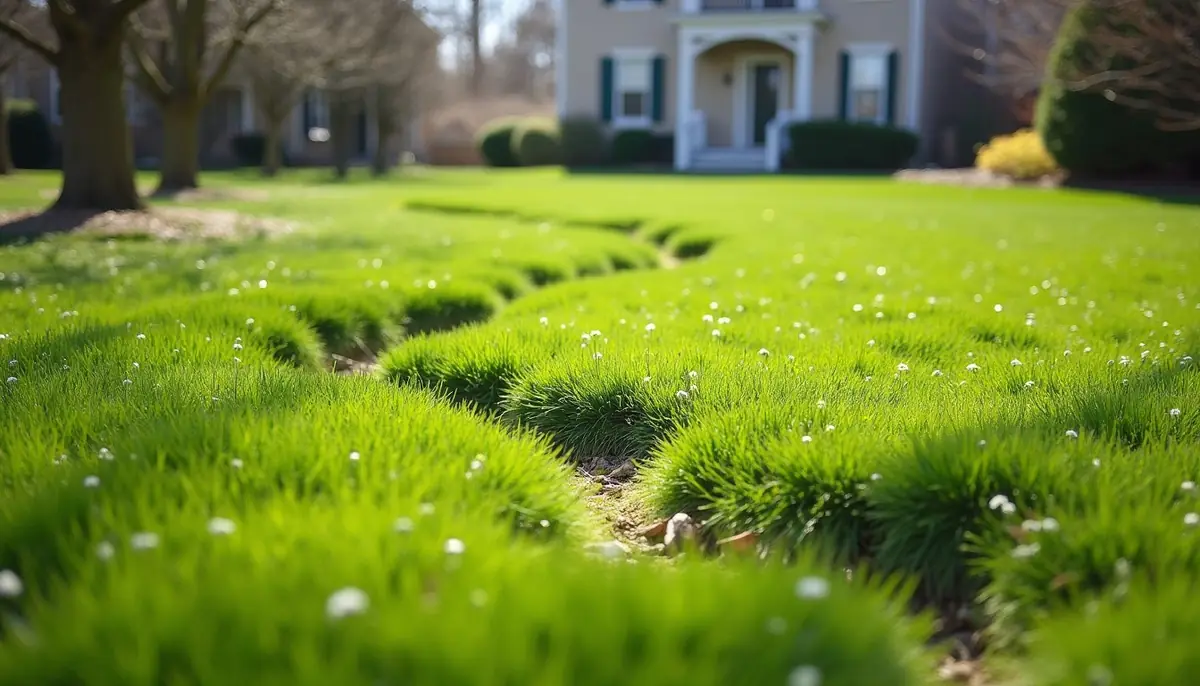
- Runways in grass: paths of clipped grass, often under ground cover or revealed by melting snow, linking burrow holes 1.5 to 2 inches across. Only voles make these. Our comparison of mole ridges against vole runways on a lawn covers the other common mix-up.
- Gnawed trunks: irregular patches of tooth marks about 1/8 inch wide and 3/8 inch long, from a few inches below ground to a few inches above, or a foot or more up under snow. That is vole girdling.
- Bulbs and roots eaten from below: voles, or pocket gophers, which UC IPM says girdle mainly below ground while voles girdle mainly above it. Pocket gophers push up closed soil mounds; the steps are in our guide to getting rid of gophers and reading their mounds.
- Droppings indoors, chewed food packets: mice. Our room-by-room list of mouse signs helps confirm it.
- Open holes with soil piles in beds or by steps: more likely chipmunks or ground squirrels; the burrow test is in telling chipmunk, groundhog and ground squirrel holes apart.
Do voles leave droppings like mice?
Yes, but they look and sit differently. UC IPM’s pistachio guidelines give vole droppings as about 0.18 inch (4.5 mm), greenish when fresh and turning brown or gray, found in runways and near burrows. ICWDM gives house mouse droppings an average of 1/4 inch, left along walls, in feeding areas and near shelter. A green pellet in a grass runway is a vole; a dark pellet in a drawer is a mouse.
Both can carry disease, so clean up with gloves and do not sweep or vacuum dry droppings. The CDC method of wetting with a 1 to 9 bleach solution is in our guide to cleaning up mouse droppings safely. Deer mice are the main hantavirus concern in the US, not house mice or voles.

Do voles come in the house?
Rarely. UC IPM calls voles poor climbers that “usually don’t enter homes or other buildings”, living instead in wildland, cropland, gardens and landscaping next to them. A vole indoors is usually a one-off, often carried in by a cat or found in a garage next to a garden. If you find several small rodents inside over days, they are almost certainly house mice or, near fields and woods, deer mice. The garage is the usual overlap point, and our guide to why mice move into garages and how to keep them out covers it.
Are voles and mice the same, and can they breed?
No on both counts. Voles and house mice are both rodents, but in different families: voles in Cricetidae, house mice in Muridae, according to the GBIF taxonomic backbone. Native deer mice are actually in the vole family, not the house mouse family. None of the extension or taxonomic sources we read describes any crossbreeding between them. The “field mouse” people mention is usually a vole or a deer mouse.
Do voles and mice live together?
They can share a yard, not a nest. Voles live in colonies in their own shallow burrows and grass nests and, according to UC IPM’s pistachio guidelines, usually stay within 10 feet of the nest. House mice nest in buildings and seldom go more than 30 feet from their nest, UC IPM says. Deer mice overlap with both, outdoors and in sheds. All three are food for the same predators; UC IPM lists coyotes, foxes, weasels, cats and especially hawks and owls for voles, and our page on which predators eat mice and how much they help covers the mouse side. Predators rarely keep either below damaging levels near homes.
How do you get rid of a vole?
- Remove cover. Mow, weed and thin heavy mulch. UC IPM says a 4-foot circle of bare ground around young trees, or a 4-foot buffer along a row, reduces damage because voles prefer not to feed in the open.
- Guard trunks. Use hardware cloth cylinders with mesh of 1/4 inch or less, buried 4 to 6 inches (UC IPM) or 6 inches (ICWDM), and tall enough to clear snow.
- Fence beds. Wire or flashing at least 12 inches high with 1/4 inch mesh, buried 6 to 10 inches.
- Trap in the runways. Standard mouse snap traps set at right angles to the runway with the trigger in it; UC IPM suggests a dozen as the minimum for a small garden, unbaited or with peanut butter and oats or apple, covered to protect birds. Move traps 15 to 20 feet once catches stop.
- Skip the gadgets. UC IPM finds ultrasonic devices, flooding and gas cartridges ineffective against voles, and repellents such as castor oil and capsaicin of questionable value.
Poison is a poor fit at home. In California, UC IPM says zinc phosphide is the only toxicant for voles in residential settings and it is restricted to licensed or certified applicators. Consumer mouse bait stations are labelled for house mice, not voles, so using them on a lawn colony would be off-label.
Getting rid of mice instead
Mice need the opposite plan: inside work. Seal gaps over 1/4 inch with metal-based materials, set snap traps no more than about 10 feet apart along walls, and remove food. The full order of steps is in our guide to getting rid of mice in a house.
The size differences that matter for trap choice are in our rat vs mouse comparison. If you have both, voles in the lawn and mice in the house, run both plans; one does not touch the other.
Frequently asked questions
How do you get rid of a vole?
Remove the dense grass, weeds and mulch they hide in, protect trunks with 1/4 inch hardware cloth, and set mouse snap traps across their runways with the trigger in the path. UC IPM suggests at least a dozen traps for a small garden. Repellents and ultrasonic devices have poor evidence.
How do I know if I have voles or mice?
Look at where the damage is and at the tail. Runways in grass, girdled bark and eaten bulbs outdoors mean voles, which have tails about 1 inch long. Droppings and chewed food indoors mean mice, whose tails are roughly as long as their bodies.
Do voles come in the house?
Rarely. UC IPM describes voles as poor climbers that usually do not enter homes or other buildings. A single vole in a garage or brought in by a cat happens, but repeated sightings of small rodents indoors almost always mean house mice or, near fields and woods, deer mice.
Do voles leave droppings like mice?
Similar in size but different in colour and place. Vole droppings are about 0.18 inch, greenish when fresh and found in grass runways and by burrows; house mouse droppings average 1/4 inch, are dark, and turn up along walls, in drawers and near food.
Can voles and mice breed?
No. Voles belong to the family Cricetidae and house mice to the family Muridae, and none of the extension sources we read records any crossbreeding. A “field mouse” in the yard is usually a vole or a native deer mouse, not a hybrid.
Sources
- University of California Statewide IPM Program, Pest Notes: Voles (Meadow Mice), publication 7439, updated 2023.
- University of California Statewide IPM Program, Pistachio Pest Management Guidelines: Voles (Meadow Vole, Meadow Mice).
- University of California Statewide IPM Program, Pest Notes: House Mouse (publication 7483) and Pest Notes: Deer Mouse (publication 74161).
- University of Nebraska-Lincoln Extension, NebGuide G887, Controlling Vole Damage, revised 2011.
- Internet Center for Wildlife Damage Management, Voles species account and vole damage prevention and control methods; House mice species account.
- Cornell University Integrated Pest Management, Mouse and rat biology and behavior.
- Global Biodiversity Information Facility (GBIF) taxonomic backbone, Microtus, Peromyscus and Mus musculus.