The Termite Zone Map, and What the Code Actually Requires
The US termite map used in the building code divides the country into four zones, from very heavy to none to slight, but it does not by itself require anything: the code says protection is needed where the local jurisdiction has filled in its table to say so. The one rule tied directly to the map is a ban on foam insulation against foundations below grade in very heavy zones. And the figure everyone quotes for annual US termite damage, $5 billion, has no traceable origin: no federal agency measures it, and the pest industry’s own trade magazine tried to trace it and could not.
Termite maps are all over the internet, usually on pest company pages, and almost always without the context that decides what they mean for a particular house. Here is what the map is, where it came from, what the code actually says, and where the separate problems of Formosan and drywood termites sit.
The four zones
The Termite Infestation Probability map covers subterranean termites only and sorts the country into four zones. It appears in the International Residential Code, and its figure number changes by edition, which trips up anyone trying to cite it.
| Zone | Broadly covers |
|---|---|
| Very heavy | Florida, Georgia, Alabama, Mississippi, Louisiana and South Carolina; the Texas Gulf coast and east Texas; most of California |
| Moderate to heavy | Most of Texas, Oklahoma, Arkansas, Tennessee, North Carolina, Virginia, Kentucky and Missouri, much of the southwest, and a band across the lower Midwest into Pennsylvania and New Jersey |
| Slight to moderate | The Pacific Northwest, Idaho, western Montana, and a band across the upper Midwest into northern New York and southern New England |
| None to slight | The northern plains, the far north of Minnesota, Wisconsin and Michigan, upstate New York and most of New England |
That table is our reading of a published reproduction of the map, and zones do not follow state lines: Colorado alone spans three. For a specific property, the local building department’s determination is what counts, not a regional generalisation.
| Code edition | Where the map is |
|---|---|
| 2015 International Residential Code | Figure R301.2(6) |
| 2018 and 2021 | Figure R301.2(7) |
| 2024 | Figure R305.4, after the termite section was renumbered from R318 to R305 |
What the code actually requires
The termite provision applies in areas subject to damage from termites as indicated by the jurisdiction’s climatic and geographic design table. That table is filled in locally. Its footnote says the jurisdiction indicates the need for protection depending on whether there has been a history of local subterranean termite damage, and the 2024 wording applies the section only where the local jurisdiction has determined the area is subject to termite damage.
So the map is a guide, not a trigger. Where protection is required, the code lets the builder choose one method or a combination: a soil-applied termiticide, a bait system installed and maintained according to its label, pressure-treated wood, naturally durable wood, a physical barrier, or cold-formed steel framing. How those work in practice, and what they cost, is covered in termite pretreatment for new construction.
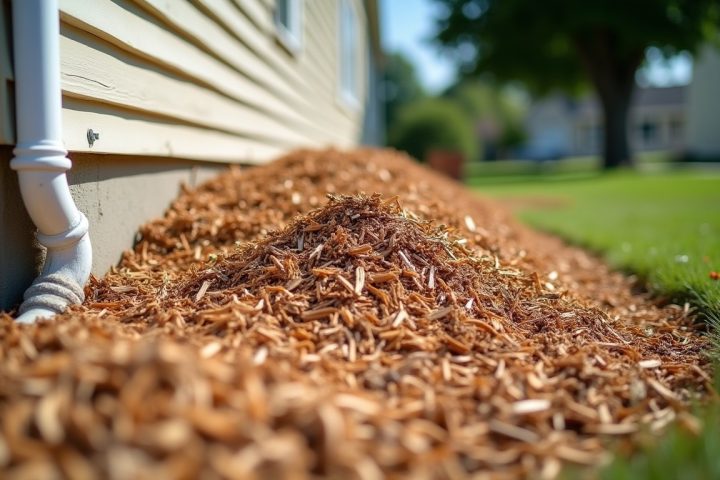
The one provision tied directly to the map concerns foam plastic insulation. In very heavy zones, foam may not be installed on the exterior face of, or under, foundation walls or slabs below grade unless an approved protection method is used, and foam above grade needs at least six inches of clearance from the ground. Rigid foam against a foundation is an invisible highway for subterranean termites, which is why this is the rule the code chose to enforce by map.
Where the map came from
The map traces to the US Forest Service and its bulletin on subterranean termites, first published in 1960 and revised over the following decades. Lenders and federal housing programmes have used the zones to decide when a wood-destroying insect inspection is required for a mortgage. It is a mid-twentieth-century regional generalisation, and building scientists have pointed out that local conditions and site microclimate vary far more than four broad zones can show. The earlier federal property standards were in some respects stricter than today’s model code, requiring protection for all foundations in the heaviest region.
Formosan termites are a separate map
The Formosan subterranean termite has been reported in about eleven states across the South, including Louisiana, Florida, Texas, Hawaii, Alabama, Mississippi, Georgia, South Carolina, North Carolina, Tennessee and California, and is rarely found north of about 35 degrees latitude. In Louisiana, the state’s agricultural extension service reports it in 42 of 64 parishes, including every parish on or south of Interstate 10.
Florida’s picture is changing fast. A 2026 University of Florida analysis of termite collection records from 1990 to 2025 found Formosan termites in most coastal counties and large cities, projected them as highly likely to be detected statewide before 2050, and estimated that around half of urban South Florida structures could be at risk from Formosan or Asian subterranean termites by about 2040.
Damage estimates for Formosan termites specifically are all modelled rather than measured. The most careful academic estimate puts US Formosan damage at likely more than $4 billion a year. A frequently quoted $300 million a year for New Orleans alone has no primary source we could find, and we do not repeat it.
Drywood termites are not on the map at all
The zone map covers subterranean termites only. Drywood termites, which live inside the wood they eat and need no soil contact, have a different distribution: coastal southern states and the Southwest. The West Indian drywood termite is the leading drywood pest in Florida and Hawaii; the western drywood termite is the structural drywood pest of California, Arizona and the Southwest. Florida alone has 20 established termite species, six of them invasive. We found no national drywood distribution map, federal or otherwise. Drywood infestations are why whole-structure fumigation exists, covered in tenting and fumigation.
About the $5 billion
The figure repeated on almost every termite page is that termites cause $5 billion of damage in the United States each year. The trade association that popularised it now publishes $6.8 billion, without a stated method. In 2015 the pest control industry’s own trade magazine set out to trace the number and, after weeks of research, could not find its origin, noting that figures from $1.5 billion to $16.6 billion were all in circulation and most were still online.
No federal agency measures annual termite damage. The academic estimates that exist are extrapolations, typically from termiticide sales: one widely cited estimate from 2002 put the figure at $11 billion, and a review of termites as global pests put worldwide damage at more than $40 billion a year as of 2010. The honest statement is that termite damage in the US is substantial, runs into billions of dollars a year, and has never been directly measured.
It is also worth knowing that most homeowners insurance excludes termite damage, which is part of why the figure is so hard to measure: there is no claims record to count. That coverage question is covered in whether insurance covers pest damage.
What it means for a homeowner or builder
- Ask the building department, not the map, whether termite protection is required for a new build or addition.
- In the very heavy zone, watch the foam. Below-grade foam against foundations is restricted, and above-grade foam needs its six-inch clearance.
- Check for Formosan pressure if you are in the Gulf states or South Florida, where the risk profile differs from native subterranean species.
- Know which termite you are dealing with before accepting a treatment plan, since drywood and subterranean species call for different approaches. Timing by species is in termite swarm season, identification of damage in reading wood damage, and inspection in termite inspection costs.
Frequently asked questions
What are the termite infestation probability zones?
Four zones used in the International Residential Code for subterranean termites: very heavy, moderate to heavy, slight to moderate, and none to slight. They are shown on a map in the code, at Figure R301.2(7) in the 2018 and 2021 editions and Figure R305.4 in 2024.
Which states have the most termites?
The very heavy zone covers the Gulf states and the Southeast, including Florida, Georgia, Alabama, Mississippi, Louisiana and South Carolina, along with the Texas Gulf coast and most of California. Zones cross state lines, so local conditions matter more than a state label.
Does the building code require termite protection?
Only where the local jurisdiction has determined it is needed, based on a history of local termite damage, which it records in its design table. Where required, the code allows chemical treatment, baits, treated or naturally durable wood, physical barriers or steel framing.
What is the foam insulation rule for termites?
In very heavy termite zones, foam plastic may not be installed on the exterior face of or under foundation walls or slabs below grade unless an approved protection method is used, and foam above grade needs at least six inches of clearance from the soil.
How much damage do termites cause each year?
Nobody has measured it. The common $5 billion figure, now $6.8 billion in trade association materials, has no published method, and the industry’s trade press could not trace its origin. Academic estimates, extrapolated from treatment spending, range from about $4 billion for Formosan termites alone to $11 billion overall.
Where are Formosan termites found?
In about eleven southern states, rarely north of 35 degrees latitude. Louisiana reports them in 42 of 64 parishes, and a 2026 University of Florida analysis projects them as likely to be detected across Florida before 2050.
Are drywood termites on the termite zone map?
No. The map covers subterranean termites only. Drywood termites are concentrated in coastal southern states and the Southwest, and we found no national map of their distribution.
Sources
- International Code Council, International Residential Code, protection against subterranean termites, via UpCodes. up.codes
- US Department of Energy, Building America Solution Center, Termite Infestation Probability map adapted from the 2021 IRC. basc.pnnl.gov
- Applied Building Technology Group, termite protection and the 2018 IRC. appliedbuildingtech.com
- LSU AgCenter, Distribution of Formosan Subterranean Termites in Louisiana. lsuagcenter.com
- University of Florida, termite distribution research, February 2026. news.ufl.edu
- UF/IFAS, Formosan Subterranean Termite, EENY-121. ifas.ufl.edu
- UF/IFAS, Termites of Florida, ENY-2079. ifas.ufl.edu
- Pest Control Technology, on the search for the origin of annual termite damage figures, February 2015. pctonline.com
- National Pest Management Association, termite press release, March 2026. pestworld.org