Are Hornet Nests Empty in Winter? What Survives, What Doesn’t
Yes: in most of the US a hornet or wasp nest is empty by winter, because the workers, males and old queen die with the first hard frosts and the nest is never used again. Only newly mated queens survive, and they spend the winter alone under bark, in leaf litter or in wall voids, not in the nest. The exceptions are yellow jacket nests in the far South, colonies in heated buildings, and wall nests whose dead contents attract scavengers.
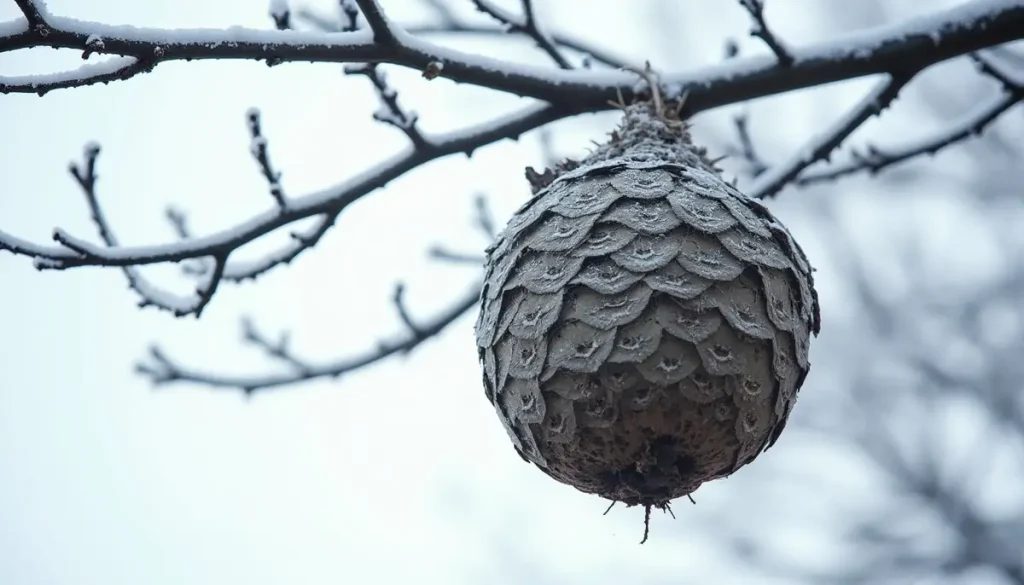
The grey football-shaped nest that appears in a bare tree each November is usually a bald-faced hornet’s, which Virginia Tech now calls the baldfaced aerial yellowjacket. Its fact sheet is blunt: “Nests are always abandoned at the end of the season and not reused the following year.” The nest only seems new because, as the University of Maryland notes, these nests are easy to miss “until winter reveals their presence.”
What is in the nest each month
| Period | Inside the nest | Where the next queens are | Source |
|---|---|---|---|
| April to May | One queen building cells and rearing the first brood alone | She is the queen | Ohio State HYG-2075; Penn State |
| June to August | Workers enlarge the nest; colony grows | Not yet reared | University of Maryland Extension |
| Late summer to early autumn | Peak numbers; new queens and males reared and leave to mate | Leaving the nest to mate, then seeking shelter | Maryland; Penn State; UF/IFAS EENY-081 |
| Autumn to first hard frosts | Old queen dies; workers “behave erratically until social order breaks down” | Already sheltering elsewhere | UF/IFAS EENY-081; Penn State |
| Winter | Dead adults and brood, or nothing; spiders and insects may shelter in it | Under bark, in leaf litter, logs, compost, soil cavities, wall voids, attics | Maryland; Virginia Tech; University of Arkansas |
| Next spring | Still empty, weathering apart | Each queen starts a new nest in a new place | Virginia Tech ENTO-49 |
Compiled by The Pest Control Brief from the named extension publications.
Why the nest dies but the species survives
The colony is built to last one season. UF/IFAS fact sheet EENY-081 describes the end: the new queens mate and seek shelter, the old founder queen dies, the workers “begin to behave erratically until social order breaks down,” and “with winter’s arrival, the remaining colony dies.” Penn State says most of a bald-faced hornet colony “will die before or shortly after the first hard frost.” Maryland puts it the same way: “Freezing weather ends any remaining nest activity.”
The survivors are the mated queens, and they do not hibernate in the paper nest. Penn State lists hollow trees, rock piles, bark and the walls and attics of buildings; Virginia Tech adds barns and rotten wood. That is why a large wasp sometimes turns up indoors on a warm February day: it is a queen woken early in your wall or attic, not a sign of a nest, and our guide to why wasps appear in the house in winter covers what to do with one.
Our data: how little is recorded in winter
We checked when people log these wasps on iNaturalist, the citizen science platform. Across 93,586 US research-grade yellowjacket records, just 4.2 per cent fall in December, January and February, against 20.8 per cent in September alone. The European hornet drops furthest: 0.8 per cent of its 20,055 records are from the winter months.
Two cautions apply. The bald-faced hornet’s 3.0 per cent winter share probably includes people recording the empty nests themselves, which become conspicuous once leaves fall; iNaturalist accepts evidence such as a nest as an observation of the species. And the highest winter shares belong to southern species such as the Guinea paper wasp (5.0 per cent), which matches the regional exceptions below. These are records of when people noticed and identified the wasps, not counts of live colonies.
The exceptions: when a nest is not empty
Yellow jackets in the far South
Virginia Tech notes that “in some places with warm winters in the far southern US, yellowjacket nests may not die out and the colony persists over the winter,” and that perennial nests are more common in the Deep South. Clemson records a southern yellowjacket colony found in Charleston County, South Carolina, in August 1991 holding an estimated 250,000 workers, a nest “thought to have been used for more than one year.” UC IPM reports colonies surviving several years in very mild winters and in coastal California south of San Francisco.
Nests inside heated buildings
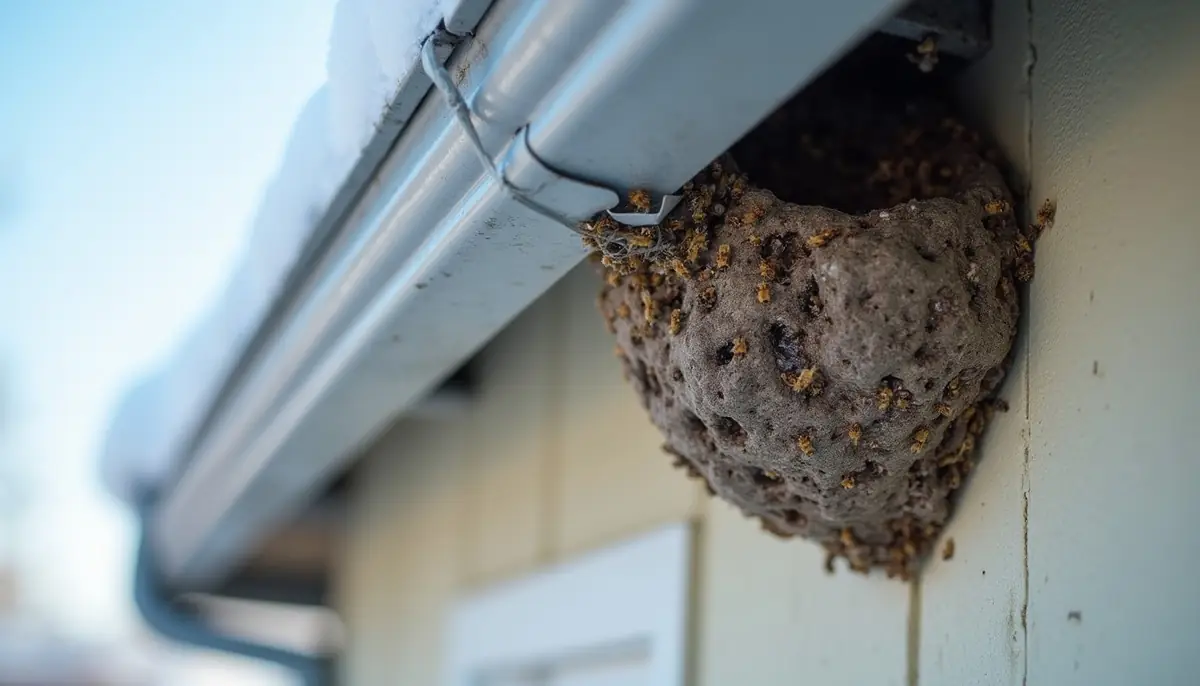
Penn State says German yellowjacket nests built “in a heated, insulated structure” occasionally survive the winter, and Virginia Tech notes the same for attic nests. A nest in a wall void or attic is the one most worth checking in winter, and our guide on how long yellow jackets stay in a ground nest covers the outdoor equivalent.
Ohio State adds a small caveat to the no-reuse rule: abandoned nests usually disintegrate over winter but are “occasionally reused by another queen.” For the full yellow jacket year, see why autumn is peak yellow jacket season.
The European hornet’s late finish
The only true hornet established in the US runs late: our analysis of iNaturalist records puts its peak in September and October, and Maryland notes it flies by day and at night. Its nests are concealed in hollow trees, barns, wall voids and attics rather than hanging in the open. Expect activity into autumn, and read our European hornet guide before disturbing a nest in a building.
Paper wasps sheltering near the old nest
UC IPM says paper wasp colonies, like yellow jacket colonies, normally live only one season, and that overwintering queens begin new nests in spring. The small open comb under an eave is not reused, although a queen may shelter nearby on the building. Our paper wasp profile covers their season, including subtropical colonies that last longer.
What else may be living in an old nest
An empty nest is not always vacant. The University of Arkansas notes that old bald-faced hornet nests “are often damaged by birds preying on insects and spiders that seek shelter in them,” which is why winter nests are often found torn open. Penn State observes that some bald-faced hornet nests are so full of yellowjacket remains that the inside has a yellowish cast. For nests inside walls and attics, Virginia Tech advises removing them promptly once the wasps are dead, because they “may attract other insects or mice” that feed on the dead adults and brood. If small bristly larvae later appear indoors near such a spot, our carpet beetle guide helps identify them.
Removing an old nest safely
- Confirm the species and the site. An exposed paper nest in a tree is the easy case. If you are unsure what built it, our wasp and hornet identification guide starts from the nest.
- Wait for hard frosts. Penn State’s guidance for annual nests is to wait until the first hard frost or two; Maryland describes a killing frost as the point when the nest ceases to be threatening.
- Watch the entrance on a mild afternoon. No wasps going in or out on the warmest day of the week is the practical test. Any traffic means wait, especially in the South or with a wall nest; our guide to getting rid of wasps by nest type covers an active one.
- Bag it and seal the gap. For nests on buildings, sealing cracks afterwards stops new queens using the same spot, which Virginia Tech recommends.
Mud dauber nests are the simplest case of all: UC IPM says that “during winter, you can safely remove the nests without spraying,” and our page on mud daubers and their nests explains why they rarely sting.
For a nest still active in autumn, published estimates on our wasp nest removal cost page put bald-faced hornet removal at around $625, though Penn State’s advice for annual nests, to wait for the first hard frost or two, often makes a late-autumn call-out unnecessary.
Frequently asked questions
Should I remove a hornet nest in winter?
You can, but you rarely need to. After hard frosts a bald-faced hornet nest is empty and will not be reused, so a nest high in a tree can be left to weather away. Remove nests on buildings, and especially in walls or attics, where Virginia Tech warns the dead contents may attract other insects or mice.
How can you tell if a hornets nest is empty?
Watch the entrance hole on the mildest afternoon after several hard frosts: no wasps flying in or out means the colony has died. A nest torn open by birds, which the University of Arkansas describes, is also a sign it is dead. In the far South or in a heated wall or attic, treat any traffic as an active nest.
What month do hornets abandon their nest?
Hornets do not move out so much as die out. New queens leave in late summer and early autumn to mate; the workers and old queen then die when cold weather arrives, before or shortly after the first hard frost according to Penn State. Our iNaturalist data shows bald-faced hornet records falling from an index of 289 in September to 94 in November and 48 in December.
Do hornets come back after you remove their nest?
Not the same colony. Virginia Tech says each overwintered queen starts a new nest in a new location in spring, and the old nest is not reused. A sheltered spot under an eave can still attract a different queen, and Ohio State notes old nests are occasionally reused by another queen, so seal gaps in buildings once the nest is gone.
Where do hornets go in the winter?
Only the newly mated queens survive, and each hides alone. Penn State lists hollow trees, rock piles, under bark and the walls and attics of buildings; Maryland adds leaf litter, compost piles, logs and soil cavities. Workers and males die in autumn, and queens emerge in spring to start new nests.
Sources
- Virginia Cooperative Extension, Baldfaced aerial yellowjacket (publication 3006-1449), and Yellowjackets in Virginia, ENTO-49, Virginia Tech.
- Penn State Extension, Baldfaced Hornet fact sheet, and German Yellowjackets fact sheet.
- University of Maryland Extension, Social Wasps: Yellowjackets, Hornets, and Paper Wasps.
- University of Arkansas, Arthropod Museum, Baldfaced hornet.
- University of Florida IFAS, Hornets and Yellowjackets, Vespula and Dolichovespula spp., Featured Creatures EENY-081 (IN238).
- Clemson Cooperative Extension, Home and Garden Information Center, Yellow Jackets fact sheet.
- Ohio State University Extension, Yellowjackets, fact sheet HYG-2075.
- Mussen, E. C. and Rust, M. K., Pest Notes: Yellowjackets and Other Social Wasps, UC ANR Publication 7450.
- Ridge, G. E., Yellowjackets (Family Vespidae), The Connecticut Agricultural Experiment Station fact sheet.
- The Pest Control Brief analysis of iNaturalist research-grade records, pulled October 2026 (b19 to b30 files).