Carpet Beetles: Larvae, Rashes and How to Get Rid of Them
Carpet beetles are small, rounded beetles whose hairy larvae eat wool, silk, fur, feathers, leather and pet hair, while the adults you see at windows feed on pollen and do no damage. In US homes the usual three are the varied, furniture and black carpet beetle. They do not bite, but the larvae’s fine hairs can cause an itchy rash in some people. Thorough vacuuming, hot laundering or dry cleaning, and freezing what cannot be washed usually clear them; stuffed furniture and heavy, recurring infestations are the cases for a professional.
Most people meet carpet beetles twice: as speckled beetles on a sunny windowsill in spring, and later as bristly brown larvae, or their empty skins, under a rug or among stored sweaters. The larvae are the part that matters.
The three carpet beetles in US homes
UC IPM names three species that cause serious damage to fabrics, carpets, furs and stored food: the varied carpet beetle (Anthrenus verbasci), the furniture carpet beetle (Anthrenus flavipes) and the black carpet beetle (Attagenus unicolor). They share a life cycle but differ in looks and in how long the damaging larval stage lasts.
| Varied carpet beetle | Furniture carpet beetle | Black carpet beetle | |
|---|---|---|---|
| Adult size | 2 to 3 mm, about a tenth of an inch | About 3 mm (1/8 inch), slightly larger and rounder than varied | 3 to 5 mm (1/8 to 3/16 inch) |
| Adult colour | Black with an irregular pattern of white, brown and dark yellow scales | Mottled black spots among white and yellow to orange scales; white underside | Shiny black to dark brown, brownish legs |
| Larva | Light and dark brown bands, broader at the rear, dense hair tufts it can raise into a plume | White at first, darkening to chestnut brown; broader at the front | Shiny, smooth, tapering to a tuft of long tail hairs; up to 5/16 inch (about 8 mm) |
| Eggs per female | 40 | 60 | 90 |
| Larval stage | 220 to 630 days | 70 to 94 days | 166 to 330 days |
| Adult lifespan | Female 2 to 6 weeks, male 2 to 4 | 4 to 8 weeks | 4 to 8 weeks |
| Worth knowing | The common one at windows in spring | Feeds on the same items as varied | In dry areas such as California, more of a stored grain and flour pest than a fabric pest |
Compiled by The Pest Control Brief from UC IPM Pest Notes 7436 (sizes, colours, life cycle table), University of Maryland Extension (varied adult in mm) and UF/IFAS ENY-204 (furniture adult size).
What do carpet beetles look like?
Adults are tiny, oval to round beetles, 1/16 to 1/8 inch long according to the University of Kentucky, and UC IPM says they look like miniature lady beetles in shape. When the coloured scales wear off with age, varied and furniture carpet beetles can look plain brown or black.
Larvae are what you find in fabric. Kentucky describes them as 1/8 to 1/4 inch long, tan to brownish, slow moving and densely covered with hairs or bristles; Clemson gives a wider 1/4 to 1/2 inch for full grown larvae, so expect a range. The black carpet beetle larva is the easiest to name: shiny, carrot shaped and ending in a tail of long hairs. If you are sorting through other small dark insects in the house, our guide to little black bugs in the house separates the biters from the harmless ones.
Signs of carpet beetles rather than clothes moths
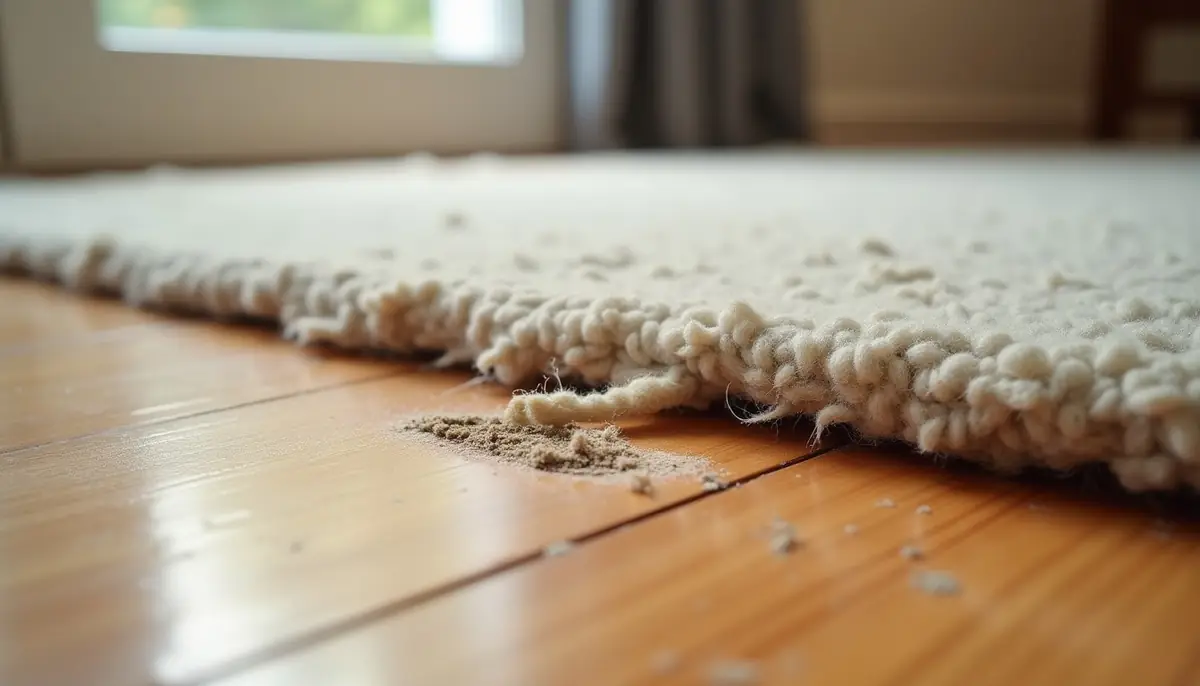
- Shed skins. Larvae leave brown, shell like, bristly cast skins every time they moult. Because larvae moult many times, Clemson notes, an infestation can look bigger than it is.
- No webbing. Clothes moth larvae spin silk; carpet beetle larvae do not.
- Damage pattern. UC IPM says carpet beetles tend to damage a large area on one part of a garment or carpet, while moth damage more often shows as scattered holes.
- Droppings. Faecal pellets about the size of a grain of salt sit where larvae have fed.
Our page on clothes moth treatment covers the moth side of the comparison.
Why are there carpet beetles in my house?
Most carpet beetles come from outside. Adults are good fliers, attracted to light, and feed on pollen of plants such as crape myrtle, spiraea and buckwheat. They fly in through open windows and vents or arrive on cut flowers, then gather on sills and window glass.
The larvae need animal material. Outdoors, females lay eggs in bird, bee and wasp nests and old spider webs; indoors, on wool rugs, woollens, furs, feathers, leather, silk and accumulated pet hair. UC IPM says they do not feed on synthetic fibres; Kentucky adds that cotton and synthetics are rarely attacked unless blended with wool or heavily soiled with food or body oils.
Where to look
- Edges and undersides of rugs and carpets, which Kentucky says are more likely to be infested than open areas, and under heavy furniture that never moves.
- Seams, folds, cuffs and collars of stored wool, especially items put away dirty.
- Floor vents, ducts and under skirting boards, wherever lint and pet hair collect.
- Attics, chimneys and light fixtures, where dead insects and old bird or wasp nests build up.
- Kitchen cupboards and pet food, because some species also infest seeds, cereals and pet food; see our pantry pests guide if the trail leads to food.
- Furniture, mattresses and pillows stuffed with hair or feathers.

Our data: when carpet beetles are seen
We analysed iNaturalist research grade records to see when people photograph carpet beetles. The varied carpet beetle has 15,997 US records across the 50 states. Its share of all observations climbs steeply from February, peaks in March at 4.2 times its yearly average (an index of 419), stays high in April, and almost vanishes from July to October. UC IPM likewise says adults usually appear in spring or early summer.
The spring peak shows adults heading for flowers and windows, not a sudden infestation. The larvae fed indoors, hidden, over the previous months, so Kentucky treats spring beetles on sills as a sign of an infestation inside.
By state, Kansas, Maryland and Georgia record the varied carpet beetle most often relative to everything else people log there. These are photographed sightings that follow observers, not a measure of indoor infestation, and several leading states rest on a few hundred records.
How long do carpet beetles live?
The larval stage is the long one. UC IPM’s life cycle table puts the varied carpet beetle at 10 to 20 days as an egg, 220 to 630 days as a larva and 10 to 13 days as a pupa, followed by an adult life of a few weeks. Clemson gives one to four generations a year. This is why one clean-out rarely ends a problem.
Are carpet beetles harmful?
To fabric, yes; to people, usually not. The damage is to wool rugs, woollens, furs, feathers, taxidermy and, UC IPM notes, even piano felts.
Do carpet beetles bite?
No. Carpet beetle larvae and adults do not bite people. What some people get instead is carpet beetle dermatitis, a skin reaction to the larvae’s hairs. Penn State Extension reports that from 1948 dermatologists described patients who felt “bitten by something” and had intense itching and a rash; biopsies tied the reactions to hairs of carpet beetle larvae in four genera, including Anthrenus and Attagenus. Sensitisation appears to follow long term exposure.
A 2021 report in the CDC journal Emerging Infectious Diseases described 11 people in seven families near Nice, France, with itchy raised spots mostly under clothing. An entomologist found Anthrenus larvae in their clothing and upholstery and ruled out bed bugs and fleas. The authors warn that this dermatitis is underdiagnosed or confused with bed bug or flea bites. After the homes were cleaned and laundered and the patients treated by doctors, the lesions healed and no new ones appeared a month later.
If you have an unexplained rash, see a doctor or dermatologist rather than treating it yourself, and bring any small larvae or skins you find in a sealed bag. Our bite identification guide explains why marks alone rarely identify the cause.
Carpet beetles vs bed bugs
Carpet beetles in bed are a common false alarm. An adult bed bug is about 6 mm (a quarter inch), flat, wingless and reddish brown, according to Cornell; a varied carpet beetle adult is 2 to 3 mm, round and speckled. The hairy, banded larvae look nothing like bed bugs. Our full comparison is in bugs that look like bed bugs.
How to get rid of carpet beetles
UC IPM is explicit that a few adult beetles indoors should not be cause for alarm and that management is only needed if you find larvae developing in fabrics or other areas. Where you do, control rests on sanitation and exclusion; if those work, insecticides are not required.
- Find the source. Put plain sticky traps on windowsills and around rooms and check them once or twice a week; the cluster of catches points to the feeding site.
- Vacuum thoroughly and often, concentrating on carpet edges, skirting boards, under furniture, closets and vents. Bin the bag outdoors straight away.
- Launder or dry clean. UC IPM calls hot water washing or dry cleaning the most important method for clothing and blankets, because it kills all stages. Kentucky adds that a clothes dryer’s heat is also effective.
- Freeze or heat what cannot be washed, using the times and temperatures in the table below.
- Throw out badly infested items, bagged first so larvae are not shed on the way out.
- Remove outdoor sources: old bird, rodent, bee and wasp nests, spider webs and dead insects in attics and around light fixtures. Check that window screens, doors and vents are secure.
- Store clean. Clean woollens before storing and seal them in tight plastic bags or containers. Both UC IPM and Kentucky say cedar is not a reliable deterrent.
Freezing, heat and cold storage: what the extension sources say
| Method | Temperature | Time | Source and note |
|---|---|---|---|
| Home freezer | Below 18°F (about minus 8°C) | 2 weeks | UC IPM 7436; items sealed in a plastic bag |
| Home freezer | 0°F (minus 18°C) minimum | At least 1 week | University of Kentucky ENT-601 |
| Deep freezer | Minus 20°F (minus 29°C) | 72 hours | Kentucky ENT-601; UF/IFAS ENY-204 also gives three days |
| Mounted specimens, trophies | Freezer | 10 to 14 days | UC IPM 7436 |
| Oven or heat chamber | 120°F (49°C) or higher | At least 30 minutes | UC IPM 7436 |
| Low oxygen (anoxic) bag | Oxygen below 0.1 to 0.5 per cent | 8 to 21 days | UC IPM 7436; museum and collection method |
| Cold storage (protects, does not kill) | 40 to 42°F | Long term | UF/IFAS ENY-204 (archival, 1999) |
Compiled by The Pest Control Brief from UC IPM Pest Notes 7436, University of Kentucky ENT-601 and UF/IFAS ENY-204. Kentucky advises wrapping items in plastic and letting them warm for about 24 hours before unwrapping.
Insecticides, mothballs and what not to spray
Kentucky says sprays are often of limited use because the larvae are inside materials; at most they supplement housekeeping, applied to carpet edges and closet floors with a product labelled for fabric pests. Kentucky, UC IPM and Clemson all say not to treat clothing or bedding, and Clemson adds that sprays do not work as a preventive. Follow the label. Moth balls, flakes and crystals containing paradichlorobenzene or naphthalene can be hazardous if used incorrectly, which we cover in are mothballs dangerous.
When professional treatment is worth it
Most light infestations are a DIY job. Call a licensed professional when:
- Larvae are inside furniture, mattresses or pillows stuffed with hair or feathers. UC IPM says surface spraying fails and recommends vault fumigation, which only licensed operators may do.
- Valuable wool or Oriental rugs, furs or heirloom textiles are affected; UC IPM suggests a pest control or carpet cleaning company, and a dry cleaner for area rugs.
- Beetles keep returning after thorough cleaning, which can point to a hidden bird, rodent or wasp nest.
Typical prices and what a visit includes are on our carpet beetle treatment cost page, so we have not repeated them here.
Frequently asked questions
Are carpet beetles harmful?
Carpet beetles are harmful to belongings rather than to people. The larvae eat wool, silk, fur, feathers, leather and pet hair, and can damage rugs, clothes, taxidermy and piano felts. They do not spread disease or sting. Some people develop an itchy rash from contact with the larvae’s hairs, called carpet beetle dermatitis, which a doctor should assess. The adults at windows feed on pollen and cause no damage.
What are carpet beetles?
Carpet beetles are small beetles in the family Dermestidae. In US homes the main three are the varied, furniture and black carpet beetle. Adults are 2 to 5 mm long, round or oval, and either speckled with coloured scales or plain black. Their hairy larvae feed on animal fibres and debris such as lint, hair and dead insects, often unnoticed for months in dark, undisturbed places.
How to get rid of carpet beetles?
Find where the larvae are feeding, then vacuum carpet edges, skirting boards, vents and closets thoroughly and bin the bag outdoors. Wash affected items in hot water or have them dry cleaned, and freeze what cannot be washed, for example at 0°F for at least a week. Remove old nests and dead insects from attics, store woollens clean and sealed, and call a professional for stuffed furniture.
Do carpet beetles bite?
No. Neither the adults nor the larvae bite people. The red, itchy spots blamed on carpet beetles come from contact with the fine hairs of the larvae, a reaction dermatologists have documented since 1948. A 2021 CDC journal report warns that this dermatitis is often mistaken for bed bug or flea bites. Anyone with an unexplained rash should see a doctor, ideally with a sample of any larvae found.
What do carpet beetles look like?
Adults look like tiny lady beetles, about 2 to 5 mm long. Varied and furniture carpet beetles are mottled with white, brown, yellow or orange scales; black carpet beetles are shiny black with brownish legs. Larvae are the stage you find in fabric: banded brown and bristly, or, for the black carpet beetle, shiny and carrot shaped with a tail of long hairs.
Sources
- University of California Statewide IPM Program, Pest Notes: Carpet Beetles, Publication 7436, D.H. Choe, revised April 2020.
- University of Kentucky Entomology, ENTFACT-601: Carpet Beetles, M.F. Potter, revised 2026.
- Clemson Cooperative Extension Home and Garden Information Center, Controlling Fabric Pests.
- University of Maryland Extension, Carpet Beetles, revised 2020.
- UF/IFAS Extension, ENY-204 Carpet Beetles, P.G. Koehler, 1991, revised 1999 (archival copy).
- Penn State Extension, Carpet Beetle Dermatitis, S. Jacobs, revised 2015; and Clothes Moths, S. Jacobs, revised 2013.
- Simon L, Boukari F, Almou Oumarou H, et al. Anthrenus sp. and an Uncommon Cluster of Dermatitis. Emerging Infectious Diseases 27(7), 2021, CDC.
- Cornell University New York State IPM Program, Identifying Bed Bugs.
- The Pest Control Brief analysis of iNaturalist research-grade records, pulled October 2026.