Pantry Pests: Which Ones Chew Into Sealed Packets

Some pantry pests chew into sealed packaging and some only exploit openings that are already there, and knowing which you have tells you how far the problem spreads. Warehouse beetle and drugstore beetle larvae chew through boxes, bags and even foil. Sawtoothed grain beetles slip into creases and folds. Weevils never enter at all, because they arrived inside the grain. Extension guidance on all of them agrees: find and discard the infested item, because insecticides in a food cupboard are not recommended and will not solve it.
The usual sequence is moths in the kitchen, followed by a sweep of the cupboard, followed by moths again three weeks later. That happens because the source was never found, and because the larvae leave the food to pupate somewhere else entirely.
What is in the cupboard
Most of these insects are under 4 mm, which is why the first sign is usually webbing, a flying adult, or the food itself rather than the insect.
The diagnostic that matters: can it get into a sealed packet?
| Species | How it gets in | What that means |
|---|---|---|
| Warehouse beetle | Chews through packaging, boxes and bags | Unopened packets are not safe. Inspect everything |
| Drugstore beetle | Chews through paperboard, bags and aluminium foil | Same, and it attacks a very wide range of dry goods |
| Indianmeal moth | Larvae penetrate intact packaging | The webbing is the giveaway; unopened bags can still be infested |
| Sawtoothed grain beetle | Exploits existing openings, creases and imperfect seals | Often hides in outer packaging and enters when the packet is opened |
| Cigarette beetle | Enters through tiny seam openings, including spice tins | Check the small containers people never suspect |
| Rice, granary and maize weevils | Neither. The egg is sealed inside the kernel before you buy it | Whole grains, rice and pasta are the source, not the destination |
| Flour beetles | Cannot open packaging and cannot feed on whole grain | Needs milled or broken material, so flour and meal are the habitat |
Purdue puts the general point plainly: cardboard, paper or plastic wrapping will not prevent insect infestations, and ordinary metal kitchen canisters are generally not tight enough to exclude insects, though some plastic containers with very tight lids may be acceptable.
Weevil or flour beetle?
These get conflated constantly, including by pages that rank for the phrase. A true weevil has a distinct snout and develops entirely inside a whole kernel: the female chews a depression, lays an egg and seals it in with a plug, and every larval stage happens inside the grain. Flour beetles cannot do any of that, and cannot feed on intact kernels at all. They need flour, meal or broken grain.
So if the insects are in your flour, they are almost certainly flour beetles. If they emerged from rice, dried beans or whole grains, they are weevils. One further ID pair: granary weevils cannot fly, while rice and maize weevils can.
Why the larvae are on your ceiling
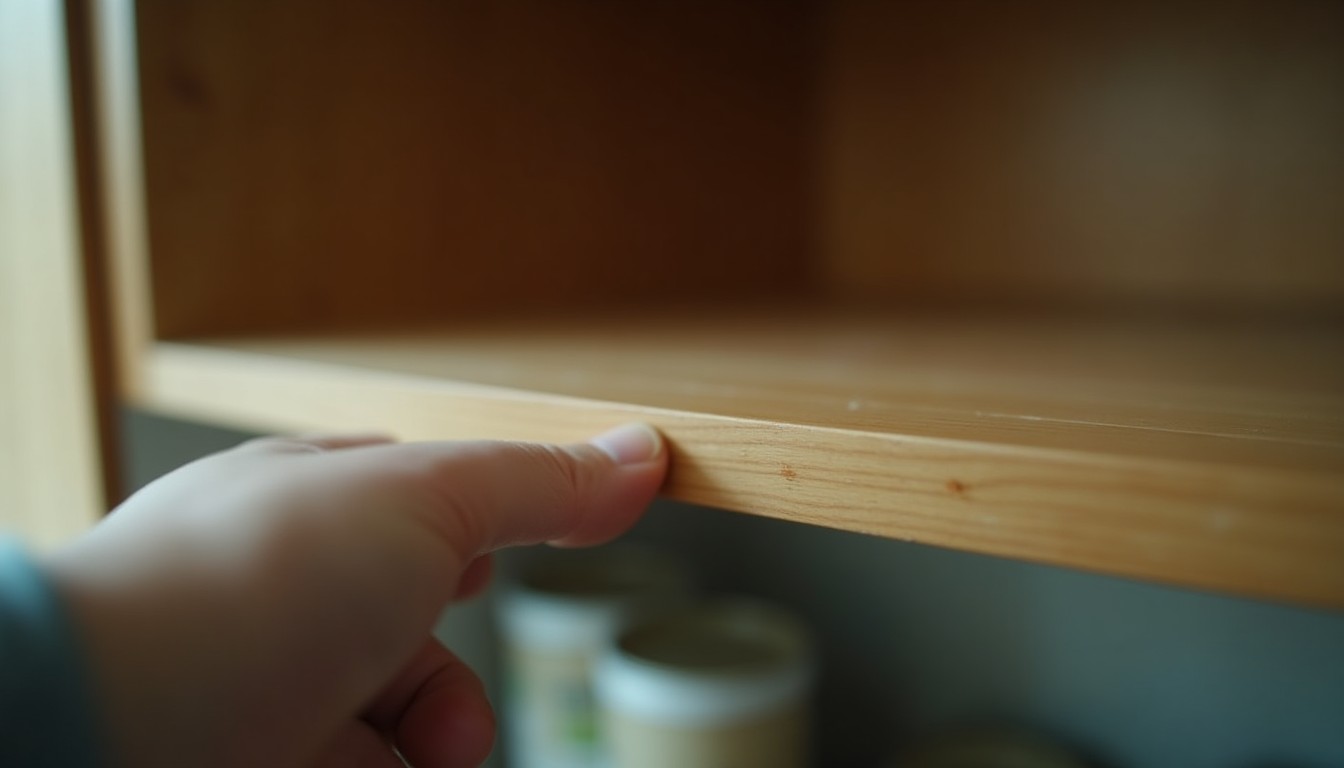
This is the single most confusing feature of pantry moths, and it has a clean explanation. Just before pupating, Indianmeal moth larvae crawl away from the food to find somewhere to spin up: the intersection of a ceiling and wall, seams inside cupboards, spaces between walls and shelves, folds of packaging, and the corrugations of cardboard boxes.
They have well-developed prolegs and can travel a surprising distance, which is why mature larvae turn up far from the original food source and get mistaken for fabric pests. If you are finding small caterpillars at the top of a wall in a room with no food in it, this is what is happening.
Warmth sets the pace
Indianmeal moths complete a generation in 25 days at 86°F, 30 days at 77°F and 60 days at 68°F, and a female lays between 40 and 400 eggs. That temperature sensitivity explains both the summer surge and the apparent winter lull. Other species are similar: sawtoothed grain beetles take about 25 days under optimum conditions, with an average of 375 eggs per female, and flour beetles average 26 days in warm humid conditions with 400 to 500 eggs.
Flour beetle adults can live longer than three years, and females can lay for over a year, which is worth knowing before assuming a quiet cupboard is a clear one.
Getting rid of them
- Find the source. Empty the cupboard completely and inspect every packet, including unopened ones, with attention to flour, meal, cereal, rice, pasta, dried fruit, nuts, spices, pet food and birdseed.
- Discard or disinfest what is infested. Heating at 130°F for at least 30 minutes works, as does freezing at 0°F, for four days by one extension source and six by another. The two disagree, so the longer freeze is the safer choice.
- Vacuum the empty cupboard, concentrating on shelf corners, cracks, screw holes and shelf supports, then dispose of the contents outside.
- Do not spray. Routine insecticide use in food storage areas is not recommended and gives little additional control without thorough cleaning. Killing the adults you can see does not solve the infestation.
- Store what you keep in hard containers with tight lids, since packaging will not exclude the chewing species.
- Check the things nobody checks: birdseed is a common origin, along with decorative dried arrangements and forgotten spices.
Pheromone traps have a role, and it is narrower than the packaging suggests. Extension guidance is that they monitor rather than control: they typically catch only male Indianmeal moths, will not eliminate an infestation, and are best used after the source has been removed to detect anything remaining. Too many traps in one space can saturate the area with attractant and work against you.
A note on what is normal
Insect fragments in milled food are regulated rather than prohibited. The FDA’s defect action level for wheat flour is an average of 75 or more insect fragments per 50 grams, on the basis that it is economically impractical to grow, harvest or process raw products that are totally free of non-hazardous, naturally occurring, unavoidable defects. Finding a live infestation is a reason to discard the packet; the existence of fragments in the food supply is a different matter.
If the damage is in wool, carpet or clothing rather than food, you are looking at a different group of insects: see clothes moth treatment and carpet beetles. For working out whether what you have is a resident population at all, see early signs of infestation, and for commercial kitchens the stakes and the inspection regime differ, as covered in restaurant pest control.
Frequently asked questions
Where do pantry moths come from?
Almost always in with something you bought. Infested dry goods, and birdseed in particular, are common origins, along with dried decorative arrangements. The insects are usually present when the item enters the house rather than arriving through a window.
Can pantry pests chew through sealed packaging?
Some can. Warehouse beetle and drugstore beetle larvae chew through boxes, bags and foil, and Indianmeal moth larvae penetrate intact packaging. Others, including sawtoothed grain and cigarette beetles, exploit existing creases and seam openings. Weevils do neither, because they develop inside the grain kernel.
Why are there larvae on my ceiling and walls?
Because Indianmeal moth larvae leave the food to pupate. They crawl to ceiling and wall junctions, cupboard seams and the corrugations of cardboard boxes, which can be a long way from the source, and they are often mistaken for fabric pests as a result.
Are the bugs in my flour weevils or flour beetles?
Almost certainly flour beetles, which is a genuine distinction rather than pedantry. Flour beetles cannot feed on whole grain and need milled or broken material. True weevils have a snout and develop inside intact kernels, so they come out of rice, whole grains and dried beans.
Do I have to throw everything out?
No, but you do have to inspect everything. Discard what is infested, and disinfest the rest by heating to 130°F for at least 30 minutes or freezing at 0°F, for four to six days depending on the source. Then store in hard containers with tight lids.
Do pheromone traps get rid of pantry moths?
No, and extension guidance is explicit. They generally catch only males, will not eliminate an infestation, and are best used after removing the source to monitor whether anything remains. Using too many can saturate the area with attractant and reduce their usefulness.
Should I spray the cupboard?
No. Routine insecticide use in food storage areas is not recommended and adds little without thorough cleaning, and treating adults alone does not resolve the infestation. Finding and removing the infested item is what ends it.
Is it safe to eat food with insects in it?
Discard anything with a live infestation. As context, the FDA sets defect action levels rather than a zero tolerance, allowing an average of 75 or more insect fragments per 50 grams in wheat flour, on the basis that totally defect-free processing is not achievable. People with allergies should note that warehouse beetle larval hairs and debris can be allergenic.
Sources
- Purdue Extension, E-37-W, Insect Pests of Home Stored Foods, 2019. purdue.edu
- Purdue Extension, E-223-W Indianmeal Moth, E-224-W Flour Beetles, E-228-W Sawtoothed Grain Beetle, E-230-W Warehouse Beetle, E-237-W Weevils. purdue.edu
- University of Georgia Extension, B-1378, Stored Product Pests in the Home, 2023. caes.uga.edu
- NC State Extension, Common Pantry Pests and Their Management, 2022. content.ces.ncsu.edu
- University of Kentucky Entomology, EF-612, Insects in Stored Food. entomology.uky.edu
- US Food and Drug Administration, Food Defect Levels Handbook. fda.gov