Love Bugs: Why They Swarm Twice a Year and Ruin Car Paint
Love bugs are small black flies with a red thorax that swarm across the Gulf Coast states for about four weeks twice a year, in April to May and August to September, and they are harmless: they do not bite, sting, carry disease or poison anything. They fly joined in mating pairs, which is where the name comes from. Their only real damage is to cars, where smashed bodies left to bake in the sun can etch paint. Insecticides do not control them, so the practical answers are washing your car promptly, screens and patience.
The lovebug, Plecia nearctica, is a march fly, a relative of gnats and mosquitoes, and a relatively recent arrival in most of the South. This guide covers when the flights happen, what draws them to roads and houses, what the acid-paint story gets right and wrong, why the University of Florida did not create them, and what our analysis of iNaturalist records shows about which states have them.
Love bugs at a glance
| Question | Answer | Source |
|---|---|---|
| What are they? | March flies (family Bibionidae), black with a red thorax; males about 6 to 7 mm, females 6 to 9 mm (about a quarter to a third of an inch) | UF/IFAS EENY-047 |
| When? | Two flights of about four weeks each: April to May and August to September in Florida; usually May and September in Texas | UF/IFAS; Texas A&M Forest Service |
| Time of day? | Daylight only, usually 10 a.m. to 6 p.m. in temperatures above 84°F; they do not fly at night | UF/IFAS |
| Do they bite? | No. They do not bite, sting or transmit disease and are not poisonous | UF/IFAS ENY-840 |
| How long do adults live? | About 3 to 4 days in nature | UF/IFAS ENY-840 |
| Car damage? | Can etch paint if remains bake in the sun for a day or more; clean within 24 hours | UF/IFAS |
| Can you spray them? | Chemical control is ineffective; new adults keep drifting in | UF/IFAS; Texas A&M Forest Service |
Love bugs season: two flights a year
UF/IFAS describes two generations a year in Florida, each lasting about four weeks, in April to May and August to September. The Texas A&M Forest Service gives the Texas version as adults usually emerging in May and September. Peaks run slightly earlier in the south of Florida, where UF/IFAS notes higher temperatures bring the populations on sooner, and a later study recorded a minor flight peak in December in south Florida.
Our analysis of iNaturalist research-grade records for the whole United States shows how sharp those two peaks are. For how lovebugs fit among the other seasonal pests, see our seasonal pest calendar.
Lovebug records sit at around a quarter to a third of their usual share from January to March (index 27 to 36). In April they jump to 250 and stay high in May at 226, then collapse to 9 in June and 2 in July. The autumn flight builds from 69 in August to the year’s peak of 396 in September, nearly four times the lovebug’s usual share of all records that month, before fading to 123 in October. Across the records, September (2,882) and April (2,459) are the two biggest months. Older UF/IFAS collecting records noted lovebugs in every month except November; the iNaturalist data include 66 November records, a small number but a sign that stragglers turn up in every month now. These are records of when people photographed and identified lovebugs, not population counts.
Love bugs in Florida, and is Florida the only state with lovebugs?
No. Lovebugs were first described in 1940 from Galveston, Texas, and UF/IFAS lists them as established in Alabama, Florida, Georgia, Louisiana, Mississippi, South Carolina and Texas, as well as in Mexico and Central America, with a 2006 report as far north as Wilmington, North Carolina. Florida is simply where they are most famous.
Our state-by-state count of iNaturalist research-grade records agrees with that list and adds a ranking. To compare states fairly, we divided lovebug records by all research-grade records of anything in each state.
Louisiana, not Florida, leads by a wide margin at 13.43 lovebug records per 10,000 observations, against 7.35 for Florida, 5.62 for Mississippi and 3.56 for Alabama. Texas (2.48), South Carolina (2.47) and Georgia (2.01) follow. In raw numbers Florida has the most records, 4,122, ahead of Texas with 2,751 and Louisiana with 1,070, but Florida also has far more naturalists recording everything else. Beyond those seven states the records fall off a cliff: 12 in Arkansas, 12 in North Carolina and 3 in Oklahoma, with single records in a handful of other states. Isolated records like these do not indicate established populations. For the other bugs Floridians and Texans run into, see our guides to common house bugs in Florida and common house bugs in Texas.
The University of Florida myth
A persistent story says University of Florida scientists created or released lovebugs, often as mosquito killers that escaped. UF/IFAS calls this a widely held myth. The fly’s spread was documented in 1976 by Buschman as a progressive movement around the Gulf Coast: from Louisiana and Mississippi after 1940, reaching Escambia County in the Florida panhandle in 1949, across north Florida by the late 1960s, and down the peninsula and into South Carolina during the 1970s. UF and USDA research began only after the lovebug was well established in Florida.
The mosquito version fails on biology too. UF/IFAS points out that lovebugs feed on pollen and nectar, lack the jaws, grasping legs and speed of predatory insects, and fly by day while most mosquitoes are active at twilight or night. A UF/IFAS county extension article traces the engineered-insect tale to an anonymous practical joke in the 1970s. Spread was more likely helped by prevailing winds, traffic, sod transport, roadside habitat and expanding pasture, in UF/IFAS’s assessment.
What attracts love bugs
Lovebugs are not attracted to cars as such. UF/IFAS research points to a set of cues that roads and some houses happen to supply:
- Sunlit exhaust fumes. Females are attracted to aldehydes in exhaust exposed to ultraviolet light; studies found formaldehyde and heptaldehyde the most attractive parts of diesel exhaust. UF/IFAS suggests they confuse these with the smell of decaying plant matter where they lay eggs.
- Heat. Warm engines and hot road surfaces add to the draw, and flight starts only once air temperature reaches about 68°F with bright light.
- Light colours and fresh paint. Both UF/IFAS and the Texas A&M Forest Service note attraction to light-coloured surfaces, especially white, and to freshly painted buildings.
- Flowers. Adults feed on nectar and pollen and are attracted to floral scents, which is why they crowd flowering shrubs and roadside weeds.
Why are there so many lovebugs outside my house?
Usually because of what is near the house, not what is on it. UF/IFAS explains that lovebug pairs are weak fliers that tend to stay within a few hundred yards of where they emerged when the wind is light. Larvae live in moist, grassy places with decaying plant material: pastures, grassy lawns, roadside verges and ground under leaf litter. A house next to such ground, or downwind of it, gets lovebugs; stronger winds pile them against whatever is in the way. Emergence varies widely from place to place, so neighbourhoods 20 to 30 miles apart can have very different years.
A light-coloured or freshly painted wall makes it worse. UF/IFAS describes homeowners wrongly concluding that they are attracting lovebugs, when they simply live near a hotspot.
Love bugs and car paint
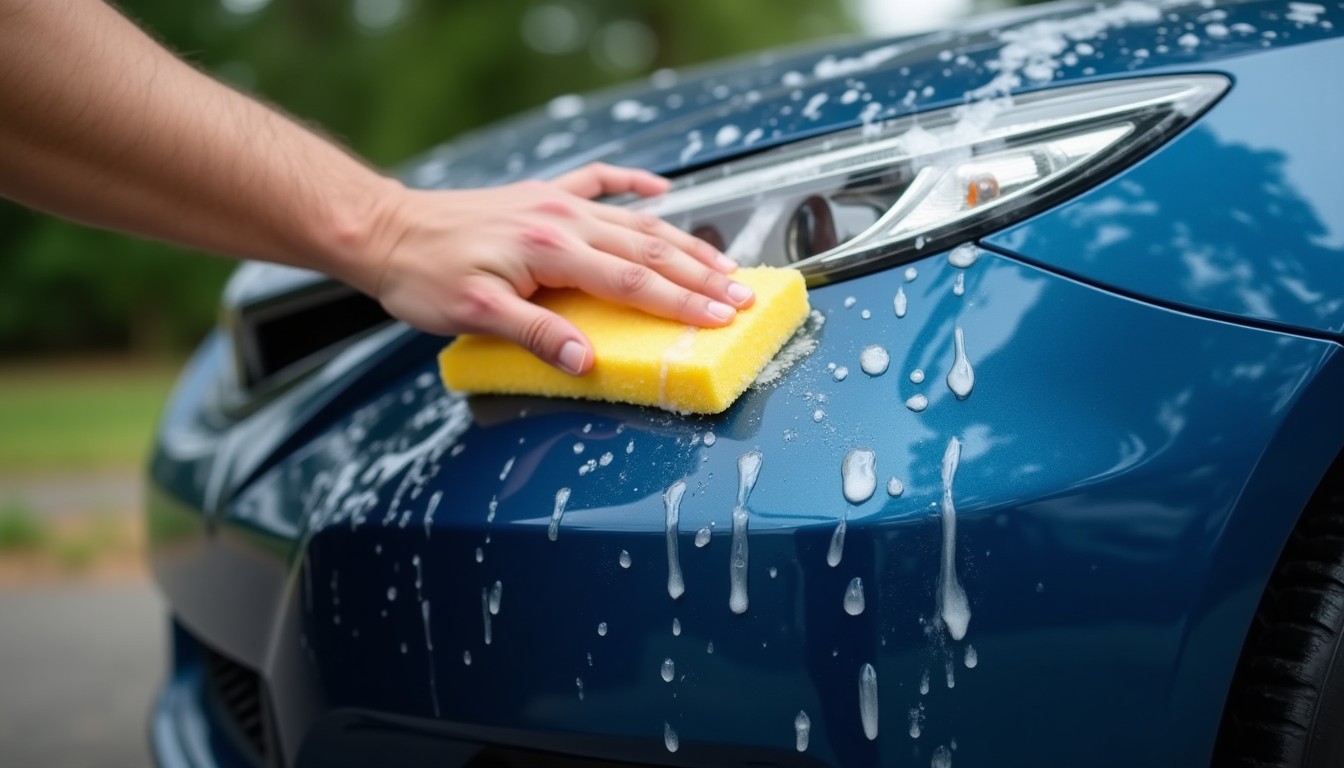
This is the one real cost of lovebugs, and the claim is half true. The UF/IFAS species profile says lovebugs can etch automobile paint because their body fluids are slightly acidic, and that bacterial action makes the remains more acidic if they stay on the car for several days. The Texas A&M Forest Service says the same: damage if not removed within a few days.
The more detailed UF/IFAS guide, Living with Lovebugs, adds the useful nuance. Crushed lovebugs measured about neutral at pH 6.5, then became acidic at pH 4.25 within 24 hours. Yet paint coated with crushed lovebugs and kept in a humid indoor room for 21 days was not damaged. The harm comes from remains, especially the egg masses, baking in the sun, and from scrubbing them off once hardened. UF/IFAS also notes that modern paint coatings have made the problem smaller than it once was.
How to protect your car
- Wash within 24 hours during a flight, sooner in strong sun.
- Soak before you scrub. UF/IFAS advises soaking with water for about five minutes, then scrubbing within 15 to 20 minutes, which removes most lovebugs without harming the paint.
- Wax the front of the car before the season so remains lift off more easily, as UF/IFAS suggests.
- Use a hood deflector or a front screen. UF/IFAS notes both reduce splatter, and screens also stop radiators clogging, since heavy loads of lovebugs can make liquid-cooled engines overheat.
- Drive at the edges of the day on long trips if you can. Lovebugs fly only in daylight and are much less active early and late.
Why are love bugs stuck together?
They are a mating pair. Males swarm over the emergence site in the morning and evening; a female flies into the swarm, a male grasps her, and the pair lands on vegetation. UF/IFAS reports that sperm transfer takes an average of 12.5 hours, but the pair can remain coupled for several days while they feed and fly. The larger female initiates and controls flight while coupled. Pairs formed in the morning fly off to disperse; those that couple in the evening stay on vegetation overnight, since lovebugs do not fly at night. Both sexes may mate again after separating.
What happens to lovebugs after they mate?
They die within days. UF/IFAS describes the adults living just long enough to mate, feed, disperse and lay eggs, about three to four days in nature. After a pair separates, the male dies, and the female lays up to 600 eggs, about 350 on average, under decaying leaves or grass before also dying. The larvae feed on decomposing plant material and are beneficial recyclers. They take about 120 days to develop in the summer generation and about 240 days over winter, then pupate for seven to nine days.
What do lovebugs do when they land on you?
Nothing harmful. Lovebugs do not bite or sting, and UF/IFAS describes them as feeding only on nectar and pollen. One that lands on you is resting, most likely drawn by warmth or light-coloured clothing, both of which attract them. Brush it off gently rather than crushing it. Lovebugs are a nuisance to drivers and people outdoors, not a health risk.
Love bugs in the house
Lovebugs do not breed indoors; the few that get in come through open doors and gaps and die within days. UF/IFAS suggests:
- Keep doors closed during flights and repair window screens, especially on the windward side.
- Run the air conditioning to create slight positive pressure, which keeps these weak fliers out.
- Vacuum any that come in.
- Use a fan outdoors near a patio, pool or work area, since lovebugs struggle to fly against moving air.
Small flies indoors outside lovebug season are something else entirely; our guide to small flying bugs in the house identifies the usual suspects. If tiny insects are biting at dusk near the coast, they are not lovebugs but no-see-ums.
How to get rid of love bugs
You cannot, in any lasting sense, and extension advice is unusually blunt about it. UF/IFAS says insecticides are expensive, potentially harmful and of no value in controlling lovebugs, because adults keep drifting in from surrounding areas and return almost immediately, while sprays risk killing beneficial insects such as lady beetles, lacewings and honeybees. The Texas A&M Forest Service says people are forced to tolerate the flies until outbreaks have run their course. Paying a pest control company to spray for lovebugs is not money well spent.
What helps is short and practical: screens, closed doors, a fan on the patio, prompt car washing, and the knowledge that each flight lasts about four weeks. Natural control is at work too: UF/IFAS research isolated several fungi from dead lovebugs, and one, Beauveria bassiana, caused 27 to 33 per cent mortality in adults and immatures in tests. UF/IFAS also reports that lovebugs have become less abundant over the past 30 years.
Lovebug or another black fly?
A similar march fly, Dilophus sayi, is smaller and entirely black, without the red thorax, and does not gather on highways, according to UF/IFAS. Swarms of black flies flying joined in pairs, with a red patch behind the head, are lovebugs.
Frequently asked questions
Are love bugs dangerous?
No. UF/IFAS states that lovebugs do not bite, sting or transmit diseases and are not poisonous. Their only harm is indirect: heavy numbers can clog car radiators and reduce visibility on the road, and remains left to bake in the sun can etch paint. Adults live about three to four days and feed only on nectar and pollen.
When is love bug season?
Two flights a year, each lasting about four weeks: April to May and August to September in Florida, according to UF/IFAS, and usually May and September in Texas. Our iNaturalist analysis shows the US peak in September, at nearly four times the lovebug’s usual share of records, with a second peak in April and May.
Do lovebugs really damage car paint?
They can, if left too long. Crushed lovebugs start about neutral at pH 6.5 and turn acidic, at pH 4.25, within 24 hours, according to UF/IFAS. Paint coated with them indoors for 21 days was undamaged; the harm comes when remains bake in the sun. Soak for about five minutes and scrub within 15 to 20 minutes, ideally within a day.
Why are there so many lovebugs some years?
Numbers depend on rainfall, natural control by fungi and local habitat, and emergence varies widely even between places 20 to 30 miles apart, UF/IFAS reports. Moist grassy ground and pasture produce the most. UF/IFAS also notes that lovebugs have become less abundant over the past 30 years, though populations rebound unpredictably.
Sources
- University of Florida IFAS, Featured Creatures: Lovebug, Plecia nearctica Hardy, EENY-047 (IN204), H. A. Denmark, F. W. Mead and T. R. Fasulo.
- University of Florida IFAS Extension, Living with Lovebugs, ENY-840 (IN694), Norman C. Leppla.
- UF/IFAS Extension Sustainable Florida Yards, Sustainability: Love Bugs.
- UF/IFAS Wakulla County Extension, Love Bugs, Les Harrison.
- Texas A&M Forest Service, Lovebugs.
- Buschman, L. L., 1976, on the lovebug’s spread around the Gulf Coast, as cited by UF/IFAS.
- The Pest Control Brief analysis of iNaturalist research-grade records, pulled October 2026.