How Many Carpet Beetles Is an Infestation? Counts and Signs

There is no published number: one carpet beetle larva, or a single shed bristly skin, indoors means beetles are breeding in your home, while a few adults on a sunny windowsill in spring often means nothing. UC IPM says “a few adult beetles indoors should not be cause for alarm” and that action is needed only when larvae are developing in fabrics or elsewhere. Count larvae and skins, not adults, and note where you find them.
That is why the question has no tidy answer in counts of adults. The varied carpet beetle adult is a pollen feeding beetle about a tenth of an inch (2.5 mm) long, per UC IPM, that often flies in from flowers; the larva is the stage that lives on your wool, and its traces are what tell you whether you have a problem.
Is it an infestation? What you see, where, and what it means
| What you find | Where | What it usually means | Next step |
|---|---|---|---|
| 1 to a few adults, spring or early summer | Window sills, curtains, panes | Often flew in or came in on cut flowers; adults are drawn to sunlight | Remove them, check screens, inspect nearby fabrics once |
| Adults appearing week after week, or outside spring | Any room, especially away from windows | Likely emerging from larvae indoors | Search for the source (below) |
| One live larva | Carpet edge, closet, under furniture, vent | Breeding indoors; a female lays 40 to 90 eggs depending on species | Search that area and every wool item nearby |
| Shed bristly skins, salt grain sized pellets | Under rugs, along skirting, in stored items | Larvae have been feeding there, possibly for months | Vacuum, launder or freeze affected items |
| Irregular holes or a grazed patch in one area | Wool, silk, felt, fur, feathers | Active or past larval feeding | Treat the item; check stored textiles |
| Larvae or skins in several rooms | Throughout the house, or near attic and vents | Established infestation, or a nest or dead insects in a void | Look for bird or rodent nests; consider a professional |
Compiled by The Pest Control Brief from UC IPM Pest Notes 7436 (2020) and University of Kentucky ENTFACT-601.

Why the adults are the weakest evidence
Varied carpet beetle adults (Anthrenus verbasci) feed on pollen and nectar and are often found on flowers such as crape myrtle and spiraea, UC IPM notes. People bring them in on cut garden flowers, and they fly through open windows and doors. Once inside, adults are attracted to sunlight, which is why they collect on sills.
iNaturalist sightings follow that pattern. In our analysis of iNaturalist research-grade records, varied carpet beetle records in March run at more than four times their usual share of everything Americans record (an index of 419, where 100 is the yearly average), falling to under a tenth of normal by August. Our main page on carpet beetle identification and control charts that season in full.
Extension sources do not read windowsill adults identically. Kentucky’s ENTFACT-601 says spring windowsill adults suggest “an infestation may be present inside the home”, while UC IPM says a few adults should not be cause for alarm. Both point to the same test: go and look for larvae.
How many carpet beetle larvae is an infestation?
One. Larvae do not fly in from outdoors; a larva indoors hatched indoors, and UC IPM says management is needed “if you find larvae developing in fabrics or other areas in your home”. Larvae are 1/8 to 1/4 inch long according to Kentucky, bristly and banded in the Anthrenus species; the black carpet beetle (Attagenus unicolor) has a smooth, shiny larva up to 5/16 inch that tapers to a tuft of long hairs, UC IPM says. If what you found is a smooth worm rather than a hairy one, our guide to little worms in the house covers the alternatives.
Shed skins count as much as live larvae. UC IPM describes the “brown, shell-like, bristly-looking cast skins” larvae leave when they moult, and these stay put after the larva has moved on. A dozen skins under one rug can be one larva’s history or several larvae’s. Either way, it marks a feeding site.
Which beetle it is matters less than where
Several dermestid beetles turn up indoors. The larder beetle, a larger relative, is a different problem with a different food source; our guide to ground beetles and larder beetles separates them.
Because carpet beetle larvae are found in beds, they are a common false alarm for bed bugs, which our page on bugs that look like bed bugs sorts out.
How fast does an infestation build?
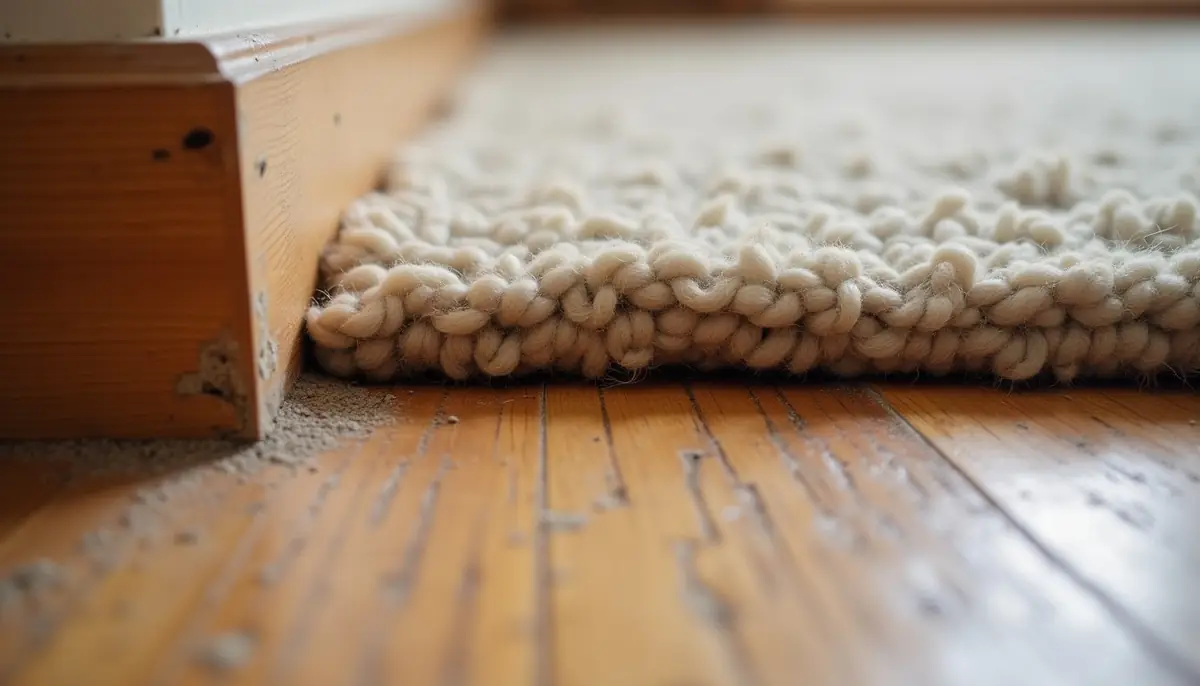
Slowly, which is the useful part of the answer, and it is why carpet beetles rarely feature among the early signs of a pest infestation people notice. A varied carpet beetle female lays about 40 eggs, which hatch in 10 to 20 days, and the larva then feeds for 220 to 630 days before pupating, according to UC IPM’s life table.
So one generation of the varied carpet beetle takes roughly one to two years. The furniture carpet beetle is faster, with a larval stage of 70 to 94 days and about 60 eggs per female; the black carpet beetle lays about 90 eggs and its larvae feed for 166 to 330 days. Finding many larvae, or damage in several places, therefore usually means a population that has been building unnoticed for more than a year, not one that arrived last week. That is a very different growth curve from the bed bug, whose thresholds are set out in how many bed bugs is an infestation.
Are carpet beetles in 90% of homes?
The real figure from the best study is higher. Bertone and colleagues (PeerJ, 2016) collected every arthropod they could find in 554 rooms of 50 houses in and around Raleigh, North Carolina. Carpet beetles (family Dermestidae) were one of only four families found in 100 per cent of the houses, alongside cobweb spiders, gall midges and ants. They turned up in 57 per cent of all rooms, feeding on dog kibble, dead insects and nail clippings.
That is the strongest reason not to panic over a single adult. Having some carpet beetles is normal; having larvae eating your belongings is the problem.
What museums do instead of using a number
Historic house collections monitor carpet beetles more closely than anyone, and even they do not work to a fixed count. In a 2011 paper on ten years of pest management at English Heritage, which covers 65 sites, Xavier-Rowe and Lauder describe sticky traps checked two to four times a year and judged by trend. At Audley End House, varied carpet beetle catches fell for seven years, then rose suddenly in 2005; the cause was a drop in housekeeping standards after staff changes, and catches fell again once deep cleaning was rescheduled in 2006. The paper names poor housekeeping, chimneys and rooms left off cleaning schedules as the main sources.
The home version is simple: put a few sticky traps on the floor near carpet edges and closets, check them once or twice a week as UC IPM suggests, and act if the count rises or larvae appear. Chimney and attic nests are worth checking too, which our guide to birds in the chimney covers.
What to do once you have found larvae
- Find every infested item: Kentucky says you must locate all of them to eliminate the beetles. Check rug edges, under furniture, closets, stored wool, felt, feathers, furs and pet hair near vents.
- Launder hot, dry clean, or freeze. Kentucky gives 0°F for at least one week; UC IPM gives two weeks below 18°F, or an oven at 120°F or higher for 30 minutes for items that tolerate it.
- Vacuum floors, carpet edges, closets and heating vents thoroughly, and empty the vacuum promptly.
- Do not spray clothing or bedding; both UC IPM and Kentucky say infested clothing or bedding should not be treated with insecticide.
The same steps clear clothes moths, and our guide on how to get rid of clothes moths gives the wash and freeze settings in detail.
If larvae keep turning up after a thorough clean, our carpet beetle treatment cost guide puts most professional jobs at $300 to $600 over two to three visits.
Frequently asked questions
Is it normal to have a few carpet beetles?
Yes. A 2016 PeerJ survey found carpet beetles in all 50 North Carolina homes sampled, and UC IPM says a few adults indoors should not be cause for alarm, since adults feed on pollen and fly in from flowers. It stops being normal when you find larvae, shed skins or fresh damage in your fabrics.
Are carpet beetles in 90% of homes?
In the one systematic US study, the figure was higher. Bertone and colleagues found carpet beetles in 100 per cent of 50 houses around Raleigh, North Carolina, and in 57 per cent of the 554 rooms they sampled. Their presence alone says little; whether larvae are feeding on wool, fur or feathers is what matters.
Can you ever fully get rid of carpet beetles?
You can stop them breeding in your belongings, but not keep every adult out. UC IPM notes adults live outdoors on flowers and come in through windows or on cut flowers. The realistic goal is no larvae in your textiles: clean or freeze infested items, vacuum edges and vents, store wool sealed and check for bird or rodent nests.
How many carpet beetles count as an infestation?
Neither UC IPM nor Kentucky extension publishes a number. One larva or shed skin indoors shows breeding, while a few adults on a spring windowsill may have flown in. Adults appearing for weeks, away from windows or outside spring and early summer, suggest a source inside. Museums judge trap catches by trend rather than a fixed count.
Are carpet beetles a sign of a dirty house?
Not on their own, since they were found in all 50 houses in the 2016 Raleigh survey. But food for larvae builds up where cleaning does not reach: lint, pet hair, dead insects and forgotten wool. English Heritage found poor housekeeping was the biggest contributor to rising catches, so vacuuming edges and vents does reduce them.
Sources
- University of California Statewide IPM Program, Pest Notes: Carpet Beetles, UC ANR Publication 7436, updated 2020.
- Potter MF. Carpet Beetles. University of Kentucky Entomology, ENTFACT-601.
- Bertone MA, Leong M, Bayless KM, Malow TL, Dunn RR, Trautwein MD. Arthropods of the great indoors: characterizing diversity inside urban and suburban homes. PeerJ, 2016.
- Xavier-Rowe A, Lauder D. Ten years of integrated pest management at English Heritage. Proceedings, Integrated Pest Management for Collections (Pest Odyssey), 2011, pages 10 to 15.
- The Pest Control Brief analysis of iNaturalist research-grade records, pulled October 2026 (b19 to b30 files).