Does Bleach Kill Roaches? Contact Kill vs Control
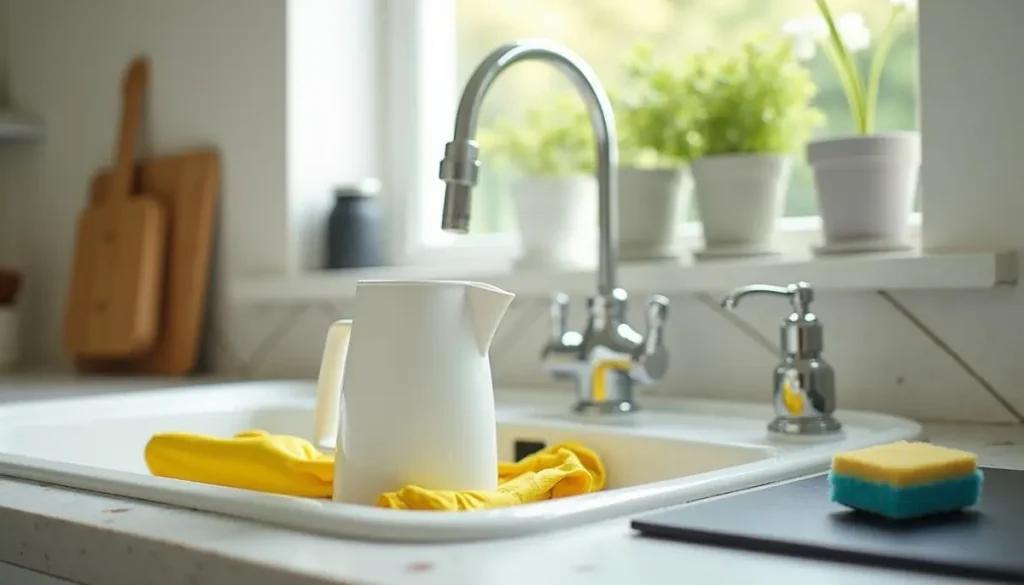
Bleach can kill a cockroach it soaks, but it will not get rid of roaches. It has no lasting effect once it dries, never reaches the insects hiding in cracks and wall voids, and is registered with EPA as a disinfectant, not an insecticide. A laboratory study found plain dish soap in water kills German cockroaches on contact without the chlorine gas risk. Clearing an infestation takes bait.
Spraying bleach at a German or American cockroach feels decisive, and the one you hit may well die. The problem is the dozens you cannot see, and the chlorine or chloramine gas you can make by accident. Here is how the household liquids people grab actually compare.
Household liquids compared
| Liquid | Kills a roach it soaks? | Lasting effect after drying? | Main hazard | Source |
|---|---|---|---|---|
| Chlorine bleach (sodium hypochlorite, about 5 to 6 per cent) | No published test found; the registered labels make no insect claim | None claimed or measured | Releases chlorine gas with acids, chloramine gases with ammonia | EPA-accepted bleach labels, Reg. No. 5813-1 and 5813-50; New Jersey Department of Health |
| Dish soap in water | Yes: at 1 per cent or more, 95 per cent or more of adults unresponsive or dead | None | Low | Szumlas, Journal of Economic Entomology, 2002 |
| White vinegar | No published kill test found | None | Releases chlorine gas if mixed with bleach | New Jersey Department of Health |
| Household ammonia | No published kill test found | None | Forms chloramine gases with bleach | New Jersey Department of Health |
| Rubbing alcohol | No published kill test found | None | Forms chloroform if mixed with bleach | New Jersey Department of Health |
| Gel bait (for comparison) | Not a contact kill: roaches eat it and die later | Yes, while bait remains | Low when placed as the label directs | Arbes and colleagues, 2003 and 2004 |
Compiled by The Pest Control Brief from the sources named in each row.
What kills cockroaches with bleach?
Nobody has published a laboratory test of household bleach on cockroaches, so any claim about how fast it works or how much is needed is a guess. What has been measured is a gentler liquid. In 2002, entomologist David Szumlas of the US Naval Medical Research Unit in Cairo treated German cockroaches with dish soap diluted in tap water at nine strengths from 0.05 to 5 per cent.
The soap knocked insects down at once, and his observations were consistent with the solution blocking the spiracles and breathing tubes, so they suffocated. Half died at 0.4 per cent soap, 99 per cent at 3.0 per cent. At 3 per cent or stronger every treated insect was unresponsive within 3 minutes, and all adults and nymphs were dead within 72 hours. Adult females were the hardest to kill.
So in Szumlas’ tests a liquid that coated a roach killed it without any insecticide in it. That is probably why a drenched roach dies under bleach too, but the kill depends on hitting the insect, and a roach that runs for cover is never hit.
Why a dead roach on the counter changes little
Most of a population is never in the open. UC IPM says roaches spend the day hidden around water heaters, in cupboard cracks, stoves, hollow walls and false-bottom cupboards, invading kitchens at night, and that sprays give a quick, temporary knockdown but no long-term control, and may disperse roaches to other parts of a building. Its Pest Notes state plainly that insecticide sprays alone will not eliminate cockroaches; a bleach spray is weaker still, because once it dries there is nothing left on the surface.
The eggs are a second gap. A German cockroach female carries her egg case, about 1/4 inch long, until 1 to 2 days before it hatches, UC IPM notes, and we found no published test of bleach on egg cases. Our guide to what each species’ egg case looks like shows where they end up.
With females carrying the next generation around, our page on how fast German and American cockroaches reproduce explains why a few surface kills do not dent the numbers.
Baits work the other way round: roaches carry the dose back to where they hide. Our comparison of gel bait and spray for roaches sets out the trials.
The German cockroach is the species where delivery matters most, as our page on why spraying stopped working on German cockroaches explains.
Bleach is a disinfectant, not an insecticide
Household bleach is a registered pesticide under the Federal Insecticide, Fungicide, and Rodenticide Act, but registered as a germicide and disinfectant. One EPA-accepted label, Reg. No. 5813-1, describes the product as a 5.25 per cent sodium hypochlorite solution and carries the standard warning: it is a violation of federal law to use this product in a manner inconsistent with its labeling. None of the accepted claims on that label or on Reg. No. 5813-50 concerns insects. Spraying it at cockroaches is a use its label does not list.
Never mix it with another cleaner
The real danger in a roach-hunting kitchen is chemistry. The 5813-50 label warns not to use or mix bleach with toilet bowl cleaners, rust removers, acids or products containing ammonia, because doing so releases hazardous irritating gases. A New Jersey Department of Health hazard alert spells out the reactions:
- Bleach plus an acid, including vinegar, lemon juice and many toilet and drain cleaners, produces chlorine gas.
- Bleach plus ammonia creates chloramine gases, which cause coughing, chest pain and, in serious cases, fluid in the lungs.
- Bleach plus rubbing alcohol forms chloroform.
The same alert describes a plumber taken to an emergency department with respiratory distress after pouring an acid drain opener into a drain that already held bleach. If a mixture has been made, leave the room for fresh air and call Poison Control on 1-800-222-1222.
Does bleach kill roaches in drains?
Only the few that the liquid touches on the way down. The large roaches that come up through drains are usually American cockroaches, and their source is out of reach. UF/IFAS Featured Creatures notes counts of more than 5,000 in individual sewer manholes and says they migrate into houses and apartments from sewers via the plumbing. UC IPM adds that they forage into ground floors when pipes are damaged, screens are missing or water traps in drains are faulty.
Even registered insecticides struggle there. In a University of California, Riverside trial published in 1991, boric acid powder and other dusts applied to sewer shafts gave excellent control for at least a month, yet cockroaches reinfested treated shafts within 3 to 6 months. A cup of bleach poured into a sink trap is gone in seconds.
The fixes are mechanical: keep water in seldom-used floor drains and sink traps, repair damaged pipes, and fit drain covers. The bleach label itself says to flush drains before and after use, a reminder that whatever is already in the pipe can react with it. Our guide to American cockroaches in the house covers telling a sewer visitor from an indoor population.
What bleach is genuinely good for: the allergen
Dead roaches, droppings and shed skins carry the allergens that trigger asthma, and cleaning removes them. The clearest evidence comes from a randomised trial by Arbes and colleagues at the National Institute of Environmental Health Sciences, published in 2003. In 16 low-income urban homes with 50 to 500 cockroaches trapped in 3 days, occupant education, insecticide bait and professional cleaning cut the Bla g 1 allergen on kitchen floors from 633 to 24 units per gram of dust in 6 months, a 96 per cent fall.
The 2004 continuation added a twist. When the original control homes were given bait alone at months 6 and 9, their kitchen floor allergen fell 95 per cent, from 287 to 14.4 units per gram, and by month 12 the two groups no longer differed. The authors called the bait-only result surprising, in contrast to other studies, and said it was being tested further. The common factor was killing the roaches; the trial does not show which cleaner was used, so it is not evidence for bleach in particular.
UC IPM recommends vacuuming cracks and crevices with a HEPA or triple-filter vacuum, because airborne fragments of shed skins and droppings can cause allergies. Our review of cockroach allergen and asthma research covers the health side.
What kills roaches instantly, and what clears them
For the roach in front of you, a direct hit with soapy water at 3 per cent or stronger left every treated German cockroach unresponsive within 3 minutes in the Szumlas tests. For the population, the evidence favours baits, and our guide to how boric acid works on roaches and where it fails covers the cheapest registered option.
Kitchen-cupboard alternatives have a thinner record: a 2025 University of Ghana trap study and one student thesis are the only tests behind our review of whether baking soda kills roaches, which explains why it does not replace bait.
No single product will reliably kill 100 per cent of the roaches in a home, so heavy German cockroach infestations, apartments where roaches move between units, and anyone with asthma at home are cases where a licensed professional is usually worth the cost. The step-by-step plan by species is in our guide to getting rid of roaches.
Frequently asked questions
What cleaner do roaches hate the most?
No published study shows cockroaches avoid bleach, vinegar or pine cleaner. The scents with laboratory evidence are citrus oils and catnip’s nepetalactone, measured over minutes rather than weeks, as our review of which smells roaches hate sets out. Clean surfaces matter because they remove food, not because roaches dislike the smell.
Does bleach kill roaches overnight?
Not in any useful sense. Bleach acts only on a roach it soaks and leaves nothing behind once dry, so roaches that come out after dark cross treated surfaces unharmed. Leaving bleach out overnight also adds fumes to a closed kitchen. Gel baits, by contrast, keep working while bait remains, as long as they are placed as the label directs.
Does bleach kill cockroach eggs?
We found no published test of bleach on cockroach egg cases. German cockroach females carry the egg case until 1 to 2 days before it hatches, according to UC IPM, so most cases are inside harbourages or on the female, not on open surfaces. Vacuuming removes cockroaches, shed skins and egg cases, UC IPM notes.
What will 100% kill roaches?
No household method has been shown to kill every roach in a home. In the laboratory, dish soap at 3 per cent killed all treated German cockroaches within 72 hours, but only the insects it touched. In homes, the Arbes trials found that bait combined with education and cleaning significantly cut cockroach numbers and allergen, which is why baits are the core of professional treatment.
Is it safe to spray bleach on roaches?
It is not a use the bleach label lists, and the main risk is accidental mixing: bleach with ammonia releases chloramine gases, and bleach with vinegar or acid cleaners releases chlorine gas, according to the New Jersey Department of Health. Soapy water does the same contact job without that risk.
Sources
- Szumlas, D.E., Behavioral responses and mortality in German cockroaches (Blattodea: Blattellidae) after exposure to dishwashing liquid. Journal of Economic Entomology 95(2): 390 to 398, 2002.
- Arbes, S.J. Jr and others, Abatement of cockroach allergen (Bla g 1) in low-income, urban housing: a randomized controlled trial. Journal of Allergy and Clinical Immunology 112(2): 339 to 345, 2003.
- Arbes, S.J. Jr and others, Abatement of cockroach allergens (Bla g 1 and Bla g 2) in low-income, urban housing: month 12 continuation results. Journal of Allergy and Clinical Immunology 113(1): 109 to 114, 2004.
- Sutherland, A.M., Choe, D.H. and Rust, M.K., Pest Notes: Cockroaches, UC ANR Publication 7467, revised December 2019.
- Barbara, K.A., American Cockroach, Periplaneta americana, UF/IFAS Featured Creatures EENY-141 (EDIS IN298).
- Rust, M.K., Reierson, D.A. and Hansgen, K.H., Control of American cockroaches (Dictyoptera: Blattidae) in sewers. Journal of Medical Entomology 28(2): 210 to 213, 1991.
- US EPA, accepted labels for household bleach, EPA Reg. No. 5813-1 (2010) and 5813-50 (2009), Pesticide Product Label System.
- New Jersey Department of Health, Hazard Alert: Mixing Bleach with Other Cleaning Products Can Be Deadly.