Mason Bees: Gentle Pollinators, Nest Tubes and Bee Houses
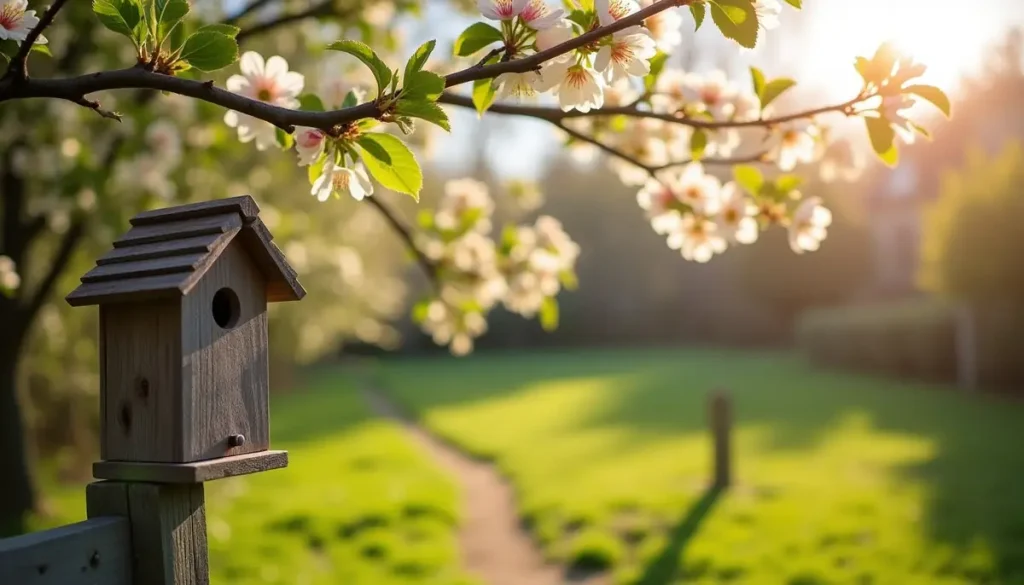
Mason bees are gentle, solitary spring bees in the genus Osmia that nest in existing holes and seal each egg cell with mud; they make no honey and very rarely sting. The common US species is the blue orchard bee, a shiny dark blue bee about the size of a honey bee and active for only a few weeks in early spring. They pollinate fruit trees efficiently, cannot drill wood, and are not a pest that needs removing.
Most questions about mason bees come down to two things: telling them apart from bees that do cause problems, and making a bee house that actually works. Extension sources agree that most backyard bee houses fail for avoidable reasons, which we set out below with the numbers.
Mason bee, carpenter bee or honey bee?
| Mason bee (Osmia) | Large carpenter bee (Xylocopa) | Honey bee | |
|---|---|---|---|
| Body length | 7 to 16 mm | 15 to 23 mm | 12 to 15 mm |
| Look | Dull metallic blue-green, or black with pale hair; robust, broad head | Black, shiny mostly hairless abdomen, bumble bee shape | Light to dark brown with banded abdomen |
| Social life | Solitary, but nests side by side | Solitary | Colonies of thousands |
| Nest | Existing holes and crevices, partitioned with mud; cannot make its own hole | Chews its own round hole, slightly under half an inch, into bare wood | Hives and cavities |
| Damages wood? | No | Yes, galleries 4 to 6 inches along the grain | No |
| Honey | None | None | Yes |
| Sting | Females only, rarely, even when handled | Males lack a stinger; their dive-bombing is a bluff | Defends the colony |
| Active | A few weeks in early spring | Emerge April to early May; adults overwinter in the galleries | Colonies persist year round |
Table compiled by The Pest Control Brief from Ohio State University Extension ENT-57 and HYG-2074, Oregon State University Extension EM 9130, and SARE, Managing Alternative Pollinators, chapter 6.
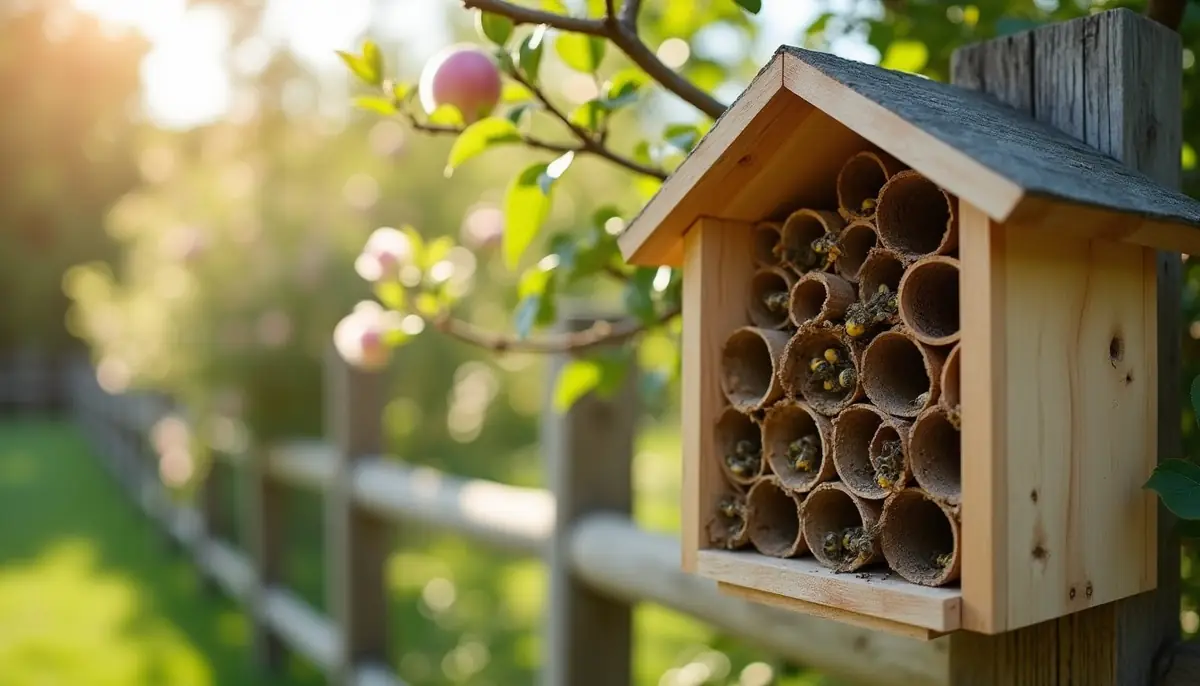
Are mason bees the same as carpenter bees?
No. Oregon State puts it plainly: mason bees cannot create their own holes and need pre-existing holes or crevices. A large carpenter bee, by contrast, chews a clean round entrance slightly less than half an inch wide into bare wood and then tunnels 4 to 6 inches along the grain, according to Ohio State. If you see a fresh, perfectly round hole with sawdust beneath it in a fascia board or deck rail, that is a carpenter bee; our guide to carpenter bees versus bumble bees covers identification, and carpenter bees and other wood-destroying insects covers the damage. A mason bee may reuse an old carpenter bee or beetle hole, but it adds only a mud plug.
What do mason bees look like?
Ohio State’s bee identification guide gives mason bees as 7 to 16 mm long, in two forms: a black body covered in pale hair, or a dull metallic green-blue and less hairy body, with a head as broad as the thorax. Females carry pollen on a brush of hairs under the abdomen rather than on the legs, so a loaded female looks yellow underneath. SARE’s mason bee manual adds that females usually have a pair of small horn-like projections on the lower face, while males have longer antennae and a tuft of white hair on the face.
How big are mason bees?
Most are 7 to 16 mm long. The blue orchard bee (Osmia lignaria) female is roughly the size of a honey bee but rounder and metallic blue. The hornfaced bee (Osmia cornifrons) is slightly smaller, brown with a striped abdomen, and was imported from Japan by the USDA in the 1970s.
What is a red mason bee?
The red mason bee is Osmia bicornis, formerly called Osmia rufa, a European species covered by most UK guides. In a German apple orchard study, Gruber and colleagues recorded females at 10 to 12 mm and males at 8 to 10 mm. It is not among the species SARE lists as sold commercially in the US, which are O. lignaria, O. californica and O. cornifrons.
Do mason bees sting? Are they aggressive?
Rarely, and no. SARE states that despite having a stinger, female mason bees are not aggressive and rarely sting, even when handled, and that the sting is much less painful than a honey bee’s; beekeepers working with them need no protective equipment. Males have no stinger at all. Oregon State says they sting only if handled roughly or trapped under clothing. Because each female defends nothing but her own tube, there is no colony to provoke, which is why they suit gardens with children. Anyone with a known severe reaction to bee stings should still follow their doctor’s advice.
Where do mason bees live?
In the wild, SARE says, Osmia nest beneath rock or bark crevices, in hollow pithy stems, or in tunnels left by wood-boring insects; Oregon State adds crevices in siding. Ohio State notes they are solitary but nest in aggregations. Washington State University counts about 150 Osmia species in North America.
The blue orchard bee is native to most western states from southern Alaska to California and east to Texas and Montana, and to most eastern states from Maine to northern Georgia, as two subspecies; SARE notes few records from the central plains. Only the western subspecies is sold commercially.
Where our iNaturalist data finds blue orchard bees
We pulled US research-grade iNaturalist records of Osmia lignaria. It is a small sample, 1,525 records, and sightings follow where people look, so treat the ranking as indicative. Washington (489 records) and Oregon (335) lead by a wide margin when adjusted for each state’s overall recording effort, which fits the Pacific Northwest’s large hobby and commercial mason bee community.
When are mason bees active?
Briefly. SARE describes managed blue orchard and hornfaced bees as active for only a few weeks in early spring, and USDA ARS scientist Theresa Pitts-Singer gives the adult life as about 4 to 6 weeks. In our iNaturalist pull, 92 per cent of blue orchard bee records and 98 per cent of hornfaced bee records fall in March, April and May, with April the peak for both. Eastern carpenter bees and honey bees, by comparison, are recorded through summer and autumn.
That short window is the reason SARE warns that bees sold as “garden pollinators” will do little for late-blooming vegetables: by tomato season, the adults are dead and their offspring are developing inside sealed tubes.
Why are mason bees important?
| Figure | What it shows | Source |
|---|---|---|
| 250 females per acre (apples), 300 per acre (almonds) | USDA Bee Lab stocking rates for blue orchard bees | SARE, chapter 6 |
| About 1,000 bees plus one honey bee hive per acre | Almond stocking used by early adopters; the blue orchard bees replace one of the two usually recommended hives | Pitts-Singer, Utah State University Extension ENT-229-21, 2021 |
| 80 per cent of apples in Aomori, Japan | Share pollinated by the hornfaced bee in Japan’s largest apple region | SARE, chapter 6 |
| Up to 25 flowers a minute | Foraging rate in warm, clear weather; 15 to 40 trips provision one cell | SARE, chapter 6 |
| About 100 yards; 200 to 300 feet | Effective foraging range from the nest | SARE; Oregon State EM 9130 |
| About 95 per cent of flowers visited | Share of visited flowers pollinated, as stated by Oregon State without a cited study | Oregon State EM 9130 |
Table compiled by The Pest Control Brief from SARE, Managing Alternative Pollinators (Mader, Spivak and Evans), Utah State University Extension ENT-229-21 and Oregon State University Extension EM 9130.
Two cautions. Pitts-Singer notes many apple orchards already have enough local native pollinators. And the popular claim that one mason bee equals 100 or more honey bees is not one we could trace to a primary study, so we have left it out. Protecting them during spraying matters as much as housing them; see our guide to pollinator protection on pesticide labels.
Mason bee houses: why most fail
| Problem | What goes wrong | Fix |
|---|---|---|
| Wrong hole size | Smaller or shorter holes give more males and fewer offspring | Blue orchard bee: 7.5 mm (19/64 inch) by 6 inches (SARE); Oregon State suggests 5/16 inch tubes about 6 inches long |
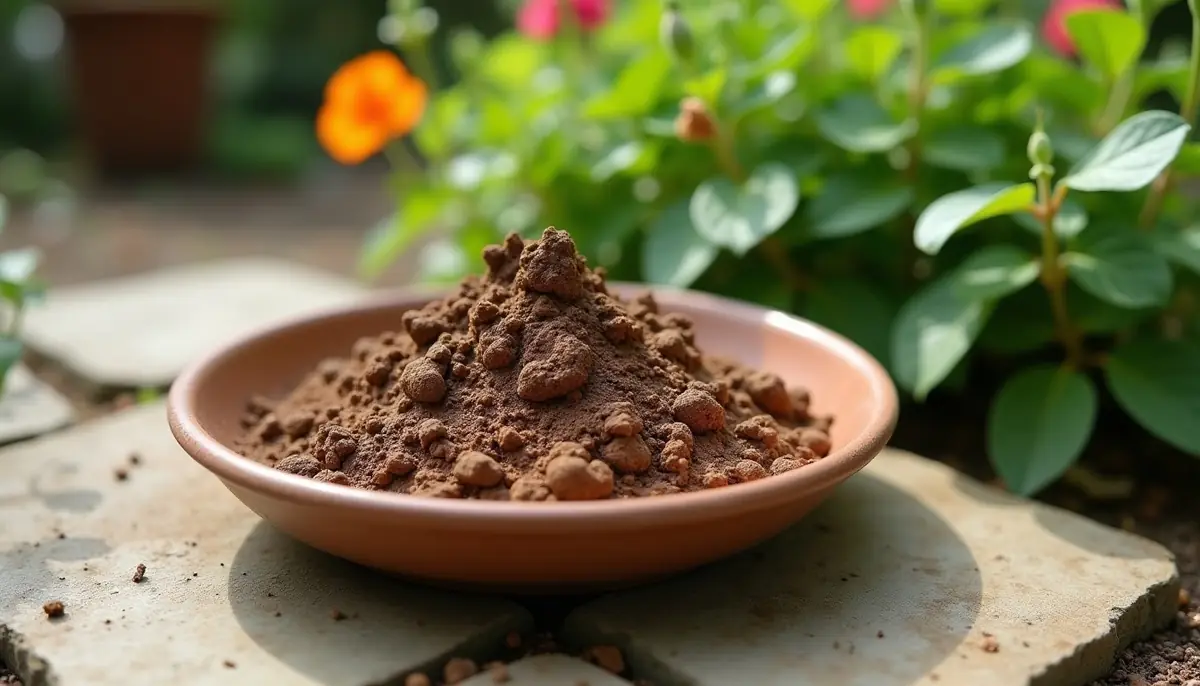
| No clay mud nearby | Without moist clay, Oregon State says the bees will not use the site | Set out a pile of clay-rich mud kept damp on one side |
| No early flowers | Without nectar and pollen close by, Oregon State says the bees will not use the site | Fruit trees, willow, dandelion or Oregon grape within 200 to 300 feet |
| Materials that cannot be opened | Solid blocks, plastic and (per Oregon State) bamboo hold moisture and build up mites and mould | Paper-lined tubes, reeds or laminated blocks you can split and clean |
| Never cleaned | Pollen mites, chalkbrood and parasitic wasps multiply year on year | Open tubes in October or November and clean cocoons |
| Poor placement | Rain, wind and hot afternoon sun reach the tubes | Morning sun, facing south or southeast, 3 to 6 feet up, sheltered from rain; away from bird feeders |
| Holes packed too tightly | Bees enter the wrong hole and spread disease spores | About 3/4 inch between holes on flat blocks, or colour the entrances |
Table compiled by The Pest Control Brief from SARE, Managing Alternative Pollinators, chapter 6 and appendix A, and Oregon State University Extension EM 9130.
The sources disagree on bamboo: Oregon State advises against it, while SARE says reed and bamboo sections that are phased out regularly support very healthy populations. Both agree the material must be replaced or cleaned each year.
Pollen mites, chalkbrood and parasitic wasps
- Pollen mites. The hairy-fingered mite (Chaetodactylus krombeini) eats the pollen store so the larva starves; SARE says a related mite is blamed for 80 per cent of hornfaced bee mortality in Japan without treatment. Bright yellow mite frass in a cell is the sign, per Oregon State.
- Chalkbrood. SARE calls this fungus the single most destructive disease of cavity-nesting bees, leaving chalky brown, grey, black or white larval cadavers, and says constant sanitation is the only effective control in the US.
- Parasitic wasps. Monodontomerus wasps, 2 to 4 mm long and metallic, can push their ovipositor through paper or cardboard tubes under about 1 mm thick. Tight backs on nest blocks and removing nests promptly after the season help.
How to clean mason bee cocoons
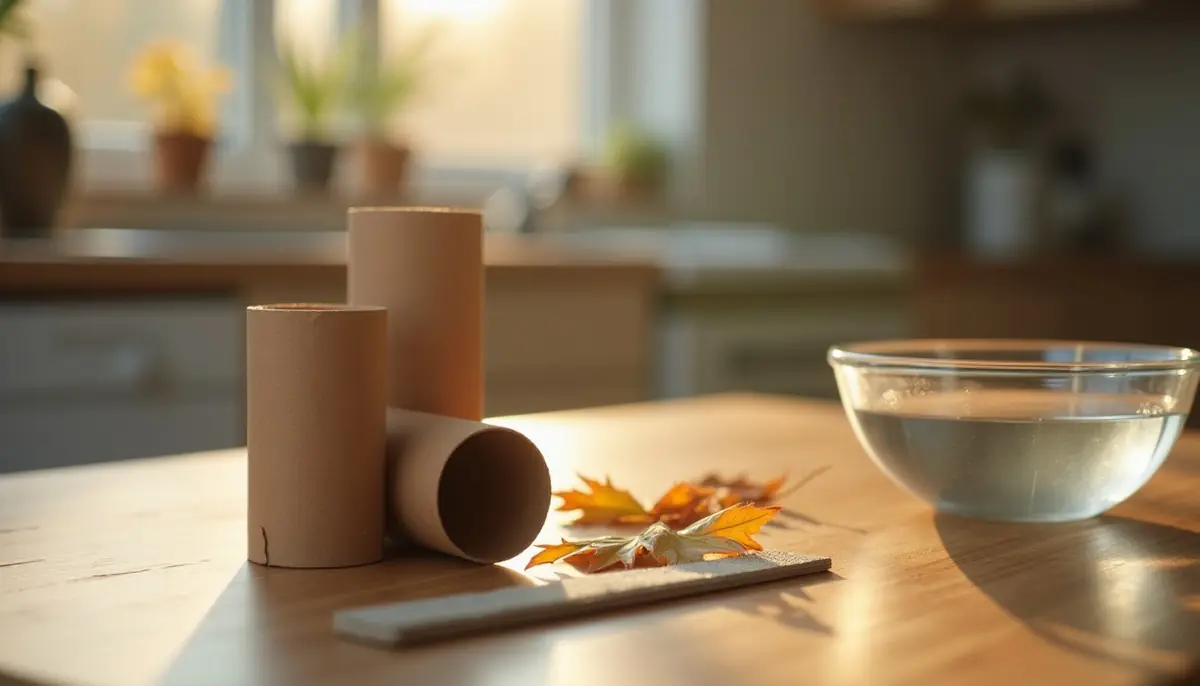
- In October or November, split the paper liners or separate laminated blocks, as Oregon State advises.
- Lift cocoons out gently with a flat nail file and discard indented ones, which did not develop.
- If a 10x lens shows mites, swirl cocoons for 1 to 2 minutes in a 0.05 per cent bleach solution (1 tablespoon of household bleach in 8 cups of cool water), rinse in cool water and air-dry. Dry sand rubbed over the cocoons also dislodges mites.
- Store them in a ventilated container in the refrigerator at 39°F with a damp, not dripping, paper towel, checking every two weeks.
- Put them out when daytime temperatures reach 50 to 55°F, alongside fresh tubes.
Buy native bees from a regional supplier. In the Mid-Atlantic, LeCroy and colleagues found six native mason bee species fell by 76 to 91 per cent in pan-trap catches from 2003 to 2017 as two Asian species, including the hornfaced bee, became established.
How to get rid of mason bees?
Usually you do not need to. They do not damage sound wood, the adults live only weeks, and they leave on their own by early summer. If females are plugging gaps in siding, mortar or window frames where you do not want them, wait until the season ends, then seal or repair those gaps, and offer a bee house nearby so they nest there instead. Because the young develop inside the sealed cells through summer and winter, avoid caulking over mud plugs mid-season if you want the bees to survive. Spraying is not warranted for a beneficial, nearly stingless bee. If the holes are fresh, round and in bare wood, you have carpenter bees, a different problem; and if bees are coming out of the lawn, see our guide to ground bees.
Frequently asked questions
Do mason bees make honey?
No. Mason bees are solitary: each female builds her own nest and stocks each cell with a ball of pollen and nectar for a single egg, then seals it with mud. There is no colony, no queen and no honey store. Oregon State notes they do not produce honey, which is one reason they are kept for pollination rather than harvest.
Do mason bees damage houses?
Not in the way carpenter bees do. Mason bees cannot drill holes; they only use existing crevices, old insect tunnels or gaps in siding and mortar, and add mud partitions. Any hole they occupy was already there. A fresh, round hole about half an inch wide in bare wood, with sawdust below, points to a carpenter bee instead.
When should I put out a mason bee house?
Before the bees emerge in early spring. Oregon State advises placing cocoons and fresh tubes outside when daytime temperatures reach 50 to 55°F, usually late February to mid-March in western Oregon and later in colder regions. Face the house south or southeast in morning sun, 3 to 6 feet up, with clay mud and spring flowers nearby.
Are mason bees native to North America?
Many are. Washington State University counts about 150 Osmia species in North America, and the blue orchard bee is native to much of the West and East. The hornfaced bee was imported from Japan by the USDA in the 1970s, and the red mason bee is European. Research in the Mid-Atlantic links the spread of Asian mason bees to declines in native species.
Sources
- Mader E, Spivak M, Evans E. Managing Alternative Pollinators: A Handbook for Beekeepers, Growers, and Conservationists. SARE, 2010: chapter 6, Mason Bees (natural history, lifecycle, preferred nest dimensions, nest materials, release rates) and appendix A (chalkbrood, mites, wasps).
- Oregon State University Extension Service, EM 9130, Nurturing Mason Bees in Your Backyard in Western Oregon (Edmunds, Little and Sagili), 2016.
- Utah State University Extension, ENT-229-21, Blue Orchard Bee (Osmia lignaria): Commercial Pollinator for Orchards (Pitts-Singer, USDA ARS), 2021.
- Ohio State University Extension, ENT-57, Bee Identification Guide, 2015; and HYG-2074, Carpenter Bees.
- Washington State University, Hortsense: Megachilidae: Mason Bees (Osmia spp.).
- Gruber B, Eckel K, Everaars J, Dormann CF. On managing the red mason bee (Osmia bicornis) in apple orchards. Apidologie 42: 564 to 576, 2011.
- LeCroy KA, Savoy-Burke G, Carr DE, Delaney DA, Roulston TH. Decline of six native mason bee species following the arrival of an exotic congener. Scientific Reports 10: 18745, 2020.
- The Pest Control Brief analysis of iNaturalist research-grade records, pulled October 2026.