Can Fleas Live in Carpet? How Long, and How to Clear It
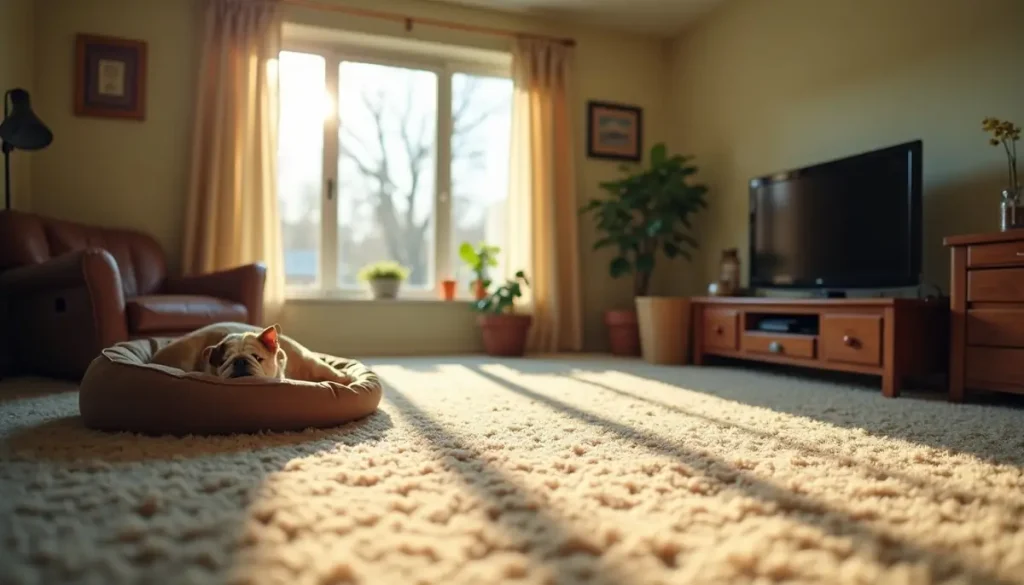
Yes, fleas live in carpet, but mostly as eggs, larvae and cocoons rather than as the biting adults, and the larvae spend more than 80 per cent of their time down at the base of the pile. There they feed on flea dirt, the dried blood adult fleas drop from the pet. An unfed adult lasts a few days to 2 weeks off an animal, while a flea waiting in its cocoon can hold on for up to 30 weeks, and up to 12 months when cool. Vacuuming kills about 96 per cent of the adults it picks up, but lifts less than 30 per cent of the larvae, so carpet needs a plan, not one clean.
Most advice treats carpet as a single place. It is not. The top of the pile, the middle and the base behave differently, carpet styles hide fleas in different layers, and a spray, a vacuum and a steam cleaner each reach a different depth. This guide covers what lives where, how long it lasts, how to confirm it and what reaches it, using extension services and the studies behind them.
What lives in your carpet, and what reaches it
| Stage | Where it sits | How long it lasts | What reaches it | What does not |
|---|---|---|---|---|
| Egg, about 0.5 mm | Falls where the pet rests; near invisible on carpet | Hatches within about 2 days | Vacuuming; IGR sprays stop development | Adult-only sprays |
| Larva, 1.5 to 5 mm | Base of the pile, away from light, coiled round fibres | 5 to 11 days, up to 2 to 3 weeks when cool | IGRs, borates in the nap, steam, air below 50% humidity | Vacuuming removes under 30% |
| Cocoon (pupa) | Top or base of the pile, by carpet style | 1 to 2 weeks to develop, then up to 30 weeks waiting | Vacuuming kills those it collects and triggers the rest to emerge | Insecticide does not penetrate the cocoon |
| Adult, 1 to 3 mm | Mostly on the pet; new adults wait at the surface | A few days to 2 weeks unfed | Vacuuming, steam, adulticide sprays | IGRs alone |
The University of Kentucky sets the order of work: adult fleas spend most of their time on the dog or cat, not in the carpet, while eggs, larvae and pupae build up wherever the pet rests or sleeps. The carpet is the nursery. Treat the pet and the house in the same period, with the animal’s product chosen by a vet.
Can fleas live in carpet without a host?
Yes. Larvae never need a host. They feed on debris in the floor covering, and the University of Florida names their main food as dried adult flea faeces. While flea dirt is in the carpet and the air is humid enough, larvae develop with no animal in the room.
Humidity is the limit. The Merck Veterinary Manual states that prolonged relative humidity below 50 per cent is lethal to larvae, and that indoors they probably survive only deep within carpet fibres, in cracks between hardwood boards in humid climates and on damp basement concrete. UC IPM and UF put the preferred range at 70 to 90°F with at least 75 per cent humidity.
How long a carpet stays infested once the pet has gone is covered in how long fleas can live without a host: adults fade in days, cocoons wait for months. If fleas appear in a home with no pets, UF’s school IPM guidance points to rodents, feral cats, raccoons, opossums, squirrels or birds in unused parts of the building; see fleas in the yard for outdoor sources.
Can fleas live in carpet overnight?
Easily. Texas A&M says an adult without a host lives a few days to 2 weeks, and the immature stages live in carpet for days to weeks. One night without the pet changes nothing.
How long fleas last in carpet, by stage
Sources differ, mostly because development speeds up in warm, humid rooms and slows in cool, dry ones.
| Stage | Figure | Source |
|---|---|---|
| Egg to hatching | Within 2 days | UF/IFAS EDIS IN137 |
| Larva | 5 to 11 days, up to 2 to 3 weeks | Merck; Texas A&M E-433 |
| Larva | 5 to 15 days | UF/IFAS EDIS IN137 |
| Adult waiting in cocoon | Up to 30 weeks | Merck Veterinary Manual |
| Adult waiting in cocoon | Up to 5 months | Texas A&M E-433 |
| Adult waiting in cocoon | Up to 12 months when cool | UC IPM Pest Notes 7419 |
| Unfed adult off the host | A few days to 2 weeks | Texas A&M E-433 |
The cocoon is what makes a carpet feel permanently infested. Its sticky surface picks up debris as camouflage, and UF notes adults emerge in response to vibration or rising carbon dioxide, which is what a person crossing the room supplies. The flea life cycle guide explains the second wave this produces about two weeks after treatment.
Where in the carpet fleas actually are
A 1987 Virginia Tech study by David Byron found that cat flea larvae move downward and away from light, which left them spending more than 80 per cent of their time at the base of the pile. Disturbed, they coil round the fibres. Eggs and larval skins clustered where the pet spent time, and busy walkways were poor places for larvae to develop. UC IPM agrees: larvae are rarely found in heavy traffic areas or sunlit spots.
Where the larva spins its cocoon depends on the carpet. A 2000 study by Miller, Dryden, Broce and Suiter recorded where larvae pupated in four carpet styles.
In wool loop carpet 92.4 per cent of pupae were at the base of the pile, against 2.2 per cent in nylon contract carpet, and control of pupae was lowest in the loop styles. On nylon saxony, vacuuming gave the same pupal control as a surface spray of permethrin. A dense loop or wool carpet is the harder job.
Sprays struggle to reach that depth. In the Virginia Tech trials, more than 93 per cent of the solution from a compressed-air sprayer landed in the top 6 mm of the carpet at every pressure tested. Kentucky’s answer is to vacuum first: raising the nap improves penetration to the base of the fibres where developing fleas live. Hardwood, tile and concrete generally need vacuuming, not insecticide, Kentucky adds.
Checking a carpet for fleas
You will rarely see a larva, and UF describes the white eggs as nearly impossible to see against carpet. Use these checks instead.
- The white sock walk. UC IPM and Kentucky suggest walking round pet resting areas in white socks pulled to the knee. Adult fleas jump on and show against the white.
- The wet paper test. Comb the pet over a white surface and wet any black specks. Ohio State says that if they turn red, they are the blood faecal pellets of adult fleas.
- Look where the pet rests: edges of pet beds, under sofa cushions, along the nearest skirting.
- A light trap for low numbers. UF’s school IPM guidance says fleas are most sensitive to green light and respond better when the light switches off for 10 seconds every 5 to 10 minutes. It treats 20 or more fleas per trap in a week as a more serious infestation.
- Bites around the ankles. See can humans get fleas for what they look like and when to see a doctor.
The sizes below show why the eye is a poor detector. For photographs of each stage and common lookalikes, see what fleas look like.
What vacuuming does to fleas, by study
Every extension source recommends vacuuming, and the evidence is better than most people expect. The detail is that killing and removing are different results.
In the Ohio State study by Hink and Needham, cat fleas were vacuumed from a tightly woven kitchen-type carpet with a single upright model. Six tests on adults killed an average of 96 per cent; tests on pupae and third-stage larvae killed 100 per cent. Only about 5 per cent of adults died when simply held in a paper vacuum bag, so the damage came from the brushes, fan and airflow.
Removal is the weak point. Byron found a beater-bar vacuum removed about 50 per cent of eggs but less than 30 per cent of larvae. Texas A&M gives up to 60 per cent of eggs and 30 per cent of larvae; Ohio State’s fact sheet says frequent vacuuming can remove up to 95 per cent of eggs.
So vacuuming kills most fleas it collects, removes many eggs and the flea dirt larvae eat, and its vibration makes cocooned adults emerge into contact with treatment, as Kentucky notes. What it cannot do alone is pull most larvae from the base of a dense carpet.
On the bag, advice differs. Texas A&M warns fleas can continue to develop inside vacuum bags and advises discarding them at least weekly; Kentucky says to seal the bag and put it in an outdoor bin. Following the cautious advice costs nothing.
Killing fleas in carpet: what each method reaches
- Steam cleaning kills adult and larval fleas and probably some eggs, says UF’s school IPM guidance, though the warmth can make remaining eggs hatch a day or two later. Keep vacuuming afterwards.
- Insecticide plus an insect growth regulator. Kentucky rates products combining an adulticide with an IGR such as methoprene or pyriproxyfen as most effective; pyriproxyfen formulations stop egg and larval development for several months. Treat where pets sleep and follow the label, including drying time.
- Borates worked into the nap kill larvae through their food for as long as a year, UF says, and it recommends professional application. Texas A&M notes they do not control adults.
- Heat. UF reports larvae die after an hour at 103°F but warns fleas deep in carpet may escape lethal temperatures. This is a professional service.
- Diatomaceous earth can be dusted lightly on carpet, left a couple of days and vacuumed, per UF. It fails when wet, and UF advises a mask and goggles when applying it.
- Citrus sprays kill fleas on contact but evaporate quickly, leaving little protection against emerging fleas, says Texas A&M.
Skip foggers. Kentucky says total-release foggers are seldom effective against fleas and are not recommended; our bug bomb illness data shows the other reason. The extension guidance we read does not recommend salt or baking soda, so we would not rely on them.
How to get rid of fleas in carpet fast
Fast, in flea terms, means two to three weeks, because UC IPM says fleas keep emerging for about two weeks after a spray.
- Book the pet’s treatment with your vet for the same week. Kentucky warns never to use carpet or yard products on pets.
- Wash pet bedding in hot, soapy water, then at least weekly (UC IPM).
- Vacuum everything, including under furniture, cushions and along room edges, to lift the nap.
- Treat the carpet with a labelled adulticide plus IGR, or steam clean, focusing on pet resting areas.
- Vacuum daily or every other day for 10 days to 2 weeks (UC IPM), emptying the vacuum outdoors.
- Do not retreat straight away. Kentucky advises vacuuming rather than respraying when fleas reappear early.
A light infestation on short-pile carpet often responds to this. Call a licensed professional if fleas still emerge after two full cycles, the carpet is dense wool or loop, you want borate or heat treatment, or there are no pets and wildlife may be the source. Prices are in our flea treatment cost guide, and preparing for pest control covers getting rooms ready.
Our data: fleas hide, ticks get photographed
The Pest Control Brief analysis of iNaturalist research-grade records, pulled October 2026, shows how rarely fleas are caught on camera. Florida has 26 research-grade cat flea records, Texas 32 and Pennsylvania 6. The American dog tick, another parasite that rides indoors on pets, has 177, 517 and 1,232.
These are confirmed photographs, mostly outdoors, not counts of infested homes. A tick sits still and is big enough to photograph; a flea jumps, and its young live out of sight at the base of the pile. Testing finds carpet fleas. Looking does not.
Frequently asked questions
How long do fleas survive in carpet?
It depends on the stage. Eggs hatch within about 2 days and larvae develop in roughly 5 to 11 days, longer when cool. A fully formed flea can then wait in its cocoon for up to 30 weeks, according to the Merck Veterinary Manual, or up to 12 months in cool conditions, according to UC IPM. An unfed adult lasts a few days to 2 weeks.
What kills fleas instantly in carpet?
Nothing kills every stage instantly. In an Ohio State study vacuuming killed about 96 per cent of adults and all pupae and larvae it collected, and steam kills adults and larvae on contact. Adulticide sprays cannot get into cocoons, so fleas keep emerging for about 2 weeks. A labelled adulticide plus an insect growth regulator, with daily vacuuming, covers what one method misses.
How do you know if fleas are in your carpet?
Walk slowly round the pet’s resting areas in white socks pulled up to the knee; adult fleas jump on and are easy to see. Comb the pet over a white surface and wet any black specks: if they turn red, they are flea dirt. Check under cushions and along skirting near where the pet sleeps.
Will vacuuming get rid of fleas?
It removes a large share and is essential, but rarely clears an infestation alone. Vacuuming kills most fleas it collects, removes many eggs and the flea dirt larvae eat, and makes cocooned adults emerge. One study found it removed less than 30 per cent of larvae, so pair it with pet and carpet treatment and keep going daily for about two weeks.
Does steam cleaning kill fleas in carpet?
Steam cleaning kills adult and larval fleas and probably some eggs, according to University of Florida school IPM guidance. The warmth and moisture can also make surviving eggs hatch a day or two later, so a few fleas may reappear. Keep vacuuming daily afterwards and treat the pet in the same week.
Sources
- University of California Statewide IPM Program, Pest Notes: Fleas, Publication 7419, M. K. Rust.
- University of Kentucky Entomology, ENTFACT-602, Flea Control and Prevention, M. F. Potter.
- University of Florida IFAS Extension, EDIS IN137, Cat Flea, Ctenocephalides felis (Bouché), Featured Creatures.
- University of Florida, School IPM, IPM for Fleas in Schools (IPM Action Plan for Fleas).
- Texas A&M AgriLife Extension, E-433, Controlling Fleas, Merchant and Robinson.
- Ohio State University Extension, Fleas, HYG-2081.
- Merck Veterinary Manual, professional version, Fleas in Dogs and Cats.
- University of California Statewide IPM Program, Pest Notes: Carpet Beetles, Publication 7436.
- Hink and Needham, vacuuming of cat flea life stages, Entomologia Experimentalis et Applicata, 2007; Ohio State University news release, December 2007.
- Miller, Dryden, Broce and Suiter, Pupation Site Selection of Cat Fleas in Various Carpet Types and Its Influence on Insecticide Efficacy, Journal of Economic Entomology 93(4): 1391 to 1397, 2000.
- Byron, D. W., Aspects of the biology, behavior, bionomics, and control of immature stages of the cat flea in the domiciliary environment, Virginia Tech dissertation, 1987.
- The Pest Control Brief analysis of iNaturalist research-grade records, pulled October 2026.