Can Bed Bugs Live in Carpet? Where They Really Hide
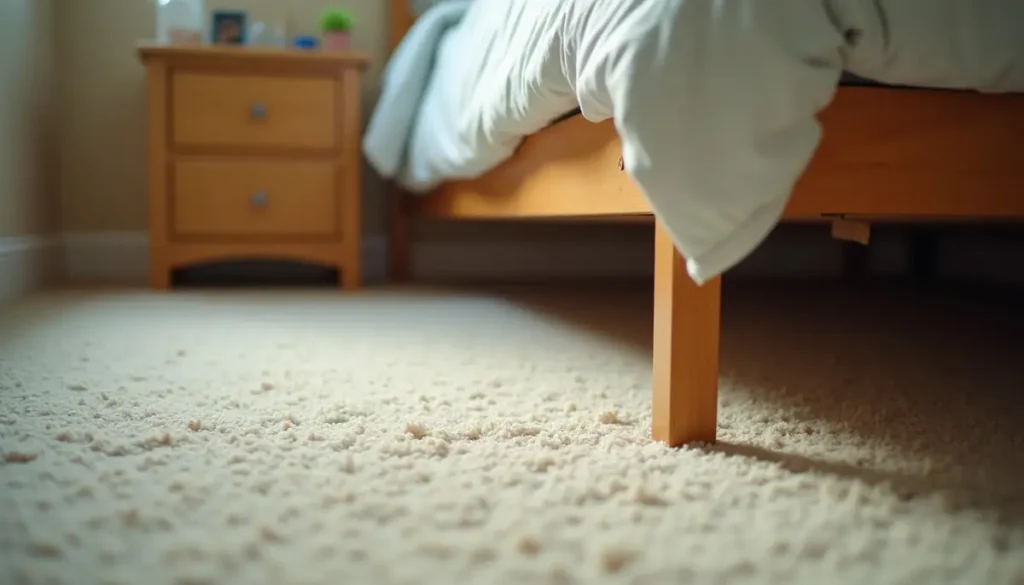
Bed bugs can live in carpet, but almost never in the open pile: they hide along and under the carpet edge next to the wall, especially behind beds and sofas, and in floor cracks close to where people sleep. Carpet fibres are a poor hiding place compared with mattress seams and furniture joints. In one Purdue study of eight infested apartments, 85 per cent of the bugs were in mattresses and box springs and only 1 per cent anywhere outside beds and sofas. Bugs in the carpet usually mean an older or larger infestation, not a carpet problem.
That distinction decides what you do next. Bugs along a carpet edge have spread out from the bed, which is why shampooing the carpet or ripping it up rarely fixes anything on its own.
Where in a carpeted room bed bugs actually hide
Bed bugs are flat, about the width of a credit card, and the EPA’s rule of thumb is that if a crack will hold a credit card, it could hide a bed bug. They choose tight, dark, undisturbed gaps close to a sleeping or resting person, then crawl out to feed. The EPA says they will readily travel 5 to 20 feet from a hiding place to reach a host, so a carpet edge across the bedroom is within range.
| Spot in the room | How likely | What to check |
|---|---|---|
| Mattress, box spring, bed frame, headboard | Most likely by far | Seams, piping, tags, screw holes and frame joints |
| Sofa, recliner, upholstered chair | Second most likely | Seams, under cushions, the underside and frame |
| Carpet edge behind the bed or sofa | Common once an infestation is established | Lift the edge at the tack strip; look along the gap at the skirting board |
| Skirting boards and floor cracks | Common in established infestations | Gaps where board meets floor, wide floorboard joints |
| Rugs on hard floors | Possible near beds and sofas | Fringe, binding, the underside and the floor beneath |
| Open carpet in the middle of a room | Unlikely | Usually only a bug in transit |
University of Kentucky entomologists list “along and under the edge of wall-to-wall carpeting, especially behind beds and sofas” among the common hiding places, alongside cracks in wood moulding, behind outlet plates and under loose wallpaper. Early infestations stay concentrated around beds and sofas and spread only when left to persist.
Do bed bugs live in rugs?
They can shelter in a rug’s binding, fringe or the gap beneath it, particularly a bedside rug. As with fitted carpet, they want a protected crevice next to a host, not deep pile. A rug is easy to deal with: lift it, inspect both sides and, if small, launder and dry it hot.
Can bed bugs live in wood floors?
Yes, in the gaps rather than the wood. Kentucky’s guidance notes that bed bugs can crawl from room to room or floor to floor through cracks and openings in walls, floors and ceilings. Wide joints between old floorboards and the gap under skirting boards give exactly the credit-card-width shelter they use. Hard floors offer fewer hiding places than a carpet edge, but not none. In the Purdue apartment study, every unit had bare floors, and the bugs were still overwhelmingly in the beds.
Signs of bed bugs in carpet
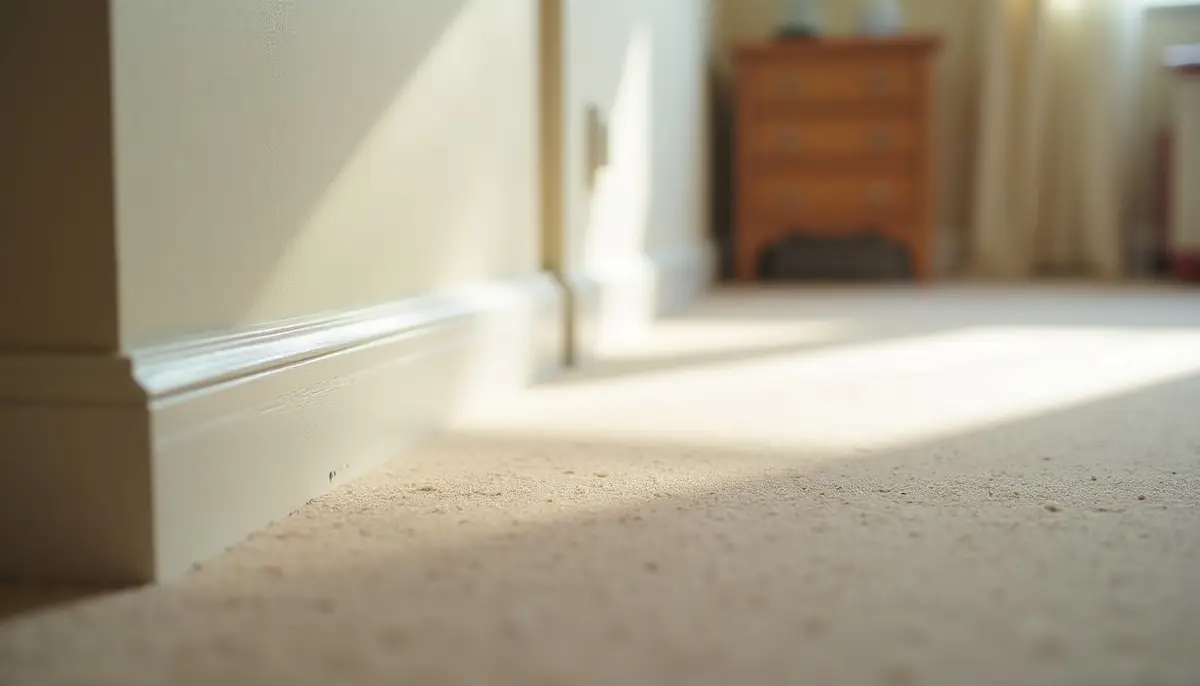
The signs are the same as on a mattress, only harder to see against carpet colour. The EPA lists four: rusty or reddish stains from crushed bugs, dark spots of excrement about the size of a full stop that bleed into fabric like a marker, eggs and eggshells about 1 mm long with pale yellow shed skins, and the live bugs. Adults are 5 to 7 mm, about 3/16 to 1/4 inch, roughly the size of an apple seed. Our bed bug identification guide shows every stage at relative size.
Most of what people find in carpet turns out not to be bed bugs at all. Carpet beetle larvae are the usual suspect: Kentucky notes that carpet beetles, as their name implies, sometimes infest carpets, because the larvae digest keratin in wool, fur, felt and feathers. The EPA warns that carpet beetles are easily mistaken for bed bugs, and the error gives a real infestation time to spread.
| What you find in the carpet | Bed bug | Carpet beetle |
|---|---|---|
| Body | Flat, oval, wingless, reddish brown | Adult rounded with patterned scales; larva bristly and banded |
| Size | Adult 5 to 7 mm | Varied carpet beetle adult about 3 mm, larva about 4 mm |
| Where in the carpet | Edges near beds and sofas | Under furniture, along edges, in wool or blended pile |
| What it eats | Blood only | Wool, fur, feathers, lint, dead insects |
| Damage to carpet | None; leaves dark spots | Irregular holes and bare patches in wool |
| Other clue | Shed skins, eggs, sweetish musty smell | Hairy shed skins; threadbare spots in wool |
Penn State notes that carpet beetle larval hairs can cause an itchy rash people describe as bites, so bites alone prove little; for a rash, see a doctor. More lookalikes are in our guide to bugs that look like bed bugs.
Our analysis of iNaturalist research-grade records shows the timing difference. Carpet and hide beetle records peak in March, at more than three times their usual share of what people record, which fits Penn State’s note that adults fly and enter homes from spring through early autumn. Bed bug records are highest from October to January. Bed bugs live indoors all year, so their winter rise mostly reflects people noticing them when little else is about outdoors, not more breeding. A bristly larva in a wool rug in spring is far more likely to be a carpet beetle.
How long can bed bugs live in carpet?
As long as they can live anywhere without a meal, because carpet gives them nothing to eat. In Virginia Tech’s starvation study, first-stage nymphs survived 13.8 to 36.3 days on average at about 79°F, and fifth-stage nymphs and adults 41.5 to 142.6 days, with pesticide-resistant field strains dying sooner than lab strains. Older records of 277 days at 64°F and 425 days at 50°F came from cool conditions, which is why an unheated room can hold bugs longer. Our guide to how long bed bugs live breaks this down by temperature and stage.
How do you draw bed bugs out of hiding?
You mostly cannot; a sleeping host is the strongest lure there is. What works is intercepting them on the way. Pitfall interceptors, small dishes with a slippery inner wall, go under the legs of beds and sofas; bugs climbing up or down fall in and cannot climb out. Kentucky advises pulling the bed a few inches from the wall and keeping bedding off the floor so the bed becomes an island the bugs can only reach through the traps. The EPA describes a do-it-yourself version and advises checking the traps every week.
The evidence is strong. In a Rutgers study of 291 infested apartments, interceptors detected 89 per cent of infestations and brief visual inspections 72 per cent. Traps under beds caught more bugs than traps under sofas, 2.8 against 1.2 per trap on average, yet 15 per cent of infestations showed up only under the sofa, so the authors advise trapping both. Nearly half of residents with live bed bugs did not know they had them.
How to get rid of bed bugs in carpet
Treat the room, starting with the bed. The carpet edge is one hiding place among several, and treating it alone leaves the source untouched.
| Method | What the evidence says | Do it yourself? |
|---|---|---|
| Targeted vacuuming | Removes some bugs; eggs are hard to dislodge; bugs survive in the vacuum | Yes, along edges and seams; seal and bin the contents |
| Steam | Kills bugs and eggs on contact; little penetration; no residual effect | Yes, slowly, with a diffuser |
| Desiccant dust | Slow; silica gel far faster than diatomaceous earth | Only EPA-registered products, used to the label |
| Carpet shampoo or extraction | No published bed bug trials we could find | Cleans debris; do not rely on it |
| Removing the carpet | Takes away one hiding place; bugs remain in the bed and walls | Rarely worth it on its own |
| Whole-room heat or professional treatment | Reaches hidden spots when temperatures are held | No, a licensed professional job |
Vacuum the edges, not the middle
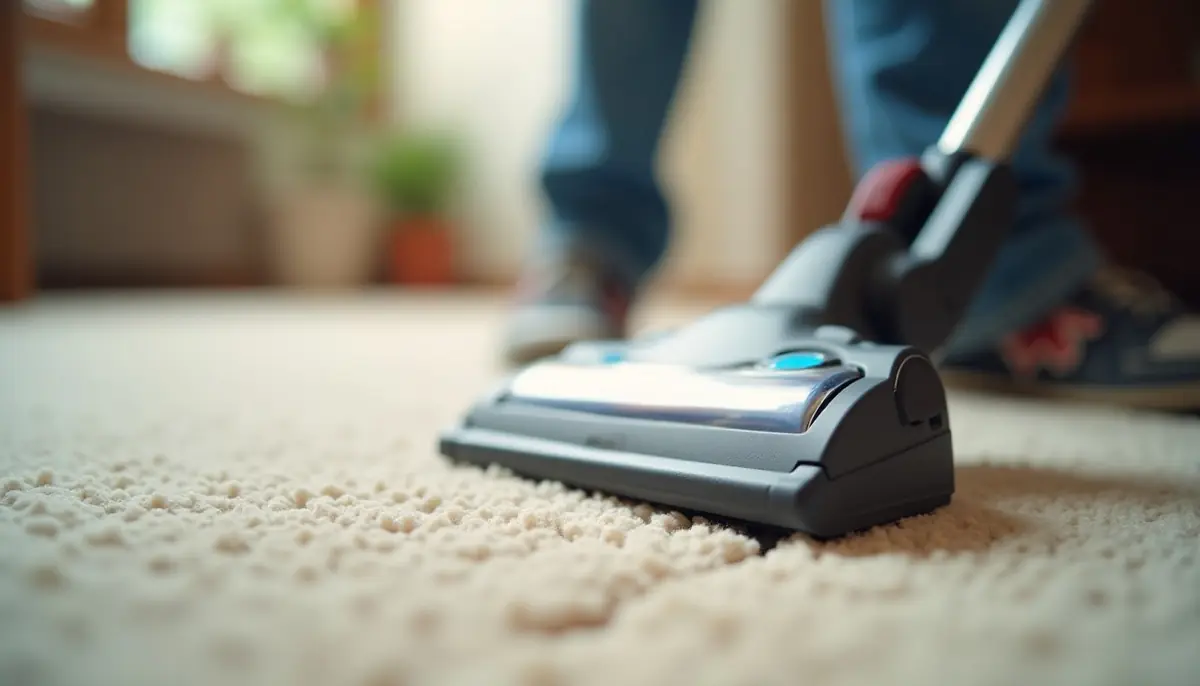
Kentucky notes that ordinary vacuuming of floors seldom reaches where bed bugs live, but targeted vacuuming helps: scrape the end of the wand slowly along the perimeter edges of the flooring, seams and folds. Bed bugs survive being vacuumed, so empty the contents into a sealed bag and put it in an outdoor bin. A knee-high nylon stocking pushed into the wand and held with a rubber band traps the bugs for easy disposal.
Steam slowly, at the surface
The EPA says steam for carpets and skirting boards must be at least 130°F at the surface, without forceful airflow that scatters bugs, so use a diffuser. In a Texas A&M trial, a commercial steamer killed every egg and 87 to 94 per cent of nymphs and adults on mattress fabric at passes of 10, 20 or 30 seconds per foot, with no significant difference between speeds. The authors put the survivors down to bugs sitting to the side of the steam head’s path. The treated surface reached 153 to 165°F, and the authors note they did not test penetration into carpet. Kentucky adds that steam has limited penetration and no residual effect, so it is seldom used alone.
Dusts along the edge
Desiccant dusts placed into the gap under skirting boards and carpet edges work by drying bugs out, and bugs cannot develop resistance to that, but the EPA warns they may take several months and should be EPA-registered products. Diatomaceous earth is the slowest of them: in the controlled comparison summarised in our diatomaceous earth review, silica gel killed half of bed bugs in 20 hours while diatomaceous earth took nearly eight days. Keep any dust to the cracks and gaps where bugs shelter; open carpet is not where they sit.
Will removing carpet get rid of bed bugs?
Usually not. If bugs have reached the carpet edge, they are almost certainly in the bed, furniture and wall gaps too, and those stay behind when the carpet goes. The EPA advises against discarding anything that can be safely treated, and asks that anything thrown out be destroyed or marked “Bed Bugs” so nobody else takes it home.

What kills 100% of bed bugs?
No single product or method is guaranteed to kill every bed bug in a home, and claims that one does should be read with care. Heat comes closest when it reaches the bugs. University of Minnesota researchers found adults die after about 95 minutes at 113°F, while eggs survived seven hours at that temperature and needed about 72 minutes at 118°F. The EPA notes that a room must be hotter than that so the heat reaches bugs wherever they hide, including under carpet edges. That is why whole-room heat is a professional job, and why the EPA advises checking for at least a year afterwards.
For more than a handful of bugs, a licensed professional is the realistic route. Our bed bug treatment cost guide compares heat with chemical treatment, including the repeat visits.
How to prevent bed bugs in carpet
- Keep the bed a few inches from the wall, with bedding off the floor and interceptors under each leg.
- Encase the mattress and box spring; Kentucky notes that bugs sealed inside eventually die and the smooth cover is easier to inspect.
- Keep luggage, bags and coats off bedroom carpet after travel. Ohio State advises guests to keep luggage off carpets and beds.
- Check secondhand beds, sofas and rugs before they come inside.
- Remember the car: bugs moved in bags can also ride in vehicles, as our guide to whether bed bugs can live in cars explains.
In apartments, bugs also arrive from neighbouring units through wall and floor gaps, so prevention there depends on the whole building, as our guide to how bed bugs spread sets out.
Frequently asked questions
How do you know if you have bed bugs in your carpet?
Fold back the carpet edge along the skirting board behind the bed or sofa and look with a torch. The EPA lists the signs as rusty stains from crushed bugs, dark excrement spots about the size of a full stop, tiny pale eggs about 1 mm long, shed skins and live bugs. If you find signs in the carpet, check the mattress seams and bed frame too, because the infestation almost always starts there.
How do you draw bed bugs out of hiding?
There is no reliable lure for home use; a sleeping person is the strongest attraction there is. The practical approach is to intercept them. Pitfall interceptors under bed and sofa legs catch bugs moving to and from a host, and in a Rutgers study of 291 infested apartments they detected 89 per cent of infestations, against 72 per cent for brief visual inspections. Check the traps weekly.
What kills 100% of bed bugs?
No single method is guaranteed. Heat comes closest when it reaches the bugs: University of Minnesota work found adults die after about 95 minutes at 113°F and eggs after about 72 minutes at 118°F, but the room must be hotter so heat penetrates hiding places. Whole-room heat should be done by a licensed professional, and the EPA advises monitoring for at least a year afterwards.
How long do bed bugs live on carpet?
Carpet provides no food, so survival depends on starvation tolerance. In Virginia Tech research, unfed adults and older nymphs survived 41.5 to 142.6 days on average at room temperature, and newly hatched nymphs 13.8 to 36.3 days. Cooler rooms extend this. In an occupied bedroom the question rarely arises, because bugs in the carpet edge are feeding on whoever sleeps nearby.
Can bed bugs live in carpet without a bed nearby?
Rarely for long. Bed bugs hide near where people sleep or sit and travel 5 to 20 feet to feed, according to the EPA. Bugs found in the middle of a room, a hallway or an empty room are usually in transit, have been carried in, or are a sign of a heavy infestation spreading outwards. Either way, inspect the nearest beds and sofas first.
Sources
- University of Kentucky Entomology, Potter, Bed Bugs, ENTFACT-636.
- University of Kentucky Entomology, Carpet Beetles, ENTFACT-601.
- Penn State Extension, Carpet Beetle Dermatitis.
- US Environmental Protection Agency, How to Find Bed Bugs; Bed Bugs: Appearance and Life Cycle; Do-it-yourself Bed Bug Control.
- Wang, Abou El-Nour and Bennett, Case study: controlling bed bugs in apartments, Pest Control Technology, November 2007 (Purdue University).
- Wang, Singh, Zha and Cooper, Bed bugs: prevalence in low-income communities, residents’ reactions, and implementation of a low-cost inspection protocol, Journal of Medical Entomology, 2016 (Rutgers University).
- Polanco, Miller and Brewster, Survivorship during starvation for Cimex lectularius L., Insects 2(2), 2011 (Virginia Tech).
- Puckett, McDonald and Gold, Comparison of multiple steam treatment durations for control of bed bugs, Pest Management Science 69, 2013 (Texas A&M University).
- Kells and Goblirsch, Temperature and time requirements for controlling bed bugs under commercial heat treatment conditions, Insects 2(3), 2011 (University of Minnesota).
- Ohio State University Extension, Bed Bugs, ENT-0109.
- The Pest Control Brief, Diatomaceous earth review, 2026.
- The Pest Control Brief analysis of iNaturalist research-grade records, pulled October 2026.