Do Bed Bugs Jump or Fly? How They Actually Get Around

No, bed bugs do not jump, and they cannot fly: they only crawl. Their wings are reduced to small pads that cannot lift them, and their legs are built for gripping, not leaping. University of Florida training material puts an adult’s crawling speed at about 4 feet a minute and a nymph’s at about 1 foot. If a small bug in your bed jumps, it is almost certainly a flea or a springtail, not a bed bug.
That one fact settles a lot: how bed bugs reach a bed, whether they can leap onto you or your clothes, and why a smooth plastic dish under a bed leg traps them. It also gives you the quickest identification test there is. Touch the bug gently. If it springs away, it is not a bed bug.
Bed bugs against the bugs that do jump
| Bug | Jumps? | Flies? | How it moves | Bites people? | Where you usually see it |
|---|---|---|---|---|---|
| Bed bug | No | No, wing pads only | Crawls, about 4 feet a minute as an adult | Yes, usually at night | Mattress seams, bed frames, sofas |
| Cat flea | Yes, about 8 inches on average | No, wingless | Powerful hind legs; jumps onto hosts | Yes | Pets, pet bedding, carpets |
| Springtail | Yes, up to several inches | No, wingless | Flicks a spring-like tail under its body | No | Damp sinks, baths, houseplant soil |
| Camel cricket | Yes, very strong jumper | No, wingless as adults | Large hind legs | No, not a blood feeder | Damp basements, crawl spaces, garages |
| Carpet beetle adult | No | Yes | Walks and flies | No; larval hairs can irritate skin | Wool items, lint under furniture |
Size alone will not separate them, because a flea at 1 to 3 mm overlaps with young bed bugs. Shape and movement do. Fleas are flattened from side to side, so they look narrow from above; bed bugs are flattened from top to bottom, like an apple seed. Our guides to what fleas look like and to springtails cover the jumpers in detail.
Can bed bugs fly?
No. The EPA describes bed bugs as true bugs with “wings that are not used for flying”. University of Florida’s bed bug IPM manual, which reproduces the Armed Forces Pest Management Board’s technical guide, calls them vestigial wings: small pads that cannot lift the insect. The CDC simply describes bed bugs as wingless.
Bed bugs also have no jumping legs. Fleas and camel crickets have powerful, enlarged hind legs; a bed bug’s legs end in claws for gripping rough surfaces and holding on to a host while it feeds. Kentucky entomologists state it plainly: bed bugs don’t fly, or jump like fleas, but can crawl rapidly over floors, walls, ceilings and other surfaces.
Do bed bugs jump like fleas?
No, and the difference is large. In a French veterinary study, cat fleas jumped 19.9 cm on average, about 8 inches, with a longest jump of 48 cm, about 19 inches. Half of the fleas tested could clear a tube 13.2 cm tall. Bed bugs do none of this; their only way up a bed is to climb it.
How fast do bed bugs move?
Faster than most people expect for an insect the size of an apple seed. University of Florida’s training material gives about 4 feet a minute for adults and about 1 foot a minute for nymphs. Commercial sites often quote 3 to 4 feet a minute; we have not found a published measurement behind that range, so treat it as an approximation.
Speed matters less than range. The EPA says bed bugs will readily travel 5 to 20 feet from their hiding places to feed, and the CDC says they can travel over 100 feet in a night but tend to live within 8 feet of where people sleep. Most of the time they do not wander at random far from home: in a Mississippi State study, roughly half the bugs placed in the middle of a test lane were still at or near the release point after 10 minutes, whether or not they had recently fed.
How fast do bed bugs jump?
They do not jump at all, so there is no jump speed. People who see a bug “jump” in a bed have almost always seen a flea, or a springtail, which flicks itself into the air when disturbed.

Why bed bugs cannot climb smooth surfaces
Climbing is where bed bugs are weakest, and it is the basis of the most useful monitor sold for them. University of Florida’s manual contrasts the bed bug’s leg, with a claw for gripping rough surfaces, against a cockroach’s, which has pads for climbing smooth surfaces. Bed bugs grip rough surfaces well and smooth ones poorly.
Research has measured this directly. In a Clemson study, hardened adult bed bugs climbed an average maximum of 2.4 to 2.6 cm, about an inch, up a smooth glass vial; bugs less than an hour after moulting, still soft, reached 4.7 cm. In a University of Florida study, recently fed females had the most difficulty climbing smooth surfaces, because a blood meal adds weight. A Malaysian, Belgian and Australian team found that adults of the tropical bed bug, which has more adhesive hairs on its leg pads, escaped all four commercial smooth-walled pitfall traps tested, unlike adults of the common bed bug found in US homes.
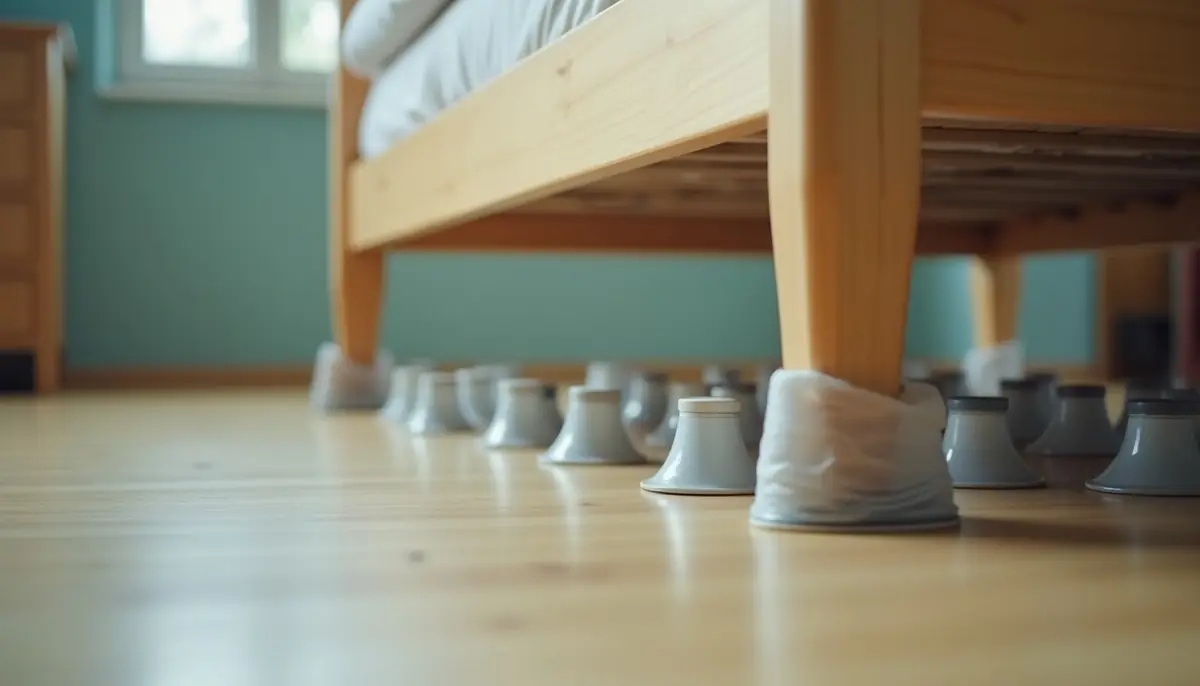
That is why interceptors work. A double-walled dish under each bed leg catches bugs climbing up to feed or down to hide, and their slippery inner wall keeps them there. Kentucky advises pulling the bed a few inches from the wall and keeping bedding off the floor, so the bed becomes an island reached only through the traps. A flea would jump straight out of the same dish.
How bed bugs actually get around
| Route | What happens | What to do |
|---|---|---|
| Crawling to feed | Bugs leave cracks and seams, usually at night, and crawl to a sleeping person | Interceptors under bed legs; bed away from the wall |
| Hitchhiking in belongings | Bugs hide in luggage, bags, bedding and secondhand furniture | Keep bags off beds and floors when travelling; inspect used furniture |
| Crawling through buildings | Bugs move room to room and floor to floor through wall, floor and ceiling gaps | Seal gaps; in apartments, inspect neighbouring units |
| Briefly on clothing | A bug may crawl into a fold of clothing or a shoe left near infested furniture | Dry clothes hot after visits to infested places |
| Jumping or flying | Does not happen | Nothing to guard against |
Our guide to how bed bugs spread covers each of these routes, including what New York housing filings show about spread between apartments.
Do bed bugs jump from person to person?
No. Bed bugs do not live on people. Kentucky notes they do not reside on or attach to people like lice or ticks; after feeding for about 3 to 10 minutes, they crawl off to a hiding place to digest. A bug can occasionally be carried in clothing or a bag and dropped somewhere new, but that is a hitchhiker in belongings, not a bug moving between people.
Do bed bugs jump on your clothes?
They cannot jump onto clothes, but they can crawl into them. Clothing left on an infested bed, sofa or floor can pick up a bug in a seam or fold. Kentucky’s advice for carers and other visitors to infested homes is practical: bring in only what you need, sit on hard chairs rather than upholstered furniture, and keep coats and bags off beds, sofas and floors. Because bed bugs hide during the day, simply walking into an infested home is unlikely to pick any up.
Do bed bugs jump in the house?
No. Indoors, bugs that genuinely jump are usually fleas, where there are pets, springtails, in damp kitchens and bathrooms, or camel crickets, in damp basements and laundry rooms. Clemson describes camel crickets’ large hind legs as making them very strong jumpers.
Our analysis of iNaturalist research-grade records shows these jumpers keep different calendars. Springtail records peak in January, at more than twice their usual share of what people record, and camel cricket records in November, at two and a half times. Bed bug records are highest from October to January. Because bed bugs live indoors all year, their winter rise mainly reflects people noticing them when little else is about outdoors, not more breeding. A jumping bug in a damp bathroom in winter is far more likely to be a springtail.

What bug could be mistaken for bed bugs?
The common mix-ups are carpet beetles, young cockroaches, fleas, ticks, bat bugs and kissing bugs. UC IPM separates bed bugs from kissing bugs, or conenose bugs, by their smaller size, rounder shape and lack of wings: kissing bugs reach about 3/4 inch and are winged as adults. Our full guide to bugs that look like bed bugs works through each one, and our bed bug identification guide shows every life stage at relative size.
Texas shows how much more often people photograph the lookalikes. Its iNaturalist research-grade records include 1,958 kissing bugs and 252 German cockroaches against 68 bed bugs. These are photographed sightings, mostly outdoors, not infestation counts, but they are a reminder to confirm what you have before paying for bed bug treatment.
What are the first signs of bedbugs?
Bites are a poor guide: the EPA notes they can look like mosquito or chigger bites, rashes or hives, and some people do not react at all. The physical signs are more reliable. The EPA lists rusty or reddish stains from crushed bugs, dark spots of excrement about the size of a full stop that bleed into fabric like a marker, tiny pale eggs and shed skins, and the live bugs, usually first along mattress seams, piping and tags.
What kills bed bugs instantly?
Direct heat. In a Texas A&M trial, bed bugs hit directly by steam died almost immediately, and no steamed egg hatched. University of Minnesota research put the temperature that kills nearly all adults on short exposure at about 119°F. A clothes dryer is the practical home tool: Kentucky advises 10 to 20 minutes on medium to high heat for bedding, clothing, shoes and bags. Spraying rubbing alcohol is not the answer; the EPA warns it can ignite with a spark, and that foggers do not reach the cracks where bed bugs hide.
Killing the bugs you can see is not the same as ending an infestation. For anything beyond a few bugs, a licensed professional is the realistic route.
Can bed bugs kill you?
No. The CDC states that bed bugs are not known to spread diseases to people. Bites can cause itching and lost sleep, scratching can lead to a skin infection, and allergic reactions, very rarely including anaphylaxis, have been reported. The CDC also lists insomnia and anxiety. Anyone with a severe reaction should see a doctor.
Frequently asked questions
Do bed bugs jump or fly?
Neither. Bed bugs have only small, vestigial wing pads that cannot lift them, and their legs are made for gripping, not leaping. They move by crawling, about 4 feet a minute for adults according to University of Florida training material, and travel between places by hiding in luggage, bags, bedding and furniture. A small bug that jumps is usually a flea or a springtail.
How do you draw bed bugs out of hiding?
There is no reliable lure for home use; a sleeping person is the strongest attraction. The practical approach is to intercept them. Smooth-walled interceptor dishes under bed and sofa legs catch bugs moving to and from a host, and in a Rutgers study of 291 infested apartments they detected 89 per cent of infestations, against 72 per cent for brief visual inspections. Check them weekly.
What bug could be mistaken for bed bugs?
Carpet beetles, young cockroaches, fleas, ticks, bat bugs and kissing bugs are the usual mix-ups. A quick test helps: fleas and springtails jump, carpet beetles and kissing bugs have wings, and ticks have eight legs. Bed bugs do none of these; they are flat, oval and reddish brown and only crawl. When in doubt, a county extension office can identify a specimen.
What kills bed bugs instantly?
Direct heat. Bed bugs hit by steam in a Texas A&M trial died almost immediately, and University of Minnesota research found nearly all adults die on short exposure at about 119°F. For washable items, a dryer on medium to high heat for 10 to 20 minutes kills all stages. The EPA warns against rubbing alcohol, which is flammable, and none of these ends an infestation alone.
Can bed bugs jump from the floor to the bed?
No. A bed bug has to climb to reach a bed, usually up a leg, a wall, or bedding that touches the floor. That is why pulling the bed slightly away from the wall, keeping sheets and blankets off the floor and standing each leg in a smooth interceptor dish cuts off the route. A bug that leaps onto the bed from the floor is almost certainly a flea.
Sources
- University of Kentucky Entomology, Potter, Bed Bugs, ENTFACT-636.
- University of Florida, Bed Bug IPM training manual, 2008, including Armed Forces Pest Management Board Technical Guide No. 44.
- US Environmental Protection Agency, Bed Bugs: Appearance and Life Cycle; How to Find Bed Bugs; Do-it-yourself Bed Bug Control.
- Centers for Disease Control and Prevention, About Bed Bugs.
- University of California Statewide IPM Program, Pest Notes: Bed Bugs (7454) and Springtails (74136).
- University of Florida IFAS, Featured Creatures EENY-011, Cat flea.
- Clemson Cooperative Extension Home and Garden Information Center, Camel Crickets.
- Cadiergues, Joubert and Franc, A comparison of jump performances of the dog flea and the cat flea, Veterinary Parasitology, 2000.
- Hinson and colleagues, Climbing ability of teneral and sclerotized adult bed bugs, PLoS ONE, 2017 (Clemson University).
- Hottel and colleagues, Climbing ability of the common bed bug, Journal of Medical Entomology, 2015 (University of Florida).
- Kim, Billen, Doggett and Lee, Differences in climbing ability of Cimex lectularius and Cimex hemipterus, Journal of Economic Entomology, 2017.
- Goddard, Caprio and Goddard, Diffusion rates and dispersal patterns of unfed versus recently fed bed bugs, Insects 6, 2015 (Mississippi State University).
- Wang, Singh, Zha and Cooper, Bed bugs: prevalence in low-income communities, Journal of Medical Entomology, 2016 (Rutgers University).
- Puckett, McDonald and Gold, Comparison of multiple steam treatment durations for control of bed bugs, Pest Management Science 69, 2013 (Texas A&M University).
- Kells and Goblirsch, Temperature and time requirements for controlling bed bugs under commercial heat treatment conditions, Insects 2(3), 2011 (University of Minnesota).
- The Pest Control Brief analysis of iNaturalist research-grade records, pulled October 2026.