How to Tell If Mice Are Gone (and Whether They Will Come Back)
Mice are probably gone when a full week passes with no captures and no new signs on surfaces you have cleaned: no fresh droppings, no tracks in a flour or talc patch, no new gnawing and no bait taken from unset traps. That one-week rule is the CDC’s. Running a second week with traps moved to new spots makes the result more reliable, because some mice avoid traps. Until every gap over a quarter inch is sealed, mice can come back.
The hard part is that “no signs” can mean no mice or simply mice you are not detecting. A trap that has caught nothing for days proves less than most people assume, as a field trial described below shows. The answer is to make evidence rather than wait for it: clean everything, set out tests that a mouse cannot cross without leaving a trace, and read them on a schedule.
The all-clear tests at a glance
| Test | How to run it | What counts as clear |
|---|---|---|
| Cleaned-surface check | Clean old droppings safely from drawers, cabinets, under the sink and along baseboards | No new droppings after a week |
| Flour or talc patch | A thin, smooth patch along a wall or in a runway, with a cracker in the middle | No footprints or tail marks over several nights |
| Snap traps | Traps against walls where signs were, checked daily | No captures for a week (CDC), ideally two with traps moved |
| Baited, unset traps | Bait the trap without setting it, in active spots | Bait untouched |
| Gnaw check | Mark or photograph existing gnaw damage | No new chewed edges, shavings or holes |
| Rub marks | Wipe greasy smudges off baseboards and pipes | Smudges do not return |
| Smell | Clean, ventilate, then shut cupboards for a day | No musky ammonia smell builds up |
| Night listening | Listen at walls and ceilings after dark | No scratching or scampering for a week or more |
No single test settles it. Clear results on three or four at once, sustained for a week or two, are a far sounder basis than any one test.

How long before you know mice are gone?
The CDC’s rodent guidance gives the clearest published threshold: “If no rodents are captured for a week and there are no new signs of rodents, the rats are gone.” The same page tells people to continue trapping until there are no more rodents and to check traps daily.
We recommend treating one week as the minimum and two weeks as the safer standard for mice, for three reasons. First, Arizona’s school and home IPM newsletter advises setting traps again a week later in slightly different places, because mice can become trap shy. Second, the trial below shows mice can walk past traps for two weeks without being caught. Third, if a rodenticide was used, Nebraska Extension says mice that take a lethal dose begin dying in five days and that anticoagulant bait has to be available for at least two weeks, so evidence can lag behind the treatment.
The protocol, step by step
- Seal first. UC IPM calls exclusion “the most successful and permanent form of house mouse control.” Close every gap over a quarter inch around pipes, vents, doors and the foundation with metal or concrete. Without this, the test only tells you no mice are inside today. Our guide to rodent exclusion materials covers what holds.
- Clean all old evidence, safely. The CDC says not to vacuum or sweep droppings or nests: ventilate for 30 minutes, wear gloves, spray until very wet with bleach solution (1 part bleach to 9 parts water) or a registered disinfectant, wait 5 minutes, then wipe up. Full steps are in our mouse dropping cleanup guide.
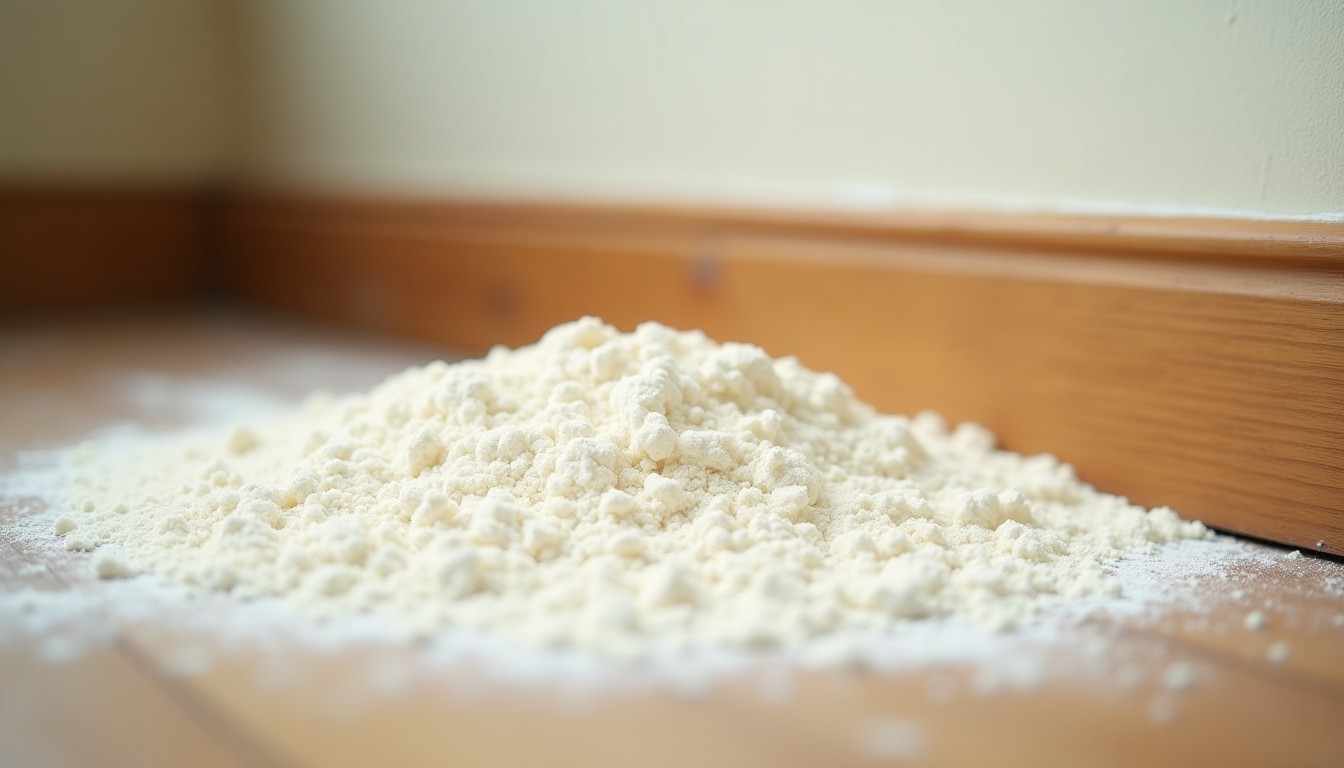
- Lay tracking patches. The wildlife damage handbook describes a flour patch “rolled smooth with a cylindrical object” left in a pathway overnight. Talc works too. Put them where signs were worst and where walls meet floors.
- Keep traps out, and add some unset ones. The same handbook suggests leaving traps baited but unset until the bait has been taken at least once, which reduces trap shyness. Untouched bait on unset traps is a useful monitor in its own right. See how to catch a mouse for placement.
- Check daily for a week, then move everything. Read the patches, traps and cleaned surfaces each morning. After a clear week, shift traps and patches a few feet and run a second week.
- Listen and sniff. Scratching in walls should stop, and a cleaned, aired cupboard should not regain the musky smell.
Why an empty trap is not proof
The most useful evidence on this question comes from a study presented at the 2017 International Conference on Urban Pests. Consultants Simmons and Swindells placed four monitoring devices at each of 25 locations in a UK supermarket distribution centre for two weeks: a motion and heat sensor over fluorescent tracking dust and a non-toxic paste bait, a plastic bait station, a cardboard bait station and a snap-trap station with a commercial attractant.
Mice were present at 9 locations, each confirmed by footprints in the tracking dust. Yet the paste bait beside the sensors was taken at only two of them, once fully and once partly. The plastic bait stations had no takes, the cardboard stations one partial take, and the trap stations caught nothing in two weeks. The authors found mice were deliberately avoiding the boxes and warned this leads to underestimated populations when inspection for other evidence is not rigorous.
Two cautions apply. The site was a building of about a million square feet with a mouse infestation believed to be 10 years old or more, where mice may have learned avoidance that a mouse in its first winter in your kitchen has not. And the study is small. But the direction is clear and matches the practical advice: a tracking patch tells you more than an empty trap, and the two together tell you more than either.
How do you tell how many mice you have?
There is no reliable count from droppings, because one mouse leaves 50 to 75 a day according to NC State. Two field methods from the wildlife damage handbook work better:
- Patch percentage. Set flour or talc patches at 20 to 30 foot intervals through the house. Because house mice stay close to their nests, the share of patches showing tracks indicates the relative size and spread of the population.
- Catch per trap night. Divide mice caught by traps set multiplied by nights. The handbook’s example is 35 mice per 100 trap nights. Falling numbers over successive nights show a population shrinking; zero over a week, with clean patches, is what “gone” looks like.
Our signs of mice checklist covers what each sign suggests about numbers, and our guide to when to call pest control for mice sets thresholds for professional help.
What is the 5 day mouse rule?
It is a rule of thumb that circulates online: five days with no catches or new signs means the mice are gone. We could not find it in CDC guidance or in any extension publication we read. The CDC’s own figure is a week. Five days is also the point at which, according to Nebraska Extension, poisoned mice only begin to die, so after a rodenticide treatment a quiet five days proves very little. Use a week as the minimum.
What gets rid of mice immediately?
Nothing removes a mouse population instantly, but enough snap traps placed well come closest. Arizona’s IPM newsletter notes mice “will be trapped easily the first night” before they become trap shy, and UC IPM says to use enough traps “to make the trapping period short and decisive.” Nebraska suggests about two dozen properly placed traps for a new infestation in a 1,500 square foot building. Rodenticides take days, and ultrasonic devices do not drive established mice out, according to UC IPM. See our review of ultrasonic pest repellers.
Why do mice suddenly disappear, and do they come back?
A sudden quiet has several explanations, and only one of them is good news.
| Why the mice went quiet | What the sources say | How to check |
|---|---|---|
| They were caught or killed | The goal; trapping lets you see the result | Run the two-week protocol above |
| They are avoiding your traps or bait | Bait shyness after a sublethal dose “can persist for weeks or months” (1994 handbook); the trial above shows trap avoidance | Flour patches and unset baited traps in new spots |
| Something frightened them briefly | Ultrasonic devices may repel rodents for a few days, then they return (1994 handbook) | Keep testing for a second week |
| They moved within the building | Mice usually range over an area 10 to 30 feet across (1994 handbook), so a quiet room is not a quiet house | Patches in other rooms and near wall voids |
Mice come back for predictable reasons. Unsealed gaps are the main one. Season is the second: UC IPM says outdoor mice frequently enter homes in autumn as night temperatures fall. Our analysis of iNaturalist research-grade records shows how sharply that season stands out.
US house mouse records rise from 235 in June to 443 in October. Deer mice, which also enter sheds and cabins, peak at 1,015 in May. Norway rat records stay between 691 and 760 a month from July to October. These are mostly outdoor sightings, not indoor infestation counts, but they match the autumn pressure extension services describe. A house that was clear in August can be tested again by November.
Released mice are another route back: UC IPM notes mice moved as much as half a mile from their home range can navigate back, which is one reason relocation is discouraged and is illegal without a permit in California.
Gone from the house, the apartment and the yard
In a house, run the protocol in every room where signs were found, plus the attic, basement and garage.
In an apartment, mice move between units through shared walls, pipe chases and gaps around penetrations, so your unit can be clear while the building is not. New York housing inspectors issued 27,273 mouse violations in 2025, as our analysis of New York apartment roach and mouse violations shows; building-wide sealing is usually the landlord’s job.
Outside, check sheds, under decks and around bins for droppings and fresh burrows, and use tracking patches in sheds and garages. Arizona’s IPM newsletter notes professionals use non-toxic monitoring bait blocks to check building exteriors.
The smell after mice are gone
A lingering musky smell usually means urine residue in places you have not cleaned yet, often along baseboards and inside cupboards. A sweet, rotten smell is different: Arizona extension notes “extremely pungent odors of decay” can come from dead mice. Nebraska Extension says whether a dead mouse causes an odour depends on how many died, where, the humidity and airflow, the size of the mouse and the sensitivity of the resident’s nose; we found no extension source giving a fixed number of days. Trapping avoids the problem, which is why UC IPM prefers it to poison indoors. If an odour persists in a wall, a professional can locate and remove the source.
When to bring in a professional: if signs return after two clean weeks, if you cannot find how mice are getting in, or if activity is in several rooms or inside walls and ceilings, a licensed pest professional can inspect the roofline and crawl spaces you cannot easily reach.
Frequently asked questions
How long before you know mice are gone?
At least a week. The CDC says that if no rodents are captured for a week and there are no new signs, they are gone. Running a second week, with traps and flour patches moved to new spots, is safer because some mice avoid traps. If you used rodenticide, allow more time: Nebraska Extension says poisoned mice begin dying only after about five days.
What is the 5 day mouse rule?
An online rule of thumb saying five days without catches or new signs means mice are gone. We could not trace it to the CDC or any extension service. The CDC’s published threshold is a full week with no captures and no new signs. Five days is too short after a poison treatment, because Nebraska Extension says poisoned mice start dying at around five days.
What gets rid of mice immediately?
Nothing works instantly, but plenty of snap traps set along walls where signs are worst comes closest. Arizona extension notes mice are trapped easily on the first night, and UC IPM advises enough traps to make trapping short and decisive. Nebraska suggests about two dozen for a new infestation in a 1,500 square foot building. Poison takes days, and ultrasonic devices do not drive mice out.
How do you tell how many mice you have?
Not from droppings, since one mouse leaves 50 to 75 a day. The wildlife damage handbook suggests flour or talc patches every 20 to 30 feet: the share with footprints shows how widespread mice are. Catches per trap night, tracked over several nights, show whether numbers are falling. Signs in several rooms usually mean more than one group.
Do mice come back after you get rid of them?
They can, mainly through gaps that were never sealed, and most often in autumn, when UC IPM says outdoor mice move indoors as nights turn cold. Sealing every opening over a quarter inch with metal or concrete is what makes the result last. Repeating a week of flour patches and unset baited traps each autumn is a simple check.
Sources
- US Centers for Disease Control and Prevention, How to Trap Up to Remove Rodents, and How to Clean Up After Rodents, healthy pets guidance.
- University of California Statewide IPM Program, Pest Notes: House Mouse, UC ANR Publication 7483, Quinn and Frye, revised July 2025.
- University of Nebraska Extension, Controlling House Mice, NebGuide G1105, revised March 2012.
- NC State Extension, Surveillance and Management of Common Structure-Invading Mice, Hayes and Alder, 2024.
- University of Arizona, School and Home IPM Newsletter, November 2014, and House Mice: Signs of Uninvited Four-Legged Visitors, January 2022.
- Timm, R.M., House Mice, in Prevention and Control of Wildlife Damage, University of Nebraska Cooperative Extension and USDA APHIS, 1994.
- Simmons, J. and Swindells, C., Controlling House Mice in the Food Industry, Proceedings of the Ninth International Conference on Urban Pests, 2017.
- The Pest Control Brief analysis of iNaturalist research-grade records, pulled October 2026.
- The Pest Control Brief analysis of New York City housing maintenance code violations, 2019 to 2025.