Ground Bees in the Lawn: Leave Them or Remove Them?
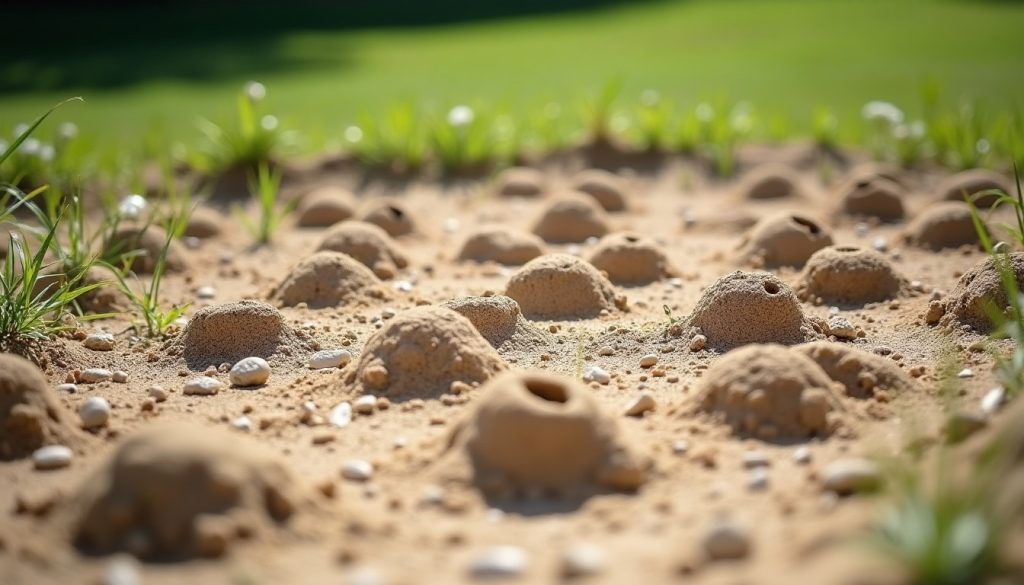
Ground bees are solitary mining and cellophane bees that dig pencil-width holes in bare, dry soil in spring, and in most yards the right move is to leave them alone for the few weeks they are active. Males hover low over the lawn but have no stinger; females can sting but rarely do, because a solitary bee has no colony to defend. If you need them gone, extension services advise watering the area and thickening the turf, not spraying. A busy single hole in late summer is a different insect, usually yellowjackets, and that one does need care.
A lawn suddenly dotted with soil mounds and bees zigzagging above the grass looks alarming, and the instinct is to reach for a spray. The bees are almost always native pollinators that will be gone within a month, and spraying is the option extension entomologists consistently advise against.
Ground bee or something else? Check four things
Most of the decision comes down to the time of year, the number of holes and how the insects behave. This table sets the three ground nesters people most often confuse side by side, with bumble bees added because they are the one bee that does nest socially in the ground.
| Ground bees (mining, cellophane) | Yellowjackets | Cicada killers | Bumble bees | |
|---|---|---|---|---|
| When you see them | Early spring to early summer, a few weeks | Late summer and autumn, when colonies peak | July and August | Through the warm season |
| Holes | Many small holes, about 1/4 inch, often with a little cone of soil | One entrance with heavy traffic in and out | Larger burrows, each with a mound of loose soil and often a shallow furrow leading in | One entrance, often an old rodent hole or under debris |
| Look | Hairy, often dark; some about three quarters the size of a honey bee | Shiny, sparsely haired, jagged yellow and black, 1/2 to 1 inch | Very large wasp, black and yellow | Large, round, very hairy |
| Social? | Solitary: one female per hole | Colony of 1,500 to 15,000 | Solitary | Small colony |
| Sting risk | Very low | High near the nest; they sting repeatedly | Very low | Moderate if the nest is disturbed |
| What to do | Leave, or water and thicken turf | Keep people away; often a job for a professional | Leave, or improve turf | Leave if possible; avoid mowing over the nest |
The quickest single test is the number of entrances. Dozens or hundreds of separate small holes across a sunny patch means solitary bees, each hole belonging to one female. A single hole with a steady stream of insects going in and out means a colony, and in late summer that is very likely a yellowjacket nest. Our wasp and hornet identification guide covers the stinging wasps in more detail.
Types of ground bees you are likely to see
Utah State University Extension, in a publication written by a USDA research entomologist, says at least three fourths of native bee species nest in the ground. In North Carolina, extension puts the figure at almost 90 per cent of the state’s more than 500 native species. The ones that turn up in lawns fall into a few groups.
Mining bees (Andrena)
Mining bees are one of the largest bee genera in the world, with around 1,500 described species, all of them ground nesting. University of Maryland Extension describes them as furry and usually darker than honey bees, ranging from honey bee size down to much smaller. UF/IFAS places the genus in its small (3 to 6 mm) and medium (7 to 10 mm) body size classes. They are mostly spring bees: NC State Extension notes that Andrena become active in February and March.
Cellophane or polyester bees (Colletes)
Cellophane bees line each brood cell with a waterproof, cellophane-like secretion, which is where the nickname “polyester bee” comes from. The eastern species most people meet, the unequal cellophane bee, is one of the first bees out in spring. The Tufts Pollinator Initiative describes it as about three quarters the size of a honey bee, active for four to five weeks (mid-March to mid-April in Massachusetts), and nesting in aggregations that can hold thousands of nests, each with tunnels 1 to 2 feet long.
Other ground nesters
Sweat bees, squash bees and longhorned bees also nest in soil, as do Calliopsis, which NC State notes become active later, in May and June.
Do ground bees sting you?
Rarely. The bees you see patrolling low over the lawn in large numbers are mostly males waiting for females to emerge, and Oregon State University Extension states plainly that male ground bees do not have stingers. Females can sting, but Utah State and USDA describe these non-social bees as having little, if any, venom in their weak stingers, and say they will not sting unless physically handled. University of Maryland Extension sums them up as not aggressive and seldom stinging.
The reason is structural. A yellowjacket colony defends a nest of thousands, so workers attack together. A solitary female has no sisters and nothing to protect beyond her own tunnel, so she flies away rather than fights. Children can usually play near an active patch, though going barefoot on it is not wise, since a bee stepped on can still sting. Anyone with a known allergy to bee or wasp stings should talk to their doctor about precautions, and CDC guidance covers sting reactions in general.
Are ground bees more aggressive?
No. Ground bees are among the least defensive stinging insects in a yard. The University of Georgia notes they do not defend their nest territory aggressively, unlike yellowjackets and honey bees, and the University of Wisconsin insect lab points out that the late summer “ground bee” stings people report are almost always ground-nesting yellowjackets. The exception within bees is the bumble bee, which is social, can nest in the ground and will defend its colony if disturbed.
Why do I have ground bees?
Because the soil suits them. Ground bees choose sunny, well-drained, dry ground with little organic matter and thin or patchy grass. The University of Georgia adds that they favour areas with morning sun, and Oregon State lists exposed soil, thin grass and good drainage. A south-facing slope, the bare strip under a tree where grass struggles, or a sandy patch beside a path are classic spots.
Their presence is not a sign of a pest problem or a dirty yard. Oregon State describes them as helpful pollinators that are not harmful to lawns and can even help aerate the soil. The holes do not damage roots, and the little cones of soil wash away in the next rain.
How long ground bees stay
Not long. University of Maryland Extension gives the flying season as only 2 to 4 weeks, and cellophane bees run four to five weeks. Most species have one generation a year: a female digs her tunnel, stocks cells with pollen and nectar, lays her eggs and dies, and the young develop underground until the next season. That is why the same sunny patch often has bees again the following spring if nothing about the soil has changed.
The Pest Control Brief analysis of iNaturalist research-grade records, pulled October 2026, shows how tightly this is tied to the calendar. Measured as a share of everything people photograph and identify each month, cellophane bees run at 418 in March and 280 in April on an index where 100 is their yearly average, then fall to 51 by June. Mining bees peak a little later, at 212 in April and 200 in May. In raw counts, 76 per cent of the year’s cellophane bee records fall in March to May.
Mining bees also show a smaller second peak, with the index climbing back to 150 in September. That fits what entomologists describe: some Andrena are summer and autumn fliers that specialise on late flowers such as asters. The aster miner bee, for example, was found by Cornell researchers to dig brood cells 50 to 91 cm (roughly 20 to 36 inches) deep. So a late season patch of small holes can still be bees, although in July and August larger holes are far more likely to belong to cicada killers, whose records crowd into those two months.
How do you get rid of ground bees?
For most yards, extension advice is to wait: activity ends within a few weeks and the bees are valuable early pollinators. If the patch is beside a door, play area or path, these steps discourage nesting without killing anything.
- Confirm they are bees. Many small holes in spring, hairy insects, no single busy entrance. If it is one hole with heavy traffic in late summer, see the yellowjacket section below instead.
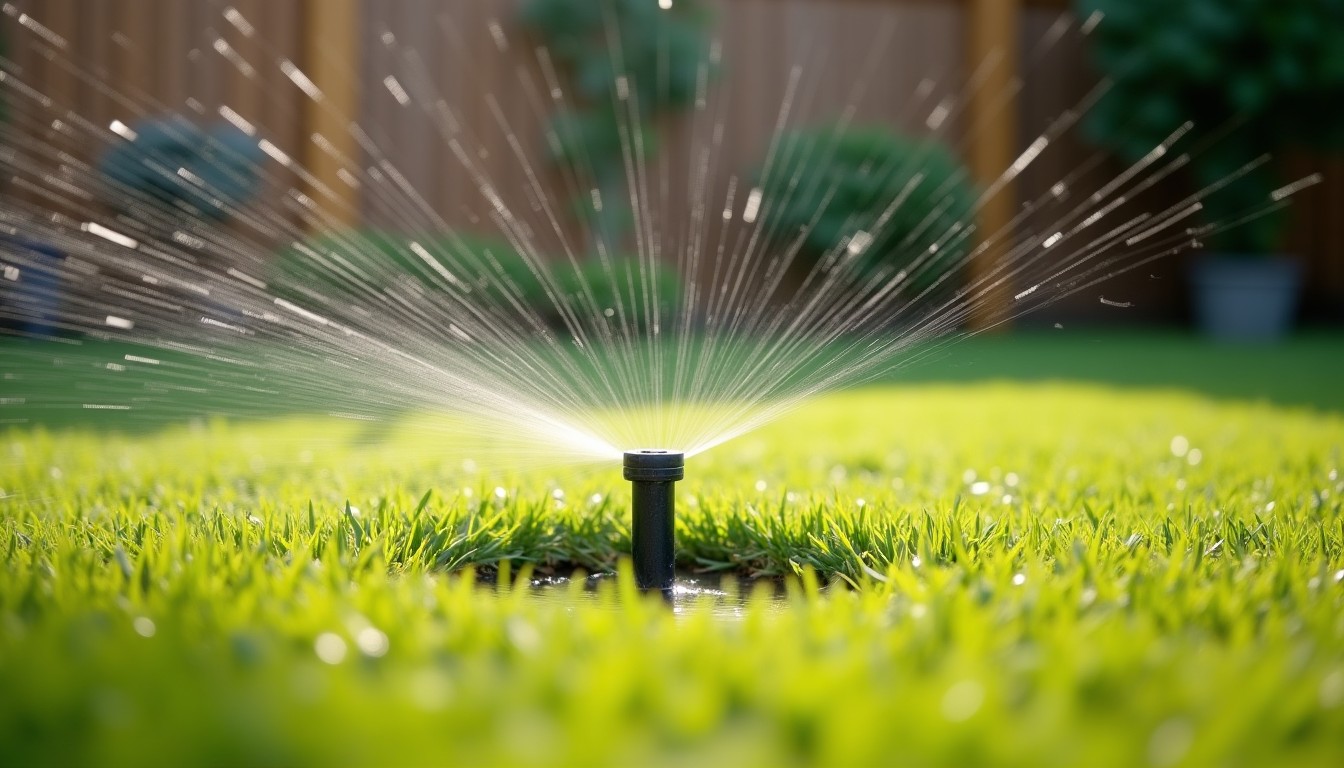
- Water the patch heavily during nest building. University of Maryland and Oregon State both say heavy watering with a lawn sprinkler discourages nesting, because these bees prefer dry soil. Utah State and USDA explain why it works: females returning to a sprinkled site find mud and obliterated entrances, and many abandon the nest. Start when you first see activity.
- Thicken the turf. The long-term fix is getting rid of bare ground: overseed, fertilise appropriately and correct whatever keeps the grass thin. Dense turf leaves nowhere to dig.
- Cover what will not grow grass. On heavy traffic patches or under trees, Utah State notes that thick mulch and landscape fabric are hard for ground nesting bees to penetrate. The University of Georgia also lists tilling and mulching.
- Change your route for a month. In many homes the simplest answer is to mow that patch less often or walk around it until the bees finish.
If you want to support pollinators instead, Utah State suggests watering at night, when females are inside their nests, or using drip irrigation during the day.
What kills ground bees, and should you spray?
Extension sources are close to unanimous that insecticides are the wrong tool here. The University of Georgia says chemical applications are not generally practical because each individual nest would need treatment, and University of Maryland stresses that mining bees are important pollinators and control should be avoided if possible. Tunnels run from a foot or two down to nearly a metre, so a surface spray mostly kills bees in flight while the next generation sits untouched below.
If any pesticide is used on a lawn with flowering plants or active bees, the label governs where and when, and many labels restrict application when bees are foraging. Our guide to pollinator protection rules on pesticide labels explains how to read those restrictions. Never pour fuel or other improvised liquids into the holes.
When it is not ground bees
Yellowjackets in the ground
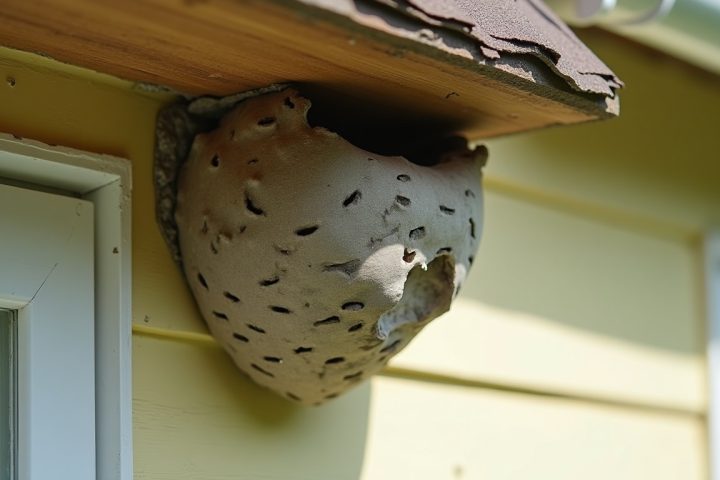
Yellowjackets nest in old rodent burrows and other ground cavities with a single entrance, and UC IPM gives colony sizes of 1,500 to 15,000 depending on the species. Their defensive behaviour increases through the season as colonies grow and food becomes scarce, and their unbarbed stingers can be used repeatedly. A single busy hole in a lawn in August or September is the case to take seriously: keep children and pets away and read our yellow jacket removal guide before doing anything. Ground nests are often worth handing to a licensed professional.
Cicada killers
Cicada killers are huge solitary wasps that dig larger burrows in light, bare soil in midsummer, each with a conspicuous mound of excavated soil at the entrance. Purdue notes that the patrolling males cannot sting and females sting only if mishandled. Our guide to cicada killer wasps covers them in full.
Honey bees and bumble bees
Honey bees do not normally nest in the ground. A cluster of honey bees on a branch is a swarm and a colony in a wall void is a removal job, which our bee removal cost guide prices. A bumble bee nest in the ground is usually best left alone where people can give it a wide berth.
For other lawn insects that leave holes or dead patches, see our lawn pest control guide, and for carpenter bees boring into decks and fascia boards, see carpenter bees and other wood-destroying insects.
How we did this
Biology and management guidance come from the extension publications listed below. Seasonal timing is our analysis of iNaturalist research-grade records for Andrena, Colletes and the eastern cicada killer. The index divides each taxon’s monthly records by all research-grade records that month, which removes the effect of more people recording in summer. These are records of when people photographed the insects, not counts of nests.
Frequently asked questions
How do you get rid of ground bees?
Usually you wait, because the nesting season lasts only a few weeks. If the patch must be cleared, University of Maryland and Oregon State Extension advise heavy watering with a sprinkler when activity starts, since these bees prefer dry soil, and then thickening the turf so there is no bare ground left. Mulch or landscape fabric works where grass will not grow. Insecticides are not recommended.
Do ground bees damage lawns?
No, in almost all cases. Oregon State University Extension describes ground bees as not harmful to lawns and says they can help aerate the soil. The holes are about a quarter of an inch across and the soil cones wash away with rain. If the grass is dying, the cause is usually the thin, dry conditions that attracted the bees, or another insect such as white grubs.
Will ground bees come back next year?
Often, yes. Most ground bees have one generation a year, and the young develop underground in the nest cells their mother stocked, emerging the following season. If the patch stays sunny, dry and bare, a new generation usually nests there again. Thickening the turf or covering the bare soil before spring is the way to break that cycle.
Are ground bees the same as yellow jackets?
No. Ground bees are hairy, solitary pollinators active mainly in spring, with many small separate holes. Yellowjackets are shiny, sparsely haired wasps living in colonies of thousands, with one busy entrance, and they are most defensive in late summer. The University of Wisconsin insect lab notes that late summer stings blamed on ground bees are almost always yellowjackets.
Sources
- University of Maryland Extension, Mining Bees: Lawns (updated 2023).
- Oregon State University Extension Service, Ground bee identification (Ask Extension featured answer).
- Cane, J.H., Gardening and Landscaping Practices for Nesting Native Bees, Utah State University Extension ENT-175-15 (2015), USDA ARS.
- Pugliese, P., Most ground-nesting bees are useful pollinators, University of Georgia CAES Field Report (2013).
- Bratcher, A., Holes in Your Yard Could Be Ground-Nesting Bees, NC State Extension, Lee County Center (2023).
- University of Wisconsin Madison Insect Diagnostic Lab, In defense of ground bees (2021).
- Tufts Pollinator Initiative, Cellophane bees are the real first sign of spring.
- UF/IFAS Extension, Florida bee identification guide: Mining bees (Andrena).
- Espinoza, A.C. et al., Biology of Andrena asteris, an eastern aster specialist that makes a very deep nest, Northeastern Naturalist 29(4) (2022).
- Gibb, T.J., Cicada Killers, Purdue Extension E-254 (2018), and Missouri Department of Conservation field guide, Eastern Cicada Killer Wasp.
- Mussen, E.C. and Rust, M.K., Pest Notes: Yellowjackets and Other Social Wasps, UC ANR Publication 7450 (2012).
- The Pest Control Brief analysis of iNaturalist research-grade records, pulled October 2026.