How to Get Rid of Opossums Under the Deck or Shed
To get rid of an opossum, remove what is feeding it, wait until it has left the den (a flour patch at the entrance shows outgoing tracks), then close the opening with galvanised hardware cloth bent into an L-shaped skirt underground. Opossums do not dig their own burrows and usually use gaps that already exist, so exclusion works well. No repellent or poison is registered for them, and moving one is illegal without a permit in some states, including California.
The opossum is the only marsupial in North America and one of the least troublesome animals that ends up under a deck. It does not dig its own burrow, it is not strong enough to tear into a roof the way a raccoon can, and its young travel in the mother’s pouch. All of that makes it easier to evict than most wildlife, provided you get the order right.
Opossum, raccoon or skunk: who is under the deck?
| Virginia opossum | Raccoon | Striped skunk | |
|---|---|---|---|
| Size | House cat size, 2 to 3 ft with tail, usually 4 to 12 lb | 2 to 3 ft, 7 to 30 lb | House cat size, up to 29 in, about 8 lb |
| Look | Grey coat, white pointed face, bare ears, bare rat-like tail | Black mask, ringed bushy tail | Black with white stripes |
| Tracks | Hind foot like a distorted hand with an opposable big toe | Hand-like front prints, five long rear toes | Five toes on each foot, claw marks usually visible |
| Makes its own hole? | No; uses existing openings | Yes; tears shingles, vents, fascia | Strong digger; burrows under porches and decks |
| Young | Carried in the pouch, then on the back | Left in the den | Left in the den |
| Rabies | Rare | Major reservoir | Major reservoir |
| Our guide | This page | Raccoons | Skunks |
The Internet Center for Wildlife Damage Management notes that opossum damage is often confused with skunk or raccoon damage, and that a well-read hind footprint settles it. It also makes the point that matters most for a homeowner: opossums are not destructive or strong, so they typically enter areas that already have an opening, while raccoons often create openings.

Are opossums dangerous?
Not usually to people. California’s vertebrate pest handbook describes them as not aggressive unless cornered. A threatened opossum hisses, growls, bares its 50 teeth and may release a musky yellow-green fluid from its anal glands. If that fails it may “play dead”: rolling over, going limp and letting its tongue hang out, which the wildlife damage literature suggests may be an involuntary comatose state rather than an act.
The real risks are to pets and other animals and from what opossums carry:
- Pets: opossums generally avoid pets, but California’s handbook warns they will fight cats and dogs and can inflict serious injury with sharp teeth.
- Poultry: they take chickens, ducks and eggs.
- Parasites and disease: fleas, including cat and dog fleas in towns, ticks, mites and lice, plus leptospirosis and other infections listed by UC IPM. See our guide to the flea life cycle if pets start scratching.
- Horses: opossums are the definitive host of the parasite that causes equine protozoal myeloencephalitis, shed in their droppings, so keep them out of stables and feed rooms.
Do opossums carry rabies?
They can, but it is rare. The wildlife damage literature describes opossums as more resistant to rabies than any other mammal, though not immune. A 2023 paper in CDC’s journal Emerging Infectious Diseases notes that their low body temperature, 94 to 97°F, and the small chance of surviving an attack by a rabid animal have been suggested as probable causes of the low prevalence in North America. That is a hypothesis, not a guarantee. Any bite or scratch from a wild animal still warrants a call to a doctor.
Do opossums really eat 5,000 ticks a week?
No, and this is the claim most worth correcting. It traces to a 2009 study in which captive, field-caught opossums had larval blacklegged ticks placed on them. That study found opossums killed 83 to 96 per cent of the ticks that tried to attach and feed. Research on captive opossums produced the estimate of about 5,500 larval ticks eaten per week, the source of the popular 5,000 figure.
In 2021, researchers at Eureka College in Illinois tested it in the wild. They searched the stomach contents of 32 Virginia opossums under a dissecting microscope and found no ticks or tick parts. They also reviewed 23 published diet studies of opossums; none had found ticks. They concluded that ticks are not a preferred food and warned that wild animals in a lab may behave atypically.
The fair reading is that opossums can kill ticks that try to feed on them, but there is no evidence that keeping opossums around lowers the tick risk in your yard. Tick protection comes from habitat and personal measures, covered in our tick identification guide.
Our analysis of iNaturalist research-grade records shows opossums at their largest share of US records in February (an index of 172 against a yearly average of 100), December (165) and January (163), and at their lowest in June (39). The winter peak lines up with the breeding season, which in Missouri begins in early February, and with opossums foraging in daylight in cold weather, which the wildlife damage literature notes. Part of it is also a winter effect, since there is less else to record. Raw sightings peak in April.
How to get rid of opossums under a deck or shed
1. Take away the reason to stay
California’s handbook is direct: once opossums have moved into a neighbourhood, they will probably remain as long as food, water and shelter are available. The wildlife damage literature calls them solitary and nomadic, with a home range of 10 to 50 acres, while California says the old belief that they have no settled home range has been disproved. Either way, the den under your deck is one stop on a route, and food decides whether it stays on the route.
- Bring pet food in by nightfall.
- Pick up fallen fruit from trees and shrubs.
- Fit lids that lock on bins, and keep compost in a closed bin.
- Stop seed falling from bird feeders, or take them down for a while.
- Remove brush piles, stack firewood tightly and store lumber 18 inches off the ground.
- Trim branches back at least 5 feet from the roof edge.
- Close pet doors at night; opossums will come through them looking for food.
2. Make sure the den is empty
UC IPM and California’s handbook describe the standard check. Sprinkle a smooth layer of flour about an eighth of an inch thick across the entrance and look at it soon after dark. Tracks leading out mean the animal has gone out to forage, and the opening can be closed. If you are unsure, repeat it for a few nights.
Young opossums make this simpler than with raccoons or skunks. UC IPM notes that the young stay in the pouch and leave with the mother. The exception is the late stage: from about 11 weeks old the young can leave the pouch for short periods and ride on her back, and they are not weaned until about 14 weeks. In spring and summer, look before you seal.
3. Use a one-way door if it will not leave
Where an opossum stays put, the wildlife damage literature describes a one-way door about 6 by 6 by 10 inches over the only remaining opening, with every other gap sealed first. Propping it partly open with crumpled newspaper at first lets the animal see out.
4. Seal with an L-shaped footer
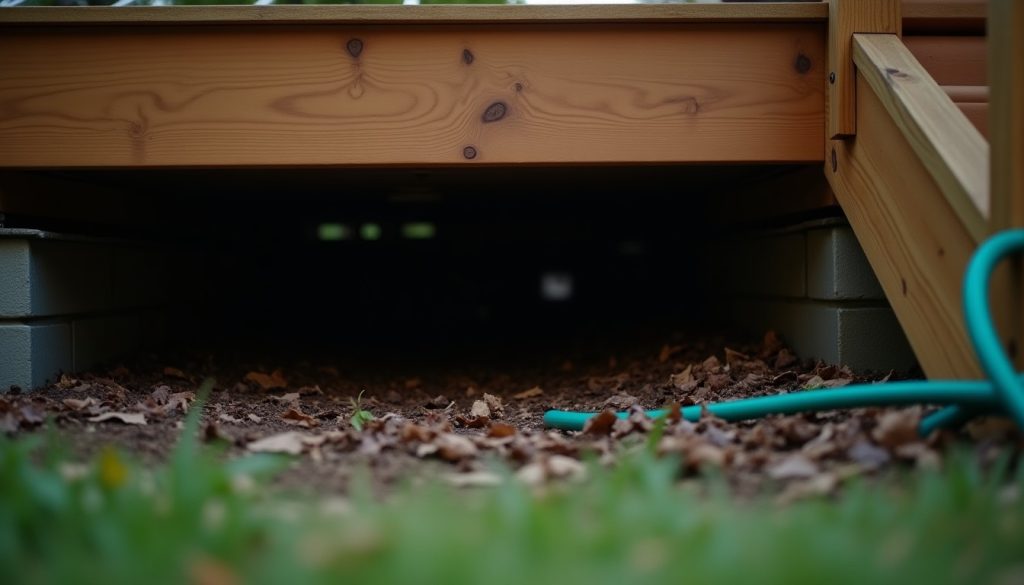
This is the permanent fix for decks, porches, sheds and crawl spaces:
- Call your local utility locating service before digging.
- Use galvanised hardware cloth. Wildlife damage specialists specify 1 by half-inch mesh; UC IPM and California’s handbook use quarter-inch, which also keeps out rats and mice.
- Fix the mesh to the deck frame or shed base and run it down into a trench.
- Bend the bottom outward to form an L. The wildlife damage literature says burying it at least 2 inches with a 12 to 18 inch skirt under the soil is enough for opossums, and that deeper burial is not necessary. UC IPM suggests burying up to 6 inches where possible.
- Backfill. Lattice in front hides the mesh if appearance matters.
Gardens and coops
UC IPM describes a 4-foot poultry wire fence with the top 12 to 18 inches bent outward and left unattached, so it flops under the animal’s weight. Alternatively, a tightly stretched electric wire 3 inches out from the top of an existing fence stops climbing. Shut poultry into a secure house every night.
Possum repellents and scare tactics
The evidence here is short and consistent. The wildlife damage literature lists no registered repellents and no effective frightening devices for opossums. California’s handbook says the array of products marketed for wildlife offers no significant results against opossums, and that a motion-activated sprinkler rarely works for more than a few days once an opossum is in the habit of visiting.
- Mothballs: California’s handbook does not recommend them, and the National Pesticide Information Center states that using mothballs in a way not specified on the label is illegal and can harm people, pets and the environment.
- Ammonia, vinegar, pepper, lights: no extension source we read found any of them effective against opossums.
- Scaring them at night: a surprised opossum may play dead or freeze, which looks like illness. The wildlife damage literature advises moving people and pets away and giving it time; if it has not left within 24 hours, assume it is sick or injured and call animal control.
Trapping, the law and when to call someone
Opossums are easy to catch in a cage trap, which is exactly why homeowners do it, and why the next problem arrives. The wildlife damage literature notes that laws protecting opossums vary by state and that most states have hunting or trapping seasons. California classes them as nongame mammals, requires a trapping licence, and prohibits relocating one without written permission. New Jersey allows owners to control property damage from opossums by lawful means. Check your state wildlife agency’s rules before setting a trap.
Relocation also tends to fail on its own terms: New Jersey’s wildlife policy states that the chances of survival are minimal for adults moved outside their home range. And an opening left unsealed is simply used by the next animal.
Never use rodent bait. California’s handbook warns that no toxicant is registered for opossums, that the penalty for this kind of pesticide misuse can be substantial, and that it usually comes to light when someone’s pet is poisoned.
A licensed wildlife control operator makes sense when the animal is in an attic, ductwork or under a mobile home, when young are present, or when you would rather not handle a trapped animal. For typical prices, see our wildlife removal cost guide.
How to get rid of possums and raccoons together
The food fixes are identical, so do them once. The differences are in the sealing: raccoons are strong enough to tear through light mesh and will pull off loose chimney caps, so a property with both needs the heavier materials in our raccoon guide. Raccoon young are left in the den, so raccoon timing rules take priority.
Frequently asked questions
What do opossums hate the most?
No smell has been shown to drive opossums away. No repellent is registered for them, California’s vertebrate pest handbook says marketed products offer no significant results, and frightening devices are not effective. What opossums cannot get past is a physical barrier: buried hardware cloth with an L-shaped skirt, a floppy-topped fence, or an electric wire at the top of a fence.
What does it mean when a possum hangs around your house?
Usually that something nearby is feeding it: pet food left out, fallen fruit, open bins or compost, spilled birdseed, or a pet door. A sheltered gap under a deck, porch or shed adds a place to sleep. California’s handbook notes that opossums tend to stay in a neighbourhood as long as food, water and shelter last, so removing food is the first step.
How do you get an opossum to leave?
Remove food, then wait for it to go out at night. A smooth layer of flour at the entrance will show outgoing tracks after dark; close the opening once they appear. If it stays, a one-way door about 6 by 6 by 10 inches over the last opening lets it out but not back in. Seal every gap with hardware cloth bent into an underground L.
What will kill possums naturally?
Opossums are short-lived anyway: most young die in their first year, and Missouri gives a wild lifespan of about two years. Deliberately poisoning them is not an option. No toxicant is registered for opossums, and California warns that using rodent bait on them is pesticide misuse that often ends with a poisoned pet. Exclusion and removing food solve the problem without killing anything.
Do mothballs get rid of possums?
No. California’s vertebrate pest handbook does not recommend them, and the National Pesticide Information Center states that using mothballs in any way not on the label, including outdoors to repel wildlife, is illegal and can harm people, pets and the environment. The vapour is a health concern in and around homes, and an opossum can simply walk past.
Sources
- University of California Statewide IPM Program, Pest Notes: Opossum, Publication 74123 (R.A. Baldwin, updated 2015).
- California Department of Food and Agriculture, Vertebrate Pest Control Handbook: Opossums.
- Internet Center for Wildlife Damage Management, Opossums: identification, biology, damage identification and control methods, based on J.J. Jackson, Prevention and Control of Wildlife Damage (1994).
- Hennessy C. and Hild K., Are Virginia opossums really ecological traps for ticks? Groundtruthing laboratory observations, Ticks and Tick-borne Diseases 12(5), 2021.
- Keesing F. et al., Hosts as ecological traps for the vector of Lyme disease, Proceedings of the Royal Society B 276, 2009.
- Ferreira-Machado E. et al., Naturally Acquired Rabies in White-Eared Opossum, Brazil, Emerging Infectious Diseases 29(12), CDC, 2023.
- Missouri Department of Conservation, Field Guide: Virginia Opossum.
- New Jersey Division of Fish and Wildlife, Policy on the Relocation of Wildlife.
- National Pesticide Information Center, Mothballs: regulation and label use.
- The Pest Control Brief analysis of iNaturalist research-grade records, pulled October 2026.