What Do Pest Control Companies Use for Ants? Actives Compared
Pest control companies mainly use slow-acting ant baits (borates, fipronil, hydramethylnon, indoxacarb) and, outdoors, non-repellent sprays such as fipronil, chosen by species. Carpenter ants usually get dust or liquid placed in the nest, fire ants get broadcast bait, and pharaoh ants get bait rather than repellent spray. Most of the difference from a store product is formulation and placement.
Species decides the tool, so a technician who picks a product before identifying the ant is skipping the first step. Our ant identification guide covers the waist and size checks, and what exterminators use explains formulations across all pests. This page deals only with ants, and names active ingredients rather than brands.
What do pest control companies use for ants?
| Ant | Usual professional application | Active ingredients named by the source | Why, and the checkable fact |
|---|---|---|---|
| Odorous house ants and other “sugar ants” | Sugar bait on trails, or a low-pressure fipronil band at the foundation | Borax, fipronil | University of Tennessee field trial: 0.06% fipronil spray cut outdoor numbers by 93% or more from week 4, with four homes per treatment |
| Argentine ants | Sugar bait all year, protein bait in spring, plus sealing entry points | Boric acid under 1%, fipronil, hydramethylnon | UC IPM: baits alone “will not usually control” this ant, so exclusion is part of the job |
| Carpenter ants | Dust or liquid in the nest through openings or drilled holes; bait for colonies nobody can find | Borates, permethrin, cyfluthrin, disodium octaborate tetrahydrate, silica gel, fipronil | UC IPM: spraying foragers “will not solve the problem”. University of Kentucky says fipronil sprays “should only be applied by licensed applicators” |
| Fire ants | Bait broadcast across the yard, then direct treatment of mounds by the foundation or in high-traffic spots | Indoxacarb, hydramethylnon, spinosad, abamectin, fenoxycarb, methoprene, pyriproxyfen, granular fipronil | Texas A&M: indoxacarb works in 3 to 10 days; insect growth regulators take 1 to 2 months in spring on its current page, 2 to 6 months on an older fact sheet |
| Pharaoh ants | Bait; non-repellent residual spray if a spray is used at all | Fipronil, chlorfenapyr | Purdue laboratory study: repellent cypermethrin led to colony budding, while fipronil gave 100% activity reduction by day 2 on concrete and mulch |
Compiled by The Pest Control Brief from University of Tennessee, UC IPM, University of Kentucky, Texas A&M AgriLife and Purdue sources. “Sugar ant” is a nickname rather than a species, and our sugar ants guide shows which ants it covers. Our pharaoh ant guide sets out the extension advice on baiting them.
Why does pest control not just spray ants?
Because for most ants the visible workers are not the problem. UC IPM says baits are “more effective and safer than sprays” when properly used, because workers carry the product to the nest, whereas a foundation spray kills “only foraging ants”. Three further limits apply.
- Budding. Purdue researchers found that cypermethrin, a repellent pyrethroid, caused colony budding in pharaoh ants, though the response was delayed.
- Bait interference. University of Arizona extension says: “If toxic baits are used, do not use insecticide sprays,” because spray stops the ants carrying bait home.
- The label. One 9.1% fipronil concentrate (EPA Reg. No. 7969-210) bars use indoors “except for applications into structural voids”, and it is limited to individuals and firms licensed or registered by the state.
The sources do not fully agree on outdoor sprays. UC IPM says perimeter treatments may appear to knock numbers down, but ants “will quickly build back up”, and it warns of more environmental risk than bait stations. The Tennessee trial found a 0.06% fipronil band kept odorous house ants at least 93 per cent below pretreatment levels through week 17, and its bait and spray combination was never significantly different from spray alone. That trial was small and covered one species, so read it as evidence that a non-repellent spray can work, not as a general rule.
Non-repellent does not mean it spreads through the colony
Fipronil and chlorfenapyr are often grouped together as non-repellent transfer sprays. The published test is less generous to chlorfenapyr. In a 2008 University of California, Riverside study, ants exposed to fipronil at 20 and 40 parts per million “readily transferred the insecticide” to nestmates, with most transfer and death within 4 days. Chlorfenapyr was among the other insecticides tested, and those “were not transferred”. The authors identified handling of contaminated corpses as an important route.
| Spray active | Repellent to ants? | Transfer between Argentine ants (2008 lab test) | Result in pharaoh ant lab test (2005) |
|---|---|---|---|
| Fipronil | No | Yes, at 20 and 40 ppm | Most effective: 100% activity reduction by day 2 on concrete and mulch |
| Chlorfenapyr | No | Not transferred | Highly effective on outdoor and indoor surfaces |
| Cypermethrin | Yes | Not tested | Colony budding, delayed |
Compiled by The Pest Control Brief from Choe and Rust (2008) and Buczkowski and colleagues (2005). Both are laboratory results on one species each, and field results vary.
Which of these do technicians reach for? We found no recent US survey. The nearest figures come from a 2019 Australian trade survey by Professional Pest Manager, so treat them as an indication only: just over 90 per cent of pest managers used ant baits, with gel baits at 70 per cent, granular at 65 per cent and liquid at 45 per cent. For specialist ant work, over 40 per cent used non-repellent sprays, about 15 per cent pyrethroids and over 40 per cent either.
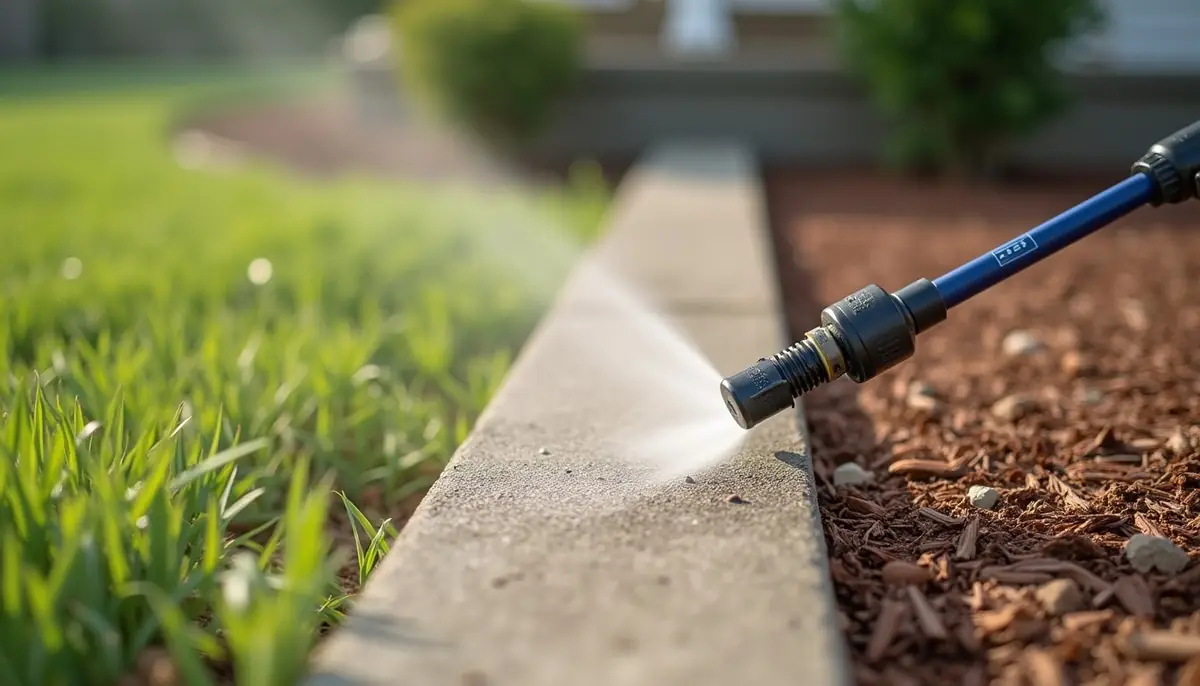
California: the same product, a much smaller band
What a California technician may spray outdoors is narrower than elsewhere, which is why a California ant visit can look different. Label limits below are from the EPA-accepted August 2023 label for one fipronil product. Other fipronil labels carry their own text, though a second one, EPA Reg. No. 84836-18, also cut the California band from 12 inches to 6 inches in 2017.
| Limit at the foundation | Rest of the US | California |
|---|---|---|
| Fipronil spray band | 1 foot up and 1 foot out | 6 inches up and 6 inches out |
| Fipronil strength | 0.03% or 0.06% | 0.03% only |
| Fipronil applications | 4 a year at 0.03%; 2 a year at 0.06% | 4 a year at 0.03%, at least 60 days apart |
| Fipronil season | No date limit on this label | None between November 1 and February 28 |
| Fipronil on driveways and garage doors | Not barred by this clause | Barred |
| Pyrethroid perimeter band (for-hire applicators) | Follows the product label | Under 3 CCR 6970: up to 3 feet out and 2 feet up |
| Spraying during rain | Barred on this fipronil label | Barred for fipronil; barred for listed pyrethroids except under eaves |
Compiled by The Pest Control Brief from the fipronil label EPA Reg. No. 7969-210 and California Code of Regulations Title 3, Section 6970.
The reason is water. Our analysis of California pesticide reports and stream samples found structural pest control accounted for 99.7 per cent of reported fipronil use in 2022 and 2023, and fipronil turned up in 16.9 per cent of 2,489 stream samples since 2015. Given the November to February bar on this label, a winter ant call in California is likely to rely on baits or products other than perimeter fipronil, so ask what is planned. UC IPM also tells readers to “Avoid spraying pyrethroids (like bifenthrin and cypermethrin) outdoors.”
What the visit looks like, and what not to spray first
University of Arizona extension describes the order for odorous house ants: identify the species, locate nests, reduce numbers with bait, apply perimeter sprays, then treat nests directly if needed. In most homes a carpenter ant visit is more of a search: UC IPM advises following trails and watching at night, and sawdust piles with dead ants point to nearby activity.
- Stop spraying before the visit. University of Wisconsin extension warns against applying spray insecticides near bait because it can reduce bait effectiveness, so a recent store spray may interfere with baiting.
- Write down where and when you saw trails, including any wall entry point and any sawdust.
- Ask for the active ingredient and label before application, and the re-entry period. The fuller list of questions is on our exterminator chemicals page.
- Fix moisture. Carpenter ant dusts stay effective only while dry, and UC IPM advises fixing leaky pipes and roofs.
Baiting a line of small sweet-seeking ants is a reasonable DIY first step, and our borax guide gives the working 0.5 to 1 per cent boric acid range. Hidden carpenter ant nests are different: University of Kentucky recommends professional help, partly because drilling can damage the structure, and our carpenter ant guide covers the steps. A published estimate on our ant control cost page puts standard treatment at $80 to $500 and carpenter ants at $250 to $500.

How long the products take to work
Baits have to travel back to the nest, so results lag the visit. Extension sources give control time, not visit length. For carpenter ants, a five-year trial at 87 field sites gives a useful range.
Control rates in that trial were 100 per cent for liquid boric acid and for granular hydramethylnon, 92 per cent for fipronil granules and 76 per cent for fipronil gel, and granular avermectin did not achieve control. The fastest bait was not the most complete. Follow-up visits on a plan are a published $40 to $70 on our cost page.
Frequently asked questions
What do exterminators use for ants?
Exterminators usually use slow baits containing boric acid or borates, fipronil, hydramethylnon or indoxacarb, and outdoors a non-repellent spray such as fipronil, often 0.03 or 0.06 per cent. UC IPM also lists bifenthrin, cypermethrin and lambda-cyhalothrin as common perimeter pyrethroids. The right mix depends on the species.
What do pest control companies use for carpenter ants?
Mostly a dust or liquid placed in the nest through openings or drilled holes. UC IPM names permethrin, cyfluthrin, boric acid and disodium octaborate tetrahydrate, and University of Kentucky adds fipronil sprays for licensed applicators. Baits help with satellite colonies nobody can locate, and any wet wood needs fixing.
What do pest control companies use for fire ants?
Texas A&M’s Two-Step Method pairs a broadcast bait across the yard with direct treatment of mounds near the foundation or in busy spots. Bait actives include indoxacarb, hydramethylnon, spinosad and insect growth regulators. Granular fipronil lasts longer, and only one treatment is permitted per year.
How long does professional ant treatment take?
Extension sources do not publish a visit length, so ask the company. Results vary by product: Texas A&M gives 3 to 10 days for indoxacarb on fire ants, Tennessee’s field trial saw 93 per cent reduction by week 4 with fipronil spray, and carpenter ant baits averaged 5.9 to 11.1 weeks.
Sources
- University of California Statewide IPM Program. Pest Notes: Ants, Publication 7411, updated 2012; Carpenter Ants and Argentine ant bait pages, Ant Key.
- Vail, K. M. and Bailey, D. Perimeter baits, spray, or combinations: which provide longer odorous house ant relief for residential accounts? University of Tennessee, ICUP proceedings abstract.
- University of Kentucky Entomology. Carpenter Ants, EF603, revised March 2026.
- Texas A&M AgriLife Extension. Fire Ant Project, Control Methods; Two-Step Method fact sheet L-5070.
- Buczkowski, G., Scharf, M. E., Ratliff, C. R. and Bennett, G. W. Efficacy of simulated barrier treatments against laboratory colonies of pharaoh ant. Journal of Economic Entomology 98(2), 2005.
- Choe, D. H. and Rust, M. K. Horizontal transfer of insecticides in laboratory colonies of the Argentine ant. Journal of Economic Entomology 101(4), 2008.
- Hansen, L. D. Efficacy of different baiting matrices as tools in the management of carpenter ants. Proceedings of the International Conference on Urban Pests, 2002.
- US EPA. Accepted label, EPA Reg. No. 7969-210, 15 August 2023; label amendment, EPA Reg. No. 84836-18, 8 June 2017.
- California Code of Regulations, Title 3, Section 6970, Surface Water Protection in Outdoor Nonagricultural Settings.
- University of Arizona Cooperative Extension. Odorous House Ants, Backyard Gardener 15. University of Wisconsin Extension. Odorous House Ants.
- Professional Pest Manager. Pest Pulse: What ant products do you use? January 2019 (Australian survey).