What Do Cockroaches Eat? Almost Anything, and Why It Matters
Cockroaches eat almost any organic matter: starches, sugars, grease, meat, paper, glue, hair, leather, dead insects, droppings and, now and then, other cockroaches. Indoors they live on crumbs in cracks, grease films, pet food and rubbish; outdoors, on decaying plant matter, sewage and dead animals. Penn State Extension says German cockroaches are especially fond of starches, sweets, grease and meat products. That breadth is why you cannot starve them out with tidiness alone, and why bait works: it joins the menu rather than fighting it.
The useful questions are which foods keep a population going, which compete with bait, and how a diet that includes droppings and dead nestmates turns one bait placement into a chain reaction.
What cockroaches eat: the full menu
| Food group | Examples recorded by entomologists | Who says so |
|---|---|---|
| Starches | Bread, rice, book bindings, wallpaper paste, the glue on stamps and envelopes | UF/IFAS; Ebeling (UC Riverside); UC IPM |
| Sugars | Sweets, fruit, dregs in unrinsed soft drink and beer bottles | UF/IFAS; Ebeling |
| Fats and protein | Grease, meat products, fish, peanuts, pet food, table scraps | Penn State; UF/IFAS; Rutgers |
| Animal fibres and fabric | Hair, the soft inner side of leather and hides, cloth, boots | UF/IFAS; Ebeling |
| Other insects | Dead insects and the cast skins of moulted cockroaches | UF/IFAS; Ebeling |
| Waste | Droppings of other cockroaches; sewage and pet droppings for American cockroaches | Rutgers; UC IPM |
| Each other | Dead cockroaches, weakened nymphs, occasionally egg cases | Rutgers; Ebeling; NC State |
| People (rare) | Fingernails, eyelashes and callused skin, only in very heavy infestations | Ebeling; UF/IFAS |
UF/IFAS describes the American cockroach as an omnivorous, opportunistic feeder that “will eat almost anything”, and lists paper, boots, hair, bread, fruit, book bindings, fish, peanuts, old rice, putrid sake, the soft inside of animal hides, cloth and dead insects. Ebeling’s Urban Entomology (UC Riverside) adds glue, wallpaper, fabrics and dead animals, and notes cockroaches surviving for months in refrigerator and range insulation on cast skins and dead insects alone.
What do cockroaches eat in your house?
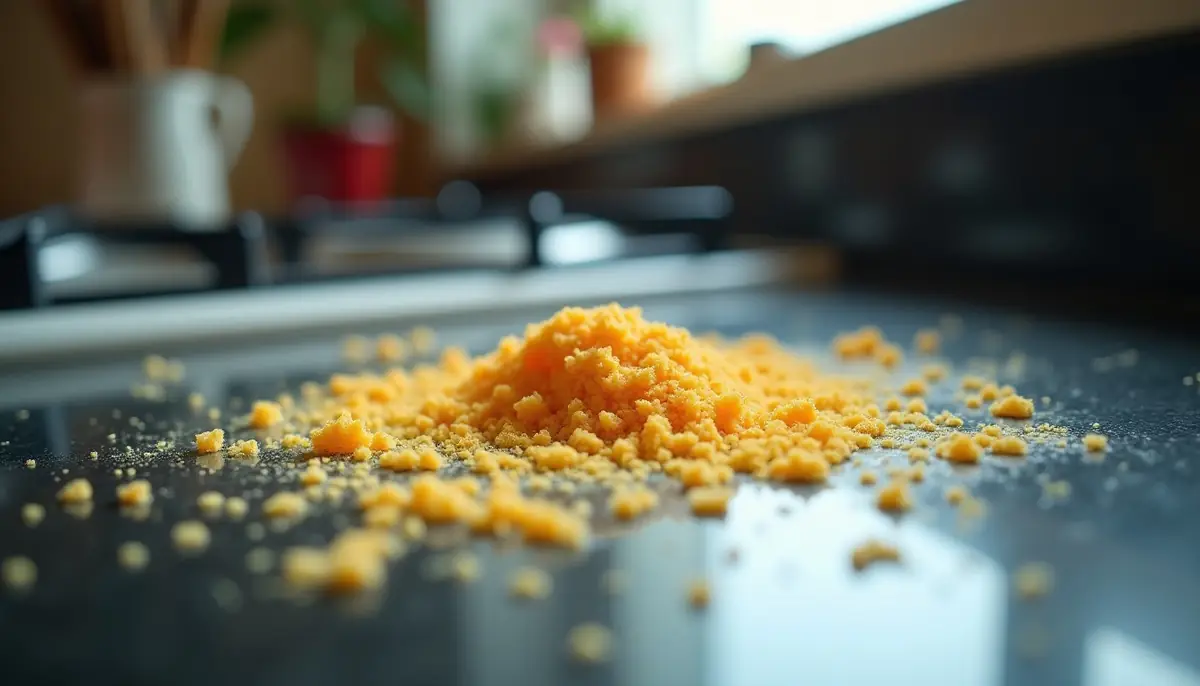
Mostly things you would not call food. UC IPM puts it plainly: even tiny amounts of crumbs or liquids caught between cracks provide a food source. In practice the kitchen menu is the grease film behind the stove, crumbs under the toaster, pet food left down overnight, the rubbish bin, and the last centimetre of a drink can. Penn State notes that in many places trash is a major food source for German cockroaches.
Away from the kitchen, cockroaches find starch in cardboard, paper and the glue in book spines and electronics. Rooms with water but little food, such as bathrooms, support them too, because water matters more than food; our guide to what attracts roaches covers moisture and the room-by-room picture, so we will not repeat it here.
What is cockroaches’ favorite food?
There is no single favourite, but there are clear preferences. UF/IFAS says the American cockroach prefers sweets. Penn State lists starches, sweets, grease and meat for the German cockroach. UC IPM says the brownbanded cockroach prefers starchy foods such as the glue on stamps and envelopes.
Laboratory work gives a more precise answer. NC State entomologists note that laboratory-reared German cockroaches offered a choice mix their own diet at roughly one part protein to three parts carbohydrate. When the same team tested cockroaches in occupied apartments in 2021, preferences varied widely between apartments, though males, females and nymphs from the same apartment chose similarly. In other words, a carbohydrate-heavy diet is the baseline, and local conditions shift it.
One important exception: some German cockroach populations have evolved to taste glucose as bitter and reject sweet baits. Our German cockroach treatment guide explains that trait and what to do about it.
What do cockroaches hate?
Mainly dry, clean, sealed spaces. Extension guidance relies on sanitation and exclusion, not repellent smells. Glucose rejection in averse German cockroach strains is the one food aversion with solid research behind it.

German, American and wood cockroaches eat differently
| German cockroach | American cockroach | Wood cockroach | |
|---|---|---|---|
| Where it feeds | Kitchens and bathrooms; cannot survive away from people | Sewers, drains, mulch, woodpiles, commercial kitchens | Leaf litter and damp organic debris outdoors |
| Typical food | Table scraps, pet food, grease, book bindings | Decaying organic matter, sweets, sewage | Decaying plant matter |
| Indoors | Breeds indoors all year | Rarely in houses; wanders in, often after heavy rain | Dies within a few days; does not feed or breed indoors |
| What it means | Sanitation plus bait; often a professional job in apartments | Seal entry points and drains; bait outdoors | Usually just remove it |
The species tells you more than the food does. UF/IFAS says German cockroaches cannot live away from human activity, while American cockroaches are rarely found in houses; Penn State says wood cockroaches die indoors within days. Not sure which you have? Our cockroach identification guide will settle it.
What do cockroaches eat in the wild?
Outdoor cockroaches are recyclers. Penn State says wood cockroaches feed on decaying plant matter, and UF/IFAS says American cockroaches outdoors use trees, woodpiles, garbage and accumulations of organic debris for food, water and shelter. NC State researchers note that the crop contents of cockroaches in natural forest populations contain arthropod cuticle, so scavenging dead insects is part of the wild diet. One North American species, the wood-feeding Cryptocercus punctulatus, lives in decayed logs that serve as both food and shelter, and digests the wood with the help of gut protozoa that convert cellulose into sugar, as Ebeling describes.
What makes such a poor diet workable is internal. Cockroaches store waste nitrogen as uric acid in their fat body, and a resident bacterium, Blattabacterium, recycles it into the essential amino acids. A 2009 genome study in PNAS concluded this partnership lets cockroaches subsist on nitrogen-poor diets and exploit nitrogenous wastes: a large part of why they can live on cardboard and crumbs.
Do cockroaches eat other cockroaches?
Sometimes. Rutgers Cooperative Extension says German cockroaches feed on the dead bodies and excrement of other cockroaches. Eating the dead, called necrophagy, appears to be a normal part of their nutrition. Killing and eating live nestmates is less common: a 2023 NC State paper says cannibalism is not common in cockroaches and tends to occur under stress, such as heat, crowding and limited food, although some occurs in all stages even when food is sufficient. Ebeling, writing earlier, reports that many investigators have seen cannibalism, including the eating of egg cases, even when food was adequate. The sources differ in emphasis, not in substance: it happens, mostly in crowded or hungry colonies.
There is also courtship feeding: female German cockroaches feed on a secretion from glands on the male’s back as they mate, and a 2022 NC State study found well-fed males mated more often than males starved for a week (73.9 against 48.3 per cent).
Do cockroaches eat poop?
Yes. Feeding on droppings, coprophagy, is routine. In a 2001 study, newly moulted first-stage German cockroach nymphs given nothing but adult droppings survived significantly longer than nymphs given nothing, and some moulted to the next stage on droppings alone. Female droppings worked better than male, and droppings from adults on a high-protein diet worked best. Second-stage nymphs gained little, so this is a habit of the very youngest. The same droppings carry an aggregation pheromone, which is why UC IPM suggests placing bait next to fecal specks.
American cockroaches go further. UC IPM notes that because they contact human excrement in sewers and pet droppings outdoors, they can carry the bacteria that cause food poisoning, Salmonella and Shigella. Rats scavenge in similar places; compare what rats eat.
Why bait works: it uses their diet against them
Bait is the primary cockroach pesticide, according to UC IPM, and the reason is the menu above. A cockroach that eats slow-acting bait returns to its shelter, where nestmates eat its droppings, its regurgitated fluid and eventually its body; NC State researchers list those routes plus simple contact.
In a 2023 NC State laboratory study, every gel bait tested killed all the adult females that ate it, and on average at least 85 per cent of first-stage nymphs exposed to those dead females and their droppings died within 48 hours. The researchers then exposed fresh nymphs to the dead nymphs, a third round, and some baits kept killing.
Speed matters. A bait that kills too fast can kill the forager before the bait passes through its gut, which cuts off the droppings route. A 2001 NC State study found that residues from slow-acting hydramethylnon bait killed most nymphs and adults after the baits were removed, while residues of fast-acting insecticides killed fewer, because slow-dying cockroaches had time to return to shelter and defecate.
When bait does not work
| What you see | Likely reason | What helps |
|---|---|---|
| Bait untouched, cockroaches still active | Competing food nearby | Remove crumbs, grease and pet food; UC IPM says this greatly enhances bait |
| Bait refused, especially sweet baits | Glucose aversion in German cockroaches | Different formulation; see the German cockroach guide |
| Numbers drop, then young nymphs reappear | Females carrying egg cases barely feed | Follow-up baiting every 2 to 4 weeks (Rutgers) |
| Bait placed in open areas | Baits do not attract from a distance | Small placements in cracks, hinges and near droppings |
| Bait sprayed over or beside spray | Contamination and repellency | Keep sprays away from bait; see bait versus spray |
UC IPM notes that egg-carrying females feed very little and that brownbanded cockroaches are especially hard to bait. Rutgers advises repeating treatments every 2 to 4 weeks until no cockroaches are found for four weeks. Our comparison of cockroach bait vs spray covers the evidence on sprays. For an established German cockroach infestation, particularly in an apartment building, a licensed professional is usually the realistic route.
How long can cockroaches go without eating?
Weeks to months, provided they have water: in the 1957 Willis and Lewis study reported by Ebeling, German females lived 35.1 days and American females 89.6 days on water alone. Our article on how long cockroaches live has the full figures. Water, not food, is the resource you can realistically take away.
What do cockroaches do to humans?
They contaminate food rather than eat people. UF/IFAS says German cockroaches adulterate food with their feces and defensive secretions, carry pathogens and may cause severe allergic responses. Rutgers notes that their feces, shed skins and dead bodies contain allergens that trigger asthma, and UC IPM links indoor infestations to asthma risk in children. Our report on cockroach allergen and asthma has the detail; for any health concern, talk to a doctor.
Can roaches bite you?
Rarely. Ebeling cites a 1957 review of 20 reports of cockroaches biting people, and says they are most likely to gnaw fingernails, eyelashes of sleeping children and callused skin. UF/IFAS says bites, and feeding on food residue on the faces of sleeping people, have been reported only in extremely heavy infestations. So, to the question “what do cockroaches eat on humans”: dead skin and nails, almost never living flesh. If you think you have been bitten, ask a doctor.
Our data: when cockroaches are recorded
The Pest Control Brief analysis of iNaturalist research-grade records, pulled October 2026, shows each species’ monthly share of everything recorded in the US. These are sightings, not infestation counts. German cockroaches peak in November (index 184) and bottom out in May (36), an indoor insect noticed when little else is about. American cockroaches also peak in November (155), with the most raw records in September (2,287).
Cutting the food supply that actually matters
- Seal dry food in glass jars or resealable plastic containers, as UC IPM advises; cardboard boxes are food too.
- Take pet food up at night in an infested home, as Rutgers recommends, and empty rubbish and recycling daily.
- Vacuum cracks and droppings with a HEPA vacuum; droppings feed young nymphs and hold the colony together.
- Rinse cans and bottles and fix drips, because water is the limit that bites.
- Then bait, close to where they hide, following the label, and keep sprays away from bait placements.
Frequently asked questions
Why should you never squish a cockroach?
Mainly hygiene. Crushing a cockroach smears its gut contents and body on the surface, and Rutgers notes that cockroach bodies and feces contain allergens, while UC IPM says American cockroaches can carry food-poisoning bacteria. The egg worry is mostly overstated: Rutgers says a German cockroach egg case detached from the female typically will not hatch unless it is within one to two days of hatching. A sticky trap or vacuum is cleaner; wash your hands afterwards.
Should I worry if I see one cockroach?
It depends on which one. A large American cockroach after heavy rain has often wandered in from a drain or yard, and UF/IFAS says this species is rarely found in houses. A small German cockroach in a kitchen is different: they live only around people and hide in cracks by day, and growing populations are about 80 per cent nymphs. Put sticky traps out for a week, as UC IPM suggests, to see how many there are.
What do cockroaches eat and drink?
They eat almost any organic matter, from crumbs, grease and pet food to paper, glue, hair, dead insects and droppings. They drink from drips, condensation, pet bowls, sink traps and the dregs in cans and bottles. Water matters more than food: in the classic 1957 laboratory study, German cockroach females lived about 35 days on water alone but about 20 days with neither food nor water.
How long can cockroaches go without eating?
Weeks to months if they have water. Laboratory data reported in Ebeling’s Urban Entomology found adult German cockroach females lived 35.1 days and American females 89.6 days on water with no food. Ebeling also notes cockroaches surviving for months in appliance insulation on cast skins and dead insects alone. That is why removing food helps bait work but rarely starves an infestation out by itself.
Will cockroaches eat bait if there is other food around?
Less readily. UC IPM says that if cockroaches have access to food, baits may take longer to give satisfactory control, and that removing other food sources greatly enhances the effect of baits. Clean up crumbs, grease and pet food before and during baiting, place small amounts of bait in cracks near where they hide, and keep insecticide sprays off and away from bait placements.
Sources
- University of California Statewide IPM Program, Pest Notes: Cockroaches, UC ANR Publication 7467.
- UF/IFAS Extension, American Cockroach, Periplaneta americana (EENY-141, EDIS IN298), revised 2024.
- UF/IFAS Extension, German Cockroach, Blattella germanica (EENY-002, EDIS IN128).
- Rutgers Cooperative Extension, Fact Sheet FS1322, German Cockroach, 2020.
- Penn State Extension, German Cockroaches; Wood Cockroaches.
- Ebeling, W., Urban Entomology, chapter 6, University of California, Riverside.
- McPherson, Wada-Katsumata, Hatano, Silverman and Schal, Comparison of diet preferences of laboratory-reared and apartment-collected German cockroaches, Journal of Economic Entomology 114(5), 2021.
- Hamilton, Wada-Katsumata and Schal, Cockroaches as Trojan horses for control of cockroach aggregations with baits, Journal of Economic Entomology, 2023.
- Buczkowski, Kopanic and Schal, Transfer of ingested insecticides among cockroaches, Journal of Economic Entomology 94(5), 2001.
- Kopanic, Holbrook, Sevala and Schal, An adaptive benefit of facultative coprophagy in the German cockroach, Ecological Entomology, 2001.
- Sabree, Kambhampati and Moran, Nitrogen recycling and nutritional provisioning by Blattabacterium, the cockroach endosymbiont, PNAS, 2009.
- McPherson and colleagues, Nutritional condition affects tergal gland secretion and courtship success of male cockroaches, PLoS ONE, 2022.
- The Pest Control Brief analysis of iNaturalist research-grade records, pulled October 2026.