Can Roaches Climb Walls? Glass, Ceilings and Beds
Yes, most roaches climb walls easily, and the common indoor species can also run across ceilings and up smooth surfaces such as glass. Claws on each foot grip rough surfaces like drywall, wood, brick and fabric, and a soft sticky pad between the claws, the arolium, lets them hold on to smooth ones. The big exception is the Oriental cockroach, which lacks that pad and cannot climb smooth vertical surfaces, so it is the roach you find stuck in a sink or bathtub. Stairs, bed legs, curtains and bedding are all easy routes for a roach that wants to go up.
Watching a roach sprint up a wall and vanish over the top of a cupboard can make it seem that nothing will stop them. That is nearly true, but not quite, and the exceptions are useful: they explain where roaches end up, where to put traps, and which species you are dealing with.
Which roaches climb what: species by species
| Species | Adult size | Rough walls, wood, fabric | Smooth glass, porcelain | Where you usually see it |
|---|---|---|---|---|
| German cockroach | 10 to 15 mm, about half an inch | Yes | Yes, needs a slippery barrier to be stopped | Kitchens and bathrooms, at any height |
| American cockroach | About 40 to 51 mm, 1.5 to 2 inches | Yes | Yes, the arolium lets it climb smooth walls | Ground floors, basements, drains |
| Brownbanded cockroach | About half an inch | Yes | Not separately documented in the sources we read | High, warm spots: ceilings, behind pictures, appliances |
| Oriental cockroach | About 1.25 inches | Yes, slowly | No, unable to climb smooth vertical surfaces | Ground floor, basements, trapped in sinks and tubs |
Height in the house is a clue to the species, which our cockroach identification guide uses as one of its main tests. A roach high on a kitchen wall at night is most often German. A large, dark, slow roach in the bathtub that cannot get out is most likely Oriental.

How roaches climb walls
Each cockroach foot ends in a pair of claws beside a soft pad called the arolium. Along the underside of the foot are further pads, called euplantulae or pulvilli. On a rough surface such as painted drywall, wood, brick or carpet, the claws catch on tiny irregularities. On a smooth surface there is nothing for a claw to catch, and the pads take over.
Lander University’s invertebrate zoology text on the American cockroach puts it plainly: the arolium is an adaptation for clinging to smooth surfaces and makes it possible for Periplaneta to climb smooth walls. The same text notes that the Oriental cockroach lacks an arolium and cannot climb smooth surfaces, which matches UC IPM’s statement that Oriental cockroaches are unable to climb smooth vertical surfaces and end up trapped in porcelain sinks or tubs.
Two kinds of pad, two jobs
A 2008 study by Christofer Clemente and Walter Federle filmed cockroaches climbing vertically and measured single legs. It found that the two pad types do opposite jobs. The arolia make contact when a leg is pulling; the euplantulae engage when a leg is pushing. So a roach climbing upwards uses the arolia on its front legs and the euplantulae on its hind legs, and the pattern flips when it climbs down. The authors concluded the euplantulae are friction pads that provide traction, while the arolium does the sticking. The study used a lobster cockroach (Nauphoeta cinerea), not a household pest, but the foot design is shared across cockroaches.
Can roaches climb glass?
The species with a working arolium can. This is where most pest control pages go wrong: several of the top results say glass is too smooth for cockroaches. That is true of the Oriental cockroach and misleading for the rest.
The practical evidence for German cockroaches comes from trap research. Auburn University entomologists Smith and Appel tested traps for German cockroaches and found glass jar traps only worked with a barrier around the inside: a thin layer of petroleum jelly kept cockroaches from escaping better than powdered clay, and jars with petroleum jelly caught about twice as many. If German cockroaches could not climb clean glass, the jar would not need a barrier at all.
The same study is a useful warning for home trappers. Even with a barrier, glass jar traps caught only half as many German cockroaches as sticky traps. For monitoring, a glue board is the better tool.
Can cockroaches climb plastic and other smooth surfaces?
We found no study testing household plastics specifically. The mechanism suggests smooth plastic behaves like glass: species with an arolium can usually hold on, and the Oriental cockroach cannot.
Can roaches climb walls and ceilings?
Yes. Walking upside down is the arolium’s main job, because a roach hanging from a ceiling is pulling against gravity with every foot, which is when, per Clemente and Federle, the arolium engages.
Roaches can also get onto a ceiling or under a shelf at speed. In a 2012 study at the University of California, Berkeley, Jean-Michel Mongeau, Robert Full and colleagues filmed American cockroaches running at 12 to 15 body lengths per second towards a ledge without braking. The insects dove off, hooked the edge with the claws of their hind legs like a grappling hook, and swung underneath in a pendulum motion that can exceed one metre per second, ending up upside down and out of sight. That is the vanishing trick people see when a roach goes over the edge of a counter and is gone.
Do roaches fall off ceilings?
Sometimes, especially larger species, and some launch off walls and glide down rather than climbing. Which species fly or glide, and why one seems to come straight at you, is covered in our guide to whether roaches can fly.
How fast roaches move, flat, vertical and squeezed
The speed figures that circulate online mostly come from one research group, Robert Full’s lab at Berkeley, and they measure different things:
- Flat out on the level: Full and Tu (1991) measured American cockroaches at 1.0 to 1.5 metres per second, about 50 body lengths a second, running on two or four legs at top speed.
- Straight up a wall: Goldman, Chen, Dudek and Full (2006) measured death-head cockroaches (Blaberus discoidalis), a large tropical species, climbing a vertical plate at about 19.5 cm per second, roughly 5 body lengths a second. That plate was coated with glass beads to help them grip, so treat it as a climbing speed on a good surface.
- In a gap: Jayaram and Full (2016) found American cockroaches crawling at close to 60 cm per second while squeezed into vertically confined spaces.
The short version: a roach climbing a wall is much slower than one running across a floor, but still quick enough to reach a ceiling before you reach it.
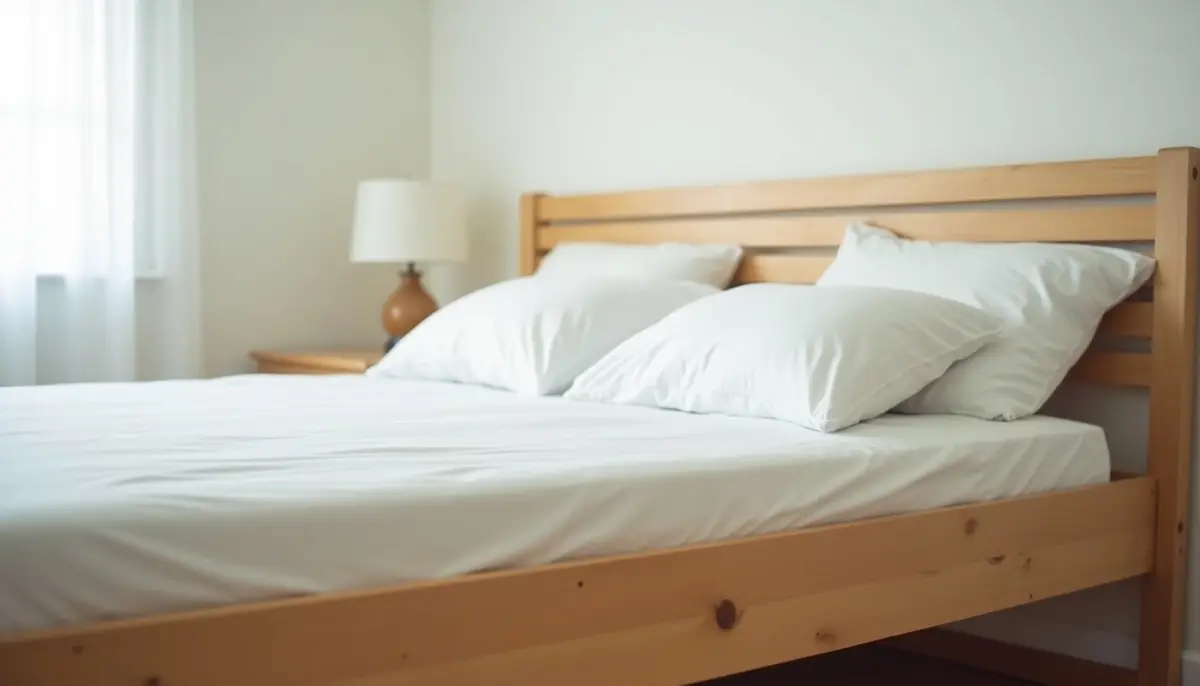
Can roaches climb into your bed?
They can. Wooden or metal bed legs, a headboard touching the wall, a bedspread trailing on the floor and bedding are all climbable, and species with an arolium can, in principle, manage smooth metal legs too. What is different from bed bugs is motive. Unlike bed bugs, roaches do not feed on blood, so a bed has nothing in particular to offer them; they forage for food and water and shelter in tight, dark cracks. UC IPM describes them hiding in narrow spaces where surfaces touch them on both sides.
Finding roaches in bed usually points to a heavy infestation or to food in the bedroom. Los Angeles County’s public health guidance notes that in heavily infested homes German cockroaches may be found in every part of the building, with clusters visible during the day. A few practical steps:
- Keep food, drinks and pet food out of bedrooms.
- Pull the bed a few inches from the wall and keep bedding off the floor, so the only route up is the legs.
- Put glue boards against the wall near the bed to see whether roaches are travelling there.
If roaches are in the bedroom of an apartment, the source is usually the kitchen or a neighbouring unit, and the fix is a proper German cockroach treatment rather than anything done to the bed.
Can cockroaches climb stairs?
Easily. Carpet, wood and painted risers are rough surfaces, so every species can climb them, including the Oriental cockroach. Stairs are rarely the route that matters, though. UC IPM lists hollow walls, false-bottom cupboards and gaps around utility pipes as the refuges to seal, and those hidden routes are how roaches move around a building out of sight. It is one reason roaches are so persistent in apartment buildings: New York housing inspectors issued 35,278 roach violations in 2025, as our analysis of roach and mouse violations in New York apartments shows.
What surfaces can roaches not climb?
| Surface | German and American | Oriental |
|---|---|---|
| Drywall, plaster, painted walls | Climb easily | Climb |
| Wood, brick, fabric, carpet | Climb easily | Climb |
| Clean glass, glazed porcelain | Can climb using the arolium | Cannot climb vertically |
| Glass with a thin film of petroleum jelly | Blocked well enough to keep German cockroaches in jar traps | Blocked |
| Sticky glue board | Caught | Caught |
So the honest answer to which surfaces roaches cannot climb is: for most indoor species, very few, and only when they are slick and treated. That is why sealing gaps and removing food work better than trying to make surfaces unclimbable. Mice are in a similar position, as our guide to whether mice can climb walls explains: rough walls are a ladder, and only slick surfaces slow them down.
What climbing means for traps and monitoring
Roaches follow edges. UC IPM notes they congregate in corners while foraging and generally travel along the edges of walls and other surfaces. That is the single most useful fact for placing traps:
- Put glue boards at the junction of floor and wall, which UC IPM names as the best place, and in every corner of the room.
- In the kitchen, place traps against walls behind the stove and refrigerator and inside cabinets.
- Number the traps and check them daily for several days. UC IPM says roaches are often caught within the first 24 hours.
- Remember that roaches climb: if floor traps stay empty but you see roaches, try the back of upper cabinets and shelves, where brownbanded and German cockroaches often shelter.
Los Angeles County’s guidance makes the key point about baits and traps alike: cockroaches will not seek them out; they must come across them during normal travel. A trap in the middle of the floor misses the wall-hugging route. If the traps are full of tiny roaches, our guide to baby cockroaches explains what that says about the infestation.
Which roaches people record, and when
In our analysis of iNaturalist research-grade records for Texas, American cockroaches far outnumber the rest, with 4,930 records, followed by smokybrown (1,292) and Australian (483) cockroaches. German cockroaches, the indoor climber most likely to be on a kitchen wall, have 252 records and Oriental cockroaches only 54. These are mostly outdoor photographs, so they show which large roaches people notice, not which species infest homes.
The seasonal pattern separates the climbers too. The Oriental cockroach, the one that cannot climb smooth surfaces, is a summer roach in the records, peaking at 174 in July against a yearly mean of 100. American cockroach records peak in autumn, at 155 in November. German cockroach records peak in November (184) and stay high through winter, which reflects an indoor species being noticed when little else is about, rather than more breeding in winter.
Frequently asked questions
What surfaces can roaches not climb?
Very few for the common indoor species. German and American cockroaches have a sticky pad between their claws, the arolium, that lets them climb smooth surfaces including glass. The Oriental cockroach lacks that pad and cannot climb smooth vertical surfaces such as porcelain sinks and tubs. A thin film of petroleum jelly on glass kept German cockroaches inside jar traps in Auburn University tests, and sticky glue boards catch every species.
What keeps roaches away at night?
Roaches are mostly nocturnal and come out to find food and water, so the most reliable deterrent is removing both: wipe crumbs, store food in sealed containers, fix leaks, do not leave dishes or pet food out overnight, and keep rubbish in closed containers. Seal cracks and gaps around pipes. Leaving lights on is not a fix: UF/IFAS notes the American cockroach responds negatively to light and rests in its harbourage, so light moves roaches out of sight, not out of the house.
Why should you never squish a roach?
There is no extension guidance against it, but two practical reasons explain the advice. Cockroaches that forage in sewers and waste can carry bacteria such as Salmonella, and their shed skins and droppings can cause allergies, so crushing one on a counter leaves material to clean up with soap and water. And squashing the one you see does nothing about the many hiding nearby; a glue board shows where they are coming from.
Can you get rid of roaches if they are in the walls?
Yes. Gel baits placed in cracks and crevices, and thin films of dusts such as boric acid or silica aerogel applied into wall voids and under appliances, reach roaches where surface sprays cannot, according to UC IPM. Foggers usually fail because they do not penetrate crevices. Seal gaps around pipes and hollow walls afterwards. For German cockroaches in walls, a licensed professional is usually the quickest route to control.
Can roaches climb walls and ceilings?
Yes. Claws grip rough surfaces such as drywall and wood, and the arolium pad sticks when a leg pulls, which is what holding on upside down requires. Berkeley researchers filmed American cockroaches diving off a ledge, hooking it with their hind claws and swinging underneath at more than one metre per second. The Oriental cockroach is the main exception on smooth surfaces.
Sources
- Sutherland, A. M., Choe, D.-H. and Rust, M. K. UC IPM Pest Notes: Cockroaches, UC ANR Publication 7467, revised 2019.
- County of Los Angeles Department of Public Health, Environmental Health, Effective Management of Cockroach Infestations.
- Valles, S. M. German Cockroach, EENY-002, UF/IFAS Featured Creatures; American Cockroach, EENY-141, UF/IFAS.
- Fox, R. Invertebrate Anatomy OnLine: Periplaneta americana, Lander University.
- Clemente, C. J. and Federle, W. Pushing versus pulling: division of labour between tarsal attachment pads in cockroaches, Proceedings of the Royal Society B, 2008.
- Mongeau, J.-M. et al. Rapid inversion: running animals and robots swing like a pendulum under ledges, PLoS ONE, 2012.
- Full, R. J. and Tu, M. S. Mechanics of a rapid running insect: two-, four- and six-legged locomotion, Journal of Experimental Biology 156, 1991.
- Goldman, D. I., Chen, T. S., Dudek, D. M. and Full, R. J. Dynamics of rapid vertical climbing in cockroaches reveals a template, Journal of Experimental Biology, 2006.
- Jayaram, K. and Full, R. J. Cockroaches traverse crevices, crawl rapidly in confined spaces, and inspire a soft, legged robot, PNAS, 2016; UC Berkeley News release, February 2016.
- Smith, L. M. and Appel, A. G. Comparison of several traps for catching German cockroaches under laboratory conditions, Proceedings of the 4th International Conference on Urban Pests, 2002.
- The Pest Control Brief analysis of iNaturalist research-grade records, pulled October 2026.