Roaches in Your Car: Getting Rid of Them Without a Bomb
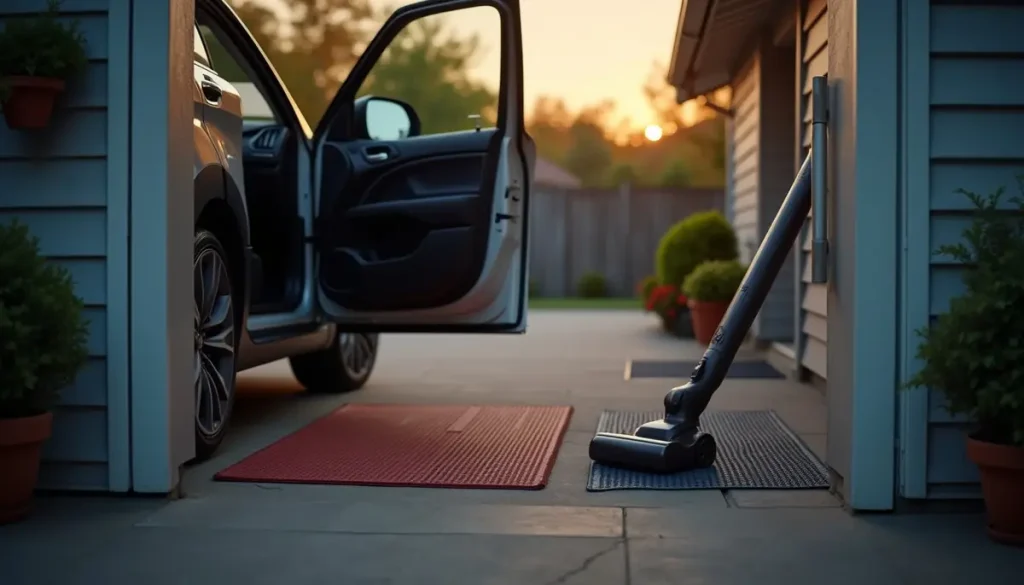
To get rid of roaches in a car, empty and vacuum it, remove food and any water source, then place cockroach bait along the seat rails and trunk corners, and do not set off a bug bomb. One roach seen once is often a stray. Egg cases, pepper-like droppings or tiny nymphs mean they are breeding, and your home is usually where they came from, so treat both.
One roach, or breeding in the car?
| What you found | What it usually means | Next step |
|---|---|---|
| One large reddish or dark roach, once, after parking near shrubs or a drain | An outdoor species wandering in. Kentucky lists American, Oriental and wood cockroaches as entering through gaps and on firewood | Vacuum, set one sticky trap for a week |
| A roach about half an inch long, light brown, with 2 dark stripes behind the head | German cockroach (UC IPM), the species that lives and breeds indoors | Full protocol below, and check your kitchen |
| Dark nymphs about 3 mm long with a pale band | Eggs have hatched nearby. See our baby cockroach guide | Full protocol, home and car |
| Pepper-like specks in seat rails or glove box corners | Current or former roach activity (Kentucky). Larger, rice-shaped droppings suggest mice in the car | Vacuum, then trap to see if it is current |
| A light tan, bean-shaped egg case | 30 to 40 eggs, hatching in 28 to 30 days (Virginia Tech) | Remove it. Bait for at least a full hatch cycle |
Why a car ends up with roaches
Almost always something carried them in. Kentucky’s entomology department says German cockroaches are often introduced in infested grocery bags, beverage cartons or furniture, and Virginia Tech adds egg cartons. A car that hauls groceries, delivery boxes or used furniture collects them the same way a kitchen does, and a home infestation can feed the car, and the reverse.
That is why treating only the car often fails. If you have seen even one German cockroach at home in the last few months, put 3 or 4 sticky traps under the kitchen sink and behind the refrigerator for a week before you decide where the problem is. Our German cockroach treatment guide covers the home side.
The protocol: 7 steps, about 4 weeks
- Empty everything, including the glove box, door pockets, seat-back pockets and trunk. Shake out bags and boxes outdoors and leave them out for now.
- Vacuum cracks and crevices, as UC IPM advises: seat rails, under seats, console edges and the spare tyre well. Seal and discard the bag or empty the canister outdoors, because it can hold live roaches and egg cases.
- Remove water first, then food. Lab data reported by Walter Ebeling show why: adult female German cockroaches lived 82 days with food and water, but only 14.7 days on dry food with no water. Dry out damp carpet, fix leaks and clear cup holders, then clear the crumbs.
- Map them with sticky traps for 2 or 3 nights, flush against edges under each front seat and in the trunk. UC IPM says cockroaches generally travel along edges and that many are caught within the first 24 hours.
- Bait where the traps caught them. Check that the product’s label lists vehicles as a use site, and follow it. Use small pea-sized dabs of gel or stations pressed flush against corners: Kentucky notes cockroaches are not drawn from a distance but find bait while foraging, so many small placements beat a few large ones. Keep bait away from vents, seat belts, airbag covers and anywhere a child or pet can reach.
- Do not spray near the bait. Kentucky says a roach that has eaten bait typically dies within 1 to 3 days, and that spraying around placements could discourage them from taking it. Our comparison of bait and spray has the studies.
- Check and replace. Expect a substantial reduction within a few weeks (Kentucky). Replace dried or eaten bait, refresh the traps every 2 weeks, and keep going until they stay empty for 4 weeks, which covers Virginia Tech’s 28 to 30 day egg hatch.
Call a licensed professional if traps still catch German cockroaches after about 4 weeks, or if the home is also infested. A German cockroach infestation is usually a job for one, and our page on exterminator costs shows the range. Ask them to confirm that their product’s label covers vehicles.
There is no fast version. Vacuuming removes what it reaches within an hour, but bait works over days per roach and weeks across the population, and any egg case missed can hatch up to a month later.
Why a bug bomb is the wrong tool for a car
Three separate records point the same way.
The can is sized for a room. EPA says a typical 6 oz fogger can treat up to 25 by 25 feet of unobstructed space. At an 8-foot ceiling that is about 5,000 cubic feet. Federal fuel economy rules class a midsize car at 110 to under 120 cubic feet of interior volume, luggage space included. By our calculation, one can is sized for roughly 40 times the volume of a midsize car.
Labels and EPA warn against it. EPA says foggers should not be used in small, enclosed places and that use in an enclosed space “may cause the product to explode”. One EPA-registered fogger label we read also says not to use it in a room 5 feet by 5 feet or smaller. EPA’s reasons are flammable propellant and a build-up of flammable vapours, and it recommends keeping foggers at least 6 feet from ignition sources.
People get hurt, and some of them in vehicles. CDC counted 3,222 fogger illnesses in 10 states from 2007 to 2015, and a footnote lists vehicles as the most common location outside the main categories, with 21 cases. In California, our fogger illness data found 340 consumer fogger cases from 2016 to 2023. CDC’s figures do not say how those 21 happened, and we found no study of fogger residue in car interiors, so we cannot give you a number for that.
It also does not reach them. Kentucky says very little fogger insecticide gets into the cracks where roaches spend their time, and that the ingredients tend to be repellent, pushing them deeper. UC IPM calls foggers often ineffective.
The same logic rules out other sealed-car tricks. One top-ranking page suggests leaving dry ice in a shut car for 12 to 24 hours. We found no published trial showing it works, and carbon dioxide in a closed cabin is a hazard to the next person who opens the door.
Will a hot car kill them? Partly, and not reliably
| Measurement | Figure | Source |
|---|---|---|
| Adult German cockroaches, 90 per cent dead | 111°F (44°C): 96 min. 118°F (48°C): 38 min. 124°F (51°C): 21 min | Lab study, KSU Journal of Natural Sciences, 2017 |
| Adult German cockroaches, 100 per cent dead | 111°F: 120 min. 124°F: 25 min | Same study |
| US Army kitchen heat treatment target | 115°F (46°C) for 45 min | Zeichner, Wood and Hoch, 1996 |
| Dark sedan, 60 min in sun, 72 to 96°F outside | Up about 40°F on average; 117°F on the coolest day | McLaren, Null and Quinn, Pediatrics, 2005 |
| Six vehicles, Tempe, Arizona, about 60 min, cabin air | Sun 118°F (47.6°C). Shade 103°F (39.5°C) | Vanos and colleagues, Temperature, 2018 |
Compiled by The Pest Control Brief from the named sources. Fahrenheit conversions are ours.
On paper, a car in full summer sun gets hot enough. In practice, nobody has shown that it works. The lab insects were adults confined in small boxes at about 22 per cent humidity, unable to walk away, and the study did not test egg cases.
Real roaches move. In the Army kitchens, ceilings reached 150°F while parts of the floor stayed under 115°F, and cockroaches gathered in the cool spots, even with propane heaters running for 4 to 6 hours. A car has the same gradient: the Tempe dashboards averaged 156°F, seats in the same sun averaged 123°F, and nobody in these studies measured under the carpet, inside door panels or in the trunk.
We found no published study of cockroach survival in a parked car, so any claim of a safe number of hours is a guess. Parking in the sun may help alongside bait, and a shaded car at 103°F is below the lowest temperature in the lab study. Never leave a child or pet in a car to treat it, and do not put a heater in one. Our page on bed bugs in cars makes the same point for a pest with better heat data.
Buying a used car: a 10-minute check
- Bring a flashlight. Look along the seat rails, under the rear seat if it lifts, in the glove box corners and in the spare tyre well.
- Look for pepper-like specks, tan egg cases and shed skins, the signs UC IPM uses to choose monitoring sites.
- Do not treat a clean daytime look as proof. UC IPM says almost all cockroaches are nocturnal, so ask to see the car after dark if you can.
- After buying, leave one sticky trap under each front seat for a week before parking in a home garage or carrying bags from the car into the house.
Frequently asked questions
How to get rid of roaches in car?
Empty the car, vacuum seat rails and trunk, dry out any damp carpet and remove food. Trap for 2 or 3 nights to find them, then bait those spots with small placements, using a product whose label lists vehicles. Do not spray near bait or use a fogger. Kentucky entomologists expect a substantial reduction within a few weeks.
Why are there roaches in my car?
Usually they were carried in. University of Kentucky entomologists say German cockroaches often arrive in infested grocery bags, beverage cartons or furniture. Outdoor species such as American cockroaches can wander in through gaps. If you have also seen roaches at home, the home is the likely source, so treat both or the car will be reinfested.
Can roaches live in cars?
Yes, for weeks at least, and they may breed if they find water. Entomologist Walter Ebeling described cockroaches as able to infest means of transport, and UC IPM says German cockroaches live and breed indoors. A dry car is a poor home: in a 1957 study, females on dry food with no water lasted only 14.7 days.
How long can roaches live in a car?
No study has measured this in a car. In the laboratory at 81°F, adult female German cockroaches averaged 20.1 days with no food or water and 35.1 days with water alone. American cockroaches lasted 41.7 and 89.6 days. See our guide to how long cockroaches live. Egg cases can restart the clock.
Will a bug bomb in my car kill roaches?
Not reliably, and it is not safe. EPA says foggers should not be used in small, enclosed places, and a typical can is sized for a space about 40 times larger than a midsize car’s interior. Kentucky reports that very little insecticide reaches the cracks where roaches hide. CDC recorded 21 fogger illness cases in vehicles from 2007 to 2015.
Sources
- University of Kentucky Entomology, ENTFACT-614, Cockroach Elimination in Homes and Apartments.
- University of California Statewide IPM Program, Pest Notes: Cockroaches (publication 7467).
- Virginia Cooperative Extension, German Cockroach fact sheet.
- Ebeling, W., Urban Entomology, University of California, chapter 6, reporting Willis and Lewis, 1957.
- CDC MMWR, Acute Illnesses and Injuries Related to Total Release Foggers, 10 States, 2007 to 2015 (2018).
- US EPA, Safety Precautions for Total Release Foggers.
- US EPA Pesticide Product Label System, registered total release fogger label, EPA Reg. No. 4-428, 2011.
- 40 CFR 600.315-08, Classes of comparable automobiles.
- KSU Journal of Natural Sciences 20(2), 111 to 114, 2017, mortality effect of elevated temperatures on adult German cockroach.
- Zeichner, Wood and Hoch, The use of heat for control of chronic German cockroach infestations in food service facilities, Proceedings of the Second International Conference on Urban Pests, 1996.
- McLaren, Null and Quinn, Heat stress from enclosed vehicles, Pediatrics 116(1), 2005.
- Vanos, Middel, Poletti and Selover, Evaluating the impact of solar radiation on pediatric heat balance within enclosed, hot vehicles, Temperature, 2018.
- The Pest Control Brief, Bug bomb fogger illness data, from California Department of Pesticide Regulation records, 2026.