How to Keep Yellow Jackets Away When Eating Outside
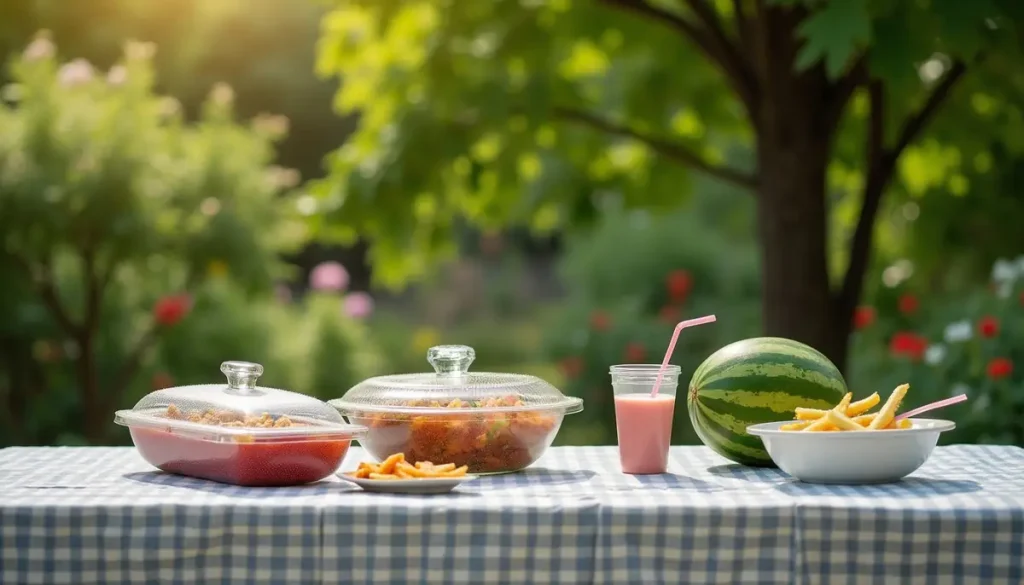
To keep yellow jackets away when eating outside, give them nothing to find: keep food covered until served, put drinks in lidded cups with straws, clear plates and bins at once, and hang lure traps at the far edge of the yard two or more days beforehand. No spray or scent clears a table instantly. From August to October colonies are at their largest and hunting sugar, so prevention before the first forager arrives matters more than anything you do once they are circling.
Clemson Cooperative Extension says yellow jackets at this season go for carbonated drinks, juices, candy, meats, cakes, fruit and ice cream, which covers most of a cookout. Ohio State’s fact sheet HYG-2075 dates the switch from protein to sweets to August through October; the colony biology behind it is explained in our guide to what attracts wasps month by month.
Every method, rated by the evidence
| Method | What the evidence says | Verdict |
|---|---|---|
| Cover food until served, clear dishes at once | Clemson, Ohio State and UC IPM all advise it; UC IPM warns that once wasps discover food they keep hunting that spot “long after the source has been removed” | Most effective single step; do it before the first wasp arrives |
| Lidded cups with straws; check cans before sipping | Clemson records yellow jackets swallowed from drinks causing a life-threatening sting in the throat; the Connecticut Agricultural Experiment Station (CAES) advises covered cups with straws | Essential, mainly for safety |
| Tight bin lids, bins away from the table | Ohio State advises choosing a site well away from uncovered bins; Virginia Tech says lidless bins may need emptying every few hours when wasps are numerous | Effective |
| Lure traps on the property edge | UC IPM: reduce local foragers but do not eliminate large populations; place as far from the patio as possible. Ohio State: set two or more days before the event | Helps if placed early and far away; harmful beside the table |
| Meat-baited water trap | UC IPM and Clemson describe it; Clemson calls raw bologna a very successful bait that does not attract beneficial insects | Useful for German and eastern species that ignore some lures |
| Essential oil repellents | Zhang and colleagues (2013) found 17 of 21 oils cut wasp visits to baited traps; measured at traps, not at a dining table | Promising, unproven for a meal |
| Skipping perfume and floral clothing | Ohio State and CAES say floral scents and bright, flowery clothing attract them; CDC NIOSH advises against cologne and perfumed products | Cheap, worth doing |
| Bug zappers | Virginia Tech ENTO-49: “no value in reducing the number of yellowjacket foragers” | Do not bother |
| Spraying the yard | Virginia Tech: removing food works better than widespread spraying, because new foragers arrive from unsprayed areas | Not recommended |
Compiled by The Pest Control Brief from the named extension publications and study.

The order that works: before, during and after the meal
Two or more days before
Hang traps now, not when guests arrive. Ohio State advises setting commercial traps “two or more days prior to the event,” and UC IPM says to place them along the property line as far from the patio as possible, between the eating area and the woodland or hedges where nests are likely. For parks and large gatherings, UC IPM gives about 200 feet from the area to be protected and a trap roughly every 150 feet around it.
As you set the table
- Serve from covered dishes and lidded coolers; uncover only while plates are filled.
- Pour sweet drinks, beer and juice into lidded cups with straws. Ohio State singles out fruit drinks, sodas and beer.
- Keep the grill clean and scraps bagged, since yellow jackets also take meat.
- Put the bin, tightly lidded, at the far side of the yard rather than beside the table.
While you eat
Ohio State and CAES both say not to swat; Ohio State adds that crushing a yellow jacket releases an alarm pheromone, part of why our yellow jacket season explainer finds late summer brings the worst stings. Brush one gently away or wait for it to leave, and look into any can or bottle before drinking from it.
The moment you finish
Clear plates, wipe spills and tie off rubbish bags straight away. Clemson advises clearing food items immediately after a picnic, and UC IPM’s warning about foragers returning to a spot they have found applies to the next day’s meal too.
Match the trap lure to your yellow jacket
Most failures with traps come from the wrong lure. UC IPM notes the common lure, heptyl butyrate, “attracts primarily the western yellowjacket and not other species.” Field studies by Peter Landolt of USDA ARS and colleagues mapped which lure catches which species.
| Yellow jacket | Where it is the main pest | Heptyl butyrate | Acetic acid with isobutanol |
|---|---|---|---|
| Western yellowjacket (Vespula pensylvanica) | Western North America | Strong lure | Attracted |
| Southern yellowjacket (V. squamosa) | Southeastern US | Good lure | Attracted |
| Eastern yellowjacket (V. maculifrons) | Eastern US | Not attracted | Main attractant in Michigan trials |
| German yellowjacket (V. germanica) | Most of the US except the far south; dominant in Ohio | Not attracted | Attracted |
| Common yellowjacket (V. vulgaris) | Across the US | Not attracted | Main attractant in Michigan trials |
| Bald-faced hornet (Dolichovespula maculata) | Aerial nests; UC IPM says it does not turn scavenger | Not attracted | Attracted, more than to acetic acid alone |
Compiled by The Pest Control Brief from Reed and Landolt (2002, The Great Lakes Entomologist), Landolt, Tóth and Jósvai (2007, Bulletin of Insectology, reviewing North American trials) and UC IPM Pest Notes 7450.
In practice, a heptyl butyrate trap is the right choice in the West and close to useless in Ohio, where Ohio State warns most commercial traps do not attract the German yellowjacket. East of the Rockies, choose a lure based on acetic acid with an alcohol, or a meat-baited trap; UC IPM says adding chicken is believed to improve catches of German and common yellowjackets. Our page on which yellow jackets nest in the ground helps narrow down the species near you.
Distance explains why a trap beside the table backfires. Extension estimates of how far workers forage run from about a quarter mile (UC IPM) to a mile (Virginia Tech and CAES), so the wasps at your plate may come from a nest several gardens away. A trap only intercepts them if it sits between that nest and you.
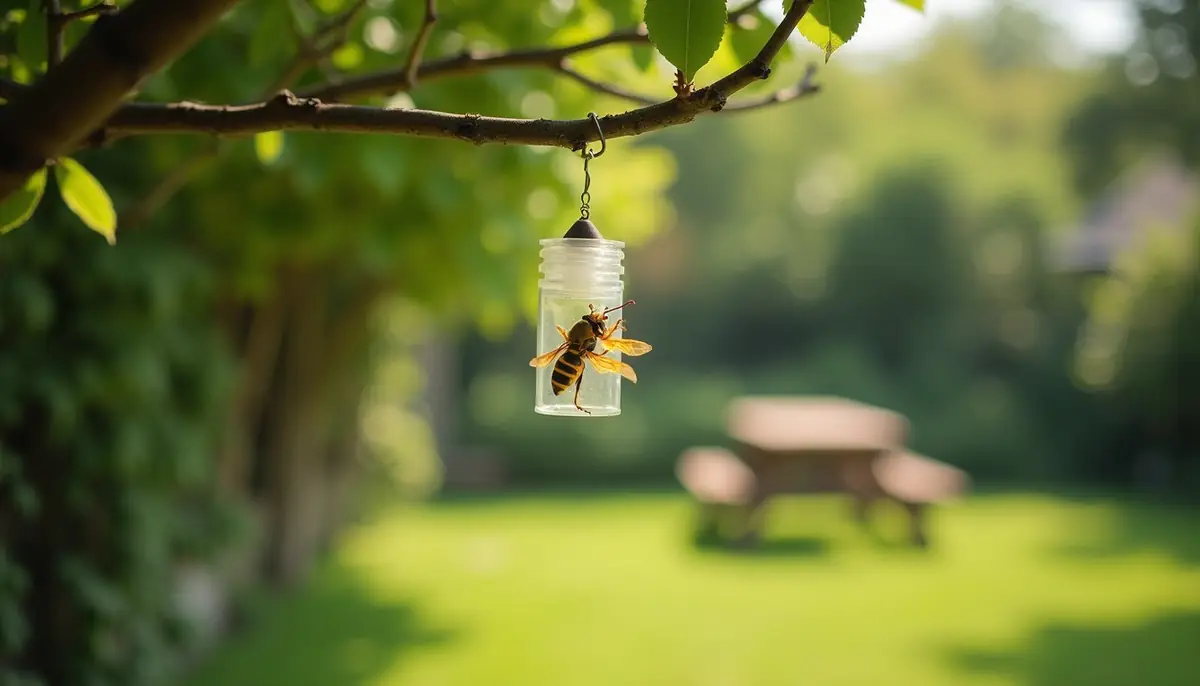
The drink is the dangerous part
A sting on the arm is painful; a sting inside the mouth or throat is a medical emergency. Clemson notes that “live yellowjackets have been swallowed by persons resulting in a life threatening sting in the throat area,” and UC IPM warns that scavengers crawl into soda cans and can sting the lips, mouth or throat. Ohio State advises medical attention for anyone stung in the mouth or around the eyes, or more than ten times, and emergency care for difficulty breathing or swallowing, confusion or slurred speech, tightness in the throat, or weakness leading to fainting. CDC NIOSH describes anaphylaxis as a severe allergic reaction that requires immediate emergency care. For anything beyond a local sting, follow a doctor’s advice.
If they keep coming back, find the nest
CAES puts it plainly: spraying individual yellow jackets will not control additional activity, and full control means locating and treating the nest. Clemson describes following a forager’s straight flight line back to the nest, usually within 1,000 yards. Our step-by-step guide on how to get rid of wasps by nest type covers what to do once it is found.
Published estimates on our wasp nest removal cost page put yellow jacket nests at $500 to $1,300, the highest of any wasp, because they sit underground or in cavities. Clemson notes that “the first hard freeze will eliminate most colonies,” so for a single late-October barbecue, covering food may be all that is needed.
Not every insect at the table is a yellow jacket
Clemson notes that foraging honey bees are often mistaken for yellow jackets because they visit the same foods; honey bees are hairier, often carry pollen on their hind legs, and sting only once. Our guide to telling a wasp from a bee has the quick checks.
Tiny metallic green or black insects landing on sweaty arms rather than on food are usually sweat bees drinking sweat for its salt, which sting only when pressed against the skin.
Paper wasps are the other common visitor: UC IPM says they are much less defensive and rarely sting humans, and our paper wasp profile explains when to leave their nests alone.
If you cannot tell which wasp you have, our wasp and hornet identification guide starts from the nest: a hole in the ground or a wall means yellow jackets, an open comb under the eaves means paper wasps.
Frequently asked questions
What smell do yellow jackets hate the most?
The best evidence is for clove, geranium and lemongrass oils. In a 2013 field study in Pest Management Science by Zhang, Schneidmiller and Hoover, a blend of those three oils totally blocked wasp attraction to baited traps, and 17 of 21 single oils, including peppermint and spearmint, cut visits significantly. The authors worked for a trap maker, and nobody has tested the oils protecting a dinner table.
What repels yellow jackets instantly?
Nothing reliably does. No extension service recommends a spray or scent that clears foragers from a table on contact, and Virginia Tech notes that sprayed areas are quickly refilled by new foragers. The fastest practical fix is removing what they came for: cover or move the food or drink they are landing on, and they lose interest.
What does Dawn dish soap do to yellow jackets?
Dish soap is a wetting agent, not a repellent. Clemson explains that detergent in a trap’s water “eliminates surface tension causing the yellowjackets to sink,” and Ohio State’s homemade trap uses a few drops of dish soap in 2 inches of water for the same reason. Soapy water around a table will not keep them away.
What eats the most yellow jackets?
No source ranks predators by numbers eaten. Clemson says skunks and bears dig into underground nests in autumn to eat the young. UC IPM lists birds, reptiles, amphibians, skunks, bears, raccoons, spiders, praying mantids and bald-faced hornets as predators, but says none gives satisfactory control around homes.
Do yellow jacket traps attract more wasps to a picnic?
They can if placed close. UC IPM advises putting lure and water traps away from patios and picnic areas so wasps are not drawn towards the food, and placing them between the eating area and likely nest sites. A trap on the table itself mostly draws extra foragers into the meal.
Sources
- Clemson Cooperative Extension, Home and Garden Information Center, Yellow Jackets fact sheet.
- Ohio State University Extension, Yellowjackets, fact sheet HYG-2075.
- Mussen, E. C. and Rust, M. K., Pest Notes: Yellowjackets and Other Social Wasps, UC ANR Publication 7450, University of California Statewide IPM Program.
- Virginia Cooperative Extension, Yellowjackets in Virginia, ENTO-49, Virginia Tech.
- Ridge, G. E., Yellowjackets (Family Vespidae), The Connecticut Agricultural Experiment Station fact sheet.
- Reed, H. C. and Landolt, P. J., Trap response of Michigan social wasps (Hymenoptera: Vespidae) to the feeding attractants acetic acid, isobutanol and heptyl butyrate, The Great Lakes Entomologist 35(1), 2002.
- Landolt, P. J., Tóth, M. and Jósvai, J., First European report of social wasps trapped in response to acetic acid, isobutanol, 2-methyl-2-propanol and heptyl butyrate, Bulletin of Insectology 60(1): 7 to 11, 2007.
- Zhang, Q. H., Schneidmiller, R. G. and Hoover, D. R., Essential oils and their compositions as spatial repellents for pestiferous social wasps, Pest Management Science 69(4): 542 to 552, 2013.
- CDC National Institute for Occupational Safety and Health, Insects and Scorpions at Work.