Bed Bugs in Winter: Do They Die in the Cold?

Bed bugs do not die off in winter, because they live indoors at room temperature where the weather never reaches them. Cold kills them only when it is deep and continuous: about 0°F for at least 3.5 days, according to University of Minnesota and Rutgers research, while bugs were predicted to survive a full week at anything warmer than about 10°F. A cold car, garage or unheated house rarely holds those conditions, so winter is not a treatment.
The temperature rules, cold and hot
| Temperature | Exposure | What happens | Source |
|---|---|---|---|
| 70 to 82°F (21 to 28°C) | Ongoing | Fastest development; a normal heated home | UC IPM |
| 46°F (7°C) | Ongoing | Bugs still survive and stay active | EPA |
| 55°F (13°C) or less | Without a meal | Survival potentially a year or longer | University of Kentucky |
| 32°F (0°C) or below | Several days (UC IPM) to one to two weeks (Kentucky) | Kills, but the two sources disagree on time | UC IPM; Kentucky |
| Above about 10°F (minus 12°C) | A full week | Survival predicted even after continuous exposure | Olson and others, 2013 |
| 5°F (minus 15°C) | 85 hours | All life stages killed | Olson and others, 2013 |
| 0°F (minus 17.8°C) | At least 3.5 days | The recommended freezer standard | Olson and others, 2013 |
| Below minus 4°F (minus 20°C) | 48 hours or less | All stages killed | Olson and others, 2013 |
| 113°F (45°C) | About 95 minutes | Adults die; eggs survived 7 hours | Kells and Goblirsch, 2011 |
| 118°F (48°C) | 71.5 minutes | Eggs die | Kells and Goblirsch, 2011 |
| 130 to 140°F (54 to 60°C) | 3 hours at 130°F, 2 hours at 140°F | Professional whole-room heat standard | UC IPM |
Compiled by The Pest Control Brief from the named sources.
The asymmetry is the point. Heat kills bed bugs in hours at temperatures a heater or dryer can reach; cold needs days at temperatures most of the US sees only in brief spells.
Can you get bed bugs in the winter?
Yes, at the same rate as any other time of year in most homes. Bed bugs travel in luggage, clothing, beds and furniture, as Kentucky’s entomologists put it, and none of those routes closes in winter. A heated bedroom sits in the 70 to 82°F band where UC IPM says development is fastest, and the body heat and carbon dioxide covered in what attracts bed bugs are there all year, so a bug carried home from a December trip breeds as it would in July.
We looked for published data on whether winter holiday travel raises bed bug cases and found none, so treat any seasonal claim on that point with caution. The risk from a trip is the same in any month: check the room, keep luggage off the floor and run clothes through the dryer when you get home, steps set out in our guide to checking a hotel room for bed bugs.
Do bed bugs get worse in winter?
Our own data says no, and shows why some people think so. In US iNaturalist research-grade records, bed bugs are photographed and identified in every month. Raw records run from 47 in February to 96 in October, with no winter surge.
Measured as a share of everything people record, the bed bug figure does rise in winter, peaking at 174 against a yearly mean of 100 in December. That is because outdoor insects and plants disappear from the records, not because bed bugs increase; German cockroaches, another indoor pest, show the same pattern. The same thing probably happens at home: with fewer outdoor insects about in January, an indoor one is easier to notice. If you have spotted a single bug, read what finding one bed bug means before assuming the worst.
What do bed bugs do in winter?
In a heated home, nothing different. In a cool space they slow down: Kentucky says cooler temperatures prolong development, and that bugs can survive without feeding for a year or longer at 55°F or less, against 1 to 4 months in a temperature-controlled building. A cold spare room or holiday cottage can therefore hold bed bugs for longer than a warm one, not shorter. Our page on how long bed bugs live without food, by temperature sets out the starvation figures.
Bed bugs do not have a proven winter dormancy. When Ohio State researchers held bed bugs at 39°F (4°C) for two weeks, their cold tolerance did not improve (Benoit and others, 2009). The same study did find a short-term effect: one hour at 32°F (0°C) made bugs better able to survive a later drop to 7°F or 3°F (minus 14 or minus 16°C). A gradual cold snap can toughen them briefly.
That is the opposite of the insects people do see in winter. Stink bugs, lady beetles and cluster flies move into walls in autumn to sit out the cold, and the guide to where bugs in the house in winter come from explains how to tell them apart and why vacuuming is the right fix for those.
Do bed bugs die in winter outside?
Only in a hard, long freeze. The Minnesota and Rutgers team (Olson and others, 2013) found that bed bugs cannot survive being frozen solid, but their bodies do not freeze until between minus 21.3 and minus 30.3°C (about minus 6 to minus 23°F), with eggs the hardiest. Above about 10°F, the model predicted survival even after a week of continuous exposure, and eggs survived brief exposures as low as minus 25°C (minus 13°F). Survivors still fed afterwards.
Benoit’s team at Ohio State found adult females were all killed by one hour at minus 16°C (3°F), while Olson’s team needed 80 hours at that temperature for full mortality across life stages. The two labs used different methods, so use the longer figure for anything you care about.
How long can bed bugs live outside in winter?
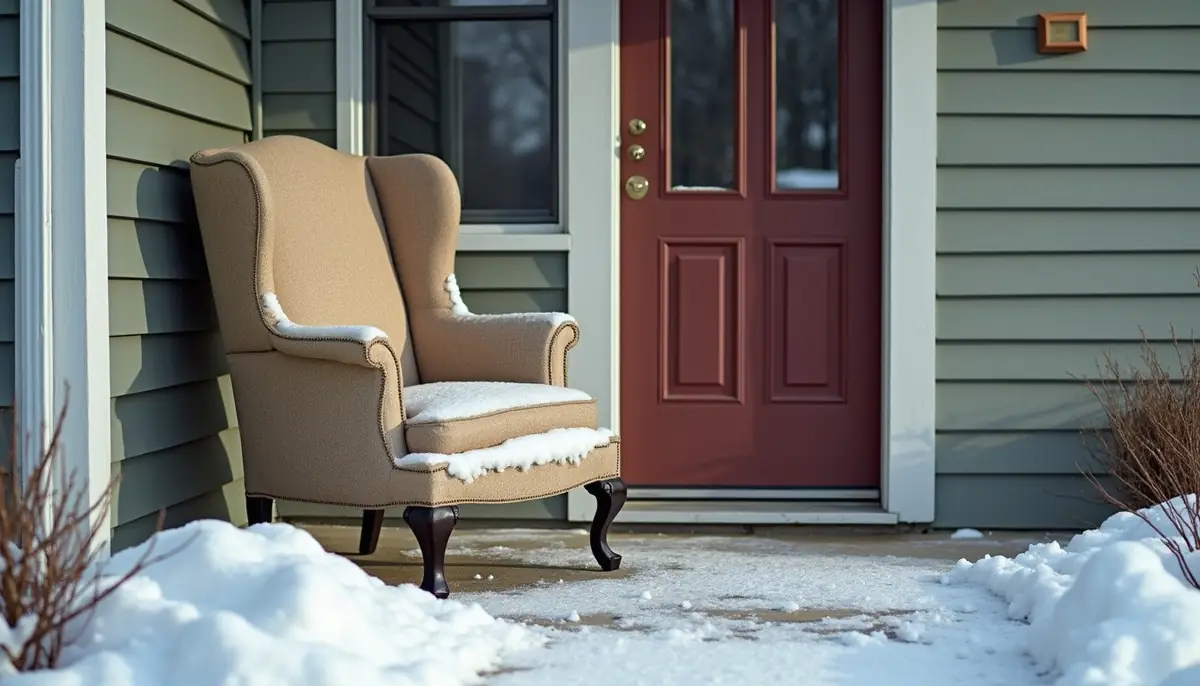
A sofa or mattress left on a porch is the classic case. To kill everything inside it, the coldest part of the stuffing has to stay below about 0°F for several days without a thaw, and Olson’s team notes that insulated items take 1 to 3 extra hours just to reach lethal temperature. Most US winters swing above freezing during the day, which gives bugs deep in padding a reprieve. Starvation works slowly too: UC IPM records survival without a meal of 20 to 400 days, longer at low temperatures.
Unheated houses, garages and cars
Turning the heating off does not work. Kentucky says efforts to rid homes of bed bugs by raising or lowering the thermostat will be unsuccessful, and that leaving a home unoccupied to starve them is usually impractical; in apartments the bugs often move to nearby units instead. That spread is mapped in our guide to how bed bugs spread through luggage, furniture and shared walls.
A car in winter is an unreliable freezer: it warms whenever it is driven or sits in sun, and the cabin rarely holds 0°F for 3.5 days. Our page on whether bed bugs can live in cars covers clearing a vehicle. Summer is the season a car helps: a 2005 Pediatrics study of a dark sedan found the cabin rose about 40°F within an hour on clear days of 72 to 96°F and reached 117°F even on the coolest day, which is why Kentucky suggests bagged items in a closed car in the sun, checked with a thermometer for at least 120°F.

How to get rid of bed bugs in winter
- Freeze small items properly. EPA says to bag them and hold them at 0°F for three days, checking with a thermometer because many home freezers are not that cold; Olson’s team recommends at least 3.5 days.
- Use the dryer for fabrics. Kentucky says medium to high heat for 10 to 20 minutes kills all stages, and that is quicker than any freezer.
- Do not rely on the weather. Freezing outdoors is uncontrolled; the tested methods are in our review of home remedies that passed lab tests.
- Book professional treatment for an established infestation. Heat and insecticide work the same in January as in July, and the process is set out in what professional bed bug treatment involves.
Frequently asked questions
What kills bedbugs immediately?
Direct heat on contact. Kentucky says commercial steamers kill bugs and eggs on contact, and EPA sets the minimum steam temperature at 130°F with gentle airflow. In Ohio State tests, nearly all adults died within an hour at 118°F (48°C). Steam reaches only what it touches, so it treats seams and cracks rather than a whole room.
Do bed bugs go away if you shower?
No. Kentucky notes that bed bugs normally do not live on or attach to people the way lice or ticks do; they feed for 3 to 10 minutes and then crawl away to hide. A shower removes nothing that matters. The bugs are in the bed, furniture and crevices, which is where to look; our bed bug identification guide shows each stage.
Does Dawn dish soap really kill bed bugs?
We found no published test of kitchen dish soap against bed bugs. When Rutgers researchers tested 11 non-synthetic products in 2014, including two detergent-based ones, only two products containing plant oils plus sodium lauryl sulfate killed more than 90 per cent of nymphs, and most had little effect on eggs. A soap spray reaches only bugs you can see.
Can bed bugs survive in the cold in a car?
Usually, yes. Olson’s team predicted survival for a week at anything above about 10°F, and a parked car warms in daytime sun and whenever it is driven. A car would need to stay near 0°F for at least 3.5 days without a break to be a reliable freezer, which is rare even in northern winters.
Sources
- Olson JF, Eaton M, Kells SA, Morin V, Wang C. Cold tolerance of bed bugs and practical recommendations for control. Journal of Economic Entomology 106(6), 2013.
- Benoit JB, Lopez-Martinez G, Teets NM, Phillips SA, Denlinger DL. Responses of the bed bug to temperature extremes and dehydration: levels of tolerance, rapid cold hardening and expression of heat shock proteins. Medical and Veterinary Entomology, 2009.
- Kells SA, Goblirsch MJ. Temperature and time requirements for controlling bed bugs under commercial heat treatment conditions. Insects, 2011.
- UC IPM, Pest Notes: Bed Bugs, Publication 7454. University of California Agriculture and Natural Resources.
- University of Kentucky Entomology, ENTFACT-636 Bed Bugs (Potter).
- US Environmental Protection Agency, How to Find Bed Bugs; Do-it-yourself Bed Bug Control.
- McLaren C, Null J, Quinn J. Heat stress from enclosed vehicles: moderate ambient temperatures cause significant temperature rise in enclosed vehicles. Pediatrics, 2005.
- Singh N, Wang C, Cooper R. Potential of essential oil-based pesticides and detergents for bed bug control. Journal of Economic Entomology, 2014.
- The Pest Control Brief analysis of iNaturalist research-grade records, pulled October 2026.