Wasp and Hornet Identification: Which One Is It?
The European hornet is the only true hornet established in the United States. The bald-faced hornet is not a hornet at all, it is an aerial yellowjacket, and the biggest wasp in most American yards, the cicada killer, is among the least likely to sting you. The one most likely to sting is the smallest on this page: a yellowjacket, at 10 to 16 mm, nesting invisibly in a hole in the lawn. Identification matters because the nest you cannot see is the one that causes the incident.
Almost every wasp call starts with a name that is wrong. The useful question is not what it is called locally but three things an ordinary person can observe: how big it is, what the nest looks like, and whether it is a colony or a single female.
Start with the nest, not the insect
| Nest | What it means | Species |
|---|---|---|
| Open comb, cells visible from below, umbrella shaped | Social, small colony | Paper wasp |
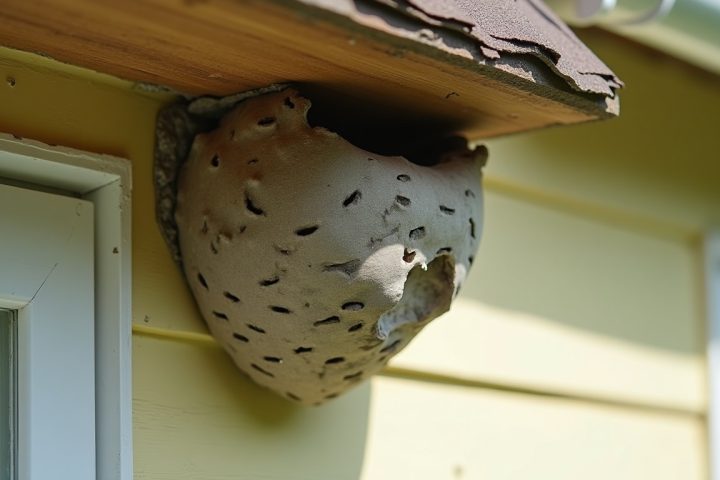
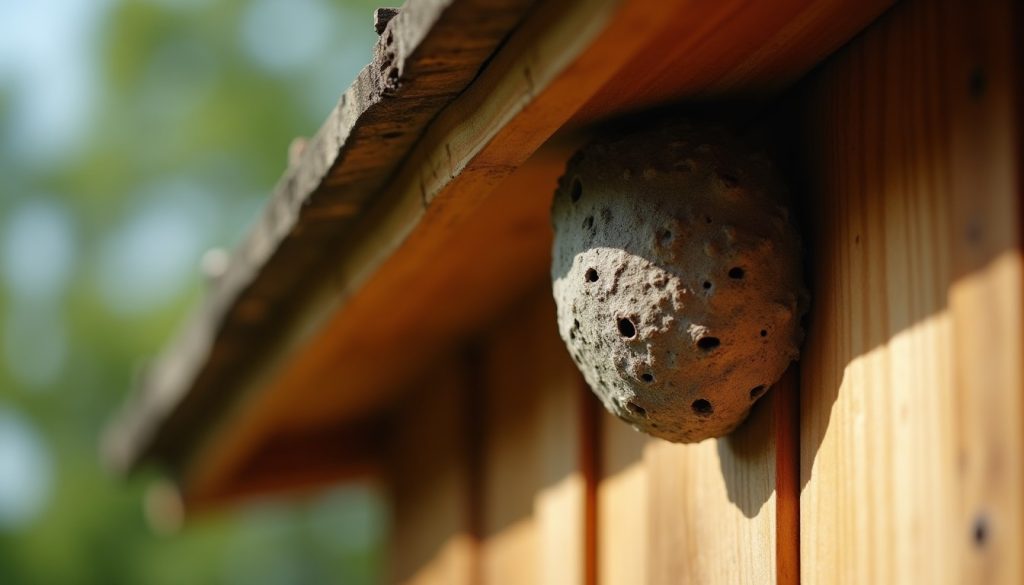
| Grey paper football hanging in the open | Social, defensive | Bald-faced hornet |
| No visible nest, wasps streaming into a hole in the ground or siding | Social, concealed | Yellowjacket |
| Wasps entering a hollow tree, wall void or attic, tan paper inside | Social, cavity nesting | European hornet |
| Single burrow in bare soil with a crescent of excavated earth | Solitary | Cicada killer |
| Mud tubes or a mud blob on a sheltered wall | Solitary | Mud dauber |
The mud nest is the fastest diagnostic on the page. Only mud daubers build in mud; every other wasp here builds in paper or in soil. A mud nest on a garage wall means a solitary wasp that Purdue describes as very unlikely to sting even when thoroughly aroused, and that provisions its cells with spiders, including black widows in the case of the blue mud dauber.
The exposed comb is nearly as quick. A paper wasp nest has no envelope, so you can see the hexagonal cells and the developing brood from underneath. Anything wrapped in a grey or tan paper envelope is a yellowjacket or a hornet.
Colony size explains the risk
A yellowjacket nest reaches 600 to 800 workers by autumn in the typical case, and large nests run into the thousands. A paper wasp nest holds 20 to 75 adults. A cicada killer burrow holds one female.
That is the whole risk calculation. A solitary female has no sisters to recruit and nothing to defend but her own burrow, so she stings only if handled. A colony of several hundred defends collectively and releases an alarm pheromone that calls in nestmates, which is why yellowjacket and bald-faced hornet incidents involve multiple stings.
The ranking that follows is assembled from extension descriptions rather than from any measured scale, because no extension source publishes a quantitative aggression index.
| Most to least likely to sting | What the sources say |
|---|---|
| Yellowjacket | “Easily agitated, may appear to sting without provocation”; concealed ground nests cause most unprovoked incidents |
| Bald-faced hornet | “Many workers swarm out of a nest aggressively when it is disturbed”; the sting is “instantly painful” |
| European hornet | “Calm when foraging but can be aggressive when protecting the nest” |
| Paper wasp | “Not as defensive of a nest as hornets and yellowjackets. May deliberately bump into an intruder as a warning” |
| Cicada killer | “Rarely sting humans unless someone tries to handle one”; males cannot sting at all |
| Mud dauber | “Very unlikely to sting, even when thoroughly aroused” |
The two that get misnamed constantly
The bald-faced hornet is not a hornet. It is Dolichovespula maculata, an aerial yellowjacket, and Maryland extension states plainly that it is not a true hornet. It is black and white, never yellow, with white face patches and three white bands at the tip of the abdomen. The grey football nest can reach roughly two feet tall by late season.
The European hornet is the real one, Vespa crabro, introduced around the 1840s in New York and the only true hornet established in the country. Two behaviours make it unmistakable. It flies at night and comes to lit windows, which almost no other US wasp does. And it strips bark from twigs to reach sap, girdling lilac, rhododendron and other shrubs in late summer. Its abdomen carries black bands with downward teardrop extensions, and the thorax is reddish brown rather than black.
On the northern giant hornet, the insect the press called the murder hornet: it was an introduction confined to north-west Washington and has been declared eradicated. It is not established in the United States, and nearly every reported sighting elsewhere is a European hornet or a cicada killer. Our giant hornet identification guide covers how to tell them apart.
The big one in the lawn is the harmless one
Cicada killers cause more alarm per sting than any insect in America. They are 29 to 41 mm, the largest wasp most people will see, they dig burrows in bare sunny soil, and in August the males patrol aggressively and dive at anyone who walks past.
Male cicada killers cannot sting. They have no sting apparatus. The females can, and according to Ohio State rarely do unless someone tries to handle one. A bank covered in burrows is not a colony with a nest to find: it is many independent single females that happen to like the same well-drained soil.
“Red wasp” is the other name worth resolving. In the South it refers chiefly to Polistes carolina, with the near-identical P. perplexus alongside it. Both are paper wasps, so the open comb and the modest colony apply.
What to do with each
- Mud dauber or cicada killer: leave them. Both are solitary, both are net beneficial, and a mud dauber nest can be scraped off once vacated.
- Paper wasp on a porch: manageable, treated at dusk when the colony is on the nest, though a nest away from traffic can simply be left for the season.
- Yellowjacket or bald-faced hornet: this is the professional job, for the reasons set out in our guide to yellowjackets and late-season aggression.
- European hornet in a wall void or tree: professional, and do not seal the entrance before the colony is dealt with.
- Never treat in daylight when foragers are out, and never plug an active entrance.
Nests are annual. With a documented southern yellowjacket exception, a US social wasp nest is not reused the following year; only mated queens overwinter and each starts somewhere new. An old nest in a shed is a historical object. For what removal costs by species and location, see our wasp nest removal pricing, and for honey bees, which should be relocated rather than killed, our bee removal guide.
How we did this
Sizes, colony figures and nest descriptions come from university extension publications: Maryland, Ohio State, Cornell, NC State, Penn State, Clemson, Purdue, Virginia Tech, Kentucky and UF/IFAS. Where sources disagree we give the wider range and say so. European hornet length is the clearest case, with Maryland starting at about 19 mm and Cornell at 26 mm, so we report roughly 19 to 38 mm across workers and queens.
The aggression ordering is qualitative. It is assembled from the sourced descriptions quoted above, because no extension programme publishes a measured aggression scale. Two further caveats: Penn State’s species page states bald-faced hornets can spray venom toward the eyes, which we have not been able to corroborate elsewhere and therefore do not assert; and UF/IFAS publishes forewing length rather than body length for Polistes carolina, so a directly comparable body length for the southern red wasp is not available.
Frequently asked questions
What is the difference between a wasp and a hornet?
Hornets are a single genus, Vespa, and the European hornet is the only true hornet established in the United States. The bald-faced hornet, despite the name, is an aerial yellowjacket in the genus Dolichovespula. In practice the more useful distinction is nest type: open comb means paper wasp, concealed or enclosed paper envelope means yellowjacket or hornet, mud means a solitary mud dauber.
Which wasp is most likely to sting me?
The yellowjacket, which is also the smallest at 10 to 16 mm. Its nest is usually concealed in the ground or a wall void, so people disturb it without warning while mowing or trimming, and a colony of 600 to 800 workers defends collectively using an alarm pheromone. The bald-faced hornet is next, swarming out when the nest is disturbed.
Are cicada killers dangerous?
No. They are the largest wasp most Americans see, at 29 to 41 mm, and among the least likely to sting. The males that dive at people have no sting apparatus at all, and Ohio State reports that females rarely sting unless handled. A bank full of burrows is many solitary females, not a colony.
What is a red wasp?
A regional common name used mainly in the southern states for Polistes carolina, with the near-identical Polistes perplexus alongside it. Both are paper wasps, so they build the exposed umbrella-shaped comb, hold colonies of roughly 20 to 75 adults, and are less defensive than yellowjackets or hornets.
Sources
- University of Maryland Extension, Social Wasps: Yellowjackets, Hornets, and Paper Wasps.
- Ohio State University Extension, European Hornets and Look-Alikes, and ENT-63 Cicada Killer Wasp.
- Cornell CALS Integrated Pest Management, European hornet.
- NC State Extension, Non-Honey Bee Stinging Insects in North Carolina.
- Clemson HGIC, Mud Daubers, and Purdue Extension E-253.
- UF/IFAS EENY-640, Paper Wasp (red wasp), Polistes carolina.
- USDA APHIS, northern giant hornet eradication.