Mice in the Shed: Protecting What You Store There
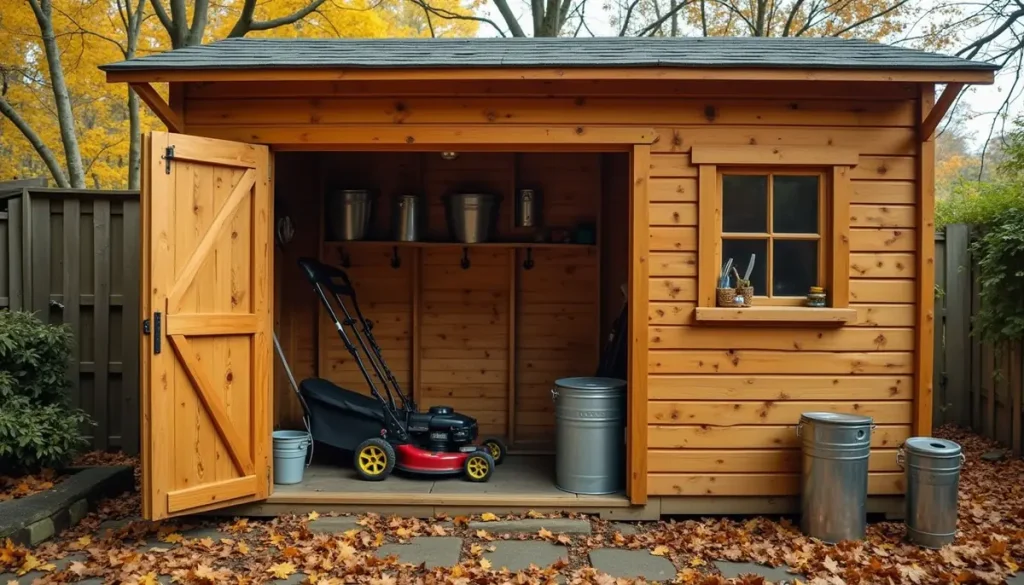
If you have mice in your shed, move seed and pet food into metal bins with lids, set snap traps along the walls, and close the gap under the door to less than 1/4 inch. Then deal with the floor: a timber shed on soil or blocks needs 1/4 inch hardware cloth over open gaps and a buried mesh apron against burrowers. Clean droppings wet after airing the shed for 30 minutes, because deer mice, the usual shed mouse in rural and suburban yards, carry hantavirus.
What you store, what mice do to it, and the fix
| Stored item | Risk | Storage fix |
|---|---|---|
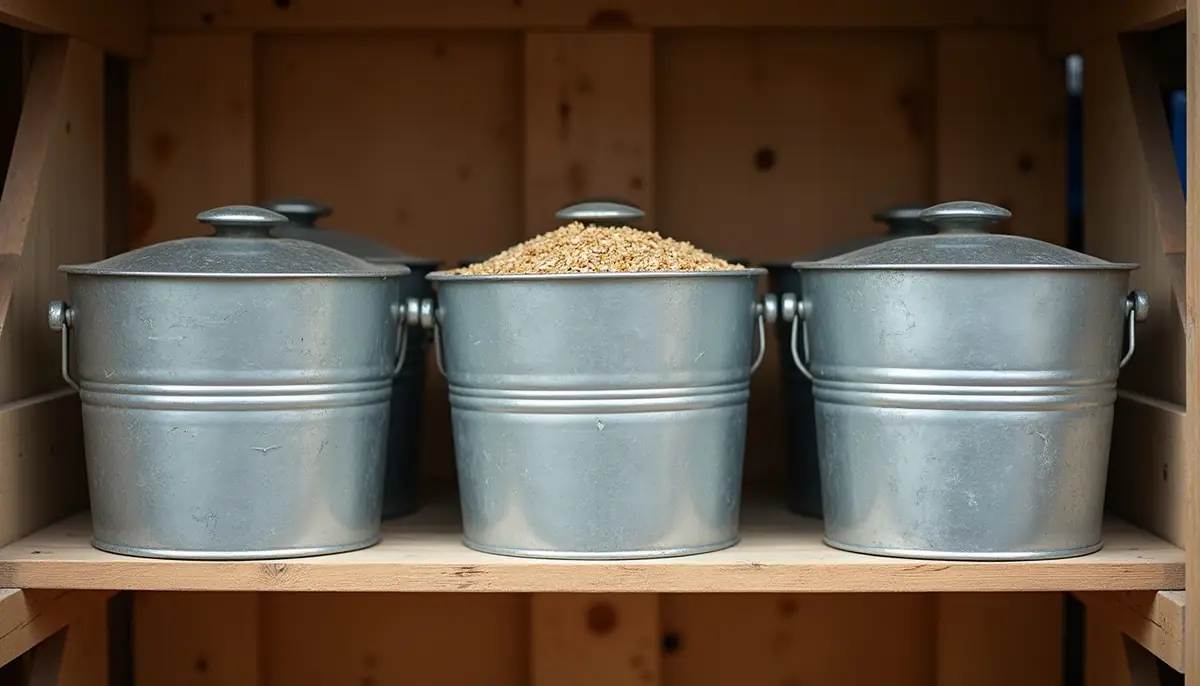
| Birdseed, grass seed, chicken feed | The main reason mice stay; sacks are chewed open and seed scattered | Metal bins with tight lids, on a shelf, not the floor |
| Dog or cat food | Food supply all winter | Rodent-proof containers, as UC IPM advises for pet food |
| Lawn mower, trimmer, leaf blower | Nests in air filter housings and engine shrouds; chewed wiring | Check filters and wiring before the first start of spring |
| Cushions, tarps, sacks, rags | Shredded for nest lining | Sealed plastic or metal boxes; stand cushions on edge |
| Cardboard boxes | Nesting cover and material; soaks up urine | Replace with lidded hard boxes; CDC says dispose of contaminated cardboard |
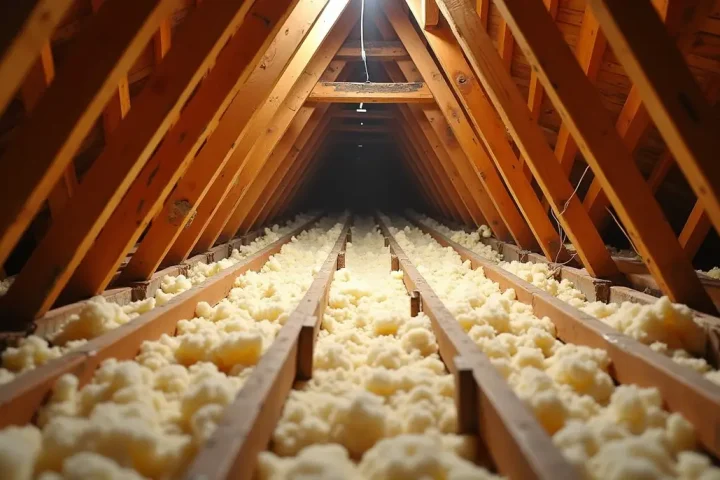
| Insulation in walls or roof | Tunnelling and nesting | Cover with 1/4 inch hardware cloth or board; bag soiled insulation |
| Bulbs, seed potatoes | Eaten in storage | Lidded metal containers or wire-mesh boxes |
Compiled by The Pest Control Brief from UC IPM Pest Notes: House Mouse (7483), Deer Mouse (74161) and Rats (74106), CDC rodent clean-up guidance, and ICWDM. Seed is the item that decides most shed problems, which is why our guide to rats under the bird feeder treats seed storage as part of the same fix.
Why are mice in my shed?
A shed offers shelter close to food and is rarely disturbed. UC IPM says sheds and similar shelters in residential areas provide refuge for deer mice, and that deer mice often enter vacated structures where they build nests and store food. House mice arrive in autumn too: UC IPM says outdoor house mice frequently move into buildings as nighttime temperatures fall. A shed beside a lawn, hedge or field edge is in deer mouse habitat, which UC IPM describes as forests, grasslands and crops.
Are mice common in sheds?
Very common, and the deer mouse is the species that matters most. In our analysis of iNaturalist research-grade records, deer mice and white-footed mice are recorded most often, relative to all observations, in Vermont at 4.33 records per 10,000, followed by Montana, Oregon and Massachusetts. These are sightings, mostly outdoors, not infestation counts, but they show where the shed mouse is likely to be a deer mouse rather than a house mouse.
Mouse or rat?
Norway rats burrow, and Nebraska Extension NebGuide G1530 notes that rats can burrow beneath the floor of a building that rests on piers or shallow foundation walls. Open burrows along the base of the shed, or droppings far larger than a mouse’s, point to rats; our guide to telling a rat from a mouse has the measurements.
What should I do if I have mice in my shed?
Work in this order: clean safely, trap, then seal. Sealing first can shut mice inside.
- Air the shed. CDC’s guidance for homes and outbuildings, naming cabins, sheds and barns, is to open all doors and windows for 30 minutes and leave the area during that time.
- Clean wet. Wear rubber or plastic gloves. Spray droppings and nests with 1.5 cups of bleach per gallon of water, or an EPA-registered disinfectant, and leave 5 minutes. CDC says to mop hard floors or spray outbuilding dirt floors with disinfectant, and not to vacuum or sweep droppings. Carry contaminated material outside and work upwind, as CDC advises. Our mouse droppings and hantavirus cleanup guide covers the full protocol.
- Trap. Set snap traps along the walls, behind stored items and beside droppings, spaced no more than about 10 feet apart, as UC IPM advises. Bait with peanut butter or peanut butter mixed with oats, which UC IPM’s deer mouse guidance calls usually effective. UC IPM advises against glue boards for deer mice. If pets or children use the shed, put traps inside a covered box or a lockable station with a mouse-sized entry.
- Store food in metal. Move every seed and feed sack into metal bins with lids, using the table above.
- Clear nesting material. Get rags, cardboard and loose sacks off the floor. NebGuide G1530 advises storing essential materials on pallets, shelves or hooks, and notes that bags of feed and debris shelter rodents. House mice jump 18 inches vertically, G1530 adds, so a low shelf is not out of reach; the lid is what protects seed.
- Seal once catches stop, using the next section.
If traps keep sitting untouched while droppings keep appearing, our guide to why a mouse trap is not working covers placement, bait and trap shyness.
What can I put in my shed to keep mice out?
Metal, in four places. Repellents do not belong on this list: ICWDM says no repellents are registered for deer or white-footed mice, and our review of what the peppermint oil studies found explains why scents fade.
1. The door
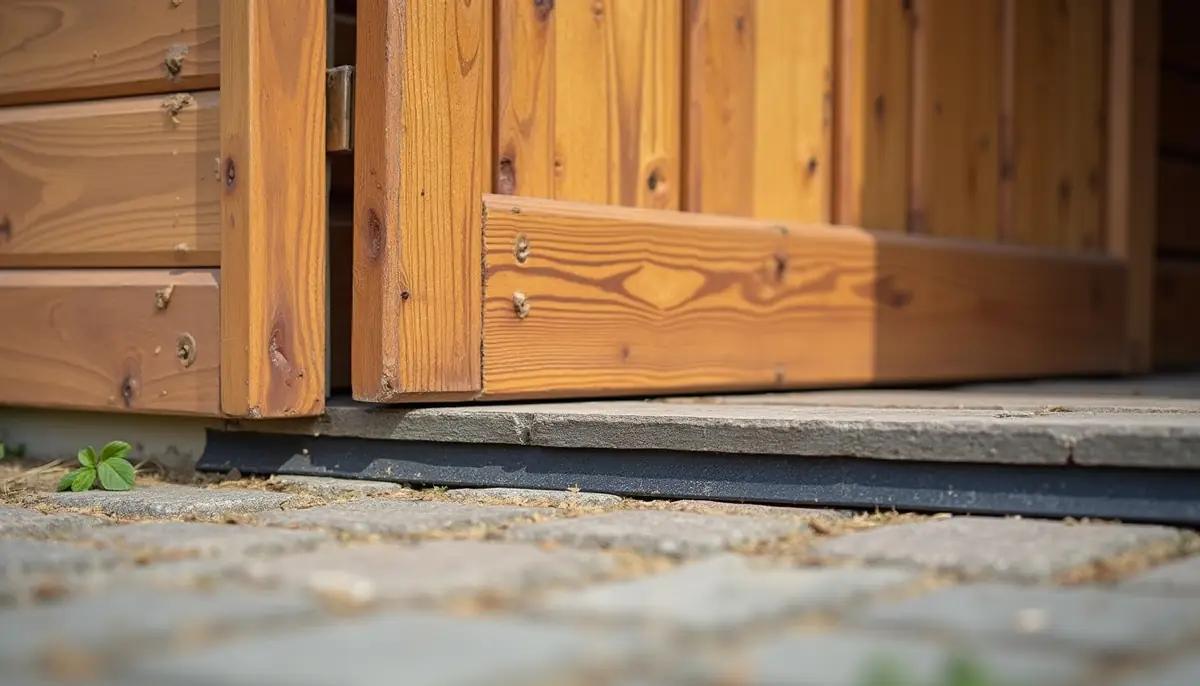
NebGuide G1530 sets the standard: the distance between the door bottom and the threshold should be less than 1/4 inch, because mice need only slightly more than a 1/4 inch gap to enter. On a wooden shed door, fit a door sweep and cover the lower edge with metal flashing ending within 1/8 inch of the door edge, which G1530 also specifies. G1530 warns that rodents gnaw rubber, vinyl, plastic and wood, so a brush or rubber sweep on its own is a temporary fix where mice have chewed before. The garage door version of this work is in our guide to keeping mice out of the garage.
2. The floor and wall junction
Look for daylight where the walls meet the floor and round the corners. Cover gaps with 24 gauge, 1/4 by 1/4 inch hardware cloth, the G1530 specification for mice; the 19 gauge, 1/2 inch mesh that G1530 lists for rats will let mice through. Fix it with screws and washers, not staples alone.
3. Vents and pipe or cable holes
UC IPM says to seal openings for pipes, vents and utility cables with metal or concrete, and rates expanding foam, rubber, vinyl and wood as ineffective for house mouse holes. Our comparison of steel wool, copper mesh and what actually stops a rodent explains why steel wool rusts out in a damp shed and copper mesh lasts longer.
4. Under the floor: a buried mesh apron
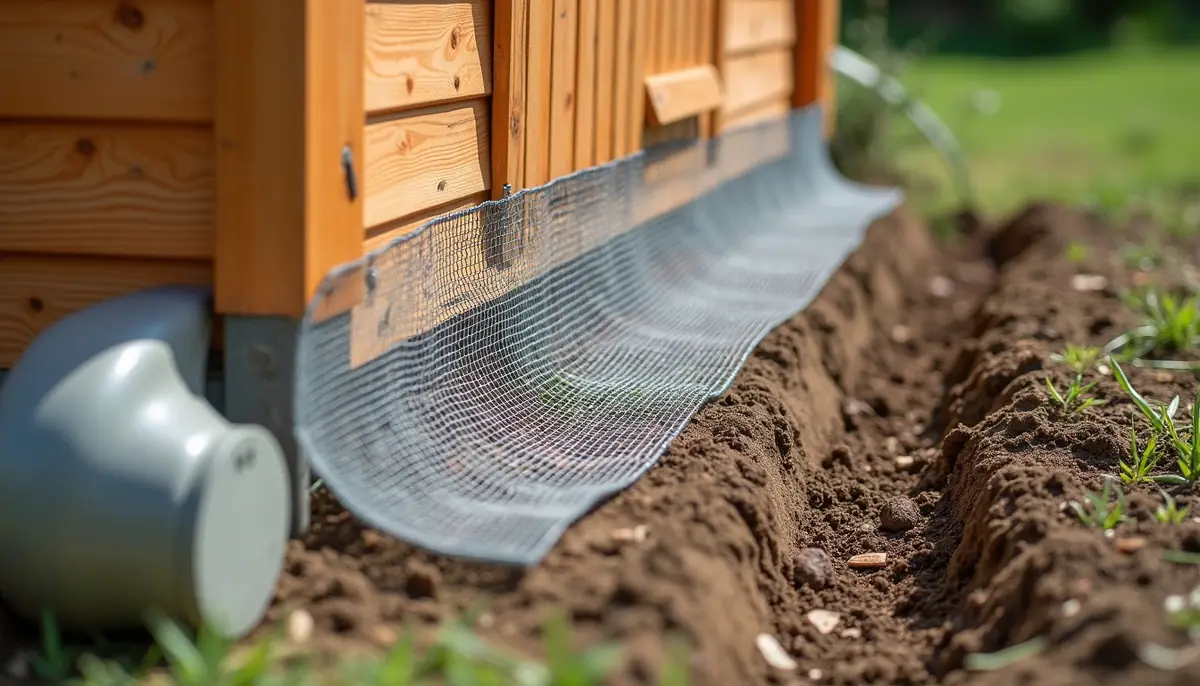
A shed on skids, blocks or soil has an open void underneath. ICWDM describes the barrier for sheds, porches and decks: hardware cloth of 1/4 or 1/2 inch mesh, running from the shed wall to 3 to 4 inches below ground, then out at least 12 inches at a right angle, so an animal digging at the wall hits mesh. Use 1/4 inch mesh where mice are the target. ICWDM adds two cautions: the barrier can restrict airflow under the shed and cause moisture problems, and an opening should never be closed until you are certain no animals are still under it.
For a permanent building, G1530 goes further and advises extending foundation walls at least 36 inches below ground to stop rats burrowing under. That is a construction job, worth knowing if you are replacing the shed.
How do I get rid of mice in my storage shed in winter?
The same way, with more traps. Mice do not hibernate, and NebGuide G1530 says house mice can survive and reproduce at temperatures as low as 24°F (about minus 4°C) if they have food and nest material, so an unheated shed full of seed supports them all winter. Check traps weekly through winter, and expect the most activity from October onwards, when UC IPM says outdoor mice move into buildings. Our guide to whether mice hibernate covers what they do in cold weather.
Mothballs, fox urine and other natural fixes
Mothballs are a pesticide whose label governs where they can be used. The National Pesticide Information Center says they should not be used against animals unless the label describes that use, and that they have little or no effect as repellents; vapour in a shed also soaks into stored cushions and tarps. Predator urine and peppermint have no registered use against deer mice, per ICWDM. Removing seed and sealing the floor are the natural fixes with evidence behind them.
What is the 5 day rule for mice?
It is an informal rule of thumb that mice are gone once 5 days pass with no catches and no new droppings. We found no extension service or health agency that publishes it. In a shed you may only visit weekly, so clean all droppings once and judge by whether fresh ones appear on the cleaned floor and shelves. When there are no new signs, leave one or two traps set along the walls through winter. The full sequence for a house is in how to get rid of mice.
Frequently asked questions
What should I do if I have mice in my shed?
Air the shed for 30 minutes, as CDC advises for outbuildings, then clean droppings wet with bleach solution and gloves, never by sweeping. Set snap traps along the walls no more than 10 feet apart, move seed and pet food into lidded metal bins, and seal the door gap and floor openings once catches stop.
How do I get rid of mice in my storage shed?
Trap first with several snap traps baited with peanut butter, then seal. Close the door gap to under 1/4 inch, the Nebraska Extension standard, cover floor gaps with 24 gauge, 1/4 inch hardware cloth, and fit a buried mesh apron round a shed on blocks or soil. Remove cardboard and sacks that give mice nest material.
What is the 5 day rule for mice?
An online rule of thumb that mice are gone after 5 days with no catches and no fresh droppings. No extension service or health agency we found publishes a 5 day rule; CDC’s own test is a week with no captures and no new signs. For a shed visited weekly, clean all droppings once, then treat any new droppings or catches on the next visit as continuing activity, and keep a trap or two set through winter.
What can I put in my shed to keep mice out?
Metal: a door sweep with metal flashing, 1/4 inch hardware cloth over floor and wall gaps, copper mesh or metal plate round pipes and vents, and lidded metal bins for seed. ICWDM says no repellents are registered for deer or white-footed mice, and NPIC says mothballs have little or no effect as repellents.
Sources
- University of Nebraska Lincoln Extension, NebGuide G1530, Rodent-Proof Construction: Structural (2003, revised 2009).
- University of California Statewide IPM Program, Pest Notes: House Mouse (UC ANR Publication 7483), Deer Mouse (74161) and Rats (74106).
- Centers for Disease Control and Prevention, How to Clean Up After Rodents.
- Internet Center for Wildlife Damage Management, Decks and Porches; and Deer and White-footed Mouse Damage Prevention and Control.
- National Pesticide Information Center, Oregon State University, FAQ: Mothballs.
- The Pest Control Brief analysis of iNaturalist research-grade records, pulled October 2026 (b19 to b30 files) or November 2026 (b35/b36 hour files).