Houseplant Pests: Fungus Gnats, Spider Mites, Scale and Mealybugs
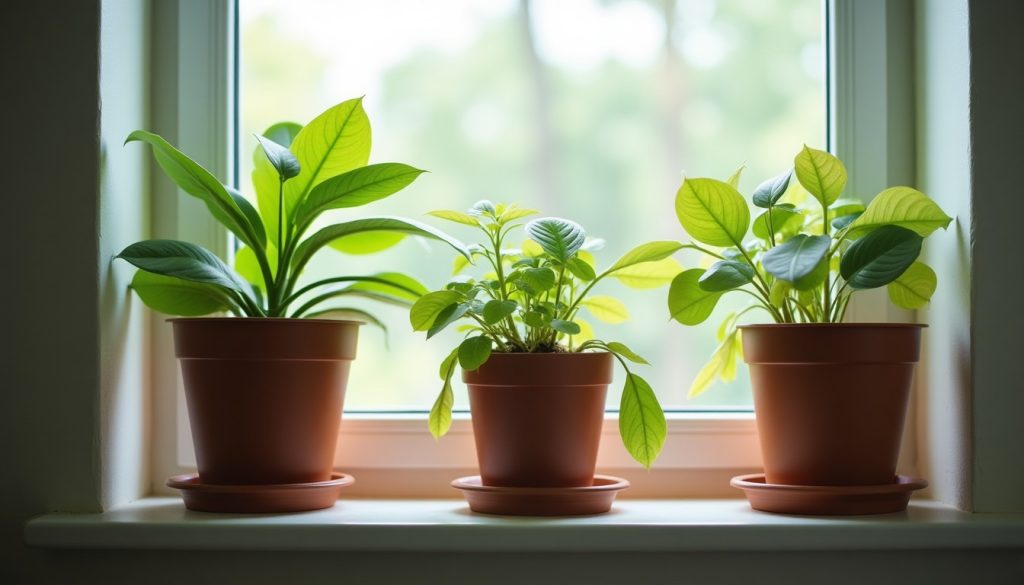
Four things account for most houseplant infestations, and none of them is a job for a pest control company: spider mites at about 1.3 mm, fungus gnats at 1.5 to 3 mm, scale insects from 1 to 6.4 mm, and mealybugs under their white wax. Three of the four are solved by changing how you water and by physically removing the insects. UC IPM’s position on fungus gnats is blunt: insecticides are rarely warranted to control these flies in and around homes.
Structural pest control companies treat buildings, not plants. That is not a dodge, it is a different trade with different products and different label restrictions, and it is the reason a quarterly service contract will not deal with the mites on your fiddle-leaf fig. Here is what you actually have and what works.
Identify by symptom first
| What you see | Almost certainly | What it is doing |
|---|---|---|
| Small flies rising from the soil when you water | Fungus gnats | Larvae feeding in damp organic matter; adults are a nuisance rather than a plant problem |
| Fine pale stippling on leaves, sometimes webbing | Spider mites | Sucking cell contents, worst in hot dry dusty air |
| White cottony clumps in leaf joints and stem crotches | Mealybugs | Sap feeding, excreting honeydew |
| Immobile bumps on stems and leaf undersides | Scale insects | Sap feeding; soft scales also excrete honeydew |
| Sticky film on leaves or the surface below | Honeydew from mealybugs or soft scale | Encourages black sooty mould |
Fungus gnats are a watering problem
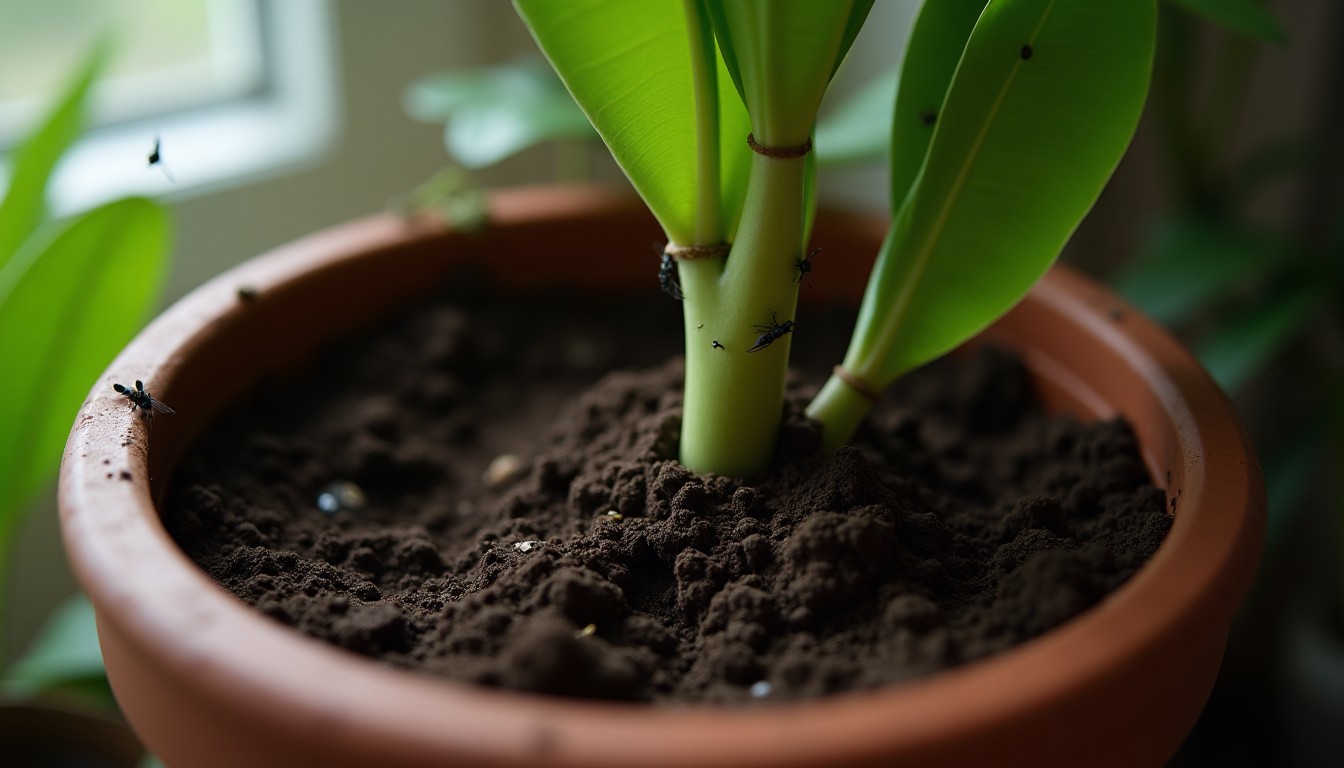
Adults are 1.5 to 3 mm and weak fliers, and the larvae live in the top layer of damp potting mix where they feed on organic matter, fungi and root hairs. At 75°F the whole cycle runs about 17 days: roughly three days as an egg, ten as a larva, then about four more before the adult emerges.
That short cycle is why the population seems to explode, and it is also why the fix is simple. Let the surface of the compost dry between waterings, improve drainage, and the larval habitat disappears. To confirm what you have, UC IPM suggests pushing chunks of raw potato into the soil, which the larvae move into and which lets you check numbers.
If the flies are not coming from the soil, they may not be fungus gnats at all. Our guide to fruit flies, drain flies and gnats covers telling the small indoor flies apart and finding the source.
Spider mites are a humidity problem
At under 1.3 mm they are close to invisible, so the damage is usually noticed first: fine pale stippling, then bronzing or yellowing, and in bad cases webbing over the foliage. They favour hot, dusty conditions and plants under water stress, which describes a lot of centrally heated rooms in winter.
A generation can complete in under a week in warm conditions, which is why an infestation moves quickly from unnoticed to obvious. Forceful spraying with water, covering the undersides of leaves, reduces populations and is often sufficient on its own. Repeat it, and raise humidity around the plant.
Mealybugs and scale are removal jobs
Mealybugs hide in protected spots: leaf joints, branch crotches, the crown of the plant, stems near the soil. UC IPM’s household recommendation is a cotton bud dipped in isopropyl alcohol at 70 per cent or less, dabbed directly onto the insects, testing one leaf first for burn. A forceful water spray works on sturdier plants, repeated every few days.
Scale insects are stranger. Adults have no visible head or legs and look like discoloured bumps, because the mobile stage, the crawler, settles and then loses its legs. Armoured scales are flat with a cover that lifts off the body and produce no honeydew; soft scales are rounder, keep their cover attached, and do excrete honeydew. For a houseplant, pruning out heavily infested growth and physically removing the rest is the practical answer.
The one timing rule worth knowing: sprays work against crawlers, not settled adults, because the adult’s cover protects it. That is why scale treatments that appear to fail often just landed at the wrong point in the cycle.
Why this is not a pest control call
- The products differ. Structural treatments are aimed at the building and its perimeter. Plant material has its own product labels and its own restrictions.
- The controls are cultural. Watering practice, humidity, drainage, dust and physical removal do most of the work here, and none of that is a service.
- The insects arrive with the plant. New plants and fresh potting compost are the usual route in, which is why quarantining a new plant for a few weeks prevents more problems than any spray.
- Spraying indoors is the wrong instinct. UC IPM states insecticides are rarely warranted for fungus gnats around homes and points to Bti or beneficial nematodes where treatment is genuinely needed.
The same targeting logic, applied to structural pests, is set out in integrated pest management. If you are weighing DIY against a professional visit generally, see DIY versus professional pest control, and for what the labels on consumer products actually permit, what professionals use versus retail. Plants in a conservatory or sunroom sit at the boundary between house and garden, which is covered in garden pests and what a pest control company will treat.
A routine that prevents most of it
- Quarantine new plants away from the others for two to three weeks and check leaf undersides before they join the collection.
- Water to the plant’s needs rather than a schedule, and let the surface dry between waterings where the species tolerates it.
- Wipe leaves. It removes dust that favours mites and lets you find scale and mealybugs early.
- Check the undersides, which is where mites and scale sit.
- Isolate anything infested at the first sign, because these pests move plant to plant on contact.
Frequently asked questions
How do I get rid of fungus gnats in houseplants?
Dry the soil surface out between waterings and improve drainage, which removes the larval habitat. UC IPM states insecticides are rarely warranted for these flies around homes, and suggests Bti or beneficial nematodes where control is genuinely needed. Raw potato chunks pushed into the compost will confirm whether larvae are present.
What are the tiny flies coming out of my plant pot?
Most likely fungus gnats, 1.5 to 3 mm adults whose larvae develop in damp potting compost. The whole cycle takes about 17 days at 75°F, which is why numbers build quickly. Flies that are not emerging from soil may be fruit flies or drain flies, which have different sources.
What causes tiny pale dots on my plant’s leaves?
Usually spider mites, which are under 1.3 mm and feed on leaf cells, producing fine stippling that progresses to bronzing or yellowing, and webbing in heavy infestations. They favour hot, dusty air and water-stressed plants.
How do I treat mealybugs on a houseplant?
UC IPM recommends dabbing the insects directly with a cotton bud dipped in isopropyl alcohol at 70 per cent or less, after testing a single leaf for burn. Forceful water spraying works on sturdy plants when repeated every few days, and hand removal or pruning handles small infestations.
What are the little bumps on my plant stems?
Probably scale insects, from about 1 to 6.4 mm. They look like discoloured bumps because the settled adult has no visible legs or head. Armoured scales are flat with a cover that lifts off; soft scales are rounder and excrete sticky honeydew.
Will a pest control company treat my houseplants?
Generally not. Structural pest control is aimed at the building, and plant treatments carry their own product labels and restrictions. Houseplant pests are managed through watering practice, humidity, physical removal and isolating affected plants.
Why do my plants keep getting pests?
New plants and fresh compost are the usual route in, and the pests then spread by contact between touching plants. Quarantining new arrivals for two to three weeks, checking leaf undersides, and isolating anything infested prevents most repeat infestations.
Sources
- UC Statewide IPM Program, Pest Notes: Fungus Gnats. ipm.ucanr.edu
- UC Statewide IPM Program, Pest Notes: Spider Mites. ipm.ucanr.edu
- UC Statewide IPM Program, Pest Notes: Mealybugs. ipm.ucanr.edu
- UC Statewide IPM Program, Pest Notes: Scales. ipm.ucanr.edu