Can Fleas Live in Your Bed? Where Fleas Actually Breed
Adult fleas do not live in your bed the way bed bugs do, but flea eggs, larvae and cocoons can develop in bedding that a flea-infested pet sleeps on. Cat fleas stay on the animal to feed and breed, and Texas A&M AgriLife says they do not normally live on humans. Their eggs fall off wherever the pet rests. With no pet on the bed there is no flea dirt for larvae to eat, and an adult flea with no animal lasts only days to a couple of weeks.
Two opposite claims circulate: that fleas cannot survive in a bed at all, and that they nest in mattresses like bed bugs. Neither is right.
What is true about fleas in beds, claim by claim
| Common claim | What the evidence says | Source |
|---|---|---|
| Fleas live in your mattress like bed bugs | Adult cat fleas remain on the host, where they feed, mate and lay eggs; the mattress gets eggs only if a pet sleeps on it | UC IPM Pest Notes 7419 |
| Fleas cannot survive in a bed at all | Eggs fall onto bedding, and cocoons are found on animal bedding | UC IPM; MSD Veterinary Manual |
| Fleas can live on people instead of pets | Cat fleas do not normally live on humans but bite people who handle or sleep with infested animals | Texas A&M AgriLife ENTO-PU-046 |
| Human blood cannot support fleas | In a 2023 lab study, females fed human blood through a membrane laid 83.0 eggs each in a week, against 129.5 on dog blood | Blakely and colleagues, PLOS Neglected Tropical Diseases, 2023 |
| Fleas in an empty bed will last for months | Unfed adults last a few days to 2 weeks; only cocooned adults wait for months | Texas A&M AgriLife E-433; MSD Veterinary Manual |
| Larvae can grow anywhere in the bedroom | Larvae need adult flea droppings to develop and die below 50 per cent relative humidity | Texas A&M AgriLife E-433; MSD Veterinary Manual |
Compiled by The Pest Control Brief from UC IPM Pest Notes 7419, Texas A&M AgriLife publications E-433 and ENTO-PU-046, the MSD Veterinary Manual and Blakely, Agnew, Gard and Romero (New Mexico State University, 2023).
Why adult fleas do not move into the bed
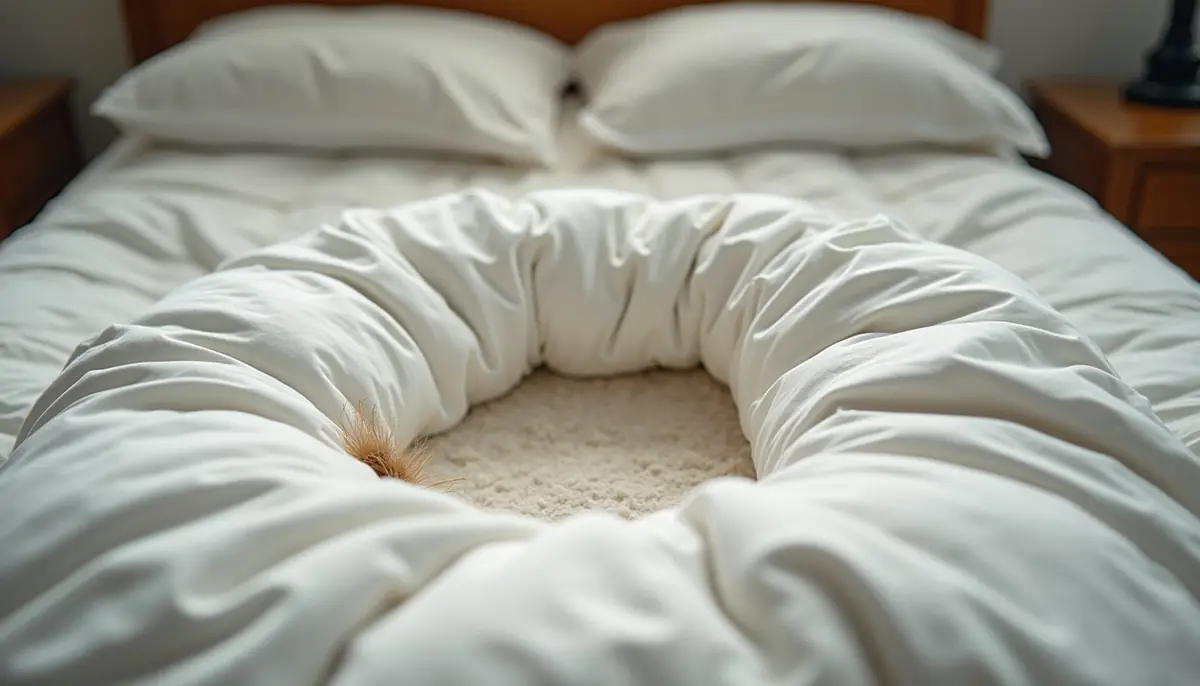
The cat flea, which Texas A&M says is far more common on pets and in homes than the dog, human or rat flea, is a permanent parasite. In a 1989 Purdue study, Michael Dryden put fleas on cats that could not groom them off: an average of 85 per cent of females and 58 per cent of males stayed on continuously for at least 50 days, and fleas survived and reproduced on the cat for at least 113 days. The MSD Veterinary Manual adds that adults start feeding about 5 minutes after finding a host and, once they begin reproducing, generally do not leave unless forced off by grooming or insecticide.
People are not the problem host for a reason other than blood quality. The 2023 New Mexico State work found fleas drank less human blood than dog blood, 5.2 against 9.5 microlitres in 48 hours, but still laid eggs on it. What cat fleas lack on a person is a furry animal to stay on. They bite and drop off, which is why our guide to why fleas bite people but do not stay points the search back to the pet or to wildlife in the building.
So an adult flea in your sheets is usually a recent arrival from a pet on the bed, or a newly emerged adult that found you; our page on how long fleas live without a host covers the no-pet case. The University of Kentucky notes adults can jump vertically about 6 inches, enough to reach a low bed from the floor or ride up on a pant leg.
Where fleas actually breed when a pet shares the bed
The eggs are the part that ends up in bedding. UC IPM says females lay about 20 to 50 eggs a day; they are smooth, pearly white, about 1/32 inch long, and readily fall off the pet onto bedding and carpet. Kentucky says eggs drop wherever the pet rests, sleeps or spends time. A dog or cat that sleeps on your duvet is spreading eggs there.
Whether those eggs become fleas depends on food and humidity. Larvae feed on adult flea droppings, the reddish black “flea dirt” of dried blood; Texas A&M says that without it they cannot survive. UC IPM says larval development needs protected places with at least 75 per cent relative humidity, and the MSD Veterinary Manual says prolonged humidity below 50 per cent is lethal, that larvae avoid direct light, and that indoor sites include pet beds, couches and spaces where pets eat or sleep. A human bed that a pet sleeps on, with crumbs of flea dirt in the folds and under the pillows, can meet those conditions; a bare, dry, regularly washed sheet usually does not.
The most likely place to find larvae, both Texas A&M publications say, is infested pet bedding. Check the pet’s own bed before the mattress, and see how fleas live in carpet for the floor around it.
How long fleas last in a bed, stage by stage
How long fleas live in your bed depends on the stage.
- Eggs: hatch in about 2 to 5 days (UC IPM).
- Larvae: feed for 5 to 11 days (Texas A&M), 8 to 15 days (UC IPM), or 2 to 3 weeks when food or warmth is short (MSD).
- Cocoons: the pupa develops in 1 to 2 weeks (MSD), and Kentucky says pupae stay in the cocoon 1 to 4 weeks. A fully formed adult can then wait inside: up to 5 months (Texas A&M), emergence delayed up to 30 weeks (MSD), or up to 12 months at cool temperatures (UC IPM).
- Unfed adults: about 12 days at 80.6°F and 90 per cent humidity, but only about 3 days at 50 per cent humidity (MSD). Texas A&M gives a few days to 2 weeks without a host.
The cocoon explains the classic surprise of fleas biting in bed after a pet has gone or a house has stood empty. Pressure, breath, movement and heat trigger emergence, says the MSD manual, and a person getting into bed provides all four. The flea life cycle and why fleas return after treatment explains why cocoons outlast sprays.
Fleas or bed bugs in the bed?
Bites in bed send many people to the wrong pest. The signs differ in where the insect is seen, where it bites and what it leaves behind.
| Cat flea | Bed bug | Source | |
|---|---|---|---|
| Size | Adult no larger than 1/8 inch; larva up to 3/16 inch | Adult about 1/5 inch; nymphs 1/20 to 1/5 inch | UC IPM 7419 and 7454 |
| Where seen | On the pet; in pet bedding; jumping on sheets or legs | Mattress seams, box springs, cracks near the bed | UC IPM 7454; Texas A&M |
| Bite location | Mainly around the ankles | Any skin exposed during sleep: face, neck, shoulders, arms | University of Kentucky ENTFACT 636 |
| Bite look | Small central red spot with a red halo, usually little swelling | Areas around bites may redden, swell and itch days later | UC IPM 7419 and 7454 |
| Droppings | Fine reddish black dust in pet fur and bedding | Dark fecal spots, light brown shed skins | Texas A&M E-433; UC IPM 7454 |
| Movement | Jumps, up to about 6 inches vertically | Wingless; no jumping described | University of Kentucky ENTFACT 602; UC IPM 7454 |
Compiled by The Pest Control Brief from UC IPM Pest Notes 7419 and 7454, Texas A&M AgriLife E-433 and University of Kentucky ENTFACT 602 and 636.
If the insect crawls rather than jumps and you find dark spots on seams, compare it with our guide to bugs that look like bed bugs.
If it jumps, our guide to what fleas look like at every stage will confirm it.
Getting fleas out of a bed
- Treat the pet first, through your vet. Kentucky says that while all pets stay on effective treatment, the home infestation is driven to extinction as developing fleas emerge, jump on pets and are killed. Product choice is a veterinary decision.
- Wash bedding hot. UC IPM advises laundering pet bedding in hot, soapy water at least once a week; do the same for sheets and throws a pet has slept on.
- Vacuum the mattress edges, under the bed and along walls. Texas A&M says vacuuming removes up to 30 per cent of larvae and up to 60 per cent of eggs from carpet, and Kentucky says it prompts cocoons to hatch sooner. Seal and bin the bag outdoors.
- Keep the pet off the bed until bites stop. UC IPM says fleas may keep emerging for up to 2 weeks after an IGR treatment, so expect a few for that long.
The full room-by-room plan is in how to get rid of fleas.
If bites continue well past the 2 week emergence window UC IPM describes, a professional visit is reasonable; what flea treatment costs explains why one visit is rarely enough.
Frequently asked questions
How long can fleas live in your mattress?
Adult fleas off a pet last a few days to 2 weeks, according to Texas A&M AgriLife, and only about 3 days in air at 50 per cent humidity. Cocooned adults last far longer, up to 5 months by Texas A&M’s figure and up to 12 months in cool conditions by UC IPM’s. Larvae survive only where there is flea dirt to eat.
Is it safe to sleep in a bed with fleas?
Fleas bite, and Texas A&M notes allergic reactions usually appear 12 to 24 hours after a bite and can last a week or more. UC IPM says cat fleas can carry flea-borne rickettsial disease. Most bites only itch, but anyone with fever or a spreading rash after flea bites should see a doctor. Treat the pet and the bedding before sleeping there again.
How do you get rid of fleas in your bed?
Treat every pet through a vet, wash sheets and pet bedding in hot, soapy water, and vacuum the mattress edges, under the bed and the floor around it, sealing the bag afterwards. University of Kentucky guidance says treating pets drives the infestation out as developing fleas emerge and are killed. Expect some fleas for about 2 weeks.
Where to sleep if you have bed bugs?
Your own bed. The University of Kentucky says bed bugs concentrate around beds and sofas and may disperse further if an infestation persists, and that they adjust feeding to when the host sleeps, so moving to the sofa does not leave them without a meal and puts you on another known hiding place. Our guide to how to get rid of bed bugs covers what to do instead.
Can fleas live in your bed without pets?
Not for long. Without a pet there is no flea dirt, and Texas A&M says larvae cannot survive without it. Adults without a host last a few days to 2 weeks. Fleas biting in a pet-free bed usually came from cocoons left by a former pet, or from wildlife such as rodents or opossums nesting in the building.
Sources
- University of California IPM. Pest Notes: Fleas, Publication 7419.
- University of California IPM. Pest Notes: Bed Bugs, Publication 7454.
- Texas A&M AgriLife Extension. Controlling Fleas, E-433 (Merchant and Robinson).
- Texas A&M AgriLife Extension. Managing Fleas, ENTO-PU-046 (Brown and Keck), January 2025.
- University of Kentucky Entomology. Flea Control and Prevention, ENTFACT 602 (Potter), revised 2026.
- University of Kentucky Entomology. Bed Bugs, ENTFACT 636 (Potter).
- MSD Veterinary Manual. Fleas in Dogs and Cats, full review April 2026.
- Dryden MW. Host association, on-host longevity and egg production of Ctenocephalides felis felis. Veterinary Parasitology 34: 117 to 122, 1989.
- Blakely BN, Agnew J, Gard C, Romero A. Effects of blood meal source on blood consumption and reproductive success of cat fleas. PLOS Neglected Tropical Diseases 17(4): e0011233, 2023.