Carpet Beetle Treatment Cost 2026 and How to Identify Them
Carpet beetle treatment costs $300 to $600 for most homes. The larvae do the damage, and shed skins are the sign that distinguishes them from moths.
Carpet beetle extermination costs $300 to $600 for most homes, with mild single-room treatment from about $150 and severe infestations reaching $1,200 or more. Per-visit pricing runs $200 to $300, and most jobs need two to three visits. Whole-house heat treatment for severe cases can reach $4,000. The larvae do the damage, not the adults you see.
Carpet beetles are routinely mistaken for clothes moths and treated as if they were the same problem. They damage the same materials for the same reason, but they are found in different places and the inspection differs, which is why misdiagnosis wastes visits.
What treatment costs
| Situation | Cost | Notes |
|---|---|---|
| Mild, single location | From about $150 | Insecticide treatment, one area |
| Per visit, typical | $200 to $300 | Varies by severity and location |
| Most homes, full job | $300 to $600 | Usually 2 to 3 visits |
| Severe infestation | $1,200 or more | Multiple rooms, extensive harbourage |
| Whole-house heat treatment | Up to $4,000 | Severe cases only |
Contractor-reported ranges compiled in 2026. No federal price index exists for pest control services.
Carpet beetles or clothes moths
| Sign | Carpet beetles | Clothes moths |
|---|---|---|
| What you see flying | Small round beetles, often at windows | Small moths, avoid light |
| Larvae | Bristly, carrot-shaped, leave shed skins | Cream coloured, may build cases |
| Damage pattern | Irregular grazing, often along seams and edges | Irregular holes, often concentrated |
| Where found | Carpet edges, under furniture, air ducts, bird nests | Wardrobes, stored textiles |
| Typical cost | $300 to $600 | About $275 |
The distinguishing evidence is shed larval skins. Carpet beetle larvae moult repeatedly and leave bristly cast skins behind, which often persist long after the larvae have gone. Our guide to moth extermination costs covers the clothes moth side.
Why the larvae matter and the adults do not
Adult carpet beetles feed on pollen and nectar outdoors. The larvae eat keratin: wool, silk, fur, feathers, and also dried animal products and accumulated pet hair and lint. So the damage is done by a life stage most people never see, in places nobody vacuums.
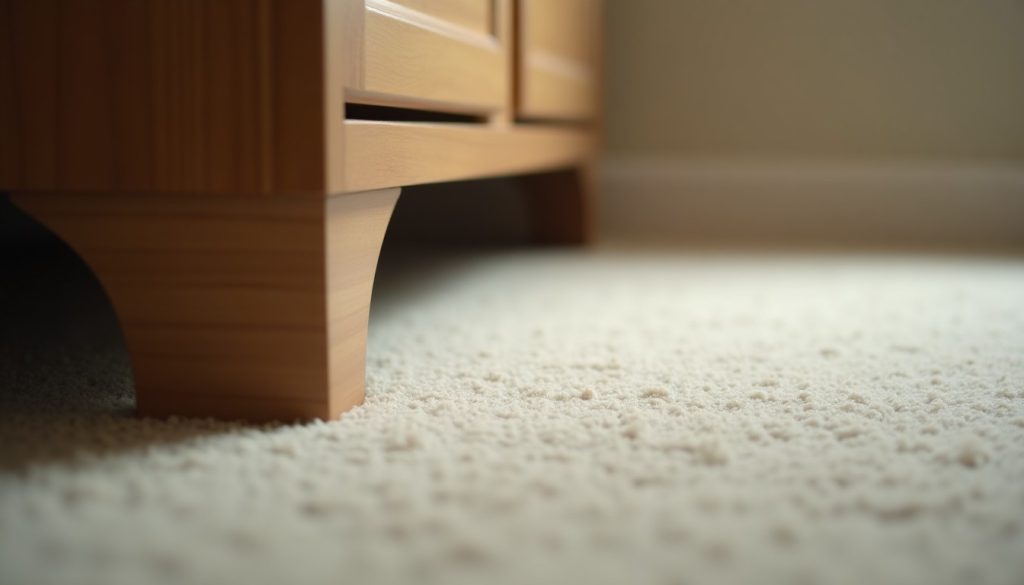
That drives where treatment goes. Carpet edges under furniture, beneath heavy items that never move, along skirting, in air ducts and in accumulated debris in wall voids. Adults appearing at windows are a symptom pointing to a source elsewhere in the building.
A frequently missed source is a bird or rodent nest in a soffit, chimney or wall void. Nest material is rich in keratin, so a carpet beetle problem that keeps returning after clean treatment often traces back to one. Removing it is exclusion work, covered in our guides to wildlife removal and pest-proofing your home.
What preparation actually changes
- Vacuum thoroughly and repeatedly, especially carpet edges, under and behind furniture, and along skirting. Dispose of the bag outside.
- Move heavy furniture that has not been moved. This is where the population usually is.
- Launder or clean affected textiles on the hottest cycle the fabric allows.
- Check stored items, particularly wool, furs, feathers, taxidermy and dried floral material.
- Look for a nest, in soffits, chimneys, vents and voids, if the problem recurs.
- Store cleaned textiles sealed, since larvae feed undisturbed in dark still spaces.
Inadequate preparation is the standard warranty exclusion across this trade, covered in our guide to preparing for treatment.
Frequently asked questions
How much does carpet beetle extermination cost?
Most homes cost $300 to $600, with mild single-location treatment from about $150 and per-visit pricing of $200 to $300. Most jobs need two to three visits. Severe infestations reach $1,200 or more, and whole-house heat treatment for severe cases can reach $4,000.
How do I know if I have carpet beetles or moths?
Look for shed larval skins. Carpet beetle larvae are bristly and carrot-shaped and moult repeatedly, leaving cast skins that persist. Carpet beetles are found along carpet edges, under furniture and in ducts, while clothes moths concentrate in wardrobes and stored textiles. Adult carpet beetles often appear at windows.
Why do carpet beetles keep coming back?
Usually an unfound source. Common ones are accumulated lint and pet hair beneath furniture that never moves, stored keratin items such as wool, furs or feathers, and bird or rodent nests in soffits, chimneys or wall voids. Nest material is rich in keratin and sustains a population indefinitely.
Do carpet beetles bite?
Carpet beetles do not bite. Some people react to contact with the bristly larval hairs, which can cause skin irritation sometimes mistaken for bites, particularly where bedding or upholstery is affected. Persistent unexplained skin irritation is worth discussing with a doctor rather than assuming a cause.
Sources
- Contractor-reported price ranges compiled by Angi, HomeGuide, Fixr and HomeAdvisor, 2026. Sample sizes and methods are not published by those sources.
- U.S. Bureau of Labor Statistics, Producer Price Index programme. Confirmed no published series for NAICS 561710.