Wasp vs Bee: How to Tell Them Apart in Seconds
Bees are hairy, stocky and feed their young pollen and nectar; wasps are smooth, shiny, narrow-waisted hunters that feed their young other insects. In the field, look for fuzz first, then the waist, then the legs: paper wasps fly with long legs dangling. The nest settles it, because bees build with wax and social wasps build with paper. Only worker honey bees usually die after stinging; yellowjackets, paper wasps and bumble bees can all sting more than once.
The confusion is mostly about one pair: a yellowjacket worker and a honey bee worker are both about half an inch long and striped. Cornell’s New York State IPM Program notes that many “bee sting” incidents are actually caused by wasps. The table compares the four insects people meet most.
Wasp vs bee at a glance
| Honey bee | Bumble bee | Yellowjacket | Paper wasp | |
|---|---|---|---|---|
| Group | Bee | Bee | Wasp | Wasp |
| Body | Fuzzy, orange brown to dark, banded | Thick, densely hairy, black and yellow | Smooth, bright yellow and black, blocky | Slender, smooth, long legs |
| Waist | Not obvious | Not obvious | Narrow but barely visible | Long and slender |
| Typical length | 12 to 15 mm (about half an inch) | 8 to 21 mm, up to about 1 inch | About 14 mm (half an inch) | 19 to 22 mm (three quarters of an inch) |
| In flight | Legs held close | Legs held close | Legs held close | Legs dangle below the body |
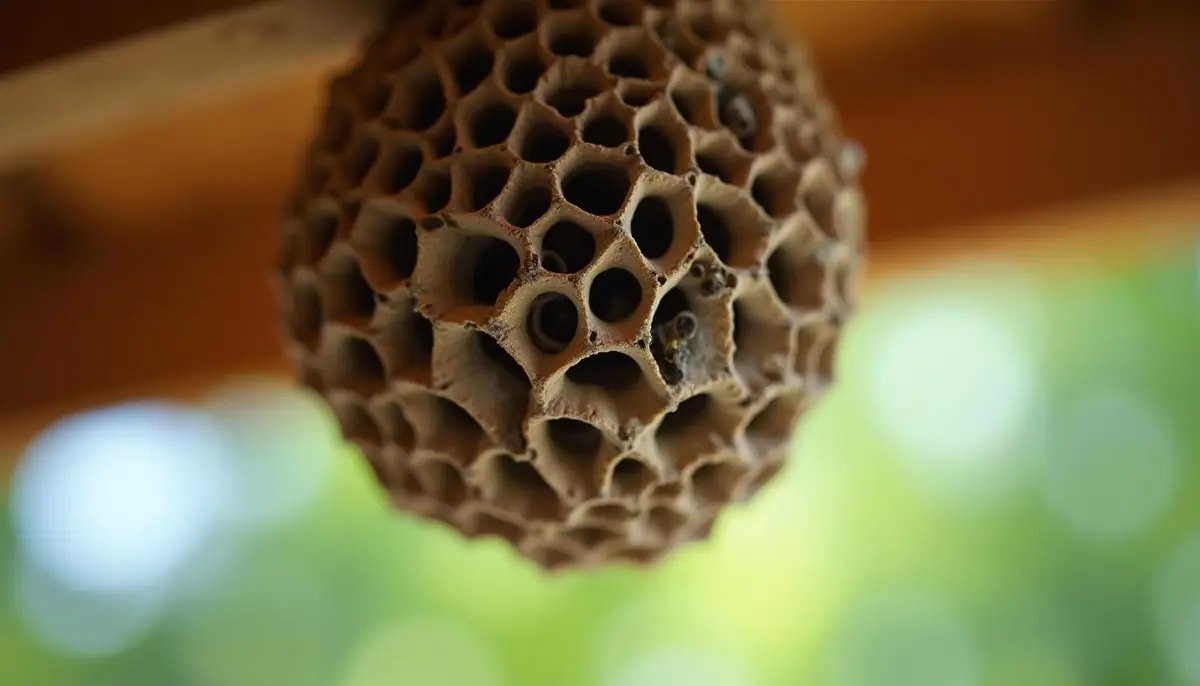
| Nest | Wax comb in a cavity, tree hollow or wall void | Small wax pots in old burrows, insulation or grass | Paper nest wrapped in an envelope, often underground or in a wall | Single open paper comb, often under eaves |
| Colony | Tens of thousands, lasts for years | 50 to 400, one season | 1,500 to 15,000, one season | A few dozen, one season |
| Feeds young | Pollen and nectar | Pollen and nectar | Chewed insects and scavenged meat | Caterpillars and soft insects |
| Scavenges your food? | No, works flowers | No, works flowers | Yes, especially late summer | No, hunts live caterpillars |
| Stings more than once? | Workers usually no | Yes | Yes | Yes |
The four checks that separate them
1. Hair
Ohio State’s bee identification guide puts it simply: bees are generally covered with hair on their bodies and legs, while wasps are smooth and almost hairless. Female bees also carry pollen-carrying hairs, which a wasp never has.
There is one well-known exception to “bees are fuzzy”: carpenter bees have a shiny, mostly bare abdomen, which is why they get mistaken for wasps and bumble bees. Our guide to carpenter bee vs bumble bee covers that pair, and tiny metallic green sweat bees are another bee that looks wasp-like at a glance.
2. The waist
Wasps have the classic pinched “wasp waist”. On paper wasps it is long and obvious. On yellowjackets, UC IPM notes, the narrow waist is barely visible, which is exactly why they pass for honey bees. Bees look thick through the middle.
3. The legs in flight
Cornell describes paper wasps as having legs that dangle when they fly. Yellowjackets, honey bees and bumble bees fly with their legs held closer to the body.
4. The diet
Bees feed their larvae pollen and nectar. Social wasp larvae need protein: UC IPM says yellowjacket adults forage mainly for other insects through spring and summer, then become particularly interested in sweet things in late summer. So a bee works flowers, while a wasp patrols your plate and your bin.
Yellow jacket vs bee: the pair everyone mixes up
Cornell lists both the honey bee and the common yellowjacket species at about half an inch, 14 mm. Size will not separate them. Colour and texture will: UC IPM describes honey bees as having more hair and being less brightly striped than yellowjackets.
Behaviour is the quicker test. Cornell notes that yellowjacket activity around picnic food, drinks, trash and compost later in summer is normal. Bumble bees and honey bees forage on flowers and do not scavenge the way yellowjackets do. If it lands on your burger, it is almost certainly a wasp.
Both can nest in old rodent burrows. A steady, fast stream of smooth yellow insects in and out of a lawn hole in August is a yellowjacket nest, and our guide to yellow jacket removal explains what to do about it.
Wasp vs bee vs hornet vs yellow jacket
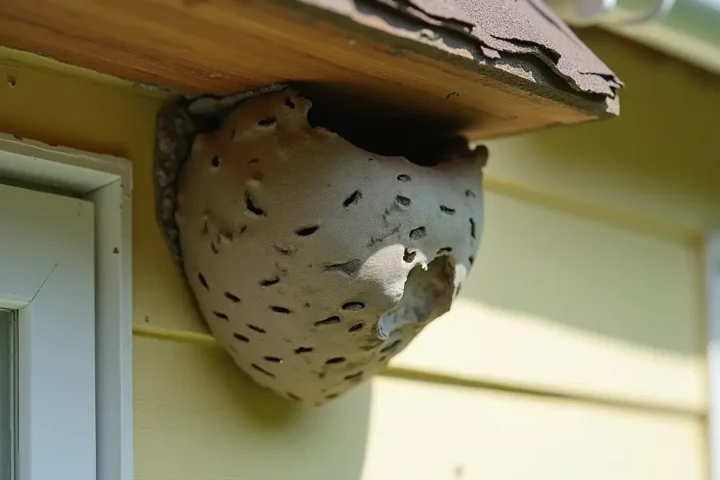
A hornet is a wasp, and a yellowjacket is a wasp. Cornell describes the European hornet, 26 to 38 mm long, as the only true hornet found in the United States. The bald-faced hornet, despite the name, is a large black and white yellowjacket that builds the grey paper football seen in trees. Our wasp and hornet identification guide goes species by species; the short version is that all of them are paper-nesting, smooth-bodied wasps, and none is a bee.
Read the nest, not the insect
If you can see where they are coming from, the nest usually answers the question faster than the insect.
| What you see | Who usually built it | What to do next |
|---|---|---|
| Waxy hexagonal comb, bees in a wall or tree cavity | Honey bees | Call a beekeeper or bee removal specialist; the comb has to come out too |
| A cloud of bees hanging in a cluster on a branch | A honey bee swarm | Leave it and call a beekeeper; swarms are generally low risk |
| Single open paper comb, cells visible, under eaves or a rail | Paper wasps | Leave it if out of the way; deal with it if it is by a door |
| Grey paper ball, in a tree or on a building | Bald-faced hornet or aerial yellowjackets | Keep clear; a job for a professional if near activity |
| Busy hole in a lawn, bank, stone wall or wall void | Yellowjackets, sometimes bumble bees | Keep people and mowers away; identify the insect, then decide |
| Neat round hole in bare wood, sawdust below | Carpenter bee | A wood problem more than a sting problem |
Before anyone sprays honey bees in a wall, note Cornell’s warning: if the bees are killed and the honey left behind, it can drip, stain ceilings, ferment and attract other pests. That is why bee removal is priced differently from wasp control, as our bee removal cost guide explains.
Do bees die after stinging?
Worker honey bees do. The University of Florida’s honey bee profile explains that workers have a barbed stinger that is torn, with the poison sac, from the end of the abdomen when they sting a tough-skinned victim, and the bee dies.
The torn-off sting keeps working. UC Riverside’s honey bee researchers describe a valve and piston at the base of the lancets that keeps pumping venom from the sac after the bee has gone, and their experiments found the welt grew the longer the sting stayed in, even over a few seconds. In the same study, published in The Lancet in 1996, whether the sting was scraped or pinched out made no difference to the welt; how quickly it came out did.
Most other stinging insects survive. Texas A&M states that, unlike honey bees, bumble bees can sting repeatedly, and Cornell says the same of wasps generally. UC IPM notes that yellowjacket stingers have no barbs and can be used repeatedly. Male bees and wasps cannot sting at all, because the stinger is a modified egg-laying tube, Cornell explains.
Wasp vs bee sting: which is more dangerous?
Per sting, there is no reliable ranking for ordinary people, and the official numbers do not try to make one. CDC’s National Center for Health Statistics counted 1,109 US deaths from hornet, wasp and bee stings from 2000 to 2017, an average of 62 a year, but the death code lumps all three together, so no one can say from it whether bees or wasps kill more people. About 80 per cent of those deaths were among males.
The practical differences are about how a sting happens:
- Repeat stings. A yellowjacket or paper wasp can sting several times; a worker honey bee usually stings once and leaves a pumping sting behind.
- Recruitment. Cornell notes that a crushed yellowjacket releases an alarm pheromone that attracts other workers. Swatting one near a nest can turn one sting into many.
- Season. Cornell describes honey bees as extra defensive in the fall, when the hive is full of honey, and yellowjackets peak in late summer, which our data below shows clearly.
- Allergy. For an allergic person, one sting from either can be serious. Cornell Cooperative Extension lists swelling away from the sting, hives or shortness of breath as signs; get urgent medical care, and see a doctor if you have reacted before.
Which is more aggressive, wasp or bee?
Away from the nest, yellowjackets cause more trouble, and the reason is the calendar. UC IPM says nests grow from spring to midsummer, and by late summer colonies stop growing while workers turn to sweet food. That is when yellowjackets crowd picnics and bins; our guide to what attracts wasps covers it month by month.
Our analysis of iNaturalist records shows the shift. The chart plots each group’s monthly share of all US research-grade records, scaled so its yearly average is 100, which removes the effect of more people recording in summer.
Bumble bees peak first, at 252 in July. Yellowjackets climb from 63 in July to 145 in August, 208 in September and 251 in October, still 195 in November. Paper wasps and honey bees both peak in September, at 174 and 158. In all, 53.7 per cent of all US yellowjacket records fall in August, September and October, the highest late-season share of the four.
Winter tells a different story. Honey bees are the only one of the four that overwinters as a whole colony: Cornell notes they become active when temperatures rise above 50 degrees, so it is not unusual to see them on a warm winter day. Bumble bee and wasp colonies die in autumn and only mated queens survive. In our data, 11.0 per cent of honey bee records fall between November and February, against 1.7 per cent for bumble bees.
These are records of where and when people photographed and identified these insects, mostly outdoors, so they show when each group is noticed, not how many stings happen. Still, a bee seen in January is very likely a honey bee, and a striped insect pestering you in October is very likely a yellowjacket.
Wasp vs bee: who would win?
One to one, usually the wasp: it is a predator that can sting repeatedly. Oregon State University explains that in late summer and autumn, when prey and nectar are scarce, yellowjackets rob honey bee colonies and kill adult bees. Strong colonies have plenty of guard bees to fend them off, but sustained pressure can kill weak ones.
Should you kill wasps or leave them?
Both bees and wasps do useful work. Bees pollinate. UC IPM describes yellowjackets as predators that eliminate large numbers of other pest insects, and Cornell notes that paper wasps feed on caterpillars and other soft-bodied insects in the garden. A paper wasp nest on a shed you rarely open is usually best left alone; the colony dies in autumn and old nests are usually not reused.
A nest by a doorway, a play area or a lawn you mow is different. Extension guidance in short:
- Early in the season, Cornell suggests knocking down a young aerial nest before there are many workers, using a strong jet of water or a long pole.
- Do not use foggers on wasps or hornets outdoors; Cornell says plainly never to rely on them, and pesticides can agitate yellowjackets.
- Ground and wall nests of yellowjackets are hidden and difficult to treat; a large or awkward one is usually a job for a licensed professional. See our guide to getting rid of wasps by nest type and the wasp nest removal cost page.
- Honey bees should be removed live, comb and all, by a beekeeper or specialist.
Any product you use should be labelled for the insect and site, and applied exactly as the label directs.
Frequently asked questions
What is the difference between wasp and bee?
Bees are hairy and stocky, carry pollen on their legs and bodies, and feed their larvae pollen and nectar. Wasps are smooth and almost hairless, usually with a visibly narrow waist, and feed their larvae insects or scavenged meat. Social bees build with wax; social wasps build paper nests from chewed wood fibre. Most wasps can sting repeatedly, while a worker honey bee usually stings once and dies.
Is a wasp sting worse than a bee sting?
Not reliably. The CDC counts about 62 US deaths a year from hornet, wasp and bee stings combined, without separating them. The difference is in the encounter: wasps can sting several times and crushed yellowjackets release an alarm scent that draws others, while a honey bee leaves a sting that keeps pumping venom until it is removed. For anyone with a venom allergy, either can be serious; see a doctor.
Why should wasps not be killed?
Because most of them are working for you. Social wasps feed their young on insects, and UC IPM describes yellowjackets as eliminating large numbers of other pest insects, while paper wasps hunt caterpillars. Their colonies die out in autumn without help, and old nests are usually not reused. Killing a nest only makes sense when it sits where people or pets will disturb it.
Is wasp good or bad?
Mostly good, sometimes a hazard. Wasps are predators of garden and crop pests and some visit flowers, so a nest far from people is best left alone. They become a problem in late summer, when yellowjacket colonies switch to sugary food and crowd picnics and bins, and when a nest is close to a door, path or lawn that is mowed. Location, not the insect, decides whether action is needed.
Do bees die after stinging?
Only worker honey bees, as a rule. Their barbed stinger catches in tough skin and is torn from the abdomen along with the venom sac, which kills the bee. Bumble bees can sting repeatedly, Texas A&M notes, and female carpenter bees can sting, though Cornell describes them as reluctant to. Male bees cannot sting at all, because the stinger is a modified egg-laying organ.
Sources
- Cornell University, New York State Integrated Pest Management Program, Identifying Bees and Wasps: European honey bees, bumble bees, paper wasps, yellowjackets and bald-faced hornets, European hornet, carpenter bees.
- University of California Statewide IPM Program, Pest Notes: Yellowjackets and Other Social Wasps, Publication 7450, 2012.
- The Ohio State University Extension, Ohio Bee Identification Guide, ENT-57, 2015.
- University of Florida IFAS, Featured Creatures: European honey bee, Apis mellifera, EENY568 (Mortensen, Schmehl and Ellis).
- Texas A&M AgriLife Extension, Bumble Bees, ENT-3005 (Merchant), 2016.
- Cornell Cooperative Extension of Nassau County, Home Grounds Fact Sheet: Stinging Insects, B-2-1.
- Oregon State University Extension, Protecting Honey Bees from Yellowjacket Wasps, EM 9211 (Breece, Sagili and Wyns), 2018.
- Visscher, Vetter and Camazine, Removing bee stings, The Lancet 348, 1996; and UC Riverside Entomology, bee sting research summary.
- Centers for Disease Control and Prevention, QuickStats: Deaths from hornet, wasp and bee stings, United States, 2000 to 2017, MMWR 68(29), 2019.
- The Pest Control Brief analysis of iNaturalist research-grade records, pulled October 2026.