Fleas in the Yard: Where They Live and How to Treat It
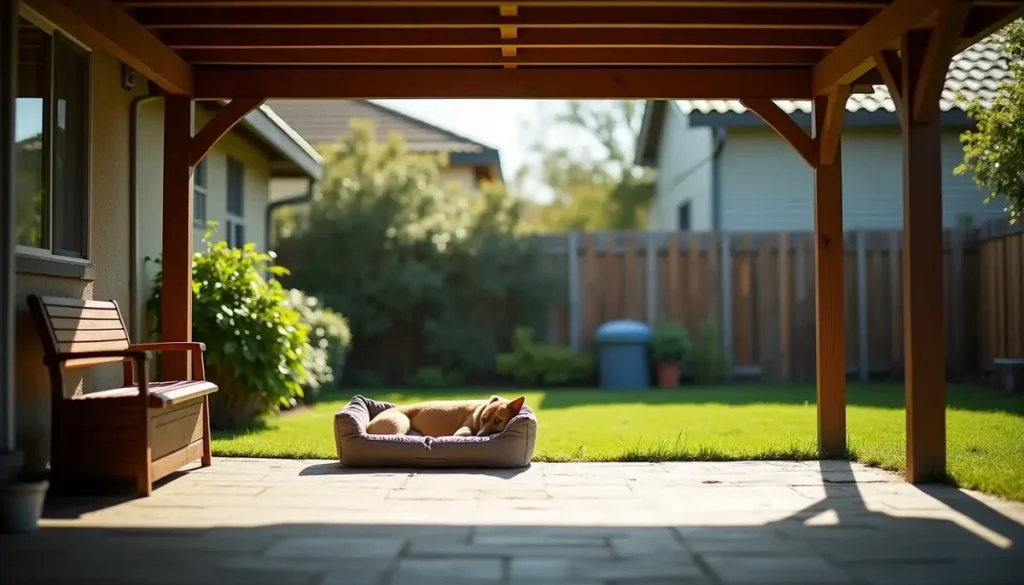
Fleas in the yard live almost entirely in shaded, humid, sheltered spots where pets or wildlife rest, not out on the open sunny lawn. Extension entomologists at UC IPM and the University of Kentucky say it is seldom necessary to treat the entire yard: treat the doghouse, kennel run, under decks, along fences and next to the foundation. Treat every pet at the same time, because without that, yard treatment rarely holds. Keep opossums, raccoons and feral cats from sleeping under the house, since they reseed fleas.
The fact that makes the job manageable: flea larvae are fragile. They need humidity, shade and the dried blood adult fleas drop where an animal lies, which limits them to a handful of spots in most yards.
Where fleas live in a yard, and where they do not
Adult cat fleas, the species on most US dogs and cats, stay on the animal. UC IPM states that adult cat fleas remain on the host where feeding, mating and egg laying occur, and a 2017 review by Michael Rust of UC Riverside notes that mating never occurred off the host. Eggs drop off wherever the animal rests, so the next generation develops in its resting places, not across the lawn.
| Yard spot | Flea risk | Why |
|---|---|---|
| Doghouse, kennel, outdoor pet bed | High | Eggs and flea dirt collect where the animal sleeps |
| Under decks, porches and steps | High | Shaded, humid, sheltered; favoured by pets and wildlife |
| Crawl spaces under the house | High | UC IPM names crawl spaces where feral animals sleep |
| Along fences and next to the foundation | Medium to high | Shade and runs where pets lie and patrol |
| Dense vegetation next to buildings | Medium | Shaded and protected; named by UC IPM |
| Open lawn in full sun | Low | Larvae are unlikely to survive sun exposure |
| Paths and play areas with heavy foot traffic | Low | Larvae are unlikely to survive substantial foot traffic |
UC IPM’s Pest Note on fleas puts it plainly: it is seldom necessary to treat the entire yard or lawn areas, and flea larvae are unlikely to survive in areas with exposure to sunlight or substantial foot traffic. The University of Kentucky says the same, adding that areas in full sun are less preferred for flea development. The University of Georgia’s IPM programme goes further: because larvae prefer shaded areas with high humidity and limited air movement, spraying the entire yard is “wasteful and irresponsible”.
Do fleas live in grass?
Not in sunny, open grass in any number. Short grass in full sun is a poor place for larvae, which UC IPM says need protected places with at least 75 per cent relative humidity to develop. Long, shaded grass against a fence or under a tree where a dog lies is different, and so is a lawn edge beside a shady foundation. If fleas jump on your ankles on the lawn, look for the nearest shaded resting place, not the grass itself. Bites on people are covered in can humans get fleas.
Is it normal to have fleas in your yard?
In warm, humid parts of the country, some outdoor fleas are normal wherever pets or wildlife spend time. Researchers at the University of Florida found cat flea larvae survived outdoors year round in north-central Florida. In California, UC IPM says outdoor populations are most prevalent in coastal areas and other places with moderate daytime temperatures and fairly high humidity, and can become very numerous in shaded, protected areas in the Central Valley.
What is not normal is a yard that keeps reinfesting a treated pet, which usually means an untreated animal is visiting.
Check before you treat: the white sock test
UC IPM advises that outdoor sprays are not necessary unless you find significant numbers of adult fleas, and gives a simple way to check: walk around pet resting areas wearing white socks pulled up to the knee. Fleas jump onto the socks and are easy to see. Walk the doghouse, the deck edge, the fence line and the shady side of the house, and note where the fleas are. Those are the only places that need attention. If you need to confirm that what you caught is a flea, see what fleas look like.
Treat the pet first, or the yard work is wasted
This is the step most yard advice puts last, and it belongs first. UC IPM notes that treating the pet with one of the preferred on-animal products normally prevents reinfestation from outdoor fleas, and that if pets are on spot-on or oral treatments, you will rarely need to spray outdoors. Kentucky calls treatment of the pet an essential step. The University of Georgia puts the reverse case: elimination of fleas from the animal alone is futile if immature fleas in the environment keep emerging and jumping back on.
So the order is: every pet on a veterinary flea product (the product is your vet’s call), then the house, then the outdoor hot spots. The indoor side is covered in our flea life cycle guide.
How to get rid of fleas in the yard
- Find the hot spots with the white sock test.
- Clean out the resting places. Remove and wash or replace outdoor pet bedding, clear debris from the doghouse and kennel, and rake out leaf litter under decks where you can reach.
- Let sun and air in. Larvae need shade, humidity and still air, so trimming dense shrubs against the house and keeping grass short around resting areas makes those spots less suitable. This is a reasonable inference from the biology rather than a tested treatment.
- Block wildlife. Close gaps under decks, porches, sheds and crawl spaces so opossums, raccoons, skunks and feral cats cannot bed down (see below).
- Spot treat only where fleas are. If you use an insecticide, choose one labelled for outdoor flea control and apply it only to the hot spots. The label is the law; keep pets and children off treated areas for the time it states.
- Restrict access to spots you cannot treat, such as the space under a deck, as the University of Georgia advises.
- Recheck in two weeks with the socks; some new adults from protected cocoons are expected.
What kills fleas in the yard fast?
Nothing clears every stage at once. An insecticide spray applied to the hot spots kills the adults and larvae it contacts, but the cocoon, as Kentucky’s extension entomologist puts it, is impervious to insecticides, so fleas keep emerging for a while after any treatment.
Two points matter for anyone buying a yard product. The University of Georgia notes that photostable insect growth regulators (IGRs) are the most effective outdoor treatments, alongside pyrethroids sprayed in the dry shaded areas the animal uses. UC IPM warns that products for killing adult fleas outdoors are somewhat limited because many field populations of cat fleas are resistant to pyrethroids such as permethrin.
The fastest overall result comes from treating pet, house and hot spots in the same week. Call a licensed professional for a heavy infestation, a crawl space you cannot safely enter, or wildlife under the house; costs are in our flea treatment cost guide.
Nematodes for fleas: what the evidence shows
Beneficial nematodes, microscopic worms sold to be watered into soil, are the main biological option. The species used against fleas is Steinernema carpocapsae. The research behind it is real but mostly small scale.
- A 1982 laboratory study by Silverman, Platzer and Rust found the nematode infected cat flea larvae, more so as soil moisture rose (from 2 to 7 per cent in sand), including on turf, and penetrated cocoons to attack pupae.
- A 1995 study by Henderson and colleagues found nematodes applied to soil, sand or gravel containing flea eggs, larvae or pupae reduced adult flea emergence, with sand and gravel results equal to or better than soil.
- The University of Georgia says the nematode has been investigated in several areas of the United States and may reduce flea populations if label directions are followed carefully, but works best in moist sandy soils and may lose effectiveness elsewhere.
Cornell’s IPM programme gives the practical limits: S. carpocapsae is typically effective at soil temperatures of 70 to 85°F, sunlight is extremely detrimental to nematode survival, so apply in early morning or evening, and keep the soil moist before, after and for at least two weeks following application.
Our reading: nematodes suit the shaded, moist hot spots where fleas develop, but are unproven as a whole-lawn cure; Rust’s 2017 review notes there has been little research on controlling outdoor flea populations at all.
Fleas in the yard with no pets
When there are fleas but no pets, wildlife is the usual source. Kentucky’s guidance is that when fleas are infesting a home and no pets are present, raccoons, opossums, skunks or squirrels often are the culprit. The University of Georgia advises controlling access of feral animals, such as skunks, opossums, raccoons and cats, to your yard, and not letting wildlife nest under the home or in outbuildings. Rust’s review lists opossums, raccoons and feral cats as sources of fleas outdoors and as one reason flea problems persist despite treatment.
Our analysis of iNaturalist records shows why this is a year-round risk. These animals are recorded every month of the year.
Raw records of the Virginia opossum peak in April (8,460) and are lowest in June (3,832), but never come close to zero. Raccoon records also peak in April (15,522), and striped skunk records are highest in June and July. These are records of when people photographed these animals, not counts in yards, and raw counts partly reflect how many people are out recording. Still, flea-carrying wildlife does not take a season off, and opossum and raccoon records peak in spring, when UC IPM says flea numbers on pets rise sharply.
A former pet is the other common explanation in a newly bought house. Pupae can wait in the cocoon for months, so fleas can emerge in a shaded spot or a crawl space long after the previous owner’s animal left. For removing the animals themselves, see how to get rid of opossums.
What do fleas hate the most?
Fleas “hate” the conditions that kill their larvae: sun, dryness and disturbance. That is the honest answer, and it is why opening up shaded resting spots does more than any scent. Larvae need humidity; Rust’s review notes they take up water from the air only when relative humidity is above 53 per cent, and UC IPM says development is restricted to places with at least 75 per cent.
Fleas in yard home remedies
The extension record on home remedies is thin and mostly negative. UC IPM reports that neither vitamin B1 supplements nor brewer’s yeast prevents fleas from feeding, and that herbal collars and ultrasonic devices are not effective repellents. The University of Georgia found the same for garlic and warns that most botanical shampoos are more toxic to the pet than to fleas. We found no extension trial supporting dish soap, salt, cedar chips or vinegar sprayed on a lawn. Diatomaceous earth has been used against larvae in carpets, but its record is mixed; see our review of diatomaceous earth evidence.
For a yard treatment that does not harm pets, the choice is between nematodes on the hot spots and a labelled product used exactly as directed, with pets kept off until the label says otherwise. More options are in pet-safe pest control products.
How long do fleas last in the yard?
It depends on the season, the shelter and whether any animal keeps visiting. The best field data come from Kern and colleagues at the University of Florida, who followed immature cat fleas outdoors through a year.
Survival peaked at up to 84.6 per cent from September to November, when temperature and humidity were moderate. From January to March, larval mortality was 91.7 to 100 per cent as cold fronts brought low temperatures and dry air. Development took 20 to 24 days in June and July and 36 to 50 days in winter. Larvae survived light frosts in protected spots such as inside a doghouse and under a mobile home.
The long tail is the cocoon. UC IPM says fully formed fleas can stay in their cocoons for up to 12 months at cool temperatures, and in a UC Riverside study some adults emerged as late as 155 days after the eggs were laid at 15.5°C (about 60°F). So a shaded crawl space can produce fleas for months after the animal that seeded it has gone, although with no host to feed on, adults cannot breed and the population runs down.
Frequently asked questions
Should I treat my whole lawn for fleas?
Usually not. UC IPM and the University of Kentucky both say it is seldom necessary to treat the entire yard, because flea larvae are unlikely to survive in sun or heavy foot traffic. Treat the shaded places where pets and wildlife rest: the doghouse and kennel, under decks, along fences and next to the foundation. The University of Georgia calls whole-yard spraying wasteful.
Do I need to treat the yard if my pet is on flea medication?
Often not. UC IPM says that if pets are on spot-on or oral treatments you will rarely need to spray outdoors, and that treating the pet normally prevents reinfestation from outdoor fleas. Check the resting areas with the white sock test first. If you find many fleas, spot treat those areas; if you find none, leave the yard alone.
Do beneficial nematodes kill fleas?
They can. Laboratory studies show Steinernema carpocapsae infects flea larvae and pupae, including pupae in cocoons, and infection rises with soil moisture. The University of Georgia says the nematode may reduce flea populations if applied as labelled, but works best in moist sandy soils. Apply in the early morning or evening and keep the soil moist, because sunlight kills the nematodes.
Why do I have fleas in my yard but no pets?
Wildlife is the usual source. The University of Kentucky says that when fleas are present without pets, raccoons, opossums, skunks or squirrels are often the culprit. Feral cats are another. Look for animals bedding under decks, sheds or the house, block those spaces, and treat the shaded spots where they slept. A previous owner’s pet can also leave pupae that emerge months later.
Sources
- University of California Statewide IPM Program, Pest Notes: Fleas, Publication 7419, M. K. Rust, September 2010.
- University of Kentucky Entomology, ENTFACT-602, Flea Control and Prevention, M. F. Potter.
- University of Georgia Integrated Pest Management, Cat Flea fact sheet, adapted from UF/IFAS Featured Creatures, 2021.
- Rust, M. K., The biology and ecology of cat fleas and advancements in their pest management: a review, Insects 8(4): 118, 2017.
- Kern, W. H. Jr., Richman, D. L., Koehler, P. G. and Brenner, R. J., Outdoor survival and development of immature cat fleas in Florida, Journal of Medical Entomology 36(2): 207 to 211, 1999.
- Metzger, M. E. and Rust, M. K., Effect of temperature on cat flea development and overwintering, Journal of Medical Entomology 34(2): 173 to 178, 1997.
- Silverman, J., Platzer, E. G. and Rust, M. K., Infection of the cat flea by Neoaplectana carpocapsae, Journal of Nematology 14(3): 394 to 397, 1982.
- Henderson, G., Manweiler, S. A., Lawrence, W. J., Tempelman, R. J. and Foil, L. D., The effects of Steinernema carpocapsae application to different life stages on adult emergence of the cat flea, Veterinary Dermatology, 1995.
- Cornell University Integrated Pest Management, Steinernema carpocapsae, beneficial nematode (Sc) fact sheet.
- The Pest Control Brief analysis of iNaturalist research-grade records, pulled October 2026.