Bird Mites: The Problem That Starts When the Birds Leave
Bird mites bite people only when the birds have gone. While a nest is occupied the mites feed on the birds; when the nestlings fledge or the adults are excluded, the starving mites scatter into the building looking for a host and find the occupants instead. That makes bird control without nest removal the single most reliable way to manufacture this complaint. They cannot complete their life cycle on humans, and the northern fowl mite survives two to three weeks off a bird while the chicken mite can last months in humid conditions.
This is the pest problem most often misdiagnosed in both directions: treated as scabies, as bed bugs, or as delusion, when it is none of those; and occasionally dismissed as delusion when it is real. The sequence of events is what identifies it.
What they are and how small
Two species account for most US complaints. The northern fowl mite reaches about 0.5 mm. The chicken mite, sometimes called the red mite, reaches about 1.5 mm. Kentucky extension describes the field impression accurately: dark slow-moving specks about the size of a full stop.
Colour is a useful tell. Unfed mites are black, grey or white; after a blood meal they may be bright red. People often report “tiny red specks that move”, which is also how clover mites are described, so our guide to clover mites is worth checking if the specks are on a sunny windowsill rather than associated with a nest.
The key structural fact: bird mites cannot burrow into skin. The only mites that do are Sarcoptes, the scabies mites, and those are invisible to the naked eye. If you can see it, it is not scabies.
Why the problem starts when the birds leave
Colorado State puts the mechanism in one sentence: bites of humans in homes usually occur when birds nesting on buildings leave the nest or die, and in the abrupt absence of their bird host the starving mites may scatter and incidentally enter living areas.
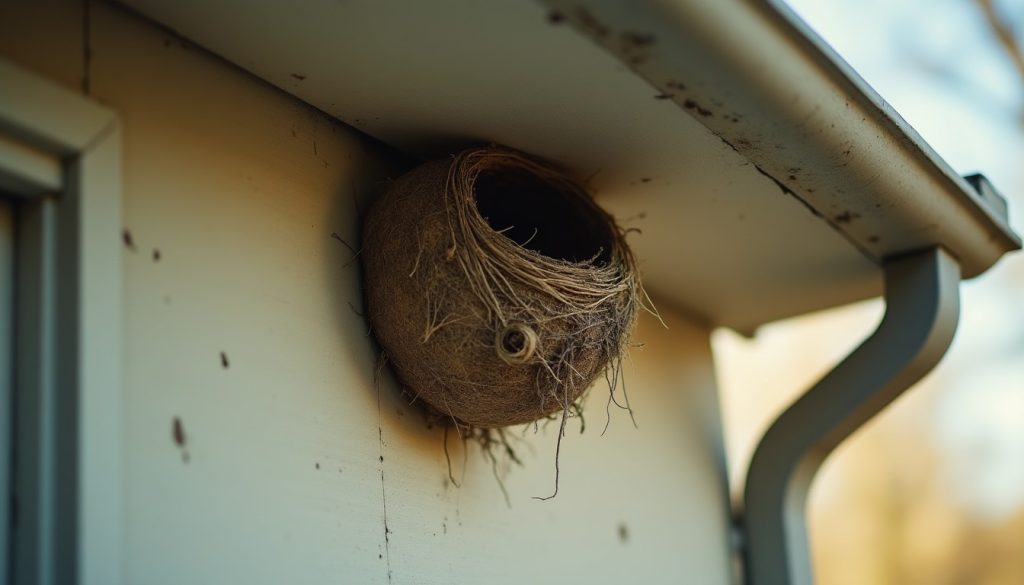
That has a direct operational consequence. Sealing birds out of a soffit, chimney or wall void without removing the nest leaves a population of mites with no host and a building full of people. The bird problem ends and the mite problem begins, usually within days.
This is why nest removal is the treatment rather than an afterthought, and why the two jobs have to be sequenced together. Our guide to bird control costs covers the exclusion side, where cleanup is already the expensive part; the mite risk is another reason it cannot be skipped.
Survival off the host decides how long the complaint runs. The northern fowl mite manages two to three weeks. The chicken mite can last up to eight months above 70 per cent humidity, though the same source expects no more than a month or two in dry indoor winter air.
So an untreated complaint is self-limiting in theory and intolerable in practice, and it does not resolve at all while the nest remains as a reservoir.
They bite, but they cannot live on you
Bird mites will take a blood meal from a person, producing itching and small red marks, often around the waist, wrists and ankles where clothing is close to the skin. The larger chicken mite does this readily; the smaller northern fowl mite is less able to.
Colorado State’s position is that the evidence is clear they cannot sustain themselves and reproduce when humans are the only remaining host. That is the sentence worth telling a frightened customer, and the honest caveat is that a 2015 review in Parasites and Vectors noted evidence of permanent infestations on non-avian hosts and flagged possible host expansion. We would not state the self-limiting rule as absolute.
Telling it apart from the things it is mistaken for
| Bird mites | Scabies | Bed bugs | |
|---|---|---|---|
| Visible? | Yes, dark moving specks | No | Yes, 4 to 5 mm |
| Burrows into skin? | No | Yes | No |
| Premises treatment needed? | Yes, the nest is the problem | No | Yes |
| Trigger | Birds left or were excluded | Person-to-person contact | Introduction on luggage or furniture |
| Where found | Near the former nest, ceilings, light fittings | On the person | Harbourage near the bed |
The history is diagnostic. A complaint that began within days of a bird nest going quiet, with visible specks spreading from a ceiling or a vent, is a bird mite problem. For the bed bug comparison, see our bed bug identification guide.
There is also a genuine risk of over-correcting. Colorado State offers a workable clock: if symptoms persist more than a few weeks after the nest and mites are gone, reconsider; beyond a few months, an alternative explanation must be considered probable. That is the territory covered in our guide to springtails, where the sensation of infestation without an arthropod cause is a recognised medical condition.
But the error runs both ways, and the trade should know it. A 2024 case in the American Journal of Tropical Medicine and Hygiene documented tropical rat mite dermatitis that had been misdiagnosed as delusional parasitosis. A visible specimen settles the question; an assumption does not.
What actually resolves it
- Find and remove the nest. This is the treatment. Soffits, eaves, dryer and bathroom vents, chimneys, window air conditioners, attic gable vents and wall voids.
- Sequence it with the exclusion, never after. Sealing birds out and leaving the nest is what causes the complaint.
- Treat the void and the route at the same time as removal, because disturbing a nest disperses mites immediately.
- Vacuum thoroughly and dispose of the bag outside, then launder affected fabrics hot.
- Dry the space. Survival falls sharply in dry indoor air, so running humidity down shortens the tail.
- Collect a specimen on clear tape before treating. It settles the identification, and it protects both the customer and the company from the misdiagnosis in either direction.
How we did this
Biology, survival figures and the dispersal mechanism come from Colorado State University Extension, which is the most complete published treatment of this problem, with supporting material from University of Kentucky ENTFACT-649 and the University of Georgia’s work on delusory parasitosis.
Two limits. Reported survival figures for the chicken mite beyond eight months appear only in secondary sources and we have not used them. And the question of whether these mites can ever establish on non-avian hosts is not fully settled, so we have reported the mainstream position together with the published caveat rather than flattening it.
Frequently asked questions
Do bird mites bite humans?
Yes, they will take a blood meal from a person, producing itching and small red marks, most often where clothing is close to the skin. They cannot complete their life cycle on humans, so an infestation does not sustain itself once the bird nest is removed, although a 2015 review flagged evidence of persistence on non-avian hosts and the rule should not be treated as absolute.
How long do bird mites live without birds?
The northern fowl mite survives two to three weeks off a host. The chicken mite can survive up to eight months in humid conditions, but in dry indoor winter air the same source expects no more than a month or two. The complaint does not resolve at all while the nest remains as a reservoir.
How do I know if it is bird mites or scabies?
Whether you can see them. Bird mites are visible as dark moving specks about the size of a full stop and cannot burrow into skin; scabies mites are invisible to the naked eye and do burrow. Bird mites also require premises treatment because the nest is the source, where scabies is treated on the person alone.
Why did I get mites after the birds were removed?
Because the mites lost their host. While the nest is occupied they feed on the birds. When the birds fledge, die or are excluded, the mites disperse in search of a host and enter living space. Removing the nest at the same time as the exclusion work is what prevents this.
Sources
- Colorado State University Extension, bird and rodent mites affecting humans.
- University of Kentucky Entomology ENTFACT-649.
- George and colleagues, Parasites and Vectors 8:178, 2015, on host range.
- Hinkle, “Delusory parasitosis,” American Entomologist 46(1), 2000.
- American Journal of Tropical Medicine and Hygiene 110(5):847, 2024, on rat mite dermatitis misdiagnosed as delusional parasitosis.