Fleas in Your Car: How Long They Last and How to Clear Them
Fleas can survive in a car for weeks to months, and clearing them usually takes two to four weeks: treat the pet first, then vacuum seats, mats and boot every other day, because cocoons keep hatching after any single clean. Adult fleas with no animal to feed on die within days, but a cocoon can wait far longer. A hot parked car may kill some larvae, although nobody has tested it on fleas in a vehicle, so treat heat as a bonus. Skip foggers: EPA says they should not be used in small, enclosed places.
The four-week schedule
One deep clean fails on timing. UC IPM notes that sprays do not kill pupae and that fleas keep emerging for about 2 weeks after treatment, and Kentucky calls the cocoon impervious to insecticides.
| When | What to do | Why then |
|---|---|---|
| Day 1 | Start every pet on a vet-chosen oral or spot-on product. Empty the car, lift the mats, slide each seat fully forward and back, and vacuum everything. Launder washable mats, covers and blankets in hot, soapy water. | Kentucky says current products kill adults within 24 hours of them jumping on, which stops new eggs. |
| Days 2 to 14 | Vacuum every other day, the interval Ohio State gives. Bin the contents outdoors in a sealed bag. | Vacuuming brings adults out of cocoons sooner (Kentucky), and this is the main emergence window (UC IPM). |
| Days 7 to 10 | Heavy infestations only: a second application of a spray, if its label permits. | Merck gives this interval, because adults keep emerging from cocoons deep in carpet. |
| Days 15 to 28 | Keep vacuuming. Do not re-spray because you see a few fleas. | Kentucky: expect some for a few weeks or longer. |
| After day 28 | Still seeing adults? Check the home, the yard and every animal that rides in the car. | Kentucky puts possible retreatment at beyond 4 weeks. |
Can fleas live in a car?
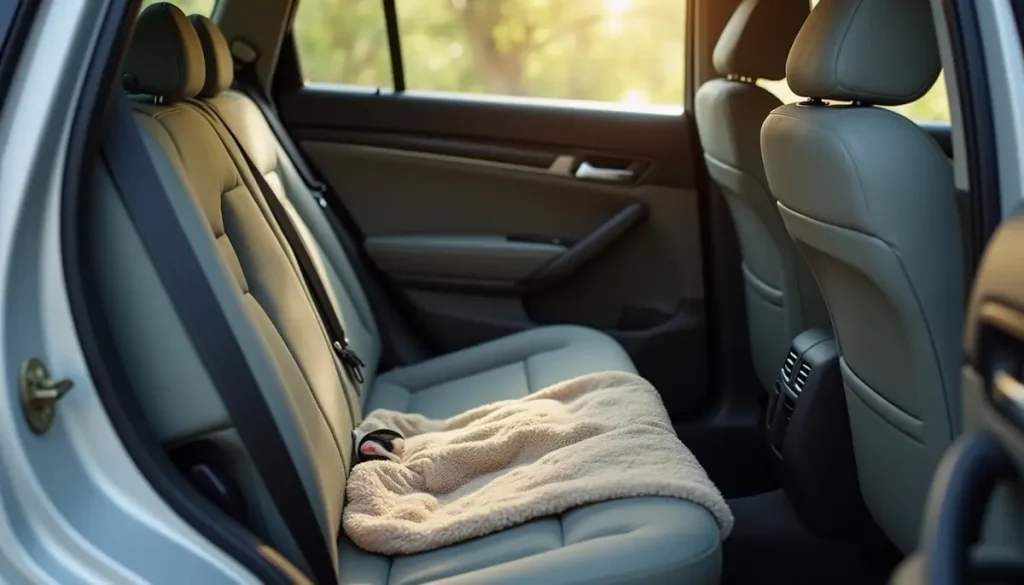
Yes, although we found no study that measured fleas in vehicles, so everything below applies house and laboratory findings to a car. Kentucky reports that a female lays 40 to 50 eggs a day in the pet’s fur, and that they fall off wherever the animal rests. Larvae then feed on flea droppings beneath carpet fibres and cushions. Start with the back seat blanket and the floor below it.
Adults spend most of their time on the animal, again per Kentucky, so a flea biting your ankle at the wheel has usually just left its cocoon. Merck lists the emergence triggers as physical pressure, exhaled carbon dioxide, substrate movement and heat. Our reading, not a measured finding: getting into a car supplies all four within a minute, in a small cabin, so a car that has sat unused may bite hardest on its first drive.
Humidity works in your favour. Merck says prolonged exposure below 50 per cent relative humidity kills larvae, and UC IPM says they develop only where it is at least 75 per cent. Nobody appears to have measured humidity inside car carpet, but a damp footwell mat is a likelier nursery than a sun-dried seat top.
How long can fleas live in a car?
Our estimate from the figures below: about three to four weeks of bites in a car that has lost its pet, potentially months if it is cool and rarely driven. The full survival guide covers the house version, and the flea life cycle page explains each stage.
| Stage | How long with no animal | Source | In a car |
|---|---|---|---|
| Egg | Hatches in about 2 to 5 days; Ohio State says 2 to 14 | UC IPM; Ohio State | Hatches into the carpet |
| Larva | 8 to 15 days; up to 200 when conditions are poor | UC IPM; Maine school IPM | At the base of the pile |
| Cocoon | 1 to 4 weeks; up to 30 weeks if kept from drying; up to 12 months when cool | Kentucky; Merck; UC IPM | Outlasts your cleaning |
| New adult, never fed | About 12 days at 80.6°F and 90 per cent humidity; about 3 days at 50 per cent | Merck | Waits for a passenger |
| Adult that has fed | Egg-laying females under 24 hours; others up to 4 days | San Mateo County MVCD | Dies soon after falling off |
Sources disagree. Texas A&M gives a few days to 2 weeks without a host, close to Merck, while the Maine sheet says 1 to 2 months. The schedule above works under either figure.
Fleas in the car with no pets
A used car that carried someone else’s dog can still hold cocoons. Otherwise, look at borrowed pet blankets, or a home or yard with wild hosts (Merck names raccoons and opossums), and see our guide to fleas in the yard. Check first: Texas A&M describes flea droppings as a fine, reddish-black dust, and bites as small, red, itchy bumps, usually on the ankles and lower legs. Find neither, and try the bite identification guide.
Will a hot car kill fleas?
Possibly some of them, but the evidence stops short. We found no study that placed fleas in a parked car. Here are the separate flea and car figures, compiled side by side.
| Source | Figure | What was measured |
|---|---|---|
| UF and Maine school IPM | Larvae die after 103°F for one hour | Cat flea larvae, room heat treatment |
| Texas A&M | Soil above 95°F kills larvae | Outdoor soil |
| Silverman and Rust, 1983 | Pupae survived outdoors except in July and August, when it often exceeded 35°C (95°F) | Field observation, not a timed lethal test |
| McLaren and colleagues, 2005 | About 40°F above outdoor air within an hour; 117°F on the coolest day | Dark sedan, 16 sunny days, 72 to 96°F outside |
| Vanos and colleagues, 2018 | 116°F air and 123°F seat in sun; 101°F air and 106°F seat in shade | Six vehicles, Tempe, Arizona, about 60 minutes |
So a sun-parked car beats the larval figure, while a shaded car, even in an Arizona summer, reached 101°F air, just under it. McLaren’s team found that windows cracked 1.5 inches made no meaningful difference. Three reasons this is not a treatment:
- Wrong location. Those readings are cabin air and seat tops. School IPM guidance warns that fleas can burrow into carpets and upholstery and perhaps escape lethal temperatures, and we found no reading taken under a mat or seat base.
- Wrong stage. The 103°F figure is for larvae. We found no lethal temperature for a sealed cocoon or an adult, so claims that a hot car kills every stage go beyond the published work.
- Heat is also a wake-up signal. Merck lists heat among the emergence triggers, so a warm car may produce more adults first.
The sensible use: on a clear day, park in full sun with the windows shut, then vacuum once the car has cooled enough to work in. Never leave a child or pet inside, even briefly: these figures come from child heatstroke research.
What about a freezing car?
Merck says no flea stage can survive below 37.4°F for several days, but also that fully formed fleas can overwinter in cocoons in spaces protected from cold. A car left outside through a long freeze may clear itself, but no one has tested that.
What the vacuum does, and what was never tested
The Ohio State study by Hink and Needham killed an average of 96 per cent of adults across six tests, and 100 per cent of pupae (three tests) and third-stage larvae (one test). See our carpet guide. Two caveats apply to cars. The test used a single upright vacuum on carpet, and was partly funded by a vacuum maker, so a cordless handheld or coin-op wand is untested. Removal is also weaker than kill: Texas A&M says vacuuming removes up to 30 per cent of larvae and up to 60 per cent of eggs from carpet, which is why repeat passes matter more than the machine.
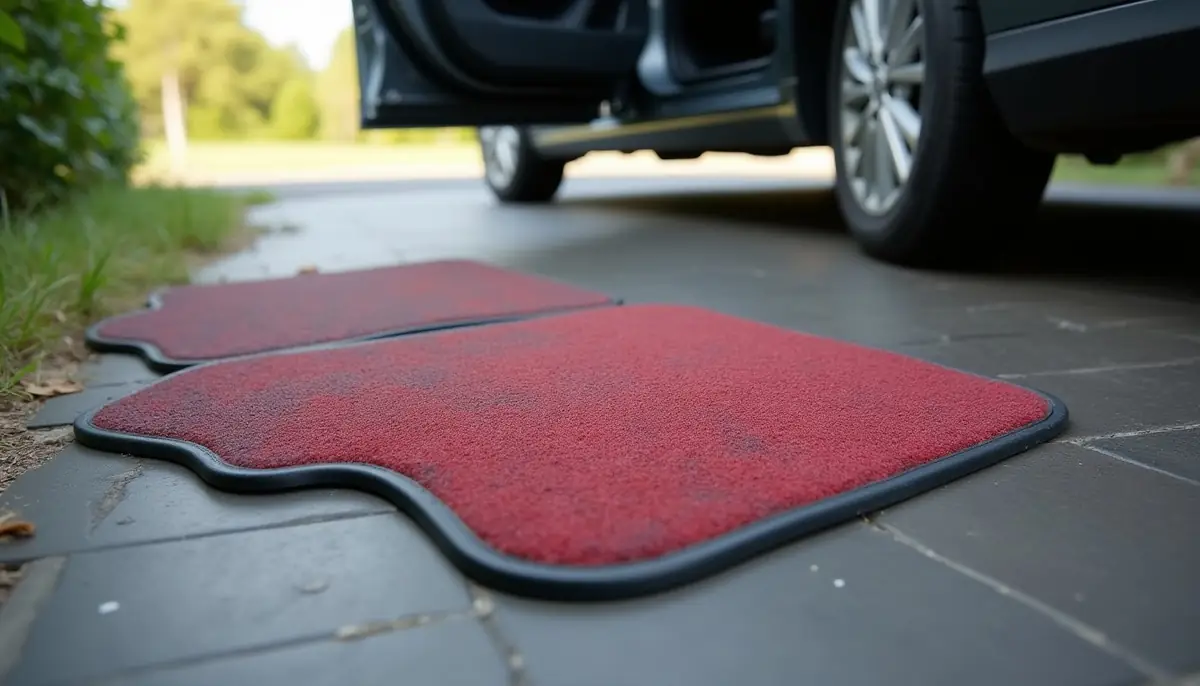
- Spend the most time where the pet rides, then on seat seams, seat rails, the gap beside the console, under the mats and the boot liner (trunk).
- Kentucky says to seal the bag in a garbage bag and use an outdoor bin; Texas A&M warns that fleas can keep developing inside a bag and advises discarding it at least weekly.
What to use in a car, and what to skip
| Method | What the sources say | The catch in a car |
|---|---|---|
| Pet product chosen with a vet | UC IPM prefers spot-on and oral types | Some products should not be used on cats (Kentucky) |
| Steam | Kills adults, larvae and probably some eggs (EPA school IPM manual) | Warmth can hatch remaining eggs a day or two later; test the fabric and dry the car fully |
| Spray with a growth regulator | Kentucky rates an adulticide plus methoprene or pyriproxyfen as most effective; Texas A&M says methoprene is unstable in sunlight | A cabin gets sun. Use only a product whose label allows this use, and stay out until dry |
| Fogger or flea bomb | Kentucky: seldom effective, not recommended. EPA: may explode in small, enclosed places | A car is one. See our fogger illness data |
| Citrus sprays | Evaporate quickly (Texas A&M) | No help against next week’s fleas |
| Salt, baking soda | Not recommended in the guidance we read | Vacuum instead |
| Light traps | For monitoring; will not end an infestation alone (Kentucky) | Best used indoors near pet beds |
Keep all sprays off a child’s car seat. Vacuum the shell and follow that seat’s manual: one Graco owner’s manual, for example, says to spot clean harness straps and never immerse them, because soaking may weaken them.
When the car is only the symptom
A pet that brings fleas into the car usually has a home problem too, and the car will keep reseeding until that stops. Merck puts the typical household cycle at 3 to 8 weeks. Call a professional if adults persist past four weeks despite a treated pet; our flea treatment cost guide gives the prices. For bites that spread or come with hives, speak to a doctor: Texas A&M notes allergic reactions usually appear 12 to 24 hours after a bite.
Frequently asked questions
How to get rid of fleas in car?
Treat every pet with a vet-chosen product on day one, launder washable mats and blankets, then vacuum the whole interior every other day for at least two weeks. UC IPM says adults keep emerging for about 2 weeks after treatment, so keep going. No foggers.
Will fleas from my car spread to my house?
Mostly by riding on an animal. Texas A&M says adult fleas do not usually travel long distances without a host and prefer to wait and jump onto one passing. A pet moving between the two links them, so treat the pet and both places in the same week.
Can I use a flea bomb in my car?
No. EPA says foggers should not be used in small, enclosed places, because the product may explode, and a car cabin fits that description. Kentucky also says total-release foggers are seldom effective against fleas, partly because they often do not reach hidden areas of flea development.
How long should I keep vacuuming the car?
At least two weeks at every other day, then until you stop seeing fleas. Ohio State says vacuuming needs to be regular to work, and UC IPM gives about 2 weeks of emergence after treatment. Kentucky suggests considering retreatment only if adults are still appearing beyond 4 weeks.
Sources
- University of California Statewide IPM Program, Pest Notes: Fleas, Publication 7419.
- University of Kentucky Entomology, ENTFACT-602, Flea Control and Prevention; ENTFACT-643, Limitations of Home Insect Foggers.
- Merck Veterinary Manual, Fleas in Dogs and Cats.
- Texas A&M AgriLife Extension, E-433, Controlling Fleas, Merchant and Robinson.
- Ohio State University Extension, Fleas, HYG-2081.
- University of Florida, School IPM, IPM Action Plan for Fleas; Maine Department of Agriculture, Conservation and Forestry, School IPM fact sheet: Fleas, 2015.
- US EPA, Safety Precautions for Total Release Foggers; US EPA, IPM for Schools manual, chapter 8.
- San Mateo County Mosquito and Vector Control District, Fleas.
- Silverman and Rust, Some Abiotic Factors Affecting the Survival of the Cat Flea, Environmental Entomology 12(2), 1983.
- Hink and Needham, vacuuming of cat flea life stages, Entomologia Experimentalis et Applicata, 2007; Ohio State University news release, December 2007.
- McLaren, Null and Quinn, Heat Stress From Enclosed Vehicles, Pediatrics 116(1), 2005.
- Vanos, Middel, Poletti and Selover, Evaluating the impact of solar radiation on pediatric heat balance within enclosed, hot vehicles, Temperature 5(3), 2018.
- Graco, Owner’s Manual for model 8488, Care and Maintenance.
- Comparison tables compiled by The Pest Control Brief from the sources named above.