Mud Daubers: Harmless Wasps and How to Keep Them Off the House
To get rid of mud daubers, scrape off the mud nests with a putty knife or stiff brush, then screen, caulk or cover the gaps and openings where they build; insecticide is rarely needed. Mud daubers are solitary wasps that do not defend their nests and very rarely sting, and University of Maryland Extension calls knocking nests down the best method of control. Removing old nests also matters because the blue mud dauber reuses them, and larvae inside will otherwise emerge next season.
Mud daubers are the wasps behind the mud tubes and lumps on garage walls, porch ceilings and the underside of decks. They hunt spiders, not people, and around most homes they are a nuisance rather than a hazard. The real problems are where they build: inside grills, dryer and exhaust vents, machinery and, famously, aircraft instruments.
The three mud daubers and their nests
Three species account for most mud nests on US homes. The nest usually identifies the builder faster than the wasp does.
| Black and yellow mud dauber | Blue mud dauber | Organ pipe mud dauber | |
|---|---|---|---|
| Scientific name | Sceliphron caementarium | Chalybion californicum | Trypoxylon politum |
| Look | Black with yellow markings, very long thin waist; females 23 to 25 mm (about an inch) | Metallic blue body and wings | Black, stockier, white “stockings” on the hind legs |
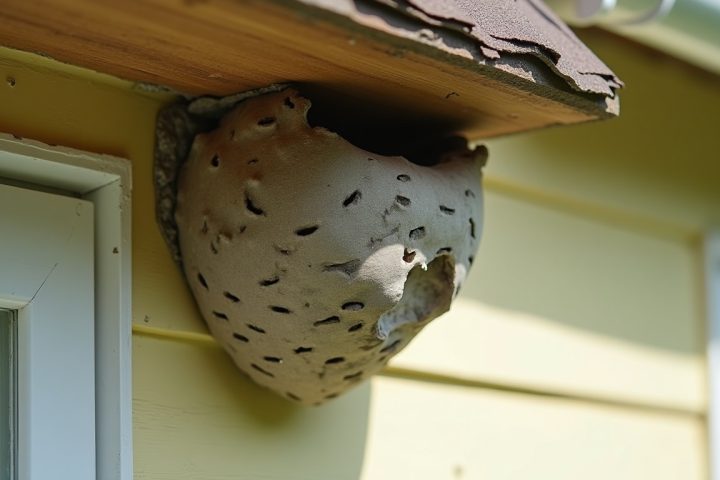
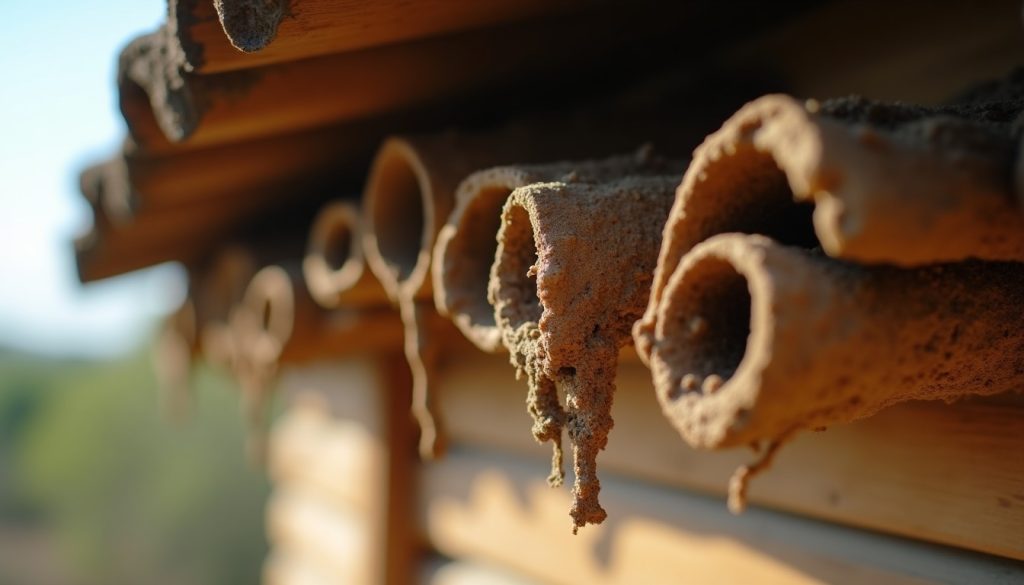
| Nest | Cells side by side, plastered into a smooth lump about the size of a lemon or a fist | Does not build from scratch; renovates old nests of other mud daubers, leaving a patchy, lumpy surface | Long parallel vertical tubes like a pipe organ, on smooth walls and bridges |
| Prey | Spiders, mostly orb weavers and other web builders | Spiders, including black widows in some regions | Spiders, typically orb weavers |
| Generations | More than one a year | Several a year | One or two a year |
Clemson Extension puts mud daubers in general at one half inch to slightly more than one inch long, and UF/IFAS measures black and yellow females at 23 to 25 mm and males at about 21 mm. All three have the long, thread-like waist that separates them from paper wasps and yellowjackets. If the nest is paper rather than mud, our wasp and hornet identification guide will point you to the right insect.
Potter and mason wasps
Small mud nests shaped like a round pot or jug with a narrow neck belong to potter wasps, which hunt caterpillars rather than spiders. University of Maryland Extension treats them the same way: knock the nest down if it is in the wrong place, otherwise leave it.
Do mud daubers sting? Are they dangerous?
They can, but almost never do. UC IPM describes mud daubers as solitary wasps that do not defend their nests and rarely sting, and the Missouri Department of Conservation says females sting people only if mishandled. Each nest is built and stocked by a single female, so there is no colony to rush out when a nest is disturbed, which is the behaviour that makes yellowjackets dangerous.
The sting itself is mild. UF/IFAS notes that black and yellow mud dauber stings are rare and not of medical importance, and that their venom is a fraction of the volume carried by social wasps and lacks the pain-producing compounds those wasps use for defence. Clemson reports the species rated 1, the mildest level, on a sting pain scale running from 1 to 4. The venom is designed to paralyse spiders, not to deter people. Anyone with a known allergy to insect stings should still avoid handling any wasp, and should speak to their doctor about precautions.
The mud dauber’s bigger health footprint may be positive. MDC notes that blue mud daubers use large numbers of black widow spiders, and black widow predation by this wasp has been recorded since the 1930s. A 1987 study in the Journal of Arachnology found the mix varies by region: in eastern Missouri cobweb spiders dominated, while in northern Florida the same wasp mostly took orb weavers. So the black widow habit is real but local. Our spider identification guide shows how to recognise a black widow if you find one in a nest cell.
What keeps mud daubers away?
Prevention works because mud daubers are choosy about sites. UF/IFAS lists the three things a site needs: shelter from the weather, a supply of mud and a supply of spiders. Take away the shelter and they move on.
- Remove every old nest. Blue mud daubers renovate abandoned nests rather than building their own, and Purdue advises scraping nests away to prevent mud daubers emerging the following year. A nest with small round exit holes is empty; one without may still hold overwintering larvae.
- Screen and seal openings. Clemson says screening or caulking openings will prevent nesting. Fit fine mesh over gable, soffit, dryer and exhaust vents, and close gaps around siding, trim and utility lines. Our guide to pest proofing your home covers materials.
- Cover anything with an open tube or hollow. Grill burner tubes, outdoor equipment, unused machinery, hose reels and trailer hitches are typical targets. University of Maryland notes nests plastered inside the motor housings of unused machinery.
- Keep garage and shed doors shut in summer, since open rafters are prime sheltered sites.
- Reduce the spiders. Fewer spiders around eaves means less food for the next generation. Regular brushing of webs from eaves and porches helps.
- Fix standing water near the house. MDC notes that females carry mud balls from the edges of puddles, so a leaking hose bib or a soggy downspout outlet beside the wall is a convenient quarry.
What scent do dirt daubers hate?
None that has been shown to work. Peppermint oil, dryer sheets and similar home remedies circulate widely, but none of the extension publications we reviewed (Clemson, Purdue, UF/IFAS, Maryland, UC IPM) recommends any scent or repellent for mud daubers. Clemson’s fact sheet mentions no repellents at all. Physical measures, removing nests and closing off shelter, are what the published guidance relies on.
How to get rid of mud daubers without killing them
For most homes this is all that is needed. Mud daubers do not defend their nests, so removal is low risk.
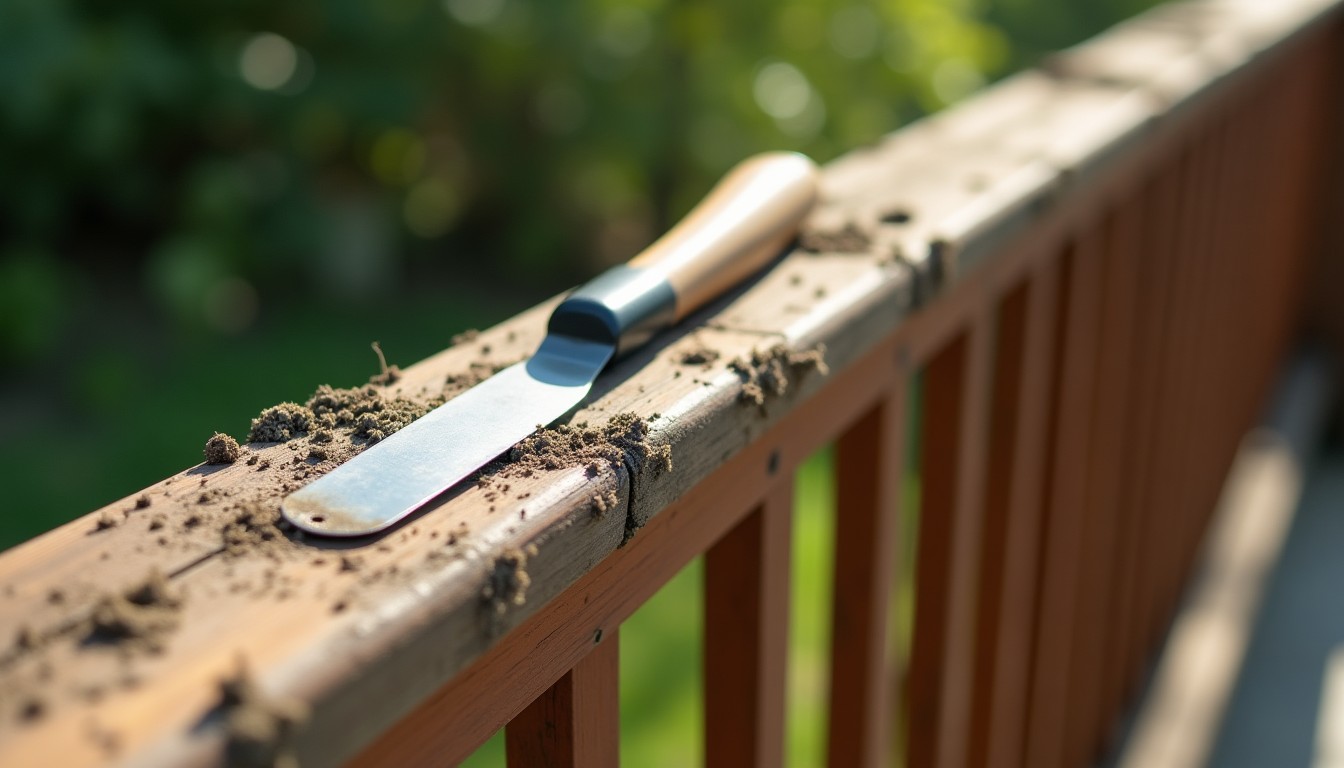
- Scrape the nest off with a putty knife, paint scraper or stiff brush, ideally early or late in the day, since UF/IFAS describes the adults as active by day.
- A strong jet from a hose softens and removes nests on masonry and siding.
- Wear gloves and eye protection; the risk is mostly falling dried mud.
- Then deal with whatever made the site attractive: the gap, the open vent or the sheltered corner.
Nests away from doors and living areas can simply be left. Purdue notes that when mud daubers nest away from where people live or work they can be considered beneficial and controls are not needed.
What kills mud daubers instantly?
A wasp and hornet aerosol labelled for the use, sprayed on the wasp or nest according to the label. Purdue suggests this only where the wasps are a nuisance in living areas, followed by scraping the nest away. Clemson notes that many wasp sprays reach up to 20 feet as a straight stream, which helps with nests under high eaves. A fly swatter works on a single wasp.
In practice, spraying is rarely necessary. Because each female works alone, killing one or two wasps and removing the nests is usually the end of it, and none of the extension guidance we reviewed calls for a general barrier spray around the house. Follow the label on any product; never use foggers, fuel or improvised mixtures, and do not spray into appliances or vents. For anything high, inside a vent stack or around electrical equipment, a licensed professional is the safer option, and our wasp nest removal cost guide shows typical pricing.
Mud daubers in the house, grill or vents
Mud daubers occasionally fly in through open doors or come out of nests built in attics or wall voids. Indoors they are looking for a way out, and opening a window or catching one under a glass is enough. Repeated sightings in the same room can mean a nest in the attic, a vent or behind a loose fixture, with adults emerging from it.
Nests in grill burners and appliance vents deserve attention because they block airflow. The most serious example is in aviation. The FAA’s lessons learned review of the 1996 Birgenair Flight 301 crash, in which all 13 crew and 176 passengers died, records that the black and yellow mud dauber was suspected of blocking the captain’s pitot tube while the aircraft sat on the ground for over 20 days, and that mud daubers have been implicated in several aircraft accidents and numerous incidents. The lesson for a homeowner is modest: if a piece of equipment relies on an open tube or vent, cover it when it is not in use and check it before you start it.
Mud daubers in the ground?
Mud daubers build above ground on sheltered surfaces; they collect mud from the ground but do not nest in it. Wasps going into holes in the lawn are a different group. In midsummer large ones are usually cicada killers, which are also solitary and rarely sting. Digger wasps such as Ammophila also nest in soil. A single hole with heavy traffic, especially in late summer, may be yellowjackets, which do sting in numbers; see our yellow jacket removal guide before going near it.
When mud daubers are active
The Pest Control Brief analysis of iNaturalist research-grade records, pulled October 2026, puts both main species firmly in summer. Measured against everything people record each month, the black and yellow mud dauber rises from an index of 33 in April to 205 in June and peaks at 287 in August, where 100 is its yearly average. The blue mud dauber jumps earlier and harder, from 92 in May to 291 in June, and stays high through August at 273. Both fall below 30 from November to March, when the next generation is sealed inside the nests as larvae or prepupae.
That timing gives a practical rule: late autumn and winter are the best time to scrape off old nests, because nothing inside can fly and anything you remove will not emerge in spring. UF/IFAS notes that adults live only three to six weeks after emerging, which is why activity at any one nest is short even though the season is long.
Frequently asked questions
Should you get rid of a mud dauber nest?
Only if it is somewhere that bothers you or blocks something. Mud daubers rarely sting and eat spiders, and Purdue considers them beneficial when they nest away from living areas. Nests near doors, inside grills, in vents or on equipment are worth removing, and removing old nests stops blue mud daubers reusing them and prevents larvae inside from emerging the following year.
Do mud daubers come back to the same nest?
The builder usually does not, but the nest gets reused. The blue mud dauber renovates abandoned nests of black and yellow and organ pipe mud daubers, bringing water to rework the old mud. Larvae sealed inside an old nest will also emerge as adults the next season, so a nest left in place often means more mud daubers in the same spot.
How do you get rid of mud daubers permanently?
No method is permanent, because new females arrive each summer, but you can make a site unattractive for good. Remove all old nests, screen vents and seal gaps, keep garages and sheds closed, cover grills and equipment, and reduce spiders around eaves. Extension sources rely on these physical steps rather than chemical treatment or repellents.
Is a mud dauber sting painful?
Mildly. UF/IFAS describes the black and yellow mud dauber’s venom as small in volume and lacking the pain-producing compounds in social wasp venom, with negligible pain or swelling, and Clemson reports a rating of 1 on a 1 to 4 pain scale. Stings are rare and happen almost only when a wasp is grabbed or trapped against skin. Anyone with a sting allergy should seek medical advice.
Sources
- Powell, E. and Taylor, L., Black and Yellow Mud Dauber, Sceliphron caementarium, UF/IFAS Featured Creatures EENY-654 (EDIS IN1478, revised 2026).
- Clemson Cooperative Extension Home and Garden Information Center, Mud Daubers: Identification, Habits and Control, HGIC 2512 (revised 2025).
- Gibb, T.J., Mud Daubers, Purdue Extension E-253 (2018).
- University of Maryland Extension, Mud Daubers (updated 2024).
- Missouri Department of Conservation field guide, Mud Daubers.
- Mussen, E.C. and Rust, M.K., Pest Notes: Yellowjackets and Other Social Wasps, UC ANR Publication 7450 (2012).
- Landes, D.A., Obin, M.S., Cady, A.B. and Hunt, J.H., Seasonal and latitudinal variation in spider prey of the mud dauber Chalybion californicum, Journal of Arachnology 15: 249 to 256 (1987).
- Kurczewski, F.E., Reuse of old Trypoxylon politum nest by Chalybion californicum in New York, Entomological News 114(5) (2003).
- Federal Aviation Administration, Lessons Learned from Transport Airplane Accidents: Birgenair Flight 301, Boeing 757-200, TC-GEN.
- The Pest Control Brief analysis of iNaturalist research-grade records, pulled October 2026.