How to Get Rid of Armadillos Digging Up the Lawn
To get rid of armadillos, trap the animal with a cage trap and boards that funnel it in, and fence small beds with a barrier buried well below the surface, because no repellent is registered for armadillos and none has been shown to work. Extension wildlife specialists in Oklahoma, Texas and Florida all put trapping and exclusion first. Cutting back lawn irrigation makes a yard less attractive. Grub treatment rarely solves it and can make digging worse for a while.
The nine-banded armadillo is the only armadillo in the United States. It hunts insects and earthworms by smell, and a watered, soft lawn is exactly what it is looking for. The damage is mostly cosmetic, and the animal is easy to catch once the trap is in the right place.
What works and what does not
| Method | What the extension sources say | Verdict |
|---|---|---|
| Cage trap with funnel boards or wire | Oklahoma State calls it highly effective; Texas A&M says baiting is usually unnecessary when funnels are used | Best single method |
| Fence around a bed or garden | Effective for small areas; impractical for a whole lawn | Works for small, valued plantings |
| Reducing irrigation and fertiliser | Recommended by UF/IFAS and Oklahoma State; moist soil brings food to the surface | Cheap, helps, slow |
| Clearing brush, rock piles and tall grass | Texas A&M: sometimes discourages burrowing | Helps near the house |
| Insecticide to remove grubs and insects | Digging may increase while food runs short; harms beneficial insects | Rarely the answer |
| Repellents, cayenne, vinegar, castor oil | No repellents registered; Oklahoma State says repellents are not effective | No evidence |
| Scare devices and lights | Oklahoma State: scare tactics do not provide relief | No evidence |
| Poison baits | UF/IFAS: illegal and ineffective | Never use |

Is it really an armadillo? Reading the holes
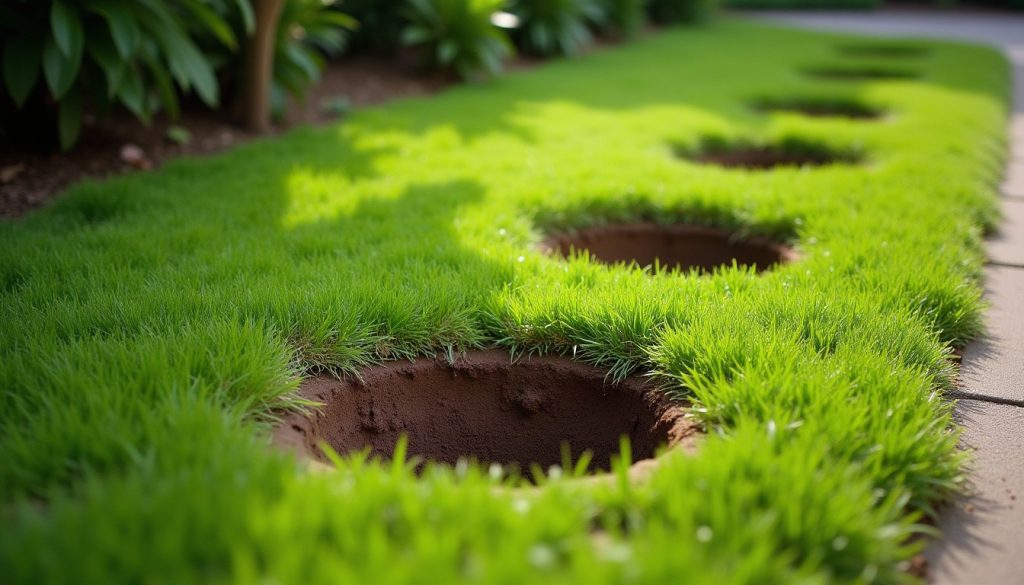
Armadillo damage is a scatter of shallow, cone-shaped holes where the animal has pushed its nose and front feet into soft soil after a grub or worm. UF/IFAS describes these holes as typically 1 to 3 inches deep and 3 to 5 inches wide, and a UF/IFAS baiting study notes that a single armadillo may dig dozens of shallow holes in one night. Oklahoma State gives a slightly deeper figure, usually up to 6 inches, and adds that armadillos often root through loose mulch the way pigs do.
| Animal | What the damage looks like | Key difference |
|---|---|---|
| Armadillo | Many shallow conical holes, uprooted plants, rooted-over mulch | Larger and deeper than skunk holes; burrows 7 to 8 in across nearby |
| Skunk | Small pits in turf | Oklahoma State: usually under 4 in across and under 3 in deep |
| Tree squirrel | Small pits where nuts are cached or dug up | Similar size to skunk pits |
| Mole | Raised ridges and volcano-shaped mounds | Soil is pushed up; no open feeding holes |
If you are seeing raised ridges and mounds rather than open holes, read our guide to moles and voles instead, because the fixes do not overlap. For the insect side of lawn damage, including when grubs genuinely are the problem, see our lawn pest control guide.
Armadillo holes by a foundation or slab
Burrows are different from feeding holes. UF/IFAS and Texas A&M both put burrow entrances at about 7 to 8 inches in diameter and up to 15 feet long, usually under brush piles, stumps, rock piles, dense brush or concrete patios. A UF/IFAS fact sheet adds that one animal keeps an average of ten burrows. Both sources note that burrows under driveways, patios and foundations can cause structural damage, so deal with one against the house promptly. UF/IFAS suggests laying chicken wire along a patio, driveway or foundation to discourage burrowing there.
Step by step: trapping an armadillo
Trapping works through placement, not bait. A UF/IFAS study of 40 captive wild armadillos found they do not notice food until within a few feet of it, and a Georgia study cited by UF/IFAS recorded one capture for every 132 nights a trap was set. Put the trap where the armadillo already walks and steer it in.
- Choose the right trap. Oklahoma State recommends a live catch trap of about 12 by 12 by 32 inches and warns that skunk-sized traps are too small. Texas A&M gives at least 10 by 12 by 36 inches. Doors at both ends double the chance of a catch.
- Set it on the animal’s route. Place it at an active burrow entrance, along a fence, wall or building edge, or where damage is heaviest. Oklahoma State notes that if damage is frequent, a burrow is probably within about 100 yards, usually in wooded or streamside cover.
- Add wings. Run boards, poultry wire on rebar or temporary garden fence out from the trap door in a V. UF/IFAS describes boards 1 by 6 inches by 6 feet. Oklahoma State recommends at least 12 inches of fence with no gap at the trap door.
- Cover the wire floor with fresh soil or leaf litter. UF/IFAS and Oklahoma State both report better capture when the animal is not walking on bare mesh.
- Bait only as an extra. If you bait, worms and crickets did best in the UF/IFAS trial, ahead of eggs, fruit and peanut butter.
- Water the area around the trap. Oklahoma State notes that armadillos are drawn to freshly irrigated ground.
- Check early in the morning. Oklahoma State reports the most activity between 2:00 and 5:00 a.m. in hot summer months.
Wear gloves when handling the trap or animal, as Oklahoma State advises, and keep your face clear: frightened armadillos jump several feet.
What to do with a trapped armadillo
Rules vary by state. In Oklahoma armadillos are unprotected and may be trapped or killed year round, but releasing one elsewhere needs the landowner’s permission. In Florida it is illegal to transport and release them. Texas allows trapping at any time but asks anyone relocating one to notify Texas Parks and Wildlife. Missouri lets landowners use lethal methods on nuisance wildlife causing damage. Florida and Oklahoma specialists advise against relocation anyway, because it moves the problem and can spread disease. A licensed nuisance wildlife control operator will trap and remove the animal for you; our wildlife removal cost guide covers typical prices.
Fencing: how deep and how high
Fencing suits a vegetable garden, a flower bed or a strip along the house, not a whole lawn. The sources differ on the numbers:
- UF/IFAS: about 24 inches above ground, the bottom buried 18 inches, slanted outward at about 40 degrees.
- Texas A&M AgriLife: slanted outward at 40 degrees with at least 18 inches buried.
- Missouri Department of Conservation: sturdy material at least 24 inches high with 8 to 12 inches buried.
- Oklahoma State: more than 12 inches tall should stop most use of small beds, provided it fits closely to the ground.
Where digging pressure is heavy, the 18 inch figure from Florida and Texas is the safer choice. Whatever the height, the fence must sit tight to the ground, because armadillos root under any gap.
Make the yard less rewarding
Damage is worst in summer on irrigated lawns, Oklahoma State explains, because watering softens the soil and draws insects and worms toward the surface. UF/IFAS lists reducing watering and fertilising as the first control method and notes that watering an area away from the lawn can sometimes draw armadillos off. Thirsty cool season grasses such as fescue attract more digging and need reseeding, while Bermudagrass usually fills its own bare spots.
Killing the grubs sounds logical but rarely solves the problem. Both Oklahoma State and Texas A&M warn that digging may temporarily increase as the animal searches for dwindling food, and that soil insecticides harm beneficial insects. Oklahoma State recommends targeting the armadillo rather than the insects unless a specific turf pest is also damaging the lawn. If you do treat a confirmed grub problem, follow the product label exactly.
Repellents: cayenne, vinegar, castor oil and scents
This is where most online advice goes wrong. UF/IFAS and Texas A&M both state that no repellents, toxicants or fumigants are registered for armadillos, and Oklahoma State says repellents are not considered effective for keeping armadillos out of the landscape. We found no university trial showing that cayenne pepper, vinegar, ammonia, mothballs or predator urine keeps armadillos away. The National Pesticide Information Center says mothballs are not meant to be used as animal repellents and have little or no effect as repellents; using them on a lawn goes against the label. Castor oil products are sold on the logic that they work on moles, but mole evidence does not transfer to a different animal.
Do armadillos carry leprosy?
Some do, and the risk to a homeowner is very low. The CDC says some armadillos in the southern United States are naturally infected with the bacteria that cause leprosy, also called Hansen’s disease, and that it may be possible for them to spread it to people, but most people who come into contact with armadillos are unlikely to get it. The CDC adds that around 95 per cent of people cannot get leprosy, and that it is curable.
The strongest evidence of a link is a 2011 study in the New England Journal of Medicine led by the National Hansen’s Disease Program. It found the same distinctive strain of the bacterium in 28 of 33 wild armadillos and in 25 of 39 US patients who lived where armadillo exposure was possible, and concluded that leprosy is probably a zoonosis in the southern United States. The authors advised against frequent direct contact and eating armadillo meat. They also noted that armadillos in the eastern United States, which descend from a separate Florida introduction, were not known to be infected at the time. UF/IFAS publications are not consistent on Florida: WEC 76 reports no infections in more than 2,500 armadillos examined there, while WEC 317 lists Florida, Georgia and Alabama among the states where leprosy has been detected in armadillos.
Wear gloves when filling holes or handling traps. If a skin change worries you, see a doctor and mention any armadillo contact.
Armadillos are spreading north: what our data shows
UF/IFAS puts the northward and eastward expansion at an average of about 7 km a year, limited by cold. The Missouri Department of Conservation says armadillos reached southern Missouri in the mid 1970s to early 1980s and now occupy practically every county south of the Missouri River. To find today’s edge, we counted research-grade iNaturalist armadillo records in nine states per 10,000 observations of anything in that state, which removes iNaturalist’s own growth.
Two patterns stand out. In Missouri, Kansas and Tennessee, armadillos are already established: raw records in Missouri rose from 2 in 2014 to 127 in 2025, yet the rate per 10,000 observations has stayed roughly level, between about 5 and 12 in most years. The real change is at the edge. Kentucky had no research-grade records in 2014 or 2015 and 2.8 per 10,000 in 2025. Indiana had none until 2024, when 4 appeared. Nebraska logged its first 2 in 2025. Ohio has had one, in 2021.
These are sightings, including road casualties, which UF/IFAS notes are common, not population counts, and small numbers swing from year to year. But a state moving from zero records to a steady trickle is a fair signal of arrival: in Kentucky, southern Illinois, Indiana or North Carolina, new shallow holes in the lawn now make an armadillo a plausible suspect. Texans will find the armadillo alongside the insects in our guide to common house bugs in Texas.
When armadillos are most noticed
Our seasonal index tells a story that runs against the damage calendar. Armadillos make up their largest share of US iNaturalist records in December through February, peaking at 176 in February, and their smallest in summer, falling to 54 in August. Oklahoma State explains why: armadillos do not hibernate, and in cold weather they feed during the warm part of the day, so people see them in daylight. In summer they work at night, which is when lawn damage peaks. A summer of fresh holes with no sightings is still an armadillo. UF/IFAS adds that four identical young are born in February or March.
DIY or call a professional?
Most homeowners can catch one armadillo with a correctly sized trap and good funnels. Call a licensed wildlife control operator when the burrow is under a slab, driveway or foundation, when you would rather not deal with a trapped animal, or when digging continues after several catches. Oklahoma State notes that some homeowners, after a few rounds of trapping, decide the damage is tolerable and simply cut back irrigation.
Frequently asked questions
What do armadillos hate the most?
No scent or substance has been shown to drive armadillos off, and UF/IFAS and Texas A&M state that no repellents are registered for them. What armadillos avoid in practice is ground that is hard to dig and poor in food. Reducing irrigation and fertiliser, which keeps worms and insects deeper, is the change extension specialists recommend. A buried, outward-slanted fence keeps them out of small beds.
How to use vinegar to get rid of armadillos?
We found no university trial showing vinegar repels armadillos, and Oklahoma State says repellents in general are not effective for keeping armadillos out of the landscape. Anything sprayed on a lawn also washes off with rain or irrigation. A cage trap set along the animal’s route with boards to funnel it in is the method extension specialists recommend instead.
What scent keeps armadillos away?
None that has been demonstrated. Cayenne pepper, ammonia, mothballs, predator urine and castor oil are all sold or suggested, but UF/IFAS, Texas A&M and Oklahoma State give no support to any repellent. The National Pesticide Information Center says mothballs are not animal repellents and have little or no effect as repellents. Fencing, trapping and drier soil are what work.
How to get an armadillo to leave your yard?
Catch it. Set a cage trap of about 12 by 12 by 32 inches at a burrow entrance or along a wall or fence, add boards or wire as wings to funnel it in, cover the trap floor with soil and check early in the morning. Then reduce watering so the next armadillo has less reason to stop. Check your state’s rules before moving or releasing a caught animal.
Sources
- Oklahoma State University Extension, Tips for Managing Nuisance Armadillo (Dwayne Elmore, Extension Wildlife Specialist).
- UF/IFAS Extension, WEC 76, The Nine-Banded Armadillo (Dasypus novemcinctus), Schaefer and Hostetler, revised 2017 and 2024.
- UF/IFAS Extension, WEC 317, Baiting the Nine-Banded Armadillo, Ober, DeGroote and Mizell, 2011, reviewed 2021.
- UF/IFAS Extension, WEC 411, Wildlife of Florida Factsheets: Nine-Banded Armadillo, Fitzwilliam and Boughton, 2019.
- Texas A&M AgriLife Extension, Wildlife Services, L-1906, Managing Armadillo Damage, 2009.
- Missouri Department of Conservation, Our New Neighbors (armadillos in Missouri).
- Centers for Disease Control and Prevention, About Hansen’s Disease (Leprosy), causes and transmission.
- Truman RW and others, Probable Zoonotic Leprosy in the Southern United States, New England Journal of Medicine, 2011.
- National Pesticide Information Center, Oregon State University, Can I use mothballs to repel insects or animals?
- The Pest Control Brief analysis of iNaturalist research-grade records, pulled October 2026.