Why Are Moths Attracted to Light? What the Research Now Says
Moths are not really attracted to light: a 2024 study found that flying insects tilt their backs toward the brightest thing they can see, a reflex that normally keeps them upright under the sky, and a nearby lamp hijacks it. Instead of flying straight at a bulb, moths circle it, stall or flip over, and stay trapped. The reflex responds most to ultraviolet and blue light, so warm white LEDs and shielded, downward fixtures pull in far fewer moths than incandescent or cool white bulbs.
For more than a century the standard answer was that moths mistake lamps for the moon. That explanation was tidy, widely repeated and, according to the first study to track insects in three dimensions around lights, wrong. Below is what the research measured, why the older theories failed, which bulbs draw the fewest moths, and what that means for a porch light that collects insects every summer night.
| Theory | What it predicts | What the 2024 flight tracking found |
|---|---|---|
| Moon navigation (transverse orientation) | Moths keep the light at a fixed angle and spiral inward | No inward spirals; moths swapped which side faced the light in 25 of 37 light switching trials |
| Escape to the light | Moths fly straight at the light, as at a gap in foliage | Moths rarely headed at the light; flight ran at right angles to it |
| Heat | Hot bulbs attract most | Refuted: LEDs give off negligible infrared yet still trap huge numbers |
| Dazzle or blinding | Random, erratic crashes | Flight followed predictable patterns: orbiting, stalling, inverting |
| Dorsal light response | Moths keep their backs toward the brightest point, which bends their path around a lamp | Supported: backs tilted toward the light in all four species tracked by motion capture |
What the 2024 study actually measured
The paper, by Samuel Fabian, Yash Sondhi and colleagues, appeared in Nature Communications in January 2024. The team filmed wild insects around lights at field stations in Monteverde, Costa Rica, with high speed stereo cameras running at about 500 frames a second under infrared illumination the insects could not see. They collected 477 field recordings across 10 orders of insects, then flew moths and dragonflies in a two metre arena wearing tiny marker frames weighing under 5 per cent of body weight, so a motion capture system could record exactly which way each insect’s back was pointing.
Three abnormal flight patterns showed up again and again:
- Orbiting: a steady circle around the light with the body banked toward it, most common in winds under 1 metre per second.
- Stalling: a steep climb while facing away from the light until the insect loses speed and stops making progress.
- Inverting: flipping upside down when passing directly over a light, followed by a dive toward the ground.
Insects filmed in the dark showed these patterns in fewer than 2 per cent of videos, which is why the authors call them abnormal.
The back tilt in numbers
The researchers scored how closely each insect’s back pointed at the light on a scale from minus 1 (pointing away) to plus 1 (pointing straight at it). Yellow underwing moths scored 0.82 near a light; a common darter dragonfly with the light switched off scored 0.17.
Under natural conditions the brightest part of an insect’s view is the sky, even at night and especially at short wavelengths below 450 nanometres. Keeping the back toward that brightness is a reliable way to know which way is up. A lamp at head height breaks the rule: the brightest point is now beside or below the insect, so it banks, turns around the light, and cannot fly away in a straight line. In simulations, giving a virtual insect this one rule was enough to reproduce all three flight patterns.
The white sheet test
The neatest experiment used an old moth collector’s trick. A UV light shining down onto a white sheet on the ground made insects flip and tumble into the ground. The same light pointed up onto a white sheet stretched overhead created a glowing ceiling, like the sky, and insects flew through underneath normally. Path tortuosity (the length of the flight path divided by the distance actually covered) was a median of 3.21 around a point light and 1.21 under the diffuse canopy. The direction the light comes from matters as much as its brightness.
Why the moon theory failed
The moon idea, still widely repeated, says moths navigate by keeping a distant light at a constant angle. Because the moon is effectively infinitely far away, that keeps a straight course; a nearby lamp should make the same rule produce a spiral into the bulb. Penn State’s 2008 explainer put it this way, and it is an elegant piece of geometry.
The flight data did not fit it. A compass rule should keep the light on the same side of the body, yet when the researchers switched between two lights, insects that had been circling one way swapped direction in 25 of 37 trials. There were no logarithmic spirals. A confused compass cannot explain why insects stall or flip upside down over a lamp. Simulated insects using a corrupted compass mostly escaped the light, while real ones did not.
The moon may still matter at long range, since some insects do use celestial cues to navigate, and the authors did not test how far away moths notice a lamp. One earlier experiment they cite released 50 moths 85 metres from a light and found that only 2 ended their flight there. Lights appear to trap insects that pass close by more than they pull them in from a distance.
Why moths and not butterflies
Mostly because butterflies are flying in daylight, when the sky is the brightest thing around and the reflex works as intended. The dorsal light response is a basic flight reflex, so the study found it in day flying dragonflies too: put a lamp in a dark room and they orbit it like moths. The authors also note that the largest insects, including butterflies, can lean on passive stability to stay upright, which may make them less dependent on light for orientation.
Not every moth is equally affected. Oleander hawkmoths in the lab flew over upward facing UV and white bulbs without circling, scoring 0.24 on the tilt index, although hawkmoths are caught readily at lights in the field. Clothes moths are a different case altogether: University of California IPM describes them as weak flyers that are not attracted to lights, which is why they stay in the dark corner of a wardrobe rather than at the window. If the moths you are seeing are indoors near wool or in the pantry, see our guide to moth treatment and what it costs instead.
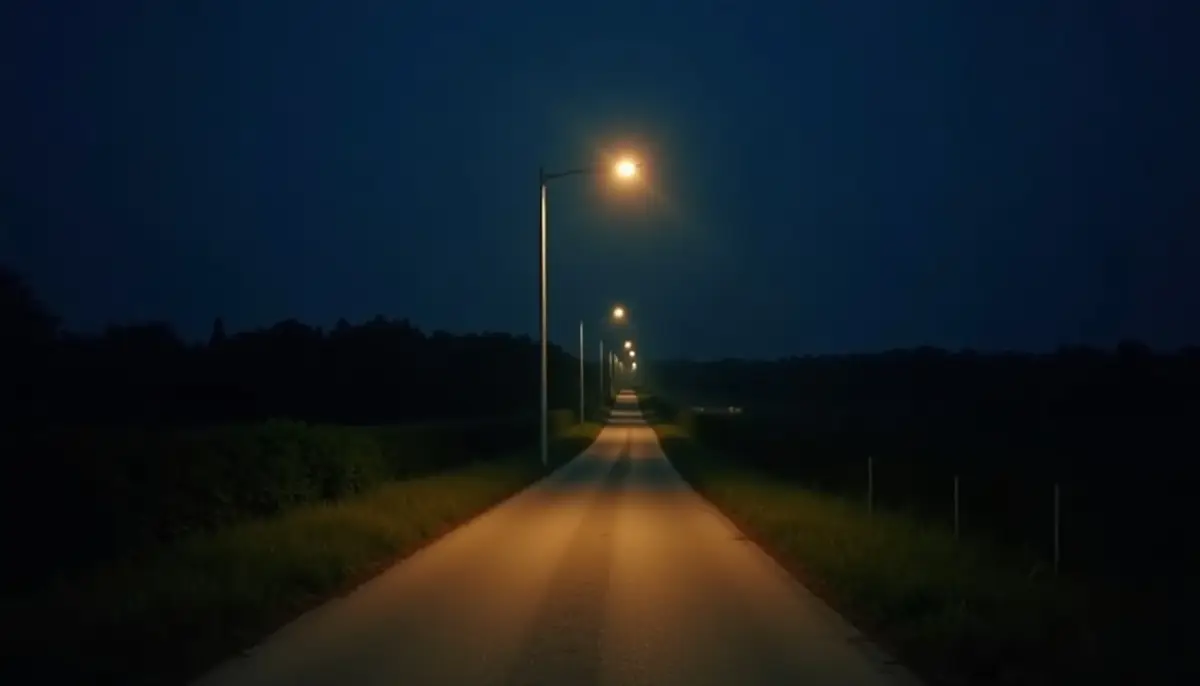
Which lights attract the fewest moths
Short wavelengths are the problem. A Dutch field study by van Langevelde and colleagues in 2011 caught more moth species and more individual moths at lamps emitting shorter wavelengths, and those lamps drew larger moths with bigger eyes. University of Florida entomologists describe luna moths as strongly attracted to light, particularly ultraviolet.
For porch lights, the most useful single study compared six ordinary household bulbs of the same brightness (790 to 800 lumens) in a light trap in Appomattox, Virginia, over 156 nights from April to September 2014. Michael and Teresa Justice posted it as a preprint in 2021, so it has not been through peer review, but it is the longest head to head test of retail porch bulbs we found, and it extends a shorter 2016 study by the same authors that also found LED lamps caught the fewest insects.
| Bulb (same brightness) | All insects caught per hour | Moths caught per hour | Earwigs caught per hour |
|---|---|---|---|
| Incandescent, 2850 K | 8.18 | 1.16 | 0.01 |
| Compact fluorescent, 3500 K | 6.73 | 0.65 | 0.09 |
| Halogen, 2900 K | 5.78 | 1.02 | 0.03 |
| Cool white LED, 5000 K | 5.08 | 0.32 | 0.06 |
| Warm white LED, 3000 K | 4.47 | 0.26 | 0.07 |
| Yellow “bug” compact fluorescent | 4.56 | 0.16 | 0.48 |
Two results stand out. Moth catches under the warm LED and the yellow bug light were roughly a quarter or less of the incandescent rate. And the yellow bulb, sold as the insect friendly choice, caught far more earwigs than any other bulb and about twice as many true bugs (Hemiptera) as the warm LED. Across all insects, the warm white LED caught the fewest.
Colour temperature on the box is a rough guide, not the whole story. A Los Angeles County study led by Travis Longcore in 2015 caught 5,579 arthropods over 32 nights and found that custom 2700 K LEDs with less blue output were 20 to 21 per cent less attractive than commercial LEDs of the same 2700 K rating. Two warm bulbs can still differ.
What moths do not like, in practical terms
- Long wavelengths: warm white, amber or yellow output rather than cool white or anything sold as daylight.
- Light that comes from above: fully shielded fixtures that point down, rather than bare bulbs, uplights or lights that bounce off pale paving.
- Darkness when no one needs it: a motion sensor or timer leaves fewer hours for insects to gather.
The Fabian team’s own conclusion was that reducing unnecessary, unshielded, upward facing lights and ground reflections can lessen the impact on flying insects at night.
Porch lights, open doors and the bugs that follow
A lit porch does more than collect moths. Washington State University Extension notes that moths drawn to lights at night are often found resting near the light source come dawn, and anything gathered at a door has a short trip inside. June beetles collect under the same bulbs in early summer (see how to get rid of June bugs). Texas A&M AgriLife calls outdoor lighting the most important single cause of severe cricket infestations around homes, and says reducing outdoor lights is the first step in cricket control (see what attracts crickets). The earwig result in the bulb study is a reminder that a bulb swap can change which insects arrive, not only how many. Earwigs have their own guide at earwigs.
Electric zappers use this same light response, usually ultraviolet, to lure insects; our review of whether bug zappers work covers the trial data on what they actually kill. If small insects are getting past the door, our guide to small flying bugs in the house helps sort gnats, drain flies and moths.
When moths are on the wing
Our analysis of US iNaturalist research grade records shows moth sightings building through spring and peaking from July to September. Sphinx moths reach more than twice their usual share of all records in July and August, and owlet moths (Noctuidae) peak in September. Many of these records are photographs taken at porch lights and moth sheets, so the chart tracks when moths are flying and being noticed, which is when lights collect the most.
The same pattern means the cheapest fix, turning off or swapping outdoor lights, matters most from midsummer into early autumn.
Why the light question matters beyond the porch
Light at night affects moth numbers, not only their behaviour. A study by Douglas Boyes and colleagues in southern England in 2021 compared caterpillar counts at lit and unlit sites. Hedgerows under streetlights had 47 per cent fewer moth caterpillars, and grass margins 33 per cent fewer, with white LED streetlights showing stronger effects than yellow sodium lamps.
Some moths are flower pollinators, according to Washington State University Extension, and bats and birds eat them; the University of Maryland Extension notes that very few are truly pests. For most homeowners the light switch is the most effective moth control there is.
Frequently asked questions
Why are moths attracted to light at night?
They are not drawn to it in the usual sense. Flying insects keep their backs toward the brightest part of their view, which under a natural sky keeps them upright. A nearby lamp becomes the brightest point, so moths bank toward it, circle, stall or flip over and cannot fly away in a straight line. This dorsal light response explanation comes from 3D flight tracking published in Nature Communications in 2024.
Why shouldn’t you touch moths?
Mainly for the moth’s sake. Washington State University Extension notes that thousands of microscopic scales cover moth wings and rub off like dust in your hand, and advises keeping contact with the wings to a minimum. Adult moths have no biting mouthparts; most feed only on nectar or pollen, and some, such as luna moths, have vestigial mouthparts and do not feed at all. If you need to move one, coax it onto paper.
Is it okay to sleep in a room with a moth?
Yes. Adult moths that fly in from outside do not bite, sting or feed on people, and most will settle on a wall or ceiling once the lights go off. Turn the lights out and open a window, or catch it under a glass and release it outside. The exception worth checking is small, fluttering moths that stay near wardrobes or food cupboards, which can signal clothes moths or pantry moths breeding indoors.
What do moths hate most?
There is no scent or spray with good evidence for repelling outdoor moths. What reliably reduces them is light choice: in a 156 night trial, warm white LED and yellow bulbs caught about a quarter or less as many moths per hour as incandescent bulbs, and shielded, downward facing fixtures cause less disruption. For clothes moths, UC IPM says little is known about herbal repellents and calls cedar debatable; vacuuming, laundering and freezing items for several days below 18°F work.
Why do moths fly at your face at night?
Probably not because of you. If you are standing near a porch light, holding a phone or wearing a head torch, you are close to the brightest point in the moth’s view, and its back tilting reflex steers it in tight, unpredictable loops around that light. Some of those loops pass your face. Moving the light away from your head usually stops it.
Sources
- Fabian, Sondhi, Allen, Theobald and Lin, Why flying insects gather at artificial light, Nature Communications 15, article 689, 2024.
- Justice and Justice, Insect attraction to the six major types of traditional style residential light bulbs and implications for insect survival and light pollution, bioRxiv preprint 2021.05.06.442978, 2021.
- Longcore and colleagues, Tuning the white light spectrum of light emitting diode lamps to reduce attraction of nocturnal arthropods, Philosophical Transactions of the Royal Society B, 2015.
- van Langevelde, Ettema, Donners, WallisDeVries and Groenendijk, Effect of spectral composition of artificial light on the attraction of moths, Biological Conservation 144, 2011.
- Boyes and colleagues, Street lighting has detrimental impacts on local insect populations, Science Advances, 2021.
- Washington State University Extension FS296E, The Larger Moths Found in Washington State, 2018.
- University of Florida IFAS Featured Creatures EENY-411, Luna moth, Hall and Rhodes.
- University of California Statewide IPM Program, Pest Notes: Clothes Moths, Publication 7435, 2013.
- University of Maryland Extension, Moths in the Landscape, 2023.
- Texas A&M AgriLife Extension, Insects in the City, Cricket control in the fall, ENT-2003.
- Penn State, Probing Question: Why are moths attracted to light?, 2008.
- The Pest Control Brief analysis of iNaturalist research grade records, pulled October 2026.