What Attracts Ticks to You and Your Yard

Ticks are attracted to the carbon dioxide you breathe out, your body heat, skin odours such as ammonia and lactic acid, and movement, and they reach your yard on the deer, mice and other animals that carry them. They cannot jump or fly. They wait on low vegetation, front legs outstretched, and grab whatever brushes past. In a yard, what draws them is shade, humidity and leaf litter at the woodland edge: in a CDC study of 67 New York properties, 67 per cent of ticks, nearly all blacklegged, were in woods and only 2 per cent on lawns.
Most guides stop at a list of cues. The useful questions are which cues matter most, whether the blood type and clothing colour claims stand up, and which parts of a yard actually hold ticks.
What attracts ticks, and how strong the evidence is
| Attractant | What the research shows | Strength of evidence | What you can do |
|---|---|---|---|
| Breath (carbon dioxide) | Connecticut’s tick handbook lists carbon dioxide first among host odours; a long-range cue | Strong | Nothing practical; rely on repellent and treated clothing |
| Body heat | Lone star and American dog ticks located a human from several metres away by radiant heat in a 2019 study | Good, one key lab study | Repellents disrupted heat sensing in the same study |
| Skin and sweat odours | Ammonia, lactic acid and other body odours are named host cues | Strong | Shower within two hours of coming in |
| Movement, vibration, shadow | CDC lists vibrations; some species recognise a shadow | Moderate | Stay in the middle of trails |
| Deer and mice in the yard | Deer feed adult blacklegged ticks; white-footed mice are the main Lyme reservoir | Strong | Deer fencing, rodent-proofing, move bird feeders and woodpiles |
| Shade, humidity, leaf litter | Nymphs die within days in dry air but survive months in humid air | Strong | Clear leaf litter, open up shade, wood-chip border |
| Light-coloured clothing | One Swedish field study found more ticks on light clothing | Weak, one study, one European species | Light clothing still makes ticks easier to spot |
| Blood type A | A pilot lab study of 100 nymphs found group A most chosen, B least | Very weak | Nothing; prevention is the same for everyone |

How ticks find a host: questing
Ticks hunt by waiting. CDC describes it plainly: ticks find their hosts by detecting animals’ breath and body odours, or by sensing body heat, moisture and vibrations, and some species can even recognise a shadow. They rest on the tips of grasses and shrubs in a position known as questing.
The Connecticut Agricultural Experiment Station’s Tick Management Handbook adds the detail: a questing tick clings on with its third and fourth pairs of legs, holds the first pair outstretched and waves them at an approaching host. Because they dry out more easily, larvae and nymphs generally stay in low vegetation, while adults may quest higher up.
That is why most bites start low. The Minnesota Department of Health notes that blacklegged ticks quest from low-lying vegetation and shrubs, not from trees, attach near ground level and then crawl upwards to find a place to bite. A tick on your scalp almost always climbed there from your ankle.
What attracts ticks to humans
Breath and carbon dioxide
Carbon dioxide is the long-range signal. A 2024 University of Kentucky review classes it, with hydrogen sulphide, as a long-range volatile, with heavier fatty acids and skin lipids working at short range.
Breath composition may matter too. In a 2019 University of Illinois experiment, 20 pairs of men and women breathed into opposite ends of a tube holding 10 adult lone star ticks, and significantly more ticks moved towards the women’s breath. It is a single laboratory study, interesting rather than practical.
Body heat
Earlier work had concluded ticks did not use radiant heat at a distance. A 2019 study by Carr and Salgado found otherwise: lone star and American dog ticks located a human from several metres away by radiant heat, sensed by a pit in Haller’s organ called the capsule. The same study found that low concentrations of DEET, picaridin, 2-undecanone and nootkatone switched off this heat-seeking without affecting smell, which may help explain how repellents work.
Sweat and skin odour
The Connecticut handbook names ammonia, lactic acid and other specific body odours alongside carbon dioxide. The observation is old: a century ago the biologist Jakob von Uexküll wrote that the odour of butyric acid works on the tick as a signal to find a host.
Do ticks like certain blood types?
The evidence is thin. The study usually cited is a 2018 pilot from Masaryk University in the Czech Republic, which offered 100 nymphs of the European castor bean tick a choice of human blood samples in Petri dishes. The ticks were attracted most by group A and least by group B, a statistically significant difference. But it was an in vitro test of one European species, with no skin, breath or heat involved.
Does clothing colour matter?
Possibly, though not in the direction most people assume. In a 2005 study by Swedish researchers, 10 participants walked through tick areas wearing light and dark clothing in turn. Light clothing collected significantly more ticks, 20.8 more per person on average, and every participant had more ticks on light clothing in every period. The authors concluded dark clothing seems to attract fewer ticks.
Two cautions: the study used a European tick, and ticks are far easier to see on light fabric, which is why the Minnesota Department of Health shows its field staff dressed in white. Colour is a minor factor either way; permethrin-treated clothing, covered below, is what changes outcomes.
What attracts ticks to your yard
Ticks are carried into yards by animals and survive only where the air near the ground stays humid. The clearest picture comes from a CDC study of 67 residential properties in Westchester County, New York, which sampled 1,790 ticks across four habitat types.
Larvae were concentrated in the woods, but nymphs and adults were spread through every habitat, and larger properties of half an acre or more had more ticks because they were more likely to include woodlots. The Connecticut handbook adds that within the lawn itself, 82 per cent of ticks were within 3 yards (about 9 feet) of the lawn edge, particularly along woodland, stone walls and ornamental plantings.
| Yard feature | Why ticks are there | What extension services advise |
|---|---|---|
| Woodland and unmown edge | Shade, leaf litter, humidity, wildlife | Keep play areas, decks and patios away from yard edges and trees |
| Leaf litter | Holds moisture; insulates ticks through winter | Remove it, especially along the lawn perimeter |
| Lawn edge within 9 feet of woods | Where 82 per cent of lawn ticks were found | A 3-foot wood chip or gravel barrier between lawn and woods |
| Stone walls and woodpiles | Shelter rodents and chipmunks that feed young ticks | Stack wood neatly in a dry area; clear brush around walls |
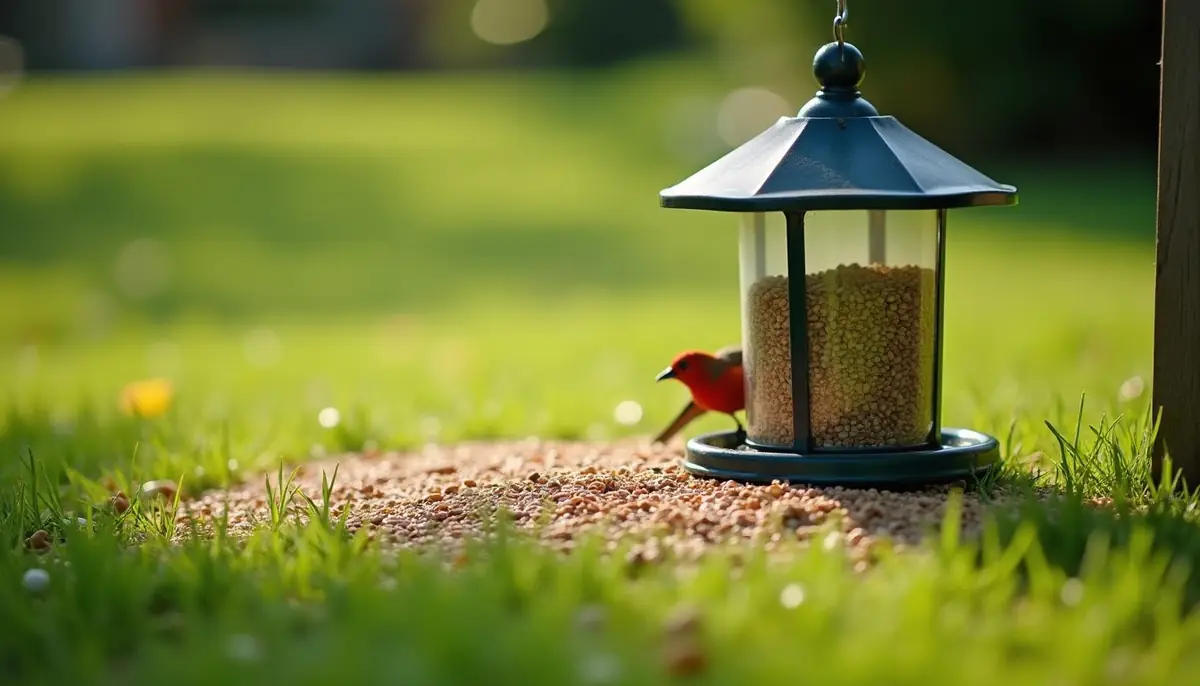
| Bird feeders | Spilled seed can attract mice; feeders were not a Lyme risk factor in one study | Place feeders away from the house, clean up spilled seed, feed in autumn and winter |
| Japanese barberry thickets | Blacklegged nymphs and adults about twice as abundant as under native shrubs | Replace invasive shrubs with native ones |
| Groundcovers such as pachysandra | Dense, shady and humid | Avoid near porches, paths and the mailbox |
| Deer browsing | Deer feed adult blacklegged ticks | Fencing; deer-resistant plantings help only if deer stay away |
Deer and mice: the animals that bring ticks in
The Connecticut handbook calls the white-footed mouse the principal reservoir of the Lyme disease bacterium and white-tailed deer the principal host of adult blacklegged ticks. Mice infect the young ticks; deer feed and carry the adults that lay the next generation’s eggs. Lone star ticks differ: the handbook notes that rodents do not appear to be important hosts for their immature stages, which feed on raccoons, rabbits, opossums, foxes and birds instead.
Deer exclusion works at scale. The handbook reports that fencing deer out of 15 to 18 acres with a slanted electric fence reduced blacklegged nymphs by as much as 84 per cent from about 70 yards inside the fence, though small animals and ticks still pass under a deer fence. Our guide to getting rid of deer in your yard covers fence heights and repellents in detail.
Humidity, shade and leaf litter
Humidity sets the limits. In laboratory work cited by the Connecticut handbook, blacklegged nymphs survived for over 6 months at 93 to 100 per cent relative humidity, but over half died in less than 4 days at 65 per cent.
Leaf litter also explains a regional puzzle. A University of Rhode Island team reported in 2017 that southern blacklegged nymphs tend to quest below the leaf litter surface, while northern nymphs climb above it, which may mean fewer human encounters in the south. In Maine, a 2022 field study found snow cover and leaf litter both improved overwinter survival of nymphs.
Fewer ticks in a yard does not guarantee fewer bites. A large controlled trial found that a barrier spray cut questing ticks without measurably reducing human tick encounters or illness, which we cover in whether yard tick spraying works. Typical prices for treatment are in our tick control cost guide.
What attracts ticks to dogs
Dogs give off the same cues as people and push through exactly the low, damp vegetation where ticks quest. UF/IFAS notes that adult American dog ticks readily feed on dogs or other larger animals when available, and the Connecticut handbook names dogs as the preferred host of the adult American dog tick.
The brown dog tick goes further. UF/IFAS says dogs are its preferred host in the United States and the tick can complete its whole life cycle indoors where a dog lives. The Kentucky review notes researchers have begun identifying canine-derived compounds the tick responds to. Ask a vet about tick preventives, check dogs after walks, and remember that a tick that drops off a dog in the house can attach to a person later.

What attracts ticks in your house
Almost nothing inside a home attracts outdoor ticks. CDC notes that ticks ride into the home on clothing and pets, then attach to a person later. The common outdoor species dry out indoors without breeding; our guide to whether ticks can live in your house covers the exceptions, brown dog ticks and soft ticks, and our guide to bugs that look like ticks covers the beetles often mistaken for them.
Which tick is drawn to you depends on where you live
The species in your yard decides which diseases are in play. Our analysis of iNaturalist research-grade records in three states shows how sharply that changes.
In Pennsylvania, blacklegged and American dog ticks are recorded at about 16 per 10,000 insect records each, with lone star ticks far behind. In Florida the lone star tick dominates at 9.1. Texas records all three at low rates. These are sightings, not infestation counts, but they match the ranges extension services describe. Our tick identification guide separates the species and their markings.
Timing differs by species too. All ticks together peak in May, at an index of 227. American dog ticks reach 368 in May and lone star ticks 341, while blacklegged tick records peak in November at 251, with a smaller spring peak in March at 165, when adults are questing. CDC adds that blacklegged nymphs, the stage most likely to spread Lyme disease, quest from April through July.
What keeps ticks away from humans
The measures with trial evidence behind them act on the person, not the yard.
- Permethrin-treated clothing. In two double-blind trials of outdoor workers, factory-treated clothing cut bites by 82 per cent (North Carolina) and 65 per cent (Rhode Island and Massachusetts) in the first year, with smaller effects in year two. In a small indoor study, volunteers in treated sneakers and socks were 73.6 times less likely to be bitten than those in untreated footwear. CDC recommends products containing 0.5 per cent permethrin for clothing and gear, which stay protective through several washings. Follow the label: these products are for fabric, not skin.
- EPA-registered repellent on skin. CDC lists DEET, picaridin, IR3535, oil of lemon eucalyptus, para-menthane-diol and 2-undecanone.
- A shower and a dryer. CDC says showering within two hours of coming indoors has been shown to reduce the risk of Lyme disease, and tumble drying dry clothes on high heat for 10 minutes kills ticks on them.
- A full tick check the same day, of people, pets, coats and daypacks. Our guide to how long ticks live explains why an unfed tick on clothing can still bite days later.
Ticks are medical as well as pest problems. If a rash or fever follows a tick bite, CDC advises seeing a doctor and mentioning the bite, when it happened and where you were.
Frequently asked questions
What smell do ticks hate most?
No household smell has been shown to protect people the way EPA-registered repellents do. CDC lists DEET, picaridin, IR3535, oil of lemon eucalyptus, para-menthane-diol and 2-undecanone. Cedarwood oil repelled blacklegged and brown dog ticks more readily than lone star and American dog ticks in laboratory strip tests, according to a 2024 review; our review of yard tick spraying covers how plant-oil yard products performed. Nootkatone, a compound found in grapefruit skin and Alaska yellow cedar, was registered by EPA in 2020.
What kills ticks immediately?
Nothing safe for home use is truly instant. For a tick on you, CDC advises pulling it out with fine-tipped tweezers, then killing it in alcohol, a sealed container, wrapped tightly in tape, or by flushing it. For ticks on clothing, a CDC study found all nymphs and adults died after 4 minutes in a dryer on high heat with dry towels, and CDC’s current advice is 10 minutes. Most ticks survive cold and warm washes.
What’s the worst month for ticks?
For most of the eastern US, May. In our analysis of iNaturalist records, ticks as a group peak in May, with American dog ticks at more than three and a half times their usual share of records and lone star ticks close behind. Blacklegged nymphs, the main Lyme risk, quest from April through July, and blacklegged adults peak again in October and November.
Why am I suddenly finding ticks in my house?
Usually because it is spring or early summer and ticks are riding in on pets, clothing or bags. The outdoor species dry out and die indoors within days to weeks. If you keep finding ticks on an indoor dog, on walls or curtains, or small and large ticks together, suspect brown dog ticks breeding indoors, which UF/IFAS says usually needs professional treatment alongside treating the dog.
Are ticks attracted to certain blood types?
Only one small study suggests it. A 2018 Czech pilot found 100 nymphs of a European tick chose blood group A most and group B least when offered blood samples in dishes. It involved no breath, heat or skin, the cues ticks actually use to find people, and has not been repeated with American ticks. Time spent in tick habitat matters far more than blood type.
Sources
- Centers for Disease Control and Prevention, About Ticks and Tickborne Disease; Preventing Tick Bites, including yard advice; Removing a Tick; How Lyme Disease Spreads.
- Stafford KC III, Tick Management Handbook, Bulletin No. 1010, Connecticut Agricultural Experiment Station, revised 2007.
- Maupin GO, Fish D, Zultowsky J, Campos EG, Piesman J, Landscape ecology of Lyme disease in a residential area of Westchester County, New York, American Journal of Epidemiology 133(11), 1991.
- Minnesota Department of Health, Ticks: Blacklegged Tick Life Cycle and Habitat, 2025.
- Lingeman DG, O’Dell KL, Syed Z (University of Kentucky), Developing attractants and repellents for ticks: promises and challenges, Current Opinion in Insect Science 63, 2024.
- Carr AL, Salgado VL, Ticks home in on body heat: a new understanding of Haller’s organ and repellent action, PLoS ONE 14(8), 2019.
- Josek T et al., Fatal attraction: lone star ticks exhibit preference for human female breath over male breath, Experimental and Applied Acarology 77, 2019.
- Žákovská A et al., Pilot study of Ixodes ricinus ticks preference for human ABO blood groups using a simple in vitro method, Annals of Agricultural and Environmental Medicine 25(2), 2018.
- Stjernberg L, Berglund J, Detecting ticks on light versus dark clothing, Scandinavian Journal of Infectious Diseases 37, 2005.
- Ginsberg HS et al., Environmental factors affecting survival of immature Ixodes scapularis, PLoS ONE 12(1), 2017.
- Volk MR et al., Microclimate conditions alter Ixodes scapularis overwinter survival across climate gradients in Maine, Ticks and Tick-borne Diseases 13(1), 2022.
- Vaughn MF et al., Long-lasting permethrin impregnated uniforms: a randomized-controlled trial for tick bite prevention, American Journal of Preventive Medicine 46(5), 2014.
- Mitchell C et al., Protective effectiveness of long-lasting permethrin impregnated clothing against tick bites, Journal of Medical Entomology 57(5), 2020.
- Miller NJ et al., Tick bite protection with permethrin-treated summer-weight clothing, Journal of Medical Entomology 48(2), 2011.
- Nelson CA et al. (CDC), The heat is on: killing blacklegged ticks in residential washers and dryers, Ticks and Tick-borne Diseases 7(5), 2016.
- UF/IFAS Extension, EENY-443 American Dog Tick (Chan and Kaufman), revised 2024; EENY-221 Brown Dog Tick, revised 2020.
- CDC, Nootkatone now registered by EPA, press release, August 2020.
- The Pest Control Brief analysis of iNaturalist research-grade records, pulled October 2026.