What Mosquito Spraying Does About Disease Risk
Florida has 111 locally acquired dengue cases in 2026 so far. Barrier sprays are measured on mosquito numbers, not illness. Only county-wide aerial spraying has disease evidence.
Florida has recorded 111 locally acquired dengue cases in 2026 as of the week ending September 5, with 95 of them in Hillsborough County, and 91 of the 111 had symptom onset in August. Residential barrier sprays have published evidence behind them, but it measures mosquito numbers and biting, not illness. The only US study showing a reduction in human disease tested county-wide aerial spraying run by a mosquito control district during an outbreak, which is a different intervention from a lawn service.
Mosquito-borne disease transmitted inside the United States is no longer a curiosity. Dengue is circulating locally in Florida right now, malaria was transmitted locally in 2023 for the first time in two decades, and West Nile virus arrives every summer. What that means for a household buying mosquito treatment is a question the surveillance agencies do not answer and the service companies answer in their own favour.
What the surveillance data shows
Dengue. In 2024, states and the District of Columbia reported 3,798 dengue cases, a 359% increase over the 2010 to 2023 annual average of 828. Almost all were travel-associated; 105 were locally acquired, with Florida at 85, California 18 and Texas 2. Florida then recorded 62 locally acquired cases across 2025.
The 2026 season has been sharper and more concentrated. Florida’s weekly arbovirus surveillance shows the year-to-date count climbing through August:
| Week ending | Locally acquired dengue, year to date | Hillsborough County |
|---|---|---|
| August 15, 2026 | 23 | 15 |
| August 22, 2026 | 41 | 30 |
| August 29, 2026 | 73 | 59 |
| September 5, 2026 | 111 | 95 |
For scale, Florida reported no locally acquired dengue at all between 1934 and 2009. Puerto Rico, a territory with established transmission, is a different order of magnitude: 6,291 cases in 2024, 52.3% of them hospitalised, with 11 deaths, following a public health emergency declared that March.
Malaria. In 2023, eight locally acquired, mosquito-transmitted Plasmodium vivax cases were confirmed with onset between May and July: seven in Sarasota County, Florida, within about a four-mile radius, and one in Cameron County, Texas. The previous locally acquired transmission of this kind was in 2003. A later review reported ten cases across four states for the full year.
West Nile. The most recent complete year is 2024: 1,808 cases, of which 1,347 or 75% were neuroinvasive, with 173 deaths. Case fatality among neuroinvasive patients was 13%. Cases were reported from 591 counties across 48 states and DC, with Texas, California and New York accounting for 40% of neuroinvasive cases. West Nile made up 92% of all arboviral disease reported that year.
What spraying has been shown to do
There are two separate bodies of evidence, and conflating them is the mistake almost every marketing page makes.
Area-wide aerial spraying has disease-endpoint evidence. During the 2005 West Nile outbreak in Sacramento County, California, researchers compared sprayed and unsprayed areas and found the odds of infection roughly six times higher in the untreated area. After the maximum incubation period, treated areas recorded no new cases while the untreated area recorded 18. That was a public mosquito control district treating an entire county during an outbreak.
Residential barrier sprays have abundance evidence. A review of 44 studies spanning 1944 to 2018, covering 20 active ingredients, concluded that barrier treatments were effective at lowering mosquito populations, with variation between studies and species. The endpoint throughout is mosquito numbers and biting, not disease incidence.
Specific published results give a fair picture of what a treatment buys:
- A bifenthrin barrier at the maximum label rate across 24 suburban properties produced 85.1% fewer Asian tiger mosquito bites than untreated controls.
- In eastern North Carolina, one barrier application gave about 84% reduction over six weeks, against 52% for up to five weeks from truck-mounted ULV spraying.
- Another North Carolina study reapplied product every 21 days and found treated properties held significantly lower mosquito abundance than controls.
Taken together, the defensible expectation is roughly three to six weeks of meaningful reduction per application, degraded by rainfall. That is a real product. It is not the same as lowering your odds of catching dengue or West Nile, and no study we could find demonstrates that for a residential barrier treatment.
What the agencies actually prioritise
CDC and EPA state that the greatest impact on mosquito populations comes when they are concentrated, immobile and accessible, which means the larval stage. Both agencies recognise a legitimate need for space sprays against adults, particularly during disease transmission or when source reduction and larval control have failed or are not feasible. Adulticiding is positioned as the fallback, not the first move.
The American Mosquito Control Association frames control as seven elements including surveillance, source reduction, biological control, targeted larviciding and adulticiding, resistance monitoring and public education, and states there is no single solution. It discourages scheduled residential misting systems on the grounds that they broadcast pesticide without regard to whether mosquitoes are present.
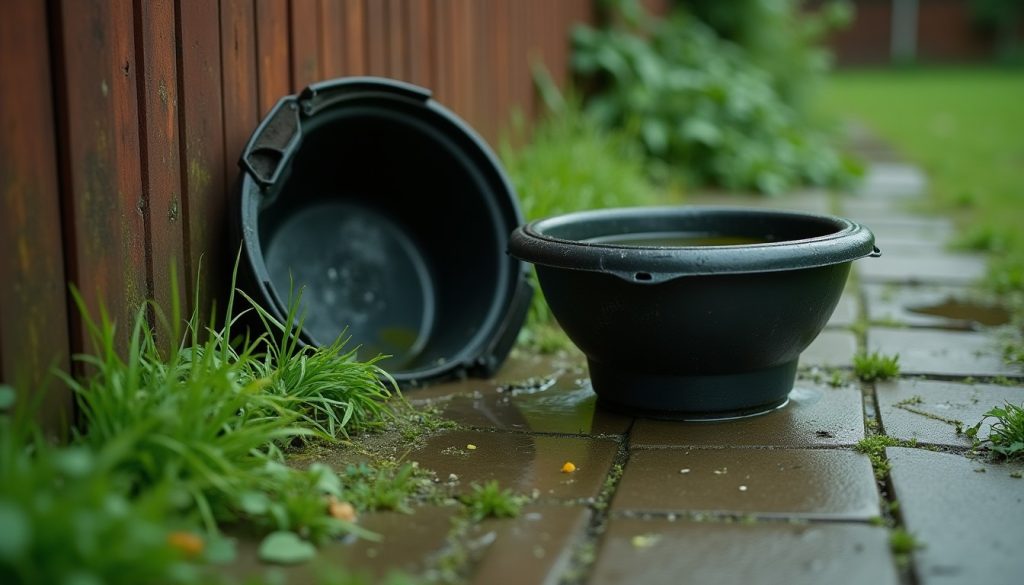
Removing standing water remains the step with the best ratio of effort to effect, because it prevents the mosquitoes existing rather than killing them afterwards. A container holding water for about a week is enough for a generation of the species that transmit dengue, and those species breed close to houses.
How to decide
- Clear standing water first, weekly, including saucers, gutters, tarps, toys and tyres. Nothing you buy substitutes for this.
- Buy barrier treatment for comfort and bite reduction, which the evidence supports, and expect it to fade in three to six weeks and to fade faster after heavy rain.
- Do not buy it as disease protection. If disease risk is the concern, the measures with support are repellent, screens, air conditioning where available, and covering up at dawn and dusk.
- Watch your local mosquito control district during an active outbreak. District-level response is the intervention with demonstrated effect on human cases.
- Be sceptical of scheduled misting systems, which the main professional association discourages.
For pricing and programme structures, see mosquito control costs, and for one-off treatment before an occasion, mosquito control for events. The hierarchy of source reduction before spraying is the subject of integrated pest management, and repeated pyrethroid use raises the issue covered in pesticide resistance.
Frequently asked questions
Can you get dengue in the United States?
Yes, though most US cases are acquired while travelling. In 2024, 105 of 3,798 reported cases in the states and DC were locally acquired, mostly in Florida. Florida has recorded 111 locally acquired cases in 2026 as of the week ending September 5, with 95 in Hillsborough County. Puerto Rico, as a territory with established transmission, reports far higher numbers.
Does mosquito spraying reduce the risk of getting sick?
Area-wide aerial spraying by a mosquito control district has been shown to, with one study during a West Nile outbreak finding infection odds about six times higher in unsprayed areas. Residential barrier sprays have been studied for their effect on mosquito numbers and biting rather than on disease, and no study we could find demonstrates a reduction in human illness from a backyard treatment.
How long does a mosquito barrier treatment last?
Published field studies support roughly three to six weeks of meaningful reduction per application, with rainfall shortening it. One North Carolina study found about 84% reduction over six weeks from a single barrier application, and another reapplied every 21 days to hold the effect.
Was there really malaria transmission in the United States?
Yes. Eight locally acquired, mosquito-transmitted Plasmodium vivax cases were confirmed in 2023 with onset from May to July, seven in Sarasota County, Florida and one in Cameron County, Texas. The previous locally acquired transmission of this type in the US was in 2003.
How many West Nile cases are there each year?
In 2024, the most recent complete year, 1,808 cases were reported, 1,347 of them neuroinvasive, with 173 deaths. Case fatality among neuroinvasive patients was 13%. Totals vary considerably year to year; 2024 was below the ten-year median of 2,162.
Is dumping standing water better than spraying?
It addresses the problem earlier. CDC and EPA state the greatest impact comes when mosquitoes are concentrated and immobile, meaning the larval stage, and position spraying for adults as the fallback when source reduction and larval control have failed or are not feasible.
Do mosquito misting systems work?
The American Mosquito Control Association discourages scheduled residential misting systems, on the basis that they release pesticide on a timer rather than in response to whether mosquitoes are present, and that effective control requires ongoing surveillance.
Sources
- Florida Department of Health, Arbovirus Surveillance Report, Week 35, August 30 to September 5, 2026. floridahealth.gov
- Increase in Travel-Associated and Locally Acquired Dengue Cases, United States, 2024. MMWR 75(18), May 2026. cdc.gov
- West Nile Virus and Other Nationally Notifiable Arboviral Diseases, United States, 2024. MMWR 75(29), July 2026. cdc.gov
- Outbreak of Locally Acquired Mosquito-Transmitted Malaria, Florida and Texas, May to July 2023. MMWR 72(36), September 2023. cdc.gov
- Carney RM, Husted S, Jean C, Glaser C and Kramer V, Efficacy of aerial spraying of mosquito adulticide in reducing incidence of West Nile virus, California, 2005. Emerging Infectious Diseases 14(5), 2008. ncbi.nlm.nih.gov
- Stoops CA, Qualls WA, Nguyen TVT and Richards SL, A Review of Studies Evaluating Insecticide Barrier Treatments for Mosquito Control From 1944 to 2018. Environmental Health Insights 13, 2019. sagepub.com
- EPA and CDC, Joint Statement on Mosquito Control in the United States. epa.gov
- American Mosquito Control Association, Frequently Asked Questions. mosquito.org