Emerald Ash Borer: Signs, Spread and Whether to Treat Your Ash
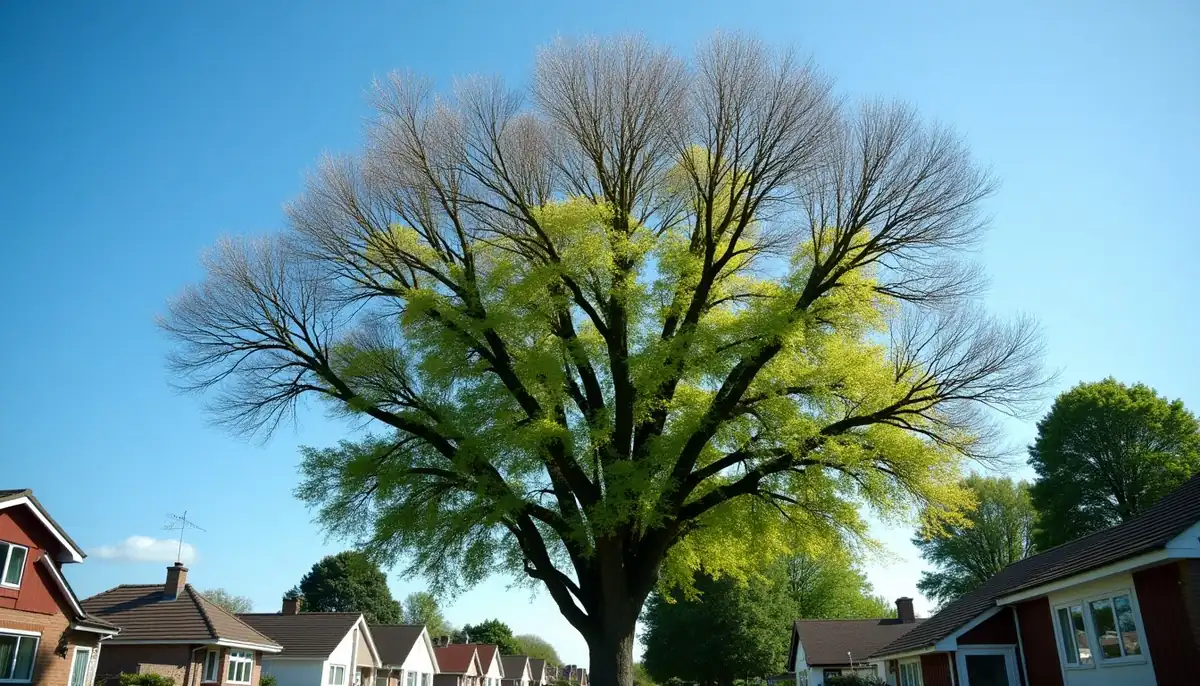
The emerald ash borer (Agrilus planipennis) is an invasive Asian beetle whose larvae tunnel under ash bark and kill nearly all untreated mature ash trees they reach, usually within a few years. It was first found in southeast Michigan in 2002 and federal officials now count 38 states plus Washington, DC. The signs to look for are D-shaped exit holes about 1/8 inch wide, S-shaped tunnels under the bark, woodpecker flecking and dieback at the top of the crown. A healthy, valued ash can be protected with insecticide; one that has lost much of its canopy is usually better removed before it becomes brittle.
EAB is still a live problem: new states keep confirming first detections, and mature ash are still being killed at a high rate, according to a 2026 USDA APHIS program presentation. The homeowner’s question is narrower: is my tree worth saving, and is it too late?
Treat, wait or remove? The decision table
| Your situation | What extension guidance says | Source |
|---|---|---|
| Ash looks healthy, no EAB known within 30 miles | Treating now is probably premature; keep watching local detection news | Herms et al., Insecticide Options, 3rd edition |
| Ash looks healthy, obvious EAB damage within 30 miles | Consider starting treatment; the tree is probably at risk | Herms et al. |
| Less than 30 per cent canopy loss | Hire a professional to protect it | Purdue Landscape Report |
| More than 30 per cent canopy loss | Make plans to remove it | Purdue Landscape Report |
| More than 50 to 60 per cent of the canopy dead, or less than half the normal foliage | Probably too late to save | Herms et al. |
| Dead or dying ash near a house, drive or path | Remove promptly with an experienced tree professional; delay makes it more brittle | Purdue; Ohio State BYGL |
Compiled by The Pest Control Brief from Herms, McCullough, Sadof, Smitley, Miller and Cranshaw, Insecticide Options for Protecting Ash Trees from Emerald Ash Borer (3rd edition, 2019), Purdue Landscape Report (2019) and Ohio State University BYGL (2019).
Note the gap between Purdue’s 30 per cent removal line and the multistate guide’s 50 to 60 per cent point of no return. A tree in between is worth a professional assessment.
What is an emerald ash borer?
EAB is a metallic wood-boring beetle (family Buprestidae) native to Asia, primarily China and Korea, where Penn State Extension says it causes few problems. In North America it feeds almost entirely on ash (Fraxinus), with green, white and black ash the main hosts. Texas A&M Forest Service says all 16 native ash species are at risk.
How big are emerald ash borers?
Sources disagree on adult size, which matters if you are comparing a beetle against a photo. Penn State gives 1/3 inch; USDA APHIS, the University of Kentucky field guide and Texas A&M Forest Service give about 1/2 inch long and 1/8 inch wide. The safest reading is a slender, bullet-shaped beetle of roughly 8 to 13 mm, bright metallic green, with a coppery-red abdomen. Larvae are cream-white, flattened and segmented, with a pair of brown pincer-like appendages at the tail, and reach 1 to 1 1/4 inches.
Penn State lists the insects most often mistaken for EAB, including the sixspotted tiger beetle, dogbane beetle, Japanese beetle, twolined chestnut borer and bronze birch borer. The bronze birch borer makes the same D-shaped holes, but in birch, not ash. Our Japanese beetle guide covers the commonest green look-alike.
Emerald ash borer signs and damage
| Sign | What it looks like | How diagnostic |
|---|---|---|
| D-shaped exit holes | About 1/8 inch (3 to 4 mm) wide, flat side in any direction; Ohio State gives up to 1/4 inch | Strong indicator in ash; native clearwing borers leave round holes 1/4 to 3/8 inch |
| S-shaped galleries | Serpentine tunnels about 1/8 inch wide under the bark, packed with fine frass | Strong indicator; native clearwing borers push frass out of the tree |
| Vertical bark splits | Cracks over the galleries where the tree forms callus | Supporting sign |
| Woodpecker flecking | Jagged holes made by woodpeckers searching for larvae, often one of the first signs; extensive damage is called flecking | Suggestive; woodpeckers attack any tree full of larvae |
| Crown dieback | Dead branches near the top, thinning canopy | General stress symptom, not proof |
| Epicormic sprouts | Leafy shoots on the trunk or at its base | General stress symptom |
Compiled by The Pest Control Brief from University of Wisconsin EAB program, Ohio State ENT-77, University of Kentucky EAB field guide, Penn State Extension and USDA APHIS.
One practical test from Ohio State: a thin wire pushed into a clearwing borer hole goes deep into the wood, because those galleries enter the sapwood. It will not go into an EAB hole, because EAB galleries wind just under the bark and are plugged with frass. Ohio State also warns that nearly every declining ash ends up colonised by native borers. For other holes in wood around a home, see our wood damage identification guide.
Woodpecker activity deserves a closer look. On an ash it is a reason to inspect the bark; on a house, it means something different, which our guide to woodpecker damage to houses explains.
When to look
Adults are on the wing from late May to July, but the damage can be found year round. Our iNaturalist analysis shows EAB records never fall away in winter: January still produces 236 US records against a June peak of 874. Japanese beetle records, by contrast, drop from 30,462 in July to 19 in January, as you would expect of an insect seen only as a summer adult. Winter EAB records most likely document galleries, exit holes and larvae rather than flying beetles, so winter is a fine time to inspect an ash.
Life cycle: why infestations hide for years
Penn State describes a one-year life cycle: adults emerge through D-shaped holes from late May, feed on ash leaves, mate, and females lay 60 to 90 eggs. Eggs hatch in 7 to 10 days and larvae feed in the phloem for several weeks, overwinter in shallow chambers in the bark, and pupate in late April or May for 1 to 2 weeks. In parts of the north the cycle takes two years, and APHIS releases two of its biocontrol wasps mainly above the 40th parallel, where that longer cycle suits them.
The multistate insecticide guide notes that nearly all EAB infestations were at least four to six years old before they were detected, and that trees with few larvae often show no outward signs. Most females lay eggs within 100 yards of the tree they emerged from, though a few fly 0.5 to 2 or 3 miles. Long jumps happen when people move infested firewood, logs or nursery stock, according to APHIS, and Texas A&M Forest Service warns that EAB can survive for up to two years in wood after a tree is cut.
What states have emerald ash borer?
USDA APHIS says EAB infestations have been detected in 38 states and the District of Columbia, and a 2026 APHIS program presentation adds six Canadian provinces. That federal count predates Washington’s first detection: a beetle spotted in Vancouver, Washington, on 3 August 2026 and confirmed later that month, according to the WSU Urban Forest Health Lab. Washington’s first infested tree was documented in Walla Walla County in October 2026, Oregon Public Broadcasting reported. Mississippi confirmed its first detection, in Issaquena County, in November 2025, and Texas has 40 confirmed counties as of June 2026, according to Texas A&M Forest Service. Federal surveys have ended and state surveys vary, so official counts lag; check your state agriculture or forestry agency.
Is EAB still regulated?
Not federally. APHIS removed its domestic EAB quarantine regulations, with the final rule taking effect on 14 January 2021, and now concentrates on rearing and releasing biocontrol wasps. States can keep their own rules, so do not move ash firewood without checking locally.
Our iNaturalist analysis shows where people photograph and identify the beetle, adjusted for how many people record nature in each state. Minnesota, Wisconsin and Missouri lead. Michigan, where EAB was first found, ranks eighth, and states with confirmed infestations can show few or no records. Use the chart as a picture of where people are seeing EAB, and the official detection map for where it is.
How to treat emerald ash borer
| Active ingredient and method | Who applies it | How long it protects | Timing (upper Midwest) |
|---|---|---|---|
| Emamectin benzoate, trunk injection | Professionals | Up to three years in trials, even at peak EAB densities; Texas A&M Forest Service says 2 to 3 years | After leaf-out, mid-May to mid-June |
| Imidacloprid, soil drench | Homeowner products (once a year) and professionals | Applied every year; results inconsistent in trials, and trees over 15 inches in diameter need the higher labelled rate | Early to mid spring, mid-March to late April; takes 4 to 6 weeks to move into the tree |
| Dinotefuran, basal trunk spray or soil drench | Both | One season; annual sprays effective in several studies | Mid to late spring |
| Azadirachtin, trunk injection | Professionals | One to two years, depending on EAB pressure | After leaf-out |
| Cover sprays on bark and foliage | Professionals | Kills adults and newly hatched larvae only | Not recommended, because of drift, coverage and effects on other species |
Compiled by The Pest Control Brief from Herms et al., Insecticide Options for Protecting Ash Trees from Emerald Ash Borer, 3rd edition (2019), and Texas A&M Forest Service. Labels vary by state; the label is the law.
Emamectin benzoate has been the most consistent performer in side-by-side trials. In one Michigan study, treated trees averaged 0.2 larvae per square metre of bark against 68 to 132 on untreated trees, a reduction of more than 99 per cent. The guide’s authors also report that spring treatments are consistently more effective than the same treatments in autumn, and that studies comparing costs found treating landscape ash much cheaper than removal. Purdue’s EAB Cost Calculator lets you compare the two for your own trees.
Two cautions from the same guide. First, insecticides stop further damage but cannot reverse it, and a declining tree may keep looking worse in the first year before the canopy improves in the second. Second, the tree must be healthy enough to move a systemic product up the trunk, which is why the canopy thresholds above matter. Lower drench rates may work on smaller trees, while trees over 15 inches in diameter need products labelled for the higher rate, so for a large shade tree an ISA-credentialed arborist is usually the better call. Our spotted lanternfly treatment guide covers the same arborist or pest company question for the other invasive insect that sends homeowners to tree services.
Can a tree survive an emerald ash borer?
An untreated mature ash rarely does. A USDA Forest Service study in Ohio found ash in forested stands went from healthy to almost complete mortality of mature trees within 6 years, and Penn State says trees die after 3 to 4 years of heavy infestation. Treated trees do survive: in a six-year Purdue study, trees 28 to 62 inches in diameter injected with emamectin benzoate every three years stayed protected while untreated trees died.
Natural predators and biocontrol wasps
Natural enemies help, but none acts fast enough to save a mature tree. Woodpeckers are the biggest: a 2024 Michigan study found they killed 38.5 per cent of larvae in declining ash and 13.2 per cent in healthy ash. Jennings and colleagues, in a 2013 caging study, concluded predation alone may not be a substantial factor in controlling EAB.
| Parasitoid wasp | Attacks | First US release | Field parasitism reported |
|---|---|---|---|
| Tetrastichus planipennisi | Larvae (3rd and 4th stage) | 2007 | 40 to 60 per cent |
| Spathius galinae | Larvae | 2015 | 13 to 78 per cent |
| Oobius agrili | Eggs | 2007 | 2 to 51 per cent |
| Spathius agrili | Larvae | 2007 | Did not establish |
Compiled by The Pest Control Brief from Dodge, Current status, successes, and limitations of the USDA APHIS PPQ emerald ash borer biological control program (2026).
The wasps are stingless. APHIS has released more than 9 million of them across 491 infested counties, including 408,985 to 135 sites in 28 states in 2025. The program’s own review is candid: it started at least ten years after EAB arrived, and its clearest effect is on ash saplings and regenerating forests, while mature trees are still being killed at a high rate. APHIS’s own forest strategy pairs trunk injections of valued trees with parasitoid releases.
Do emerald ash borers eat other trees?
Almost only ash. The one confirmed exception in the field is white fringetree (Chionanthus virginicus), a native ornamental. Don Cipollini of Wright State University reported in 2015 that 4 of 20 mature fringetrees he examined around Dayton, Ohio, showed EAB symptoms, and that one held evidence of at least three generations of larvae.
Frequently asked questions
Can a tree infested with emerald ash borer be saved?
Often, if treatment starts early. The multistate insecticide guide says that if more than 50 to 60 per cent of the canopy is dead, it is probably too late, while Purdue advises protecting trees under 30 per cent canopy loss. Trunk injection with emamectin benzoate has protected trees for up to three years per treatment in trials. Expect the canopy to look no better, or worse, in the first year and improve in the second.
What kills emerald ash borer?
Systemic insecticides are the only reliable tool for an individual tree, and emamectin benzoate trunk injections have been the most consistently effective in university trials. Woodpeckers eat many larvae, killing 13 to 39 per cent in a 2024 Michigan study, and four introduced parasitoid wasps have been released since 2007. Natural enemies slow populations in forests but do not save a mature yard tree.
What states have emerald ash borer?
USDA APHIS counts 38 states plus the District of Columbia, a tally made before Washington confirmed its first detection in August 2026. Recent first detections include Mississippi in November 2025. Because federal surveys have ended and state surveys vary, official maps understate the true range; your state department of agriculture or forestry has the most current local information.
Are emerald ash borers still a problem?
Yes. A 2026 USDA APHIS program presentation says mature ash trees are still being killed at a high rate, and new states and counties continue to confirm detections. Where the first wave has passed, EAB persists at lower densities on surviving trees and saplings. Ash regeneration is plentiful in post-invasion forests, and biocontrol wasps are helping young ash, but landscape trees still need protection.
Sources
- Herms, D.A., McCullough, D.G., Sadof, C.S., Smitley, D.R., Miller, F.D. and Cranshaw, W., Insecticide Options for Protecting Ash Trees from Emerald Ash Borer, 3rd edition, North Central IPM Center, 2019.
- USDA APHIS, Emerald Ash Borer program page (detections, quarantine removal, signs).
- Dodge, C., Current status, successes, and limitations of the USDA APHIS PPQ emerald ash borer biological control program, USDA APHIS PPQ, 2026.
- Penn State Extension, Emerald Ash Borer, updated October 2025.
- Ohio State University Extension, ENT-77, Distinguishing Emerald Ash Borer from Native Borers (Herms), 2016; BYGL, Ash Breakage: the Hazard Continues (Boggs), 2019.
- Purdue Landscape Report, Avoid deadly risk of dying ash trees with timely tree removal (Barnes, Sadof and Purcell), 2019.
- University of Wisconsin, Emerald Ash Borer in Wisconsin: Symptoms and Signs of EAB.
- University of Kentucky Department of Entomology, Emerald Ash Borer Field Guide.
- Texas A&M Forest Service, Emerald Ash Borer, 2026.
- WSU Urban Forest Health Lab, Emerald ash borer detected in Washington State, August 2026.
- Oregon Public Broadcasting, A beetle that decimates ash trees has arrived in southeast Washington, 25 October 2026.
- Mississippi Forestry Commission, MFC Confirms First Detection of Emerald Ash Borer in Mississippi, November 2025.
- Knight, K.S., Brown, J.P. and Long, R.P., Factors affecting the survival of ash trees infested by emerald ash borer, Biological Invasions 15: 371 to 383, 2013.
- Wilson, C.J., Petrice, T.R., Poland, T.M. and McCullough, D.G., Environmental Entomology, 2024 (woodpecker and parasitoid mortality of EAB larvae).
- Jennings, D.E. et al., Quantifying the Impact of Woodpecker Predation on Population Dynamics of the Emerald Ash Borer, PLoS ONE 8(12): e83491, 2013.
- Cipollini, D., White Fringetree as a Novel Larval Host for Emerald Ash Borer, Journal of Economic Entomology 108(1): 370 to 375, 2015.
- The Pest Control Brief analysis of iNaturalist research-grade records, pulled October 2026.