How Fast Do Bed Bugs Multiply? An Infestation Growth Timeline

Bed bugs multiply fast: once established at room temperature with a person to feed on, a population can double about every 13 to 16 days. Starting from one mated female, our model built on Virginia Tech life-table data gives roughly 37 bugs and eggs at week 4, 120 to 190 at week 8 and 630 to 860 at week 12. That is a laboratory ceiling. In real apartments, most introductions of a few bugs grow far more slowly, and many die out.
One female, twelve weeks: the model
| Week | Eggs | Nymphs | Adults | Total, faster field strain | Total, slower lab strain |
|---|---|---|---|---|---|
| 4 | 9 | 27 | 1 | 37 | 38 |
| 8 | 83 | 79 | 25 | 186 | 120 |
| 12 | 253 | 507 | 96 | 855 | 629 |
Stage columns are for the faster strain. Model by The Pest Control Brief from Polanco, Miller and Brewster (Virginia Tech, 2011) life tables; assumptions below.
For the first five weeks nothing multiplies at all. The founder simply lays eggs, and at week 4 the household holds one adult and a few dozen eggs and pinhead nymphs, most of them too small to notice. The curve turns upward only after her first daughters reach adulthood, at about day 35 to 40, and start laying. By week 12 two overlapping generations are breeding at once.
The assumptions, stated
- Start: one mated female who has just fed, at about 79°F (26°C), with a sleeping host available. VDACS and Virginia Tech note that a single mated female can found an infestation without a male, mating with her own offspring later.
- Egg output: 1.28 eggs a day per adult female, double the 0.64 daughter eggs a day Polanco and colleagues measured over a female’s life, assuming the 1:1 sex ratio Virginia Tech reports. At that rate she lays about 107 eggs in 12 weeks, close to Virginia Tech’s lifetime average of 113.
- Development: egg to adult in 34.8 days for the pyrethroid-resistant Richmond field strain, 40.4 days for the susceptible Harlan lab strain.
- Survival: 86 per cent of eggs reach adulthood in the field strain’s fecundity cohort and 79 per cent in the lab strain.
- Daughters begin laying 4 days after their final moult, when Polanco’s life table first records eggs.
- No adult deaths within 12 weeks; a newly moulted female’s life expectancy was about 127 days.
As a check, the faster scenario’s growth between weeks 8 and 12 works out to a doubling every 12.7 days, matching the 12.86 day doubling time in the published life table. Virginia Tech’s extension sheet gives 16 days. Egg laying is spread evenly here; real females peak around their fifth week of adult life, so the early weeks are slightly flattered.
How long does it take for bed bugs to multiply?
About five to six weeks before the first new breeders appear, because that is how long one generation takes to grow up. Polanco’s team measured each stage at 26°C with weekly blood meals, and the two strains differed by about five days overall.
Sources differ on egg hatching. Virginia Tech found 60 per cent of eggs hatch by day 6 and over 90 per cent by day 9 above 70°F; UC IPM gives 10 to 15 days at room temperature. Some consumer pages say adults take two to four months to develop, which matches UC IPM’s outer range of five weeks to four months only for cool rooms or hungry bugs.
How many eggs does a bed bug lay per day?
Usually one to three. In Polanco’s cohort, on days when a female laid at all, 79.0 per cent of the time she laid 1 to 3 eggs, 20.6 per cent 4 to 6, and 0.4 per cent 7. She laid nothing on 72 per cent of her adult days, because egg production follows blood meals: Virginia Tech says a female lays 1 to 7 eggs a day for about 10 days after a meal, 5 to 20 per meal, then must feed again. UC IPM gives a higher range of two to five a day and 200 to 500 in a lifetime.

What speeds it up or slows it down
Temperature
UC IPM says development is fastest between 70 and 82°F. Kentucky says that at 70 to 80°F bugs can mature in as little as a month, and cooler temperatures prolong it. Virginia Tech found each nymph stage takes two or three days longer at 50 to 60°F, and egg hatching slows by several days at 50°F. A cold spare room grows a population far more slowly than a heated bedroom.
Blood meals
A nymph cannot moult without feeding, so it waits in its current stage until it finds a host or dies. Virginia Tech notes bed bugs usually feed every 3 to 7 days. When Pereira and colleagues simulated a single pair with food available only once a week for 5 minutes, the population reached about 300 in 15 weeks, as reported by Rutgers researchers. Our 12-week figures assume a nightly sleeper, which is why they are higher.
Mating
Repeated mating injures females. Virginia Tech reports that females mated only once produce 25 per cent more eggs than females mated repeatedly.
How fast do bed bugs multiply in your house, compared with the lab?
Usually more slowly, and often not at all. Rutgers researchers found 23 never-treated New Jersey apartments with 1 to 10 trapped bugs and no history of bed bugs; bugs were gone from 22 of them within 22 weeks with interceptor traps alone. The authors concluded that small populations rarely reach their growth potential under field conditions. The model shows what an unchecked, well-fed population can do; the field data show many introductions fail first. Our found one bed bug guide covers that situation.

How many bed bugs is an infestation?
There is no standard low, moderate and heavy scale. These are the count bands Rutgers field studies used, and what each predicted.
| Bugs counted | What the research found | Study |
|---|---|---|
| 1 to 10 in traps | Treated as low level; 22 of 23 never-treated units cleared within 22 weeks with traps only | Cooper, Wang and Singh, 2016 |
| Under 30 | Eliminated within 3.5 months of treatment | Singh and others, 2013, as reported by Cooper |
| Over 30 | Persisted beyond 5.5 months despite repeated treatment | Singh and others, 2013, as reported by Cooper |
| 9 to 318 before treatment | Only 5 of 23 assessed units cleared in 12 weeks, all starting at 9 to 14 bugs | Wang, Singh and Cooper, 2014 |
Compiled by The Pest Control Brief from the named Rutgers studies.
On a mattress seam, a growing infestation is mostly young bugs. Polanco’s stable age distribution is 34 per cent eggs, 54 per cent nymphs and 12 per cent adults, so for every adult you see there are roughly three eggs and four or five nymphs nearby. Kentucky notes that early on most bugs congregate in the bed area; Virginia Tech says crowded, heavy infestations push bugs to hide several yards from the bed. Signs at each stage are in our bed bug identification guide.
Why early detection decides the outcome
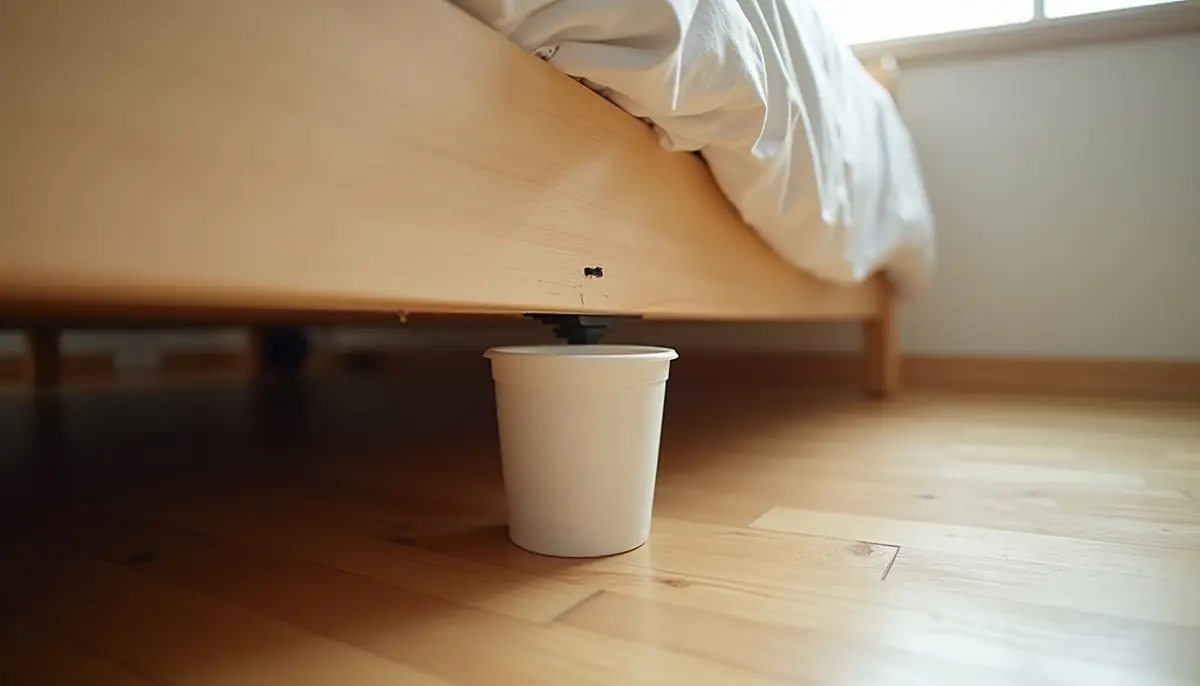
Low numbers are both easier to clear and easy to miss. Among 103 apartments with low-level activity in the Rutgers trapping study, residents in 80 did not know they had bed bugs, and Kentucky notes that about 30 per cent of people do not react even when bitten repeatedly. Interceptor cups under the legs of beds and sofas catch bugs before a person notices bites. If traps keep catching, treat it as a job for a licensed firm: see bed bug pest control. How long adults survive between meals, and why starving them out rarely works, is in how long do bed bugs live.
Frequently asked questions
How fast do bed bugs multiply?
Once established at room temperature with a host, a bed bug population can double about every 13 days, according to a Virginia Tech life table, or every 16 days by Virginia Tech’s extension estimate. From one mated female, a model built on those data reaches about 37 bugs and eggs at four weeks and 630 to 860 at twelve weeks.
How many eggs does a bed bug lay per day?
Usually one to three on days when she lays. Virginia Tech measured 1 to 3 eggs on 79 per cent of laying days and 4 to 6 on about 21 per cent. A female lays for about 10 days after each blood meal, 5 to 20 eggs per meal, so output depends on how often she feeds.
How long can bed bugs reproduce without a mate?
A female mated once can keep laying for a while, but Virginia Tech notes she eventually runs out of sperm and must mate again. Because she can mate with her own adult offspring, one mated female is enough to start an infestation. Females mated once produce 25 per cent more eggs than those mated repeatedly.
How long does it take bed bugs to go from egg to adult?
About 35 to 40 days at around 79°F with regular blood meals, according to Virginia Tech life tables for two strains. UC IPM gives five weeks to four months, depending on temperature and food. Development is fastest between 70 and 82°F, and nymphs cannot moult without a blood meal.
Sources
- Polanco, A. M., Miller, D. M. and Brewster, C. C., Population growth potential of the bed bug, Cimex lectularius L.: a life table analysis, Insects 2(2), 2011.
- Miller, D. M. and Polanco, A., Bed Bug Biology and Behavior, Virginia Tech Department of Entomology, distributed by the Virginia Department of Agriculture and Consumer Services.
- University of California Statewide IPM Program, Pest Notes: Bed Bugs, Publication 7454.
- University of Kentucky Entomology, ENTFACT-636, Bed Bugs (M. F. Potter), revised 2026.
- Cooper, R., Wang, C. and Singh, N., Effects of various interventions, including mass trapping with passive pitfall traps, on low-level bed bug populations in apartments, Journal of Economic Entomology 109(2), 2016 (advance access December 2015), including its citations of Pereira and others (2013) and Singh and others (2013).
- Wang, C., Singh, N. and Cooper, R., Efficacy of an essential oil-based pesticide for controlling bed bug infestations in apartment buildings, Insects 5(4), 2014.