Spider Mites: Signs, Webbing and Treatments That Work
Spider mites are tiny plant-feeding arachnids, usually the twospotted spider mite, that suck leaf cells dry and leave pale stippling, bronzing and fine silk webbing on the undersides of leaves. They do not bite people, and they thrive in hot, dry, dusty conditions and on water-stressed plants. A hard water spray, insecticidal soap or horticultural oil with full underside coverage controls most infestations. Broad-spectrum insecticides often make them worse by killing their predators.
The adult female twospotted spider mite is about 0.4 mm long, so most people find the damage weeks before they see a mite. Below: how to confirm them with a sheet of paper, why they keep coming back, which sprays help and which cause outbreaks, and what to do differently indoors.
Spider mites at a glance
| Question | Short answer | Source |
|---|---|---|
| What are they? | Arachnids (family Tetranychidae), related to spiders and ticks: eight legs, no antennae, oval body | UC IPM 7405; Ohio State HYG-2012 |
| How big? | Adult female about 0.4 mm (about 1/50 inch); UC IPM gives a ceiling of “less than 1/20 inch” | UF/IFAS EENY-150; UC IPM |
| What colour? | Usually green, greenish yellow or almost translucent with two dark spots; overwintering females orange to orange-red | UF/IFAS EENY-150; Ohio State |
| Key sign | Pale stippling, then yellow, grey or bronze leaves, then silk webbing | UC IPM; UF/IFAS |
| How fast? | A generation in 5 to 20 days depending on temperature, under a week in hot weather | Ohio State; UC IPM |
| Bite people? | Not listed among biting mites; they feed on plant cells | NPIC; Cornell NYSIPM |
Table compiled by The Pest Control Brief from UC IPM Pest Notes 7405, UF/IFAS EENY-150, Ohio State HYG-2012, NPIC and Cornell NYSIPM.
What do spider mites look like, and how big are they?
To the naked eye a spider mite is a moving dot. A 10x hand lens shows eight legs, an oval body and, on the twospotted spider mite, a dark blotch on each side, which UF/IFAS explains is accumulated body waste showing through the transparent body wall. Newly hatched larvae have six legs. Eggs are spherical and translucent, like tiny droplets.
The “white” and “black” spider mites people search for are mostly the same animal at different moments. Ohio State notes that summer adults and nymphs are white with two greenish spots, while overwintering females turn reddish orange. A tiny black beetle among the webbing is more likely a “spider mite destroyer” lady beetle (Stethorus), a predator worth keeping.
Published sizes disagree. UF/IFAS and Ohio State give about 0.4 mm and Missouri Botanical Garden less than 1/60 inch, while UC IPM’s “less than 1/20 inch” (about 1.3 mm) is a ceiling, which is why some pages make spider mites sound three times bigger than they are.
Spider mite signs: the white paper tap test
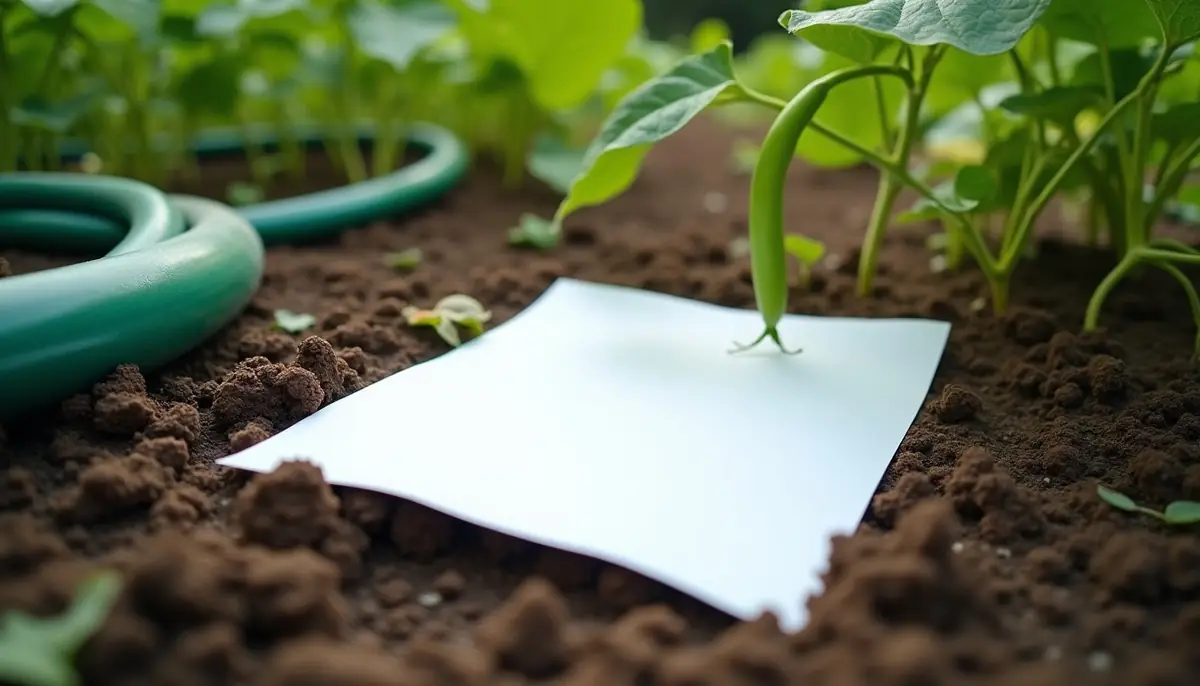
- Hold white paper under a damaged shoot and strike the foliage sharply.
- Watch for specks like dust or pepper that start to move, as Missouri Botanical Garden describes them.
- Smear one. Ohio State’s rule: plant-feeding mites usually leave a green streak; yellow or orange streaks suggest beneficial predators.
- Count. Ohio State suggests that if 10 or more spider mites per sample are common, controls are probably needed.
Webbing settles most look-alike questions: UC IPM calls the silk an easy way to tell spider mites from other mites and from aphids and thrips. Thrips stippling looks similar, but thrips leave black, varnish-like specks instead of silk; our guide to thrips covers the difference.
Why am I getting spider mites?
- Heat and dry air. Colorado State explains that low humidity lets mites feed more, while most of their natural enemies need more humid conditions.
- Water stress. UC IPM says drought-stressed plants are the most likely to be damaged; Colorado State adds that drought can make leaves more nutritious to mites.
- Dust. Mites are usually first found beside dusty roadways or at garden margins, and UC IPM says washing dust off mid-season can prevent late infestations.
- A spray that killed the predators. The counter-intuitive cause, covered below.
Where do spider mites come from?
Outdoors, twospotted spider mites overwinter as mated orange or red females under bark and in ground litter, and UC IPM reports that females disperse on wind currents when a plant declines. Indoors, the usual route is a new plant: Ohio State says they are often introduced on infested bedding and house plants and advises quarantining new houseplants. UF/IFAS notes they survive year round in greenhouses throughout the US.
Why are there spider mites in my house?
If the specks are on plants, they arrived on a plant and are enjoying dry, heated air. Tiny red mites crawling on windowsills in spring or autumn are more likely clover mites, which Colorado State says commonly enter homes; see our clover mites guide.
When people find spider mites: what the iNaturalist records show
We pulled every US research-grade iNaturalist record of spider mites (Tetranychidae). The sample is small, 901 records, so treat it as indicative. Even so, 42 per cent fall in December to February against 16 per cent in June to August, and January has the most records of any month (167).
That does not mean they breed more in winter outdoors; extension sources put the outdoor peak in hot weather, June through September in California and mid-July to September in Missouri. The likelier reading is that winter records are dominated by houseplants and greenhouse plants in heated rooms, noticed when little else is about. Whiteflies and scale insects show the same winter rise. For houseplant owners: check leaf undersides most closely from December to March.

Which insecticides cause spider mite outbreaks
UC IPM states that spider mites frequently become a problem after insecticides are applied, partly because the products kill natural enemies and partly because some stimulate mite reproduction, with sprays in hot weather causing dramatic outbreaks within a few days.
| Insecticide | What the source reports | Source |
|---|---|---|
| Carbaryl | Exposed mites reproduced faster in the laboratory; it devastates most spider mite natural enemies | UC IPM 7405; Colorado State 5.507 |
| Some pyrethroids and organophosphates | Weak on mites, often kill predators, and can raise leaf nitrogen, which favours mites | UC IPM 7405 |
| Malathion | Can aggravate some spider mite problems despite being advertised for mites | Colorado State 5.507 |
| Imidacloprid (soil-applied) | Has contributed to outbreaks. Central Park elms given more than 14,000 applications in 2005 to 2007 developed mite outbreaks; predators were poisoned by eating exposed mites and mite fecundity rose | Colorado State 5.507; Szczepaniec et al. 2011 |
Table compiled by The Pest Control Brief from UC IPM Pest Notes 7405, Colorado State University Extension 5.507 and Szczepaniec, Creary, Laskowski, Nyrop and Raupp (2011).
Our guide to garden pest control explains why pest control companies generally will not spray food crops, and our biological pest control guide covers protecting natural enemies.
How to get rid of spider mites
Work up this ladder and stop at the first step that holds them.
| Step | How | Rules that matter |
|---|---|---|
| 1. Water | Irrigate stressed plants; UC IPM suggests spraying or misting leaf undersides at least once a day on infested plants | Ohio State: regular syringing keeps mites in check on most ornamentals and spares predators |
| 2. Insecticidal soap | Potassium salts of fatty acids, covering both leaf surfaces | Contact only; not on water-stressed plants or above 90°F; Colorado State rates it marginal where webbing blocks the spray |
| 3. Horticultural oil | Petroleum or plant oils such as neem, canola or cottonseed; Colorado State calls 2 per cent “summer oil” perhaps the most effective home miticide | Test a few leaves first; avoid open flowers; UC IPM says no sulfur within 30 days of an oil spray |
| 4. Predatory mites | Release into hot spots, matched to temperature and humidity | UC IPM: about one predator per 10 spider mites |
| 5. Miticides | Only products labelled as miticides; Ohio State found none registered over the counter when it wrote its fact sheet | If one fails within five to seven days, switch mode of action; follow the label |
Coverage decides success: soaps and oils work only on contact, so a spray that wets only leaf tops misses most of the colony. Because most miticides do not kill eggs, UF/IFAS advises repeats at five-day intervals in summer and seven-day intervals in winter. Our neem oil guide covers that product.
Does Dawn dish soap kill spider mites?
It can, but extension entomologists advise against it. Kansas State cites research in which a liquid dishwashing soap at 0.4 to 3.0 per cent controlled spider mites, but stresses that dish products are not registered insecticides, give less predictable results and may injure plants by dissolving the waxy leaf cuticle. UConn’s soap fact sheet is blunter: do not use dishwashing soaps and detergents. Use a labelled insecticidal soap, testing one leaf and waiting at least 24 hours.
Miticide resistance
UF/IFAS says the twospotted spider mite develops resistance to most acaricides after prolonged use, and a 2019 Scientific Reports study says it has developed resistance to almost all acaricides available for its control. Rotating modes of action, or not spraying when water and predators can do the job, matters more here than for almost any garden pest; see our article on pesticide resistance.
Choosing predatory mites: match them to your conditions
UC IPM notes the best results usually come from protecting wild predators rather than buying them. If you do buy, each species suits a different climate, according to UConn’s fact sheet for greenhouse growers.
Phytoseiulus persimilis is the fastest specialist, but UConn reports its eggs fail to hatch below 60 per cent humidity. In a hot, dry room or garden, Neoseiulus californicus or Galendromus occidentalis fits better. Colorado State cautions that effective outdoor use has not been demonstrated in Colorado, where air is often too dry. Released predators starve if no spider mites are present, and soap sprays harm them, so do not spray and release together.
What plants are most prone to spider mites?
| Plant group | Plants named by extension sources | Source |
|---|---|---|
| Vegetables | Beans, eggplant, tomatoes, squash, cucumber, melons, sugar peas | Colorado State; UF/IFAS; UC IPM |
| Fruit | Raspberries, blackberries, blueberries, strawberries, currants, pear | Colorado State; UF/IFAS |
| Shrubs | Roses, burning bush, viburnum, azalea, camellia, hollies, arborvitae, boxwood | UC IPM; Ohio State; UF/IFAS; Missouri Botanical Garden |
| Trees | Maple, elm, redbud, honeylocust; conifers host other spider mite species | UF/IFAS; Colorado State; Ohio State |
| Indoors | The twospotted spider mite is the most important species on houseplants | Colorado State |
Table compiled by The Pest Control Brief from UF/IFAS EENY-150, Colorado State 5.507, Ohio State HYG-2012, UC IPM 7405 and Missouri Botanical Garden.
UF/IFAS reports more than 200 host species and the 2019 Scientific Reports study over 1,100. Conifers break the summer rule: Ohio State says spruce spider mites are active in spring and autumn and lay dormant eggs after three straight days above 86°F.
Are spider mites bad for plants?
A few are not; UC IPM says most woody plants tolerate low to moderate numbers. Heavy infestations yellow and drop leaves, and on squash and melons leaf loss can cut yield and sunburn fruit. Mites are sometimes gone by the time damage shows, so confirm live mites before treating.
Houseplants versus outdoor plants
Indoors, Colorado State calls control “particularly frustrating” because there are generally no biological controls and few effective chemical ones beyond soaps and oils. Its routine: treat all susceptible houseplants at once, bag heavily infested leaves, discard badly infested plants, rinse small plants in the shower, wipe larger leaves, and repeat every one to two weeks. Our houseplant pests guide covers humidity and other indoor problems. Outdoors, water, dust control and predators do most of the work. Neither is a job for a structural pest control company.
Are spider mites harmful to humans?
They do not bite. The National Pesticide Information Center groups them with plant-damaging mites, and its list of biting mites (chiggers, bird mites, rodent mites) does not include them. The documented human effect is allergy under heavy occupational exposure: a 2007 study of 207 table grape farm workers found 9.5 per cent allergic to the twospotted spider mite, more often among pesticide sprayers. For an itch or rash, see a doctor; houseplant spider mites are an unlikely cause.
Frequently asked questions
Do spider mites bite?
No. Spider mites feed by piercing individual plant cells and removing the contents, which produces the pale stippling on leaves. The National Pesticide Information Center’s list of mites that bite people covers chiggers, bird mites and rodent mites, not spider mites. If you have unexplained bites or a rash, ask a doctor rather than treating your plants.
What kills spider mites instantly?
Nothing safe kills a whole colony at once, because eggs survive most sprays. A forceful water spray knocks many off immediately, and insecticidal soap or horticultural oil kills those it wets. UF/IFAS advises repeats at five-day intervals in summer and seven-day intervals in winter to catch newly hatched mites. Full coverage of leaf undersides matters more than the product.
How long does it take to get rid of spider mites?
Usually several weeks. A generation can complete in under a week in hot weather and most treatments miss eggs, so plan on repeated sprays over two to four weeks, checking with a tap test each time. Colorado State advises repeating houseplant treatments every one to two weeks, and UConn says released predatory mites should reduce colonies in two to three weeks.
Will spider mites go away on their own?
Sometimes, outdoors. UC IPM reports that high populations may crash in late summer when predators overtake them, the weather cools or rain falls, and plants often recover. Indoors that rarely happens, because heated rooms stay warm and dry and predators are absent, so houseplant infestations usually need repeated treatment.
Sources
- University of California Statewide IPM Program, Pest Notes: Spider Mites, UC ANR Publication 7405 (L.D. Godfrey).
- University of Florida IFAS, Featured Creatures EENY-150: Twospotted Spider Mite, Tetranychus urticae (Fasulo and Denmark).
- Ohio State University Extension, HYG-2012, Spider Mites and Their Control (D.J. Shetlar), 2011.
- Colorado State University Extension, fact sheet 5.507, Spider Mites.
- Missouri Botanical Garden, Spider Mites (Outdoors), help for the home gardener.
- UConn Extension IPM Program, Insecticidal Soaps; and Biological Control of Two-Spotted Spider Mites.
- Kansas State University, Fundamentals of Using Soaps as Insecticides, 2020.
- National Pesticide Information Center (Oregon State University), Mites.
- Cornell University, New York State IPM Program, What’s Bugging You: Mites.
- Szczepaniec A, Creary SF, Laskowski KL, Nyrop JP, Raupp MJ. Neonicotinoid insecticide imidacloprid causes outbreaks of spider mites on elm trees in urban landscapes. PLoS ONE 6(5): e20018, 2011.
- Adesanya AW and others. Physiological resistance alters behavioral response of Tetranychus urticae to acaricides. Scientific Reports, 2019.
- Jeebhay MF and others. Risk factors for allergy due to the two-spotted spider mite (Tetranychus urticae) among table grape farm workers. International Archives of Allergy and Immunology 144(2), 2007.
- The Pest Control Brief analysis of iNaturalist research-grade records, pulled October 2026.