How to Get Rid of Flies Outside on the Patio and Deck
To get rid of flies outside, remove what they are breeding in or feeding on around the yard, then deal with the adults that are left. House flies and blow flies can go from egg to adult in as little as 7 days in summer, so bins, dog waste, compost, rotting fruit and wet grass clippings need clearing at least weekly. For the flies already there, a fan over the table, a swatter and odour-baited traps hung well away from where you sit do most of the work. Bags of water, sticky ribbons outdoors and bug zappers do very little.
Most advice on outdoor flies is a list of scents and gadgets. Extension entomologists start elsewhere: a fly problem outside is almost always a breeding or feeding problem nearby, and the flies on the deck are the visible end of it.
Which flies are on your patio
A handful of flies account for nearly every outdoor complaint, and each comes from a different place.
| Fly | Size | How to recognise it | Where it breeds | Bites? |
|---|---|---|---|---|
| House fly | 1/8 to 1/4 in | Grey, four dark stripes on the thorax | Manure, dog waste, garbage, lawn clippings, rotting fruit and vegetables | No |
| Blow fly (bottle fly) | 1/8 to 5/8 in | Shiny metallic green or blue body | Protein-rich garbage such as meat scraps, dead animals, manure | No |
| Stable fly | 5 to 7 mm, about 1/4 in | Looks like a house fly but has a stiff, forward-pointing beak | Wet grass clippings, rotting hay and straw, manure mixed with bedding | Yes, usually legs |
| Little house fly | About 2/3 of a house fly | No thorax stripes; males hover in a swarm at head height on porches | Animal waste, especially poultry manure, and other moist organic matter | No |
| Horse and deer flies | 1/2 to 1 1/4 in | Large, often patterned eyes; deer flies have dark-banded wings and go for the head | Mud at pond edges, streams and wetlands | Yes, painfully |
If the fly biting your legs on a summer evening looks like a house fly, it is very probably a stable fly. UF/IFAS notes that people usually get bitten on the legs, behind the knees and on the elbows, and that the bites are extremely painful. If something large is circling your head near water, read our guide to horse flies and deer flies, because the source-removal advice below does not apply to them.
Why do I have a lot of flies outside?
Because something nearby is feeding them or raising their young. UC IPM lists the egg-laying sites plainly: warm, moist, organic material such as manure, garbage, lawn clippings, decaying vegetables and fruits, or soil contaminated with any of these. A single house fly lays several batches of about 100 to 150 eggs, and in good summer conditions those eggs can be adults again in as little as 7 days. One forgotten bag of kitchen scraps can supply the whole deck.
The source is not always on your property. University of Kentucky entomologist Lee Townsend notes that house flies can easily move one to two miles, and that in marked-release studies 60 to 80 per cent were recaptured within a mile of release. A neighbour’s chicken run, a stable or a restaurant dumpster can fill a spotless yard. Then the options shrink to airflow, traps and a word with whoever owns the source.
The usual sources, in rough order of how often they are the answer
- Outdoor bins. UC IPM advises putting garbage out for collection at least once a week even when the can is not full, because garbage that sits for more than a week is likely to produce adult blow flies. Our guide to maggots in the trash can covers cleaning a bin that is already breeding.
- Dog waste. UC IPM recommends removing dog feces, rotting fruit and kitchen waste at least once a week. In hot weather, more often is better.
- Wet grass clippings and compost. Damp clipping piles breed house flies and stable flies; Texas A&M AgriLife lists wet grass clippings among stable fly larval sites. Spread clippings thinly or leave them on the lawn.
- Fallen and rotting fruit. Windfalls under fruit trees and overripe vegetables in the garden feed adults and can host larvae.
- The grill and outdoor kitchen. Grease trays, meat scraps and marinade spills are protein-rich waste of the kind Purdue says blow flies develop in.
- Something dead. A sudden cloud of metallic blow flies around one spot often means a dead rodent or bird under the deck or in a crawlspace. Purdue notes that blow flies usually develop in decaying carcasses such as rodents.
What is the fastest way to get rid of flies outside?
For tonight: a fan across the table, food covered and a swatter. For the season: clear the source, because nothing you do to today’s adults touches the flies hatching next week.
- Walk the yard around the seating area and check bins, the dog run, the compost, the grill and under the deck. Look for maggots or a smell, not just flies.
- Bag and remove what you find the same day. UC IPM recommends sealing household garbage and pet feces in plastic bags before they go into the outdoor container.
- Wash the bin and the grill drip tray with soap and water so the residue stops attracting egg-laying females.
- Hang odour-baited traps at the edge of the yard, not beside the seating, to pick off the adults still arriving.
- Repeat the source check weekly through warm weather, since the cycle restarts as fast as a week.
Once no new flies are being raised, the adults already about die off over the following weeks; our guide to how long flies live explains the timing by temperature.
Fans: the cheapest thing that measurably helps
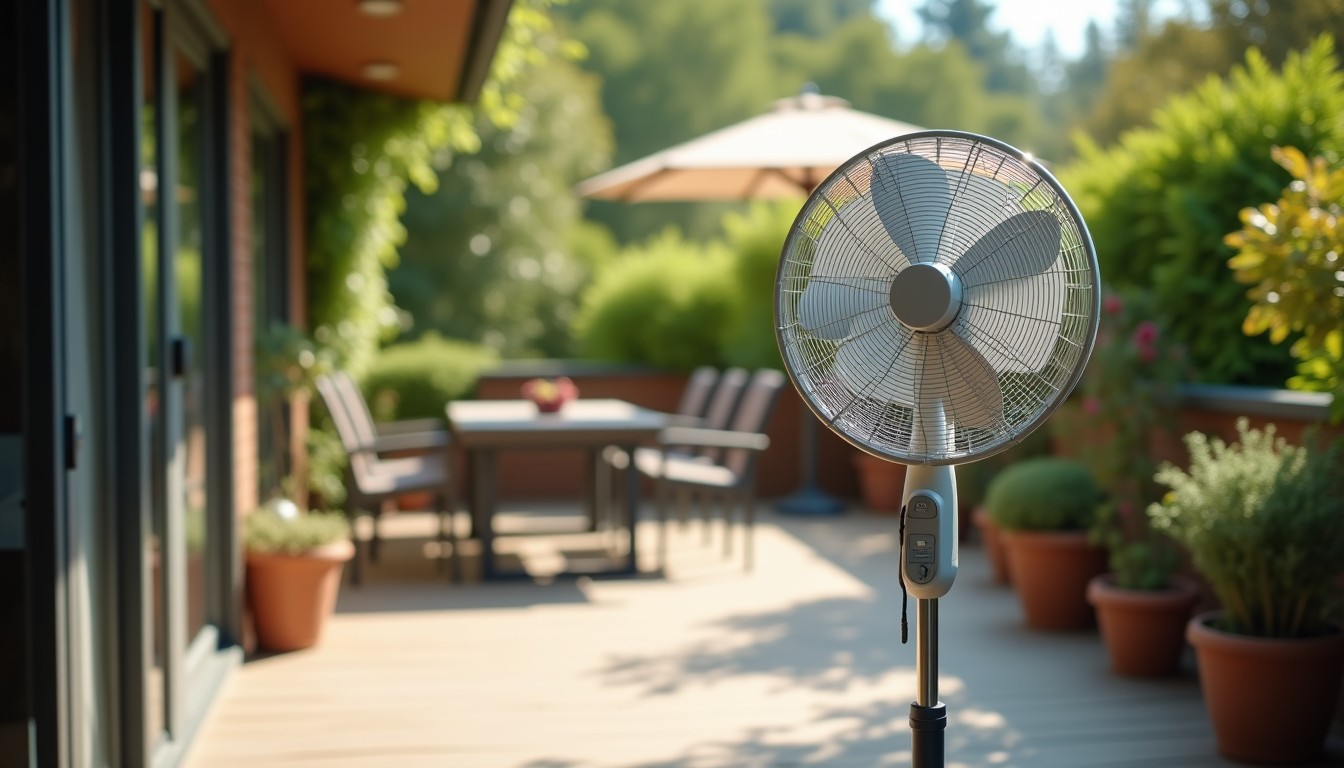
Air movement is one of the few deterrents with extension backing. UC IPM notes that little house flies gather on patios, entryways and garages, with males swarming about 5 or 6 feet up, in still, shaded spots. Strong air currents disperse these swarms, and UC IPM says strong fans placed where they gather give some relief; these flies ignore the baits that catch house flies. UF/IFAS adds that stable flies avoid strong air currents. Point a fan across the food, use two on a large deck, and remember it protects only the area it blows over.
Traps: where you put them matters more than which one
- Odour-baited jug or bag traps. These hold a fermenting or rotting attractant. UC IPM says they work when they are not competing with nearby garbage or animal waste, but smell foul, so should hang some distance from occupied buildings. Put them at the edge of the yard to intercept flies on the way in, never beside the table, or you draw flies towards your guests.
- Sticky ribbons and fly paper. UC IPM is direct: they are effective at removing a few flies in relatively confined areas, but not effective enough for heavy infestations or for control in an outdoor setting. They also miss blow flies, which UC IPM notes do not regularly rest on vertical surfaces.
- Ultraviolet light traps and bug zappers. UC IPM says UV fly traps may work indoors where they are not competing with daylight. Outdoors the record is poor: a University of Delaware study of electric traps at six suburban sites in 1994 found that only 31 of nearly 14,000 insects killed were biting flies, less than a quarter of one per cent, and that almost half were harmless aquatic insects.
The water bag myth, tested
A plastic bag of water with a few pennies, hung on the porch, is supposed to scare flies with a magnified reflection. In a small trial published in Texas A&M’s undergraduate research journal, a bag was hung beside one of five flypaper strips in a Texas sheep barn, with the others at 0.6, 1.2, 1.8 and 3 metres away. After 48 hours the strip by the bag had caught 0.44 flies per square centimetre, more than the 0.38 on the control strip 3 metres away, and the author found no correlation between the bag and fewer flies. One barn over two days proves little, but it gives no reason to think the bags work, and no extension service we checked recommends them.
What scent keeps flies away?
The strongest evidence is for catnip oil, and it is narrower than product labels suggest. In laboratory tests by USDA Agricultural Research Service scientists, published in Medical and Veterinary Entomology in 2009, catnip essential oil gave average repellency of 96 per cent against stable flies and 79 per cent against house flies. Those were controlled bioassays, not patios, and the same paper found catnip oil to be a moderate skin irritant in rabbit tests.
For basil, lavender, mint and marigold in pots, or peppermint and eucalyptus sprays, we found no extension trial showing they reduce flies on a patio. Citronella is sold mainly against mosquitoes; the evidence there is in our guide to what attracts mosquitoes, and our review of natural pest control evidence covers the wider pattern.
What can I pour on my porch to keep flies away?
Nothing poured on a porch reliably repels flies. What helps is washing away what attracts them: spilled drinks, food residue, grease and pet urine or feces. Soap and water is enough for that.
Vinegar attracts rather than repels: the University of Kentucky’s fruit fly trap is a paper funnel in a jar baited with a few ounces of cider vinegar. Pouring it on a porch adds a fermenting smell where you want fewer flies.
Purdue Extension notes that residual insecticide sprays labelled for outdoor use can be applied to fly resting places such as porches, covered patios, garages, breezeways, kennels and the outside of garbage cans. If you go that route, use a product labelled for that site, follow the label exactly, keep it off food surfaces, and treat it as a supplement to sanitation. Purdue adds that fly baits kill quickly but are short-lived unless repeated.
How to get rid of flies outside when cooking
- Keep meat and cooked food covered until it goes on the grill or plate, and bring leftovers in promptly.
- Empty and wipe the grill grease tray after each use.
- Run a fan across the serving table, and bag scraps straight into a bin with a tight-fitting lid, as Purdue advises.
- Keep odour-baited traps well away from the cooking area.
When outdoor flies are busiest: what iNaturalist records show
We measured each group’s share of all US research-grade iNaturalist observations by month, which removes the summer rise in people out recording. Horse and deer flies peak sharply in July at 319 on our index, more than three times their usual share. Blow flies peak in September and October at 161 and 160. House flies rise from July to 200 in October and 225 in November; that late peak partly reflects how little else is being photographed in autumn, so read it as flies being noticed, not a breeding surge. The practical point: outdoor fly pressure runs from early summer well into autumn, so keep the weekly source check going until hard frosts. Flies appearing indoors in autumn usually have a different cause, covered in our guide to flies in the house all of a sudden.
When to call a professional
UC IPM notes that chemicals are only rarely required for fly management around homes, and that their use generally gives only short-term control. Most outdoor fly problems at a home are solved by sanitation. A licensed pest professional is worth calling when flies persist for weeks with no source you can find, or when you suspect a dead animal under a deck or in a crawlspace you cannot reach. To keep flies out of the house itself, screens and sealed gaps do more than any outdoor treatment; see our pest-proofing guide.
Frequently asked questions
What is the fastest way to get rid of flies outside?
Clear the source and protect the table at the same time. Bag and remove dog waste, overripe fruit, food scraps and wet grass clippings, wash the bin and grill tray, and keep garbage collected at least weekly, since house flies can go from egg to adult in about 7 days in summer. For immediate relief, run a fan across the table, cover food and use a swatter. Hang any baited traps at the edge of the yard.
What scent keeps flies away?
Catnip oil has the best evidence. USDA scientists found catnip essential oil gave average repellency of 96 per cent against stable flies and 79 per cent against house flies in laboratory tests published in 2009, though it can irritate skin. Herbs in pots and essential oil sprays such as peppermint or lavender have no extension trial behind them for patios. Removing the source does far more than any smell.
What can I pour on my porch to keep flies away?
There is no liquid that reliably repels flies when poured on a porch. Wash away spilled drinks, food residue, grease and pet waste with soap and water, since those are what attract flies. Avoid vinegar, which attracts fruit flies and is used as trap bait. Purdue Extension notes residual insecticides labelled for outdoor resting places can help, used exactly as the label directs and alongside sanitation.
Why do I have a lot of flies outside?
Something nearby is feeding them or giving them a place to lay eggs: garbage, dog waste, compost, rotting fruit, wet grass clippings, grill scraps or a dead animal. If your own yard is clean, the source may be off the property. The University of Kentucky notes house flies easily travel one to two miles, so a neighbouring farm, stable or dumpster can supply them.
Sources
- University of California Statewide IPM Program, Pest Notes: Flies, UC ANR Publication 7457, A. C. Gerry, updated 2015.
- Purdue University Extension, E-7, Fly Control Around the Home, T. J. Gibb and G. W. Bennett, 2018.
- University of Kentucky Entomology, ENTFACT-506, How Far Can House Flies Fly?, L. Townsend.
- University of Kentucky Entomology, ENTFACT-621, Fruit Flies, and ENTFACT-511, Horse Flies and Deer Flies.
- Utah State University Extension, Urban Pest Guide: Stable Fly.
- UF/IFAS Extension, EENY642, Stable Fly, Stomoxys calcitrans, P. E. Kaufman, E. R. Burgess and E. N. I. Weeks, 2016, revised 2022.
- Texas A&M AgriLife Extension, Livestock Veterinary Entomology: Stable Fly.
- Missouri Department of Conservation, Field Guide: Horse and Deer Flies (Tabanids).
- Zhu J. J. et al., Efficacy and safety of catnip (Nepeta cataria) as a novel filth fly repellent, Medical and Veterinary Entomology 23(3), 2009.
- Harris C., A Common Method of Barn Fly Control: Debunked, Instars, Texas A&M University Department of Animal Science.
- University of Delaware, Research shows beneficial insects, environment suffer from electric traps (Frick and Tallamy study), UD Messenger, 1996.
- The Pest Control Brief analysis of iNaturalist research-grade records, pulled October 2026.