Cicadas: When They Come Out, Are They Harmful, and Broods

Cicadas are large, harmless sap-feeding insects: they do not bite or sting and are not poisonous, and the only real damage they do is egg-laying in the twigs of young trees. Annual or dog-day cicadas sing every summer from July to September. Periodical cicadas spend 13 or 17 years underground and emerge in huge, predictable broods in late April to June. No periodical brood is due in 2026; the next is Brood XXII in 2027.
About 150 cicada species live in the US, according to the University of Connecticut periodical cicada project, and almost all of them are “annual” cicadas whose generations overlap so that some adults appear every year. Only the seven Magicicada species have synchronised development. That one difference explains why some years are deafening and others are not.
Annual or periodical: which cicada are you seeing?
| Annual (dog-day) cicadas | Periodical cicadas | |
|---|---|---|
| Genus | Neotibicen and Megatibicen in the East; many smaller genera in the West | Magicicada (seven species) |
| Size | About 1.25 to 1.75 in (32 to 44 mm) | About 3/4 to 1 1/4 in (19 to 32 mm) |
| Colour | Dark green to black, green wing veins, dark eyes | Black body, red eyes, orange to red wing veins and legs |
| Adults out | July to September, every year | Late April to June, only in brood years |
| Years underground | 2 to 5 years, generations overlap | 13 or 17 years, all the same age |
| Numbers | A few per tree | Can exceed a million per acre in dense spots |
| Range | Across the US | Eastern US only; found nowhere else in the world |
| Risk to trees | Negligible | Can kill twigs and harm young or newly planted trees |
Compiled by The Pest Control Brief from NC State, Wisconsin, Kentucky and Penn State extension and UConn (density from a 1956 Illinois census).
What is a cicada?
A cicada is a true bug in the order Hemiptera, family Cicadidae. Adults are large, heavy and wedge-shaped, with clear wings held roof-like over the body and short antennae. Males make their sound with tymbals, ribbed membranes on the sides of the first abdominal segment that muscles buckle in and out. Females are silent.
A female lays eggs in slits cut into twigs; they hatch in six to ten weeks, Wisconsin and Kentucky extension say, and the nymphs drop and burrow 6 to 18 inches down to feed on roots. Years later the grown nymph climbs a trunk or fence post, splits its skin and leaves the brown cicada shell behind.
Do cicadas bite?
No. UConn’s cicada researchers put it simply: cicadas do not bite or sting defensively, and they are not toxic or poisonous. Kentucky extension adds that periodical cicadas cannot sting and do not harm humans, livestock or pets. Wisconsin extension’s wording is that they do not bite readily. A cicada’s mouthparts are a piercing beak for drinking plant fluid, not jaws, and it has no venom.
The pointed spike under a female’s abdomen is an ovipositor for cutting twig bark, not a stinger. If something large stung you near cicadas in late summer, it was a wasp, not the cicada.

Are cicadas dangerous or harmful?
Not to people. The risks are small and specific:
- Young trees and shrubs. Egg-laying is the one real harm, covered in detail below.
- Noise. A dense periodical chorus can interfere with outdoor events, which is why Wisconsin extension suggests moving or postponing them in emergence years.
- Eating them. UConn notes that periodical cicadas have been shown to accumulate mercury, so eating them carries a risk that is hard to quantify. If a pet eats a lot of them and seems unwell, ask a vet.
What do cicadas eat?
Plant fluid, and only one kind. Nymphs and adults both pierce xylem, the vessels that carry water up from the roots, and drink the watery fluid inside. UConn calls it a myth that adults do not feed. Nymphs feed on roots; adults on twigs and branches. UConn adds that adult feeding has not been shown to affect trees and shrubs much, probably because each insect takes only a small fraction of the flow. Cicadas do not chew leaves, flowers, vegetables or lawn grass; UConn says they have little interest in annuals and perennials unless the plants are woody.

Why are there cicadas every year?
Because most species are not periodical. UConn explains that the so-called annual cicadas have unsynchronised development, so some individuals mature in every year, and we hear them every summer. Wisconsin gives dog-day cicadas a two to five year life cycle with overlapping broods at any one site. Periodical cicadas are the opposite: every nymph in a population is the same age, so adults are almost absent for 12 or 16 years and then appear by the million.
Penn State Extension explains why the mass emergence pays: cicadas are clumsy fliers and easy prey, so when millions appear at once, birds and other predators eat their fill and leave most of them to breed.
When do cicadas come out?
Two seasons, two groups. Periodical cicadas emerge when the soil 8 inches down passes 64°F, which Kentucky puts in late April or early May there and Penn State in late May or early June in Pennsylvania. UConn’s guide says about four to six weeks pass from first emergence to quiet, with the serious noise starting about a week and a half in and lasting about two weeks more. Annual cicadas follow from July into September.
Our analysis of iNaturalist research-grade records shows the split cleanly. Periodical cicadas run at 711 on our index in May, seven times their usual share of everything people record that month, and fall to 15 by July. Dog-day cicadas (Neotibicen) are almost invisible until June, then climb to 335 in July and 473 in August; the giant Megatibicen peak at 484 in August.
Periodical cicada broods: 2026 and the next ten years
A brood is all the periodical cicadas emerging in one year in one area. UConn’s brood guide lists 12 active broods of 17-year cicadas and three of 13-year cicadas, numbered I to XVII for the 17-year broods and XVIII to XXX for the 13-year broods. Brood XIV emerged in 2025, and Broods XIII and XIX in 2024.
No periodical brood is scheduled to emerge in 2026. Stragglers, small groups emerging one to four years off schedule, appear most years, and Penn State notes the largest off-year emergences come from 17-year cicadas that emerge four years early. Expect scattered individuals, not a chorus.
| Year | Brood | Cycle | States (UConn brood guide) |
|---|---|---|---|
| 2026 | None | Stragglers only | |
| 2027 | XXII (Baton Rouge Brood) | 13-year | LA, MS, OH, KY |
| 2028 | XXIII (Lower Mississippi Brood) | 13-year | AR, IL, IN, KY, LA, MO, MS, TN |
| 2029 | I (Shenandoah Brood) | 17-year | TN, VA, WV |
| 2030 | II (East Coast Brood) | 17-year | CT, GA, MD, NC, NJ, NY, OK, PA, SC, VA |
| 2031 | III (Iowan Brood) | 17-year | IA, IL, MO |
| 2032 | IV (Kansan Brood) | 17-year | IA, KS, MO, NE, OK, TX |
| 2033 | V | 17-year | MD, OH, PA, VA, WV |
| 2034 | VI (Brushy Mountains Brood) | 17-year | GA, NC, SC |
| 2035 | VII (Onondaga Brood) | 17-year | NY |
| 2036 | VIII | 17-year | OH, PA, WV |
Compiled by The Pest Control Brief from the University of Connecticut periodical cicada brood guide. A state on this list does not mean cicadas everywhere in it: UConn warns that populations are patchy and county-level maps overstate brood ranges. The big ones to plan around are Brood XIX (13-year, 15 states) in 2037 and Brood X, the Great Eastern Brood, in 2038.
Where do cicadas live?
Annual cicadas live across the US; Colorado alone has about 29 species, most about half an inch long. Periodical cicadas are native to the eastern US and, Penn State notes, occur nowhere else in the world; 17-year broods are generally northern and 13-year broods southern, overlapping in a band from North Carolina and Georgia west to Missouri.
Scaled to each state’s total iNaturalist activity, Maryland leads with 34.6 periodical cicada records per 10,000 observations, followed by Kentucky, Illinois, Tennessee, Missouri and Virginia. These counts follow brood years: Maryland sat inside Brood X in 2021 and Brood XIV in 2025, and Illinois hosted both broods of 2024. A state that has not had a large brood since iNaturalist became popular will look thin even if it has cicadas.
Cicada damage: flagging on young trees
The damage is done by females laying eggs. A female cuts a row of slits into twigs 1/4 to 1/2 inch across; Penn State describes pockets of 24 to 28 eggs, sometimes forming a continuous slit two to three inches long, and each female lays 400 to 600 eggs in her life. The weakened twig breaks, dangles and turns brown: flagging. Kentucky lists oak, hickory, apple, peach, pear and grapevines among the favoured hosts, and notes pines and other gummy trees are avoided.
Mature trees usually survive even dense emergences without lasting harm, UConn says, although a canopy full of brown tips looks alarming for a month or so. Young trees are different: small trees have many twigs of exactly the preferred size, so a far larger share of the canopy can be hit. Annual cicadas lay in the same way but in numbers too small to matter.
How to protect young trees in a brood year
- Delay new planting. Kentucky and Wisconsin advise waiting until adult activity has ended; NC State suggests avoiding new orchard plantings when a large emergence is due within two to three years.
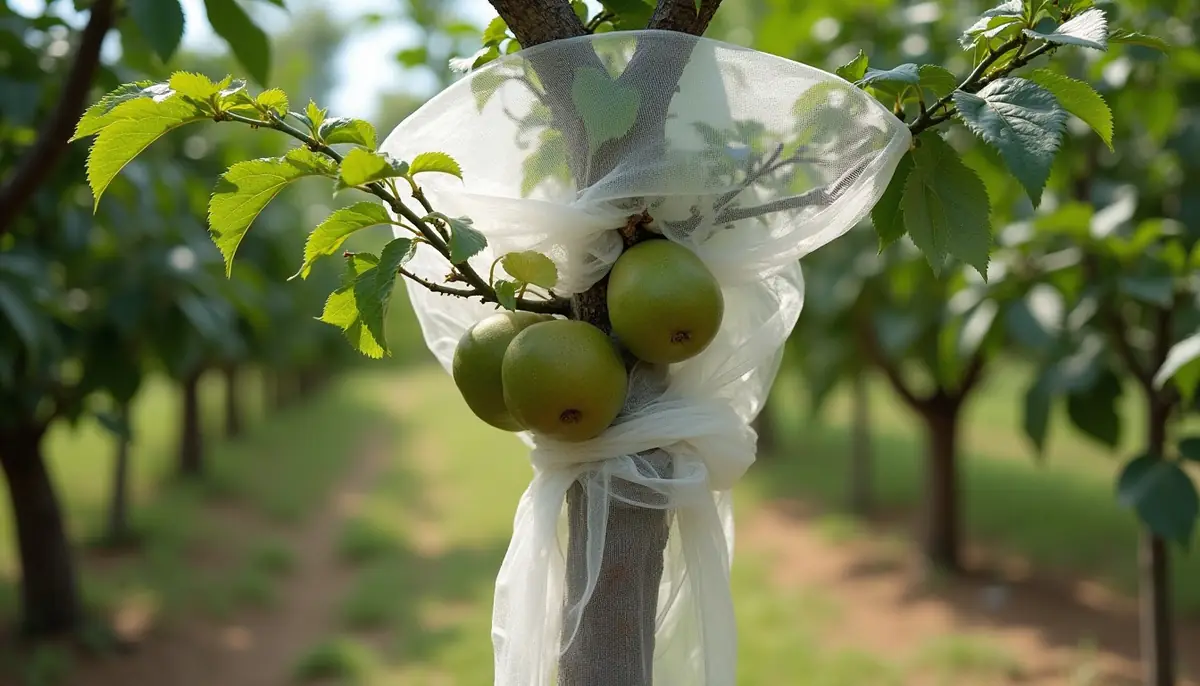
- Net, do not spray. Cover small trees with netting of 1/4 inch (6.5 mm) mesh or finer, the size NC State and Wisconsin give. Check the mesh before buying: netting with larger openings lets cicadas through.
- Time it to the singing. Put the netting on when you first hear males calling. UConn notes females do not lay until at least a week after emerging, so there is no hurry.
- Close the bottom. Tie the netting around the trunk below the lowest branches so cicadas cannot climb up underneath, and remove it once adults are gone, usually by the end of June.
- Prune out egg slits on prized young trees within about three weeks after egg-laying ends, Kentucky says, to stop the hatching nymphs from settling on that tree’s roots.
Wisconsin states that insecticides are generally not needed or recommended for periodical cicadas, and UConn notes they are usually too numerous for spraying to be practical. Kentucky adds that repeat treatment would be needed as new cicadas fly in.
How loud are cicadas?
Very, up close. A single cicada can exceed 105 decibels at 50 cm, and two large North American annual cicadas, Tibicen walkeri and T. resh, share the highest average alarm call among the species compared in the University of Florida Book of Insect Records. Periodical choruses are louder in total because of their numbers: UConn says they may reach 90 decibels or more for someone standing beneath them, and Wisconsin compares a busy emergence site to a vacuum cleaner or a busy road at about 70 to 80 or more.
Cicadas sing by day and fall quiet at night. If the noise keeping you awake comes after dark, it is crickets or katydids; our guide to bugs that make noise at night identifies them by sound, and covers why there is no way to silence a chorus.
Cicada killer wasps
In July and August the large wasps patrolling bare, sunny patches of lawn are eastern cicada killers, native solitary wasps that paralyse dog-day cicadas and drag them into burrows to feed their young. Kentucky extension gives females 1.5 to nearly 2 inches and males up to 1.5 inches. Males, the ones that buzz at your head, have no stinger at all, and females are not considered a stinging hazard unless handled or stepped on. Our full guide to cicada killer wasps covers their burrows and the turf changes that move them on; to rule out other large wasps, see our wasp and hornet identification guide.
Should you get rid of cicadas?
In almost every case, no. Adults live only about four weeks and the season ends on its own. Shells can be brushed off and the small emergence holes in the lawn need no repair. The only steps worth taking are the tree measures above, in brood years. Cicadas are not a job for a pest control company. See our seasonal pest calendar for the rest of the year.
Frequently asked questions
Are cicadas dangerous?
No. University of Connecticut researchers state that cicadas do not bite or sting defensively and are not toxic or poisonous, and Kentucky extension says periodical cicadas do not harm people, livestock or pets. The real risks are limited: egg-laying can kill twigs on young trees, choruses can be very loud, and periodical cicadas can accumulate mercury, so they are not a sensible food.
What is a cicada?
A cicada is a large true bug, family Cicadidae, that spends most of its life underground as a nymph feeding on root fluid, then climbs out, sheds its skin and lives a few weeks as a winged adult. Males sing with drum-like tymbals on the abdomen. About 150 species occur in the US; seven are periodical cicadas on 13-year or 17-year cycles.
Why are there cicadas every year?
Because most US cicadas are annual species whose generations overlap. Each nymph takes two to five years to mature but they are not synchronised, so some adults emerge every summer. Only the seven periodical cicada species are all the same age within a population, which is why they appear in huge broods every 13 or 17 years and are nearly absent in between.
Do cicadas bite?
No. Cicadas have a piercing beak for drinking xylem fluid from plants and cannot chew. Wisconsin extension says they do not bite readily, and UConn says they do not bite or sting defensively; they have no venom. The spike on a female’s abdomen is an egg-laying tool for cutting twigs.
What do cicadas eat?
Only plant fluid from xylem, the water-carrying vessels of plants. Nymphs feed on tree roots underground for years, and adults feed from twigs and branches. UConn notes it is a myth that adults do not eat, and that their feeding has not been shown to harm trees much. Cicadas do not eat leaves, fruit, vegetables or grass.
Sources
- University of Connecticut, Periodical Cicada Information Pages: Broods (brood guide and emergence years), FAQ, and Pest status.
- Penn State Extension, Periodical Cicada (updated 2021).
- University of Kentucky Entomology, ENTFACT-446: Periodical Cicadas in Kentucky; and Cicada Killer Wasps fact sheet.
- University of Wisconsin Division of Extension, Garden Facts XHT1068: Periodical Cicadas (P.J. Liesch, revised 2024).
- NC State Extension, Annual and Periodical Cicada (Walgenbach and Schoof, 2015).
- Colorado State University Extension, Cicadas (IPM pests).
- Petti, J.M. 1997. Chapter 24: Loudest. University of Florida Book of Insect Records, citing Sanborn and Phillips 1995 and Villet 1987.
- The Pest Control Brief analysis of iNaturalist research-grade records, pulled October 2026.